


perl脚本中有时候执行的操作可能会引发异常,为了直观的说明,这里举一个json反序列化的例子,脚本如下:
#! /usr/bin/perl
use v5.14;
use JSON;
use Data::Dumper;

# 读取json字符串数据
my $json_str = join('', <DATA>);
# 反序列化操作
my $json = from_json($json_str);

say to_json($json, { pretty => 1 });

__DATA__
bad {
   "id" : 1024,
   "desc" : "hello world",
   "other" : {
      "test_null" : null,
      "test_false" : false,
      "test_true" : true
   }
}
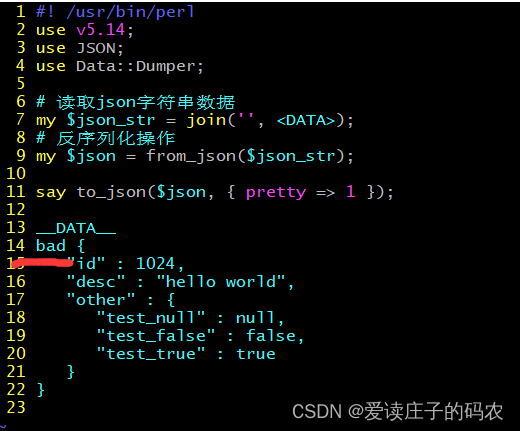
脚本中有意把正确json字符串之前加了几个字符,显然这个json字符串是不符合规范格式的,在git bash中执行这个脚本,结果如下:

下面用perl的eval函数改造这个脚本:
#! /usr/bin/perl
use v5.14;
use JSON;
use Data::Dumper;

# 读取json字符串数据
my $json_str = join('', <DATA>);
# 反序列化操作
my $json = eval {
	return from_json($json_str);
};

unless (defined $json) {
	say "from_json failed !!!!";
} else {
	say to_json($json, { pretty => 1 });
}

__DATA__
bad {
   "id" : 1024,
   "desc" : "hello world",
   "other" : {
      "test_null" : null,
      "test_false" : false,
      "test_true" : true
   }
}
脚本中用把from_json的操作放在eval函数中,输出结果如下:

显然,这个结果是可控的,可预期的。比如就可以使用这种方法判断json字符串是否合法,能够正常反序列化的就是合法的,否则就是非法的。eval函数的具体使用可以使用perldoc -f eval查看。
    eval EXPR
    eval BLOCK
    eval    "eval" in all its forms is used to execute a little Perl
            program, trapping any errors encountered so they don't crash the
            calling program.

            Plain "eval" with no argument is just "eval EXPR", where the
            expression is understood to be contained in $_. Thus there are
            only two real "eval" forms; the one with an EXPR is often called
            "string eval". In a string eval, the value of the expression
            (which is itself determined within scalar context) is first
            parsed, and if there were no errors, executed as a block within
            the lexical context of the current Perl program. This form is
            typically used to delay parsing and subsequent execution of the
            text of EXPR until run time. Note that the value is parsed every
            time the "eval" executes.

            The other form is called "block eval". It is less general than
            string eval, but the code within the BLOCK is parsed only once
            (at the same time the code surrounding the "eval" itself was
            parsed) and executed within the context of the current Perl
            program. This form is typically used to trap exceptions more
            efficiently than the first, while also providing the benefit of
            checking the code within BLOCK at compile time. BLOCK is parsed
            and compiled just once. Since errors are trapped, it often is
            used to check if a given feature is available.

            In both forms, the value returned is the value of the last
            expression evaluated inside the mini-program; a return statement
            may also be used, just as with subroutines. The expression
            providing the return value is evaluated in void, scalar, or list
            context, depending on the context of the "eval" itself. See
            "wantarray" for more on how the evaluation context can be
            determined.

            If there is a syntax error or runtime error, or a "die"
            statement is executed, "eval" returns "undef" in scalar context,
            or an empty list in list context, and $@ is set to the error
            message. (Prior to 5.16, a bug caused "undef" to be returned in
            list context for syntax errors, but not for runtime errors.) If
            there was no error, $@ is set to the empty string. A control
            flow operator like "last" or "goto" can bypass the setting of
            $@. Beware that using "eval" neither silences Perl from printing
            warnings to STDERR, nor does it stuff the text of warning
            messages into $@. To do either of those, you have to use the
            $SIG{__WARN__} facility, or turn off warnings inside the BLOCK
            or EXPR using "no warnings 'all'". See "warn", perlvar, and
            warnings.

            Note that, because "eval" traps otherwise-fatal errors, it is
            useful for determining whether a particular feature (such as
            "socket" or "symlink") is implemented. It is also Perl's
            exception-trapping mechanism, where the "die" operator is used
            to raise exceptions.

            Before Perl 5.14, the assignment to $@ occurred before
            restoration of localized variables, which means that for your
            code to run on older versions, a temporary is required if you
            want to mask some, but not all errors:

             # alter $@ on nefarious repugnancy only
             {
                my $e;
                {
                  local $@; # protect existing $@
                  eval { test_repugnancy() };
                  # $@ =~ /nefarious/ and die $@; # Perl 5.14 and higher only
                  $@ =~ /nefarious/ and $e = $@;
                }
                die $e if defined $e
             }

            There are some different considerations for each form:

            String eval
                Since the return value of EXPR is executed as a block within
                the lexical context of the current Perl program, any outer
                lexical variables are visible to it, and any package
                variable settings or subroutine and format definitions
                remain afterwards.

                Under the "unicode_eval" feature
                    If this feature is enabled (which is the default under a
                    "use 5.16" or higher declaration), EXPR is considered to
                    be in the same encoding as the surrounding program. Thus
                    if "use utf8" is in effect, the string will be treated
                    as being UTF-8 encoded. Otherwise, the string is
                    considered to be a sequence of independent bytes. Bytes
                    that correspond to ASCII-range code points will have
                    their normal meanings for operators in the string. The
                    treatment of the other bytes depends on if the
                    "'unicode_strings"" feature is in effect.

                    In a plain "eval" without an EXPR argument, being in
                    "use utf8" or not is irrelevant; the UTF-8ness of $_
                    itself determines the behavior.

                    Any "use utf8" or "no utf8" declarations within the
                    string have no effect, and source filters are forbidden.
                    ("unicode_strings", however, can appear within the
                    string.) See also the "evalbytes" operator, which works
                    properly with source filters.

                    Variables defined outside the "eval" and used inside it
                    retain their original UTF-8ness. Everything inside the
                    string follows the normal rules for a Perl program with
                    the given state of "use utf8".

                Outside the "unicode_eval" feature
                    In this case, the behavior is problematic and is not so
                    easily described. Here are two bugs that cannot easily
                    be fixed without breaking existing programs:

                    *   It can lose track of whether something should be
                        encoded as UTF-8 or not.

                    *   Source filters activated within "eval" leak out into
                        whichever file scope is currently being compiled. To
                        give an example with the CPAN module
                        Semi::Semicolons:

                         BEGIN { eval "use Semi::Semicolons; # not filtered" }
                         # filtered here!

                        "evalbytes" fixes that to work the way one would
                        expect:

                         use feature "evalbytes";
                         BEGIN { evalbytes "use Semi::Semicolons; # filtered" }
                         # not filtered

                Problems can arise if the string expands a scalar containing
                a floating point number. That scalar can expand to letters,
                such as "NaN" or "Infinity"; or, within the scope of a "use
                locale", the decimal point character may be something other
                than a dot (such as a comma). None of these are likely to
                parse as you are likely expecting.

                You should be especially careful to remember what's being
                looked at when:

                    eval $x;        # CASE 1
                    eval "$x";      # CASE 2

                    eval '$x';      # CASE 3
                    eval { $x };    # CASE 4

                    eval "\$$x++";  # CASE 5
                    $$x++;          # CASE 6

                Cases 1 and 2 above behave identically: they run the code
                contained in the variable $x. (Although case 2 has
                misleading double quotes making the reader wonder what else
                might be happening (nothing is).) Cases 3 and 4 likewise
                behave in the same way: they run the code '$x', which does
                nothing but return the value of $x. (Case 4 is preferred for
                purely visual reasons, but it also has the advantage of
                compiling at compile-time instead of at run-time.) Case 5 is
                a place where normally you *would* like to use double
                quotes, except that in this particular situation, you can
                just use symbolic references instead, as in case 6.

                An "eval ''" executed within a subroutine defined in the
                "DB" package doesn't see the usual surrounding lexical
                scope, but rather the scope of the first non-DB piece of
                code that called it. You don't normally need to worry about
                this unless you are writing a Perl debugger.

                The final semicolon, if any, may be omitted from the value
                of EXPR.

            Block eval
                If the code to be executed doesn't vary, you may use the
                eval-BLOCK form to trap run-time errors without incurring
                the penalty of recompiling each time. The error, if any, is
                still returned in $@. Examples:

                    # make divide-by-zero nonfatal
                    eval { $answer = $a / $b; }; warn $@ if $@;

                    # same thing, but less efficient
                    eval '$answer = $a / $b'; warn $@ if $@;

                    # a compile-time error
                    eval { $answer = }; # WRONG

                    # a run-time error
                    eval '$answer =';   # sets $@

                If you want to trap errors when loading an XS module, some
                problems with the binary interface (such as Perl version
                skew) may be fatal even with "eval" unless
                $ENV{PERL_DL_NONLAZY} is set. See perlrun.

                Using the "eval {}" form as an exception trap in libraries
                does have some issues. Due to the current arguably broken
                state of "__DIE__" hooks, you may wish not to trigger any
                "__DIE__" hooks that user code may have installed. You can
                use the "local $SIG{__DIE__}" construct for this purpose, as
                this example shows:

                    # a private exception trap for divide-by-zero
                    eval { local $SIG{'__DIE__'}; $answer = $a / $b; };
                    warn $@ if $@;

                This is especially significant, given that "__DIE__" hooks
                can call "die" again, which has the effect of changing their
                error messages:

                    # __DIE__ hooks may modify error messages
                    {
                       local $SIG{'__DIE__'} =
                              sub { (my $x = $_[0]) =~ s/foo/bar/g; die $x };
                       eval { die "foo lives here" };
                       print $@ if $@;                # prints "bar lives here"
                    }

                Because this promotes action at a distance, this
                counterintuitive behavior may be fixed in a future release.

                "eval BLOCK" does *not* count as a loop, so the loop control
                statements "next", "last", or "redo" cannot be used to leave
                or restart the block.

                The final semicolon, if any, may be omitted from within the
                BLOCK.

 90


 扫一扫


 被折叠的 条评论
为什么被折叠?
 到【灌水乐园】发言


