



 本文通过Kotlin的Comparable接口,详细介绍了compareTo()、coerceAtLeast()、coerceAtMost()和coerceIn()等方法的使用,并结合BinarySearchTree的应用,展示了如何在Kotlin中进行比较和操作。文章包含多个实例演示,适合面试复习和学习。
💪0. 比较神器——Comparable
👸VS👸🏻,🙅Fight!叽里咕噜…
比较这个嗜好,女人们最喜欢,比上比下,比房子比车子,甚至比子女。
👀:在 Kotlin 世界里,你插这个就能比,就是 Comparable 插件 。
🏎️1. 方程 compareTo()
compareTo() 是主打方程,发出比一比的号角。
这个 class 是地主🐢,compareTo( 对手🐰 )。
👧🏻:这不是龟兔赛跑吗?好玩!
🤔:这个比喻不好,不明白,咱还是画圈吧。
介绍个两个免费网上Kotlin 编译器 ——
- Kotlin Playground 游乐园 —— 这个快👍。
- JDoodle —— 怪名。现打现用,今天就是用这个面试废了。我不是应聘写手机的吗?考官就考基础。我就琢磨着这是干什么来着,手机只有两个问题,其它全是 order,sort,linked list, binary search,可能银行就喜欢这个。记性不好,明年再来。哈奇😷!
✔️它们好处是现打现用,❌坏处是编译功能缺失。你们谁能写个 AI 补补?
…
class Circle(val radius: Int): Comparable<Circle> {
    private val area: Double = 3.14 * radius * radius

    override fun compareTo(other: Circle): Int {
        val area2 = other.area

        // 对比面积
        if(area == area2){
            return 0;
        } else if(area < area2){
            return -1;
        }
        return 1;
    }

    override fun toString(): String {
        return "Type(circle) -> radius = $radius, area = $area"
    }
}

fun main(){
    val cirs: List<Circle> = listOf(
        Circle(5), Circle(4), Circle(4), Circle(7), Circle(8), Circle(10))

    println("Is cir1 > cir2? ${cirs[0] > cirs[1]}")
    println("Is cir3 > cir1? ${cirs[2] > cirs[1]}")
    println("Is cir3 == cir1? ${cirs[2] == cirs[1]}")
}
这个 compareTo 需要覆盖,因为 Comparable 只是个 Interface,骨头也。它要做出三种答复 ——
- 等于 ⇨ 0
- 小于 ⇨ -1
- 大于 ⇨ 1
简单,明快。
结果:
Is cir1 > cir2? true
Is cir3 > cir1? false
Is cir3 == cir1? false
🚝2. 方程 coerceAtLeast() 较大
这是比最小大一点的意思,例子:
coerceAtLeast( 较大 ):
- 是问我比最小大吗?—— 是就我上,反之最小上。
咱们试试:
    var min = Circle(2)
    var max = Circle(9)

    println("\nmin: ${min}\ncir2: ${cirs[1]}")
    println("Find bigger: cir1 > min? Bigger is ${cirs[1].coerceAtLeast(min)}")
🏃结果:
min: Type(circle) -> radius = 2, area = 12.56
cir2: Type(circle) -> radius = 4, area = 50.24
Find bigger: cir1 > min? Bigger is Type(circle) -> radius = 4, area = 50.24
➕找个大小差不多看看:
    println("\ncir1: ${cirs[0]}\ncir2: ${cirs[1]}")
    println("Find bigger: cir1 > cir2? Bigger is ${cirs[0].coerceAtLeast(cirs[1])}")
    println("Find bigger: cir2 > cir1? Bigger is ${cirs[1].coerceAtLeast(cirs[0])}")
🏃结果:
cir1: Type(circle) -> radius = 5, area = 78.5
cir2: Type(circle) -> radius = 4, area = 50.24
Find bigger: cir1 > cir2? Bigger is Type(circle) -> radius = 5, area = 78.5
Find bigger: cir2 > cir1? Bigger is Type(circle) -> radius = 5, area = 78.5
都是较大的胜出,这就是 coerceAtLeast 。
🚈3. 方程 coerceAtMost() 较小
顾名思义,coerceAtMost() 就比最大小点,较小也。
    println("\ncir5: ${cirs[4]}\nmax: ${max}")
    println("Find bigger: cir5 > max? Bigger is ${cirs[4].coerceAtMost(max)}")
    println("Find bigger: cir5 > max? Bigger is ${max.coerceAtMost(cirs[4])}")
比对 8 号选手 和 max 选手。
cir5: Type(circle) -> radius = 8, area = 200.96
max: Type(circle) -> radius = 9, area = 254.34
Find bigger: cir5 > max? Bigger is Type(circle) -> radius = 8, area = 200.96
Find bigger: cir5 > max? Bigger is Type(circle) -> radius = 8, area = 200.96
8 号较小胜出。现在看来好像多余,其实不是,思维有点不一样而已。反正又不用我写,用就是了。
🚅4. 方程 coerceIn() 域内
明白不?这个方程当然有一大一小,要不怎么知道是否在队伍内。
例子:
coerceIn( 最小,最大 )
拿来玩玩:
    println("\ncir4: ${cirs[3]}\nmin: ${min}\nmax: ${max}")
    println("Is cir4 in min and max? ${cirs[3].coerceIn(min, max) == cirs[3]}")
在室吗?🏃🏼
cir4: Type(circle) -> radius = 7, area = 153.86
min: Type(circle) -> radius = 2, area = 12.56
max: Type(circle) -> radius = 9, area = 254.34
Is cir4 in min and max? true
做两个域外的:
- [ ✔️ ] X < min
    min = Circle(6)
    println("\ncir1: ${cirs[0]}\nmin: ${min}\nmax: ${max}")
    println("Is cir1 in min and max? ${cirs[0].coerceIn(min, max)}")
🏃🏼:
cir1: Type(circle) -> radius = 5, area = 78.5
min: Type(circle) -> radius = 6, area = 113.03999999999999
max: Type(circle) -> radius = 9, area = 254.34
Is cir1 in min and max? Type(circle) -> radius = 6, area = 113.03999999999999
证明在 min 方向,域外。
…
- [ ✔️ ] X > max
    min = Circle(6)
    println("\ncir6: ${cirs[5]}\nmin: ${min}\nmax: ${max}")
    println("Is cir6 in min and max? ${cirs[5].coerceIn(min, max)}")
🏃🏼:
cir6: Type(circle) -> radius = 10, area = 314.0
min: Type(circle) -> radius = 6, area = 113.03999999999999
max: Type(circle) -> radius = 9, area = 254.34
Is cir6 in min and max? Type(circle) -> radius = 9, area = 254.34
max 方向,域外。
🚀5. 对比应用 BinarySearchTree
BinarySearchTree 是 LinkedList 的一种。用 node 节点法插,左右两只手,不是左就是右。
…
👳🏾(面试官):你好!
🤓(老板派个不好相语的): 你好!
👳🏾:懂 Comparable 吗?
😅(&*#%¥,忘记大半):嗯,懂的。
👳🏾:(敲键盘)按这个 List [ 8,10,9,2,1,5,4,6,7,3 ] 来,这是圆圈的半径。你用 Comparable 建一个 BinarySearchTree ,语言 Kotlin 。
😨(喔槽…万马奔腾呼啸而过!):OK, 我来推敲推敲…用半径啊…
Circle :
class Circle(val radius: Int): Comparable<Circle> {

    override fun compareTo(other: Circle): Int =
    	when {
            radius == other.radius -> 0
            radius < other.radius -> -1
            else -> 1
        }

    override fun toString(): String = "Circle($radius)"
}
还可以,超简单的。
…
⭕️ 测试空车
来开个头:
class BinarySearchTree<T : Comparable<T>> {

	data class Node<T: Comparable<T>>(
		var data: T,
		var left: Node<T>? = null,
		var right: Node<T>? = null
	) {
	}

	var root: Node<T>? = null
BinaryTree 当然是太极 ☯️ 分俩仪,data class 是 Kotlin 简化版 class 类别。加点印刷 🖨️ 能力:
	data class Node<T: Comparable<T>>(
		var data: T,
		var left: Node<T>? = null,
		var right: Node<T>? = null
	) {
        override fun toString(): String =
        	"\tdata($data),\n<-($left),\t->($right)\n"
    }

	var root: Node<T>? = null

	override fun toString() = root?.toString() ?: "empty tree"
🌽 main:
fun main(){

    val cirs: List<Circle> = listOf(
        Circle(8), Circle(10), Circle(9),
        Circle(2), Circle(1), Circle(5),
        Circle(4), Circle(6), Circle(7),
        Circle(3)
    )

    val bt: BinarySearchTree<Circle> = BinarySearchTree<Circle>()
    println("BT: $bt")
}
🙉Run:
BT: empty tree
活的!这是好的开始。
😆:考官,后面用说的成不?
👳🏾(你考还是我考?):🐽,用 insert() 插入数据。
😆:呵呵,来啦来拉…
…
♈️ 插入测试
    fun insert(value: T) {
        root?.apply { insert(value) } ?:
        	run { root = Node(value) }
    }
?: 是干啥的?左边应该是 非NULL,就是有东西,进 Data Class 里面那个 insert() 寻找方向;右边是没有东西,直接插新值。
	data class Node<T: Comparable<T>>(
        var data: T,
        var left: Node<T>? = null,
        var right: Node<T>? = null
	) {
        override fun toString(): String = ...

        fun insert(value: T) { // <= 左边;> 右边
			if (value <= data) {
				left?.insert(value) ?: run { left = Node(value) }
			} else {
				right?.insert(value) ?: run { right = Node(value) }
			}
		}
    }
🌽 main:
    for (c in cirs) { bt.insert(c) }
    println("BT: $bt")
🙉Run:
BT: 	data(Circle(8)),
<-(	data(Circle(2)),
<-(	data(Circle(1)),
<-(null),	->(null)
),	->(	data(Circle(5)),
<-(	data(Circle(4)),
<-(	data(Circle(3)),
<-(null),	->(null)
),	->(null)
),	->(	data(Circle(6)),
<-(null),	->(	data(Circle(7)),
<-(null),	->(null)
)
)
)
),	->(	data(Circle(10)),
<-(	data(Circle(9)),
<-(null),	->(null)
),	->(null)
)
🙄:难看点,左右还能插对了,好了。
👳🏾:加 contains() 作搜寻,找 8,7 和 11 。
😅:还有?接着了。
…
🕵搜索节点
照虎画猫,递牌子进 Data Class。
👵🏻:什么什么!你教坏小朋友,是照猫画虎。
    fun contains(value: T): Boolean {
        var found = false;
        root?.apply {
            found = contains(value)
        }
        return found
    }
💿 data class:
        fun contains(value: T): Boolean =
            when {
                value < data && left != null ->
                	left!!.contains(value)
                value > data && right!=null ->
                	right!!.contains(value)
                else ->
                	value.compareTo(data) == 0
            }
🌽 main:
...
    println("Search for Circle(8): ${bt.contains(Circle(8))}")
    println("Search for Circle(7): ${bt.contains(Circle(7))}")
    println("Search for Circle(11): ${bt.contains(Circle(11))}")
🙈Run:
Search for Circle(8): true
Search for Circle(7): true
Search for Circle(11): false
漫天神佛保佑,pass!
👳🏾:不错不错,加个 remove(),删除 8,3,10 。
😅(没完没了):Sí,no problemo!
…
💣去除节点
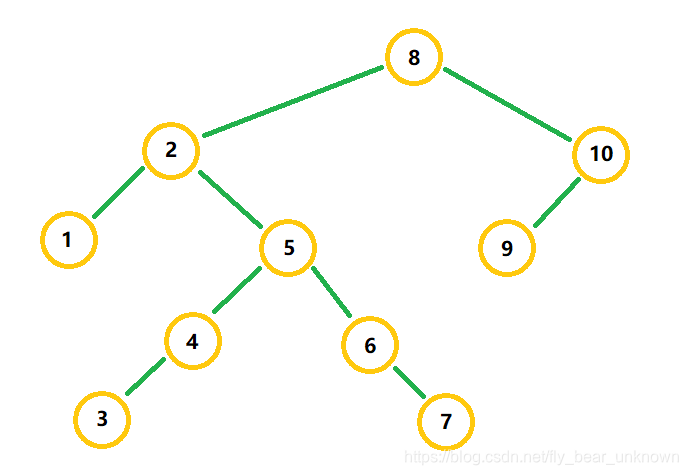
这个好复杂也,多种状况。
8 号置顶,大号骨头。两个仔。
3 号最底层,最简单。
10 号跟 3 号差不多。
💥去没仔的
🌽 main:
    bt.insert(Circle(8))
    println("BST: $bt")
    println("Removed circle(8): ${bt.remove(Circle(8))}")
    println("BST: $bt")
拿一个试手。
🌲 BinarySearchTree:
    fun remove(value: T): Boolean {
        root = remove(value, root)
        return !contains(value)
    }

    fun remove(value: T, parent: Node<T>?): Node<T>? {
        parent ?: return null

        when {
            parent.data.compareTo(value) == 0 -> {
                when {
                    // no left child
                    parent.left == null -> {
                        return parent.right
                    }
                    // no right child
                    parent.right == null -> {
                        return parent.left
                    }
                }
                // two children

            }
        }
        return parent
    }
🐵Run:
BST: 	data(Circle(8)),
<-(null),	->(null)

Removed circle(8): true
BST: empty tree
👳🏾(在试?):🐽,继续看手机。
…
💥去单仔:只有右边
🌽 main:
    bt.insert(Circle(8))
    bt.insert(Circle(9))

    println("BST: $bt")
    println("Removed circle(8): ${bt.remove(Circle(8))}")
    println("BST: $bt")
🐵Run:
BST: 	data(Circle(8)),
<-(null),	->(	data(Circle(9)),
<-(null),	->(null)
)

Removed circle(8): true
BST: 	data(Circle(9)),
<-(null),	->(null)
Good!
…
💥去单仔:只有左边
🌽 main:
    bt.insert(Circle(8))
    bt.insert(Circle(7))

    println("BST: $bt")
    println("Removed circle(8): ${bt.remove(Circle(8))}")
    println("BST: $bt")
🐵Run:
BST: 	data(Circle(8)),
<-(	data(Circle(7)),
<-(null),	->(null)
),	->(null)

Removed circle(8): true
BST: 	data(Circle(7)),
<-(null),	->(null)
…
❌去两个仔的
现在去 8 号。
➕没找到的线路。
🌲 BinarySearchTree:
    fun remove(value: T, parent: Node<T>?): Node<T>? {
        parent ?: return null

        when {
            parent.data.compareTo(value) == 0 -> {
                when {
                    // no left child
                    parent.left == null -> {
                        return parent.right
                    }
                    // no right child
                    parent.right == null -> {
                        return parent.left
                    }
                }
                // two children

            }
            // less to left
            value < parent.data -> parent.left = remove(value, parent.left)
            // most to right
    		else -> parent.right = remove(value, parent.right)
        }
        return parent
    }
➕找到的线路:
8 号要 9 号顶,叫右小(右边最小)。
Node Data Class 加 minNode:
	data class Node<T: Comparable<T>>(
        var data: T,
        var left: Node<T>? = null,
        var right: Node<T>? = null
	) {
        ...
        // right min:
        val minNode: Node<T>?
  			get() = left?.minNode ?: this
    }
remove(value: T, parent: Node?) 里面:
            parent.data.compareTo(value) == 0 -> {
                when {
                    // no left child
                    parent.left == null -> {
                        return parent.right
                    }
                    // no right child
                    parent.right == null -> {
                        return parent.left
                    }
                }
                // two children
                val rightMin = parent.right?.minNode!!
                println("Right minimum: ${rightMin.data}")

            }
🐵Run:
Right minimum: Circle(9)
找到了,接收 8号 的遗产。
            parent.data.compareTo(value) == 0 -> {
                when {
                    // no left child
                    parent.left == null -> {
                        return parent.right
                    }
                    // no right child
                    parent.right == null -> {
                        return parent.left
                    }
                }
                // two children
//                 val rightMin = parent.right?.minNode!!
//                 println("Right minimum: ${rightMin.data}")
//              // move value of rightMin up
				parent.right?.minNode!!.data?.let {
                    parent.data = it
                }
                // remove rightMin
                parent.right = remove(parent.data, parent.right)
🌽 main:
    for (c in cirs) { bt.insert(c) }
    println("Removed circle(8): ${bt.remove(Circle(8))}")
    println("BST: $bt")
🐒Run:
Removed circle(8): true
BST: 	data(Circle(9)),
<-(	data(Circle(2)),
<-(	data(Circle(1)),
<-(null),	->(null)
),	->(	data(Circle(5)),
<-(	data(Circle(4)),
<-(	data(Circle(3)),
<-(null),	->(null)
),	->(null)
),	->(	data(Circle(6)),
<-(null),	->(	data(Circle(7)),
<-(null),	->(null)
)
)
)
),	->(	data(Circle(10)),
<-(null),	->(null)
)
连续去 8号, 3号,10号。
🌽 main:
    println("Removed circle(8): ${bt.remove(Circle(8))}")
    println("Removed circle(3): ${bt.remove(Circle(3))}")
    println("Removed circle(10): ${bt.remove(Circle(10))}")
    println("BST: $bt")
🐒Run:
Removed circle(8): true
Removed circle(3): true
Removed circle(10): true
BST: 	data(Circle(9)),
<-(	data(Circle(2)),
<-(	data(Circle(1)),
<-(null),	->(null)
),	->(	data(Circle(5)),
<-(	data(Circle(4)),
<-(null),	->(null)
),	->(	data(Circle(6)),
<-(null),	->(	data(Circle(7)),
<-(null),	->(null)
)
)
)
),	->(null)
😂:好了,好了。
👳🏾:很好,省得改题了,你加个 asSortedList() 方程,分别印顺次,和反向的次序。
😵:Sort, sort, sort, 怎么写?来啦…
…
♐️ Sort
🌲 BinarySearchTree:
fun asSortedList(): List<T> = root?.toList() ?: emptyList()
让 root 去搜货。
💎 Node Data Class :
        fun toList(): List<T> = listOfNotNull(
                left?.toList(),
                listOf(data),
                right?.toList()).flatten()
- listOfNotNull() 是只收 NotNull 的货。瞧,我收左边的 toList(),左边最小;再收现在这个;然后收右边的 toList() 。BST就这好,从左到右不用再 sort 。
- flattern() 就是把 X 条 List 合成一条新的 List 。
🌽 main:
    val mlist = bt.asSortedList()
    println("Sorted list: ${mlist}")
🐒Run:
Sorted list: [Circle(1), Circle(2), Circle(3), Circle(4), Circle(5), Circle(6), Circle(7), Circle(8), Circle(9), Circle(10)]
反向, 🌽 main:
    val revlist = mlist.asReversed()
    println("Reversed Order list: ${revlist}")
🐒Run:
Reversed Order list: [Circle(10), Circle(9), Circle(8), Circle(7), Circle(6), Circle(5), Circle(4), Circle(3), Circle(2), Circle(1)]
…
🍋. 结果
👳🏾:正确,但是时间到了,但是这里还有几道题,我会向上级汇报你的情况,你回去等消息吧。祝你好运!
😬:谢谢!你也一样。





 扫一扫
扫一扫


 被折叠的 条评论
为什么被折叠?
被折叠的 条评论
为什么被折叠?
 到【灌水乐园】发言





