
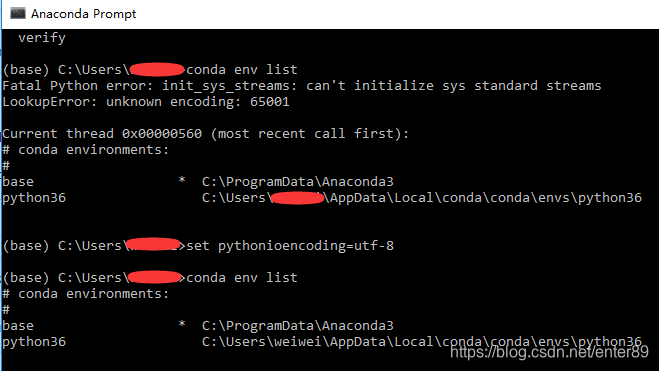
利用AnacondaPrompt执行conda命令,会提示Fatal Python error: init_sys_streams: can't initialize sys standard streams
LookupError: unknow encoding: 65001
解决方法:
执行: set pythonioencoding=utf-8


 AI摘要
本文介绍在使用AnacondaPrompt执行conda命令时遇到的Fatal Python error: init_sys_streams: can't initialize sys standard streams LookupError: unknown encoding: 65001问题及其解决方法。通过设置pythonioencoding=utf-8,可以有效解决此问题。
利用AnacondaPrompt执行conda命令,会提示Fatal Python error: init_sys_streams: can't initialize sys standard streams
LookupError: unknow encoding: 65001
执行: set pythonioencoding=utf-8
终端运行pip提示:LookupError: unknown encoding: cp65001 解决方案
终端运行pip提示:LookupError: unknown encoding: cp65001 解决方案错误提示原因解决方案持续报错 错误提示 原因 脚本试图打印的Unicode字符不能使用当前控制台字符编码表示, 解决方案 cp65001就是utf-8, 所以需设置环境变量编码格式为utf-8,终端执行指令:set PYTHONIOENCODING=UTF-8。 亲测可以解决问题,看了下网上还有其他解决方便,大家也可以尝试一下,如下: //查看页面编码 chcp //修改为1252 拉丁1字符 (A
Python报错:ImportError: cannot import name ‘xxx‘ from ‘xxx‘
Python报错:ImportError: cannot import name ‘xxx‘ from ‘xxx‘
AMD显卡跑Ollama大模型?手把手教你搞定Windows下GPU识别与加速(以RX 9600XT为例)
本文详细指导如何在Windows系统下使用AMD显卡(如RX 9600XT)运行Ollama大模型,解决GPU识别与加速问题。通过获取非官方Ollama版本、替换ROCm库文件等步骤,实现高效的GPU加速推理,提升大语言模型的运行效率。
解决:cannot import name ‘xxx‘ from ‘xxx‘
官网地址:https://www.catalyzex.com/这里我选择作为Chrome插件进入 Google、ArXiv、Twitter、Github等等页面检索,如果存在匹配的代码,就会自动显示例如进入ArXiv:https://arxiv.org/任意检索内容,发现如果存在代码,将会有相关显示...
头歌工程实训答案-机器学习篇之手写体识别篇
第2关:激活函数'''x:负无穷到正无穷的实数'''if x<=0:return 0else:return x#***第3关:反向传播算法import os。
openEuler Embedded新增软件包及在线安装软件方法
openEuler Embedded是基于Yocto构建的嵌入式操作系统,默认不包含dnf/apt软件包管理器,主要使用rpm格式。新增软件需通过manifest文件检查是否集成,未集成则需适配新配方。对于在线安装需求,可采用轻量级容器方案:通过isulad运行openEuler服务器版容器镜像,在容器内使用dnf命令安装软件(如Nginx),实现服务器生态兼容。部署前提包括设备支持、存储空间(≥10GB)和网络连接,需先安装并启动isulad服务。这种方法结合了嵌入式系统的轻量化特性和服务器系统的软件管理
Python异常处理:ImportError: cannot import name 'XXX' from 'XXXX'
在python IDE Pycharm中出现导入模块异常 异常显示为:ImportError: cannot import name ‘Style’ from ‘openpyxl.styles’ 异常分析:主要是 .py 文件路径的问题,当在同一文件下,存在子文件内有同样命名的 .py文件时,编辑器就不能正确选择所要导入的是哪一个文件下的模块,因此出现异常 异常处理:正确规范文件以及类、方法、...
奥比中光Dabai深度相机SDK在Ubuntu22.04的兼容性安装指南
本文详细指导如何在Ubuntu22.04系统上安装奥比中光Dabai深度相机的SDK。针对新旧版本不兼容的核心问题,重点推荐使用经过验证的v1.10.18版本SDK,并提供了从系统依赖检查、SDK下载安装、Python环境配置到编译测试的完整步骤,帮助用户成功解决安装难题并实现相机驱动。
解决python导包报错ImportError: cannot import name ‘xxx‘ from
花了较长时间,最后发现循环引用导致。既然循环引用了,只要让让它们别循环引用就行。 那么解决掉循环引用的部分即可正常! 解决办法:1,拆解成多个文件,将要互相引用的分开 2,缩小导入的范围,如一般情况下import在文件顶部,这时候可以将import移动到紧挨需要导入的代码上方即可; ...
ONNC Open Neural Network Compiler 开源神经网络编译器 一个 开源、模块化、可重用编译器算法和工具链的库,专门针对深度学习加速器(DLA)部署导入ONNX模型
ONNC是一个集合了开源、模块化、可重用编译器算法和工具链的库,专门针对深度学习加速器(DLA)。ONNC从底层开始构建,旨在将ONNX中间表示(IR)翻译成专有DLA代码。其软件架构设计强调可移植性和可重用性,从而简化了开发新后端的工作。上图展示了ONNC软件栈的顶层框图。软件栈从导入ONNX计算图模型到输出相应的硬件二进制文件,展示了各个功能块。
LAMMPS模拟新合金没势函数?手把手教你用`pair_style hybrid`混合势函数(附FeCMnSiTi案例)
本文详细介绍了在LAMMPS中如何使用`pair_style hybrid`混合势函数模拟新型高熵合金(如FeCMnSiTi),解决缺乏现成势函数的问题。通过实战案例,涵盖参数查找、命令编写、错误排查等关键步骤,特别适合处理多组元体系的复杂相互作用。文章还提供了EAM势函数与LJ势的组合技巧,帮助研究者准确模拟合金性能。
ImportError: cannot import name ‘XXX‘ 问题解决方案
ImportError: cannot import name ‘XXX‘ 问题解决方案
[QMT量化交易小白入门]-九、如何用Python记录每一笔交易和调试,报错信息?
定义一个函数来获取日志记录器。: 返回全局的日志记录器,以便在其他地方调用。
Fatal Python error: initfsencoding: unable to load the file system codec问题的解决
项目场景: 提示:这里简述项目相关背景: 例如:项目场景:示例:通过蓝牙芯片(HC-05)与手机 APP 通信,每隔 5s 传输一批传感器数据(不是很大) 问题描述: 提示:这里描述项目中遇到的问题: 例如:数据传输过程中数据不时出现丢失的情况,偶尔会丢失一部分数据 APP 中接收数据代码: @Override public void run() { bytes = mmInStream.read(buffer); mHandler.obta
STM32+FreeRTOS环境下LwIP协议栈移植详解
本文详细介绍了在STM32F407ZGT6平台上移植轻量级TCP/IP协议栈LwIP的过程。使用FreeRTOS操作系统和LAN8720A以太网PHY芯片,通过STM32CubeMX生成基础工程配置。重点包括LwIP源码的获取与工程集成、关键配置文件的编写(如lwipopts.h)、操作系统适配层sys_arch.c的实现,以及以太网接口驱动ethernetif.c的移植。文章特别强调内存管理、中断优先级、硬件校验和等关键配置项的注意事项,为基于STM32和LwIP的嵌入式网络开发提供了实用参考。
RU DOS版、EFI版32bit/64bit BIOS常用工具
DOS版、EFI版的RU工具,可用来查看IO、MEM、PCI、SMBIOS等资源。亲测在EFI SHELL下可用。
conda虚拟环境运行Python报错:Fatal Python error: Py_Initialize: can‘t initialize sys standard streams
该问题的本质是, 尽管已经使用conda activate激活了虚拟环境, 虚拟环境的python.exe所依赖的库等(也可以称为环境),却是conda中base环境! 比如执行了 env/py36/python.exe 在执行过程中,原生库却使用了base环境(如path/miniconda3/python.exe)。当虚拟环境python版本和base环境差异很大的时候,就会报错: Fatal Python error: Py_Initialize: can't initialize sys s
Data-Structures-and-Algorithm-Analysis-in-Java.pdf
作者: Weiss, Mark A. 出版社: Addison Wesley Data Structures and Algorithm Analysis in Java is an “advanced algorithms” book that fits between traditional CS2 and Algorithms Analysis courses. In the old ACM Curriculum Guidelines, this course was known as CS7. This text is for readers who want to learn good programming and algorithm analysis skills simultaneously so that they can develop such programs with the maximum amo...
【Python】Fatal Python error: init_sys_streams: can‘t initialize sys standard streams
记录一个error的解决方法: 最近想跑一个baseline的代码,所以就用conda建了一个新的python虚拟环境,但是发现新建的python环境无法设置为Pycharm的SDK,一直提示该SDK不合法。 于是我又去命令行挨个试了一下所有的python虚拟环境,除了base环境和其中一个虚拟环境py38,其余所有的虚拟环境都出现如下报错: (py37) E:\project_file\PyCharm\reid>python Fatal Python error: init_sys_streams:
深度学习工具包 DeepLearningToolbox
深度学习工具包Deprecation notice.-----This toolbox is outdated and no longer maintained.There are much better tools available for deep learning than this toolbox, e.g. [Theano](http://deeplearning.net/software/theano/), [torch](http://torch.ch/) or [tensorflow](http://www.tensorflow.org/)I would suggest you use one of the tools mentioned above rather than use this toolbox.Best, Rasmus.DeepLearnToolbox================A Matlab toolbox for Deep Learning.Deep Learning is a new subfield of machine learning that focuses on learning deep hierarchical models of data.It is inspired by the human brain's apparent deep (layered, hierarchical) architecture.A good overview of the theory of Deep Learning theory is[Learning Deep Architectures for AI](http://www.iro.umontreal.ca/~bengioy/papers/ftml_book.pdf)For a more informal introduction, see the following videos by Geoffrey Hinton and Andrew Ng.* [The Next Generation of Neural Networks](http://www.youtube.com/watch?v=AyzOUbkUf3M) (Hinton, 2007)* [Recent Developments in Deep Learning](http://www.youtube.com/watch?v=VdIURAu1-aU) (Hinton, 2010)* [Unsupervised Feature Learning and Deep Learning](http://www.youtube.com/watch?v=ZmNOAtZIgIk) (Ng, 2011)If you use this toolbox in your research please cite [Prediction as a candidate for learning deep hierarchical models of data](http://www2.imm.dtu.dk/pubdb/views/publication_details.php?id=6284)```@MASTERSTHESIS\{IMM2012-06284, author = "R. B. Palm", title = "Prediction as a candidate for learning deep hierarchical models of data", year = "2012",}```Contact: rasmusbergpalm at gmail dot comDirectories included in the toolbox-----------------------------------`NN/` - A library for Feedforward Backpropagation Neural Networks`CNN/` - A library for Convolutional Neural Networks`DBN/` - A library for Deep Belief Networks`SAE/` - A library for Stacked Auto-Encoders`CAE/` - A library for Convolutional Auto-Encoders`util/` - Utility functions used by the libraries`data/` - Data used by the examples`tests/` - unit tests to verify toolbox is workingFor references on each library check REFS.mdSetup-----1. Download.2. addpath(genpath('DeepLearnToolbox'));Example: Deep Belief Network---------------------```matlabfunction test_example_DBNload mnist_uint8;train_x = double(train_x) / 255;test_x = double(test_x) / 255;train_y = double(train_y);test_y = double(test_y);%% ex1 train a 100 hidden unit RBM and visualize its weightsrand('state',0)dbn.sizes = [100];opts.numepochs = 1;opts.batchsize = 100;opts.momentum = 0;opts.alpha = 1;dbn = dbnsetup(dbn, train_x, opts);dbn = dbntrain(dbn, train_x, opts);figure; visualize(dbn.rbm{1}.W'); % Visualize the RBM weights%% ex2 train a 100-100 hidden unit DBN and use its weights to initialize a NNrand('state',0)%train dbndbn.sizes = [100 100];opts.numepochs = 1;opts.batchsize = 100;opts.momentum = 0;opts.alpha = 1;dbn = dbnsetup(dbn, train_x, opts);dbn = dbntrain(dbn, train_x, opts);%unfold dbn to nnnn = dbnunfoldtonn(dbn, 10);nn.activation_function = 'sigm';%train nnopts.numepochs = 1;opts.batchsize = 100;nn = nntrain(nn, train_x, train_y, opts);[er, bad] = nntest(nn, test_x, test_y);assert(er < 0.10, 'Too big error');```Example: Stacked Auto-Encoders---------------------```matlabfunction test_example_SAEload mnist_uint8;train_x = double(train_x)/255;test_x = double(test_x)/255;train_y = double(train_y);test_y = double(test_y);%% ex1 train a 100 hidden unit SDAE and use it to initialize a FFNN% Setup and train a stacked denoising autoencoder (SDAE)rand('state',0)sae = saesetup([784 100]);sae.ae{1}.activation_function = 'sigm';sae.ae{1}.learningRate = 1;sae.ae{1}.inputZeroMaskedFraction = 0.5;opts.numepochs = 1;opts.batchsize = 100;sae = saetrain(sae, train_x, opts);visualize(sae.ae{1}.W{1}(:,2:end)')% Use the SDAE to initialize a FFNNnn = nnsetup([784 100 10]);nn.activation_function = 'sigm';nn.learningRate = 1;nn.W{1} = sae.ae{1}.W{1};% Train the FFNNopts.numepochs = 1;opts.batchsize = 100;nn = nntrain(nn, train_x, train_y, opts);[er, bad] = nntest(nn, test_x, test_y);assert(er < 0.16, 'Too big error');```Example: Convolutional Neural Nets---------------------```matlabfunction test_example_CNNload mnist_uint8;train_x = double(reshape(train_x',28,28,60000))/255;test_x = double(reshape(test_x',28,28,10000))/255;train_y = double(train_y');test_y = double(test_y');%% ex1 Train a 6c-2s-12c-2s Convolutional neural network %will run 1 epoch in about 200 second and get around 11% error. %With 100 epochs you'll get around 1.2% errorrand('state',0)cnn.layers = { struct('type', 'i') %input layer struct('type', 'c', 'outputmaps', 6, 'kernelsize', 5) %convolution layer struct('type', 's', 'scale', 2) %sub sampling layer struct('type', 'c', 'outputmaps', 12, 'kernelsize', 5) %convolution layer struct('type', 's', 'scale', 2) %subsampling layer};cnn = cnnsetup(cnn, train_x, train_y);opts.alpha = 1;opts.batchsize = 50;opts.numepochs = 1;cnn = cnntrain(cnn, train_x, train_y, opts);[er, bad] = cnntest(cnn, test_x, test_y);%plot mean squared errorfigure; plot(cnn.rL);assert(er<0.12, 'Too big error');```Example: Neural Networks---------------------```matlabfunction test_example_NNload mnist_uint8;train_x = double(train_x) / 255;test_x = double(test_x) / 255;train_y = double(train_y);test_y = double(test_y);% normalize[train_x, mu, sigma] = zscore(train_x);test_x = normalize(test_x, mu, sigma);%% ex1 vanilla neural netrand('state',0)nn = nnsetup([784 100 10]);opts.numepochs = 1; % Number of full sweeps through dataopts.batchsize = 100; % Take a mean gradient step over this many samples[nn, L] = nntrain(nn, train_x, train_y, opts);[er, bad] = nntest(nn, test_x, test_y);assert(er < 0.08, 'Too big error');%% ex2 neural net with L2 weight decayrand('state',0)nn = nnsetup([784 100 10]);nn.weightPenaltyL2 = 1e-4; % L2 weight decayopts.numepochs = 1; % Number of full sweeps through dataopts.batchsize = 100; % Take a mean gradient step over this many samplesnn = nntrain(nn, train_x, train_y, opts);[er, bad] = nntest(nn, test_x, test_y);assert(er < 0.1, 'Too big error');%% ex3 neural net with dropoutrand('state',0)nn = nnsetup([784 100 10]);nn.dropoutFraction = 0.5; % Dropout fraction opts.numepochs = 1; % Number of full sweeps through dataopts.batchsize = 100; % Take a mean gradient step over this many samplesnn = nntrain(nn, train_x, train_y, opts);[er, bad] = nntest(nn, test_x, test_y);assert(er < 0.1, 'Too big error');%% ex4 neural net with sigmoid activation functionrand('state',0)nn = nnsetup([784 100 10]);nn.activation_function = 'sigm'; % Sigmoid activation functionnn.learningRate = 1; % Sigm require a lower learning rateopts.numepochs = 1; % Number of full sweeps through dataopts.batchsize = 100; % Take a mean gradient step over this many samplesnn = nntrain(nn, train_x, train_y, opts);[er, bad] = nntest(nn, test_x, test_y);assert(er < 0.1, 'Too big error');%% ex5 plotting functionalityrand('state',0)nn = nnsetup([784 20 10]);opts.numepochs = 5; % Number of full sweeps through datann.output = 'softmax'; % use softmax outputopts.batchsize = 1000; % Take a mean gradient step over this many samplesopts.plot = 1; % enable plottingnn = nntrain(nn, train_x, train_y, opts);[er, bad] = nntest(nn, test_x, test_y);assert(er < 0.1, 'Too big error');%% ex6 neural net with sigmoid activation and plotting of validation and training error% split training data into training and validation datavx = train_x(1:10000,:);tx = train_x(10001:end,:);vy = train_y(1:10000,:);ty = train_y(10001:end,:);rand('state',0)nn = nnsetup([784 20 10]); nn.output = 'softmax'; % use softmax outputopts.numepochs = 5; % Number of full sweeps through dataopts.batchsize = 1000; % Take a mean gradient step over this many samplesopts.plot = 1; % enable plottingnn = nntrain(nn, tx, ty, opts, vx, vy); % nntrain takes validation set as last two arguments (optionally)[er, bad] = nntest(nn, test_x, test_y);assert(er < 0.1, 'Too big error');```[](https://bitdeli.com/free "Bitdeli Badge")
python安装报错
Fatal Python error: initfsencoding: unable to load the file system codec ModuleNotFoundError: No module named ‘encodings’
问题解决:Fatal Python error: initfsencoding: unable to load the file system codec
原因: 由环境配置导致出现的错误,从这个显示了两个文件地址, 这里环境变量设置为了其中某个模块路径,导致另一个模块运行加载路径出错,从而导致运行失败。 结果就会输出 思考解析: 当出现这个问题是基本上就是环境变量的问题了,那么你可以去环境变量中删除即可,我这里是因为在系统环境变量中加了,系统的环境变量优先级要高于用户变量,在系统环境中删除后,添加到了用户变量的python环境的后面。如果不同于这篇安装python来安装python的话很多会让你设置一个环境变量为,但是这个变量其实也可以不需要,当自定
python无法加载文件系统代码_致命的Python错误:initfsencoding:无法加载文件系统cod...
我已经创建了一个简单脚本的.exe文件,打算在服务器上运行它,但是我似乎无法找出这个错误的含义,也无法在网上找到任何答案。故障代码如下:Fatal Python error: initfsencoding: unable to load the file system codecModuleNotFoundError: No module named 'encodings'Current thre...
Fatal Python error: initfsencoding: unable to load the file system codec(pyinstaller打包的问题)
环境配置 RTX1080Ti Win10 cuda10.2 Python3.7 Pytorch1.7.0 问题描述 本人需要将有导入torch包的python文件通过pyinstaller打包生成exe pyinstaller命令使用D参数,即生成一个dist文件夹,里面包含exe和需要调用的dll 打包显示成功,但是运行exe会报如下错误: Fatal Python error: initfsencoding: unable to load the file system codec zipimport.
LookupError: unknown encoding: 65001
LookupError: unknown encoding: 65001
Fatal Python error: initfsencoding: unable to load the file system codec
我是直接运行exe程序(几乎没有配置python环境),我的python和python环境安装在e盘,但是运行的exe程序的python环境指向c盘,所以造成错误。二、在c盘安装python 并配置相关环境:版本冲突,路径混乱问题?一、更改python路径,使用非系统路径:无法更改,无效。
python3启动失败 Fatal Python error: initfsencoding: unable to load the file system codec
python2和python3同时存在时,其中一个启动失败,报错如下两种情况 1、python3启动失败,python2路径下文件报错 Fatal Python error: initfsencoding: unable to load the file system codec File "C:\Python27\Lib\encodings\__init__.py", line...
unable to load the file system codec No module named ‘encodings‘解决方法记录
运行时报错:Fatal Python error: initfsencoding: unable to load the file system codec ModuleNotFoundError: No module named 'encodings'。


 被折叠的 条评论
为什么被折叠?
 到【灌水乐园】发言

 4152


 扫一扫


