


 本文深入解析USBgadget机制,涵盖gadgetdriver与composite_driver的交互,详细阐述gadgetdriver的匹配过程,composite_bind函数的工作原理,以及USB请求的处理流程。文章还探讨了structusb_composite_dev和structusb_composite_driver的结构,ep0端点的配置,以及gadget与gadget_driver之间的绑定。同时,文中分析了USB设备描述符和字符串描述符的初始化,以及配置描述符的使用。
USB gadget----gadget driver
USB gadget Driver
USB gadget(1)----controller driver中,匹配gadget driver时,调用bind函数,这里调用的就是composite_bind。
struct usb_composite_driver 是struct usb_gadget_driver的子类,可以通过usb_gadget_driver获取相应的usb_composite_driver,执行子类的函数完成多态。
serial.c中初始化usb_composite_driver内的设备描述符和字符串描述符,实现多态需要的bind和unbind函数。
模块初始化函数init中,初始化配置描述符的相关字段,和设备描述符的设备类字段,iproduct的字符串描述符的index。
//drivers/usb/gadget/legacy/serial.c
struct usb_composite_dev {
	struct usb_gadget		*gadget;
	struct usb_request		*req;
	struct usb_request		*os_desc_req;

	struct usb_configuration	*config;

	/* OS String is a custom (yet popular) extension to the USB standard. */
	u8				qw_sign[OS_STRING_QW_SIGN_LEN];
	u8				b_vendor_code;
	struct usb_configuration	*os_desc_config;
	unsigned int			use_os_string:1;

	/* private: */
	/* internals */
	unsigned int			suspended:1;
	struct usb_device_descriptor	desc;
	struct list_head		configs;
	struct list_head		gstrings;
	struct usb_composite_driver	*driver;
	u8				next_string_id;
	char				*def_manufacturer;

	/* the gadget driver won't enable the data pullup
	 * while the deactivation count is nonzero.
	 */
	unsigned			deactivations;

	/* the composite driver won't complete the control transfer's
	 * data/status stages till delayed_status is zero.
	 */
	int				delayed_status;

	/* protects deactivations and delayed_status counts*/
	spinlock_t			lock;

	unsigned			setup_pending:1;
	unsigned			os_desc_pending:1;
};
struct usb_composite_driver {
	const char				*name;
	const struct usb_device_descriptor	*dev;
	struct usb_gadget_strings		**strings;
	enum usb_device_speed			max_speed;
	unsigned		needs_serial:1;

	int			(*bind)(struct usb_composite_dev *cdev);
	int			(*unbind)(struct usb_composite_dev *);

	void			(*disconnect)(struct usb_composite_dev *);

	/* global suspend hooks */
	void			(*suspend)(struct usb_composite_dev *);
	void			(*resume)(struct usb_composite_dev *);
	//gadaget 结构,usb_composite_driver是gadget driver的子类。
	struct usb_gadget_driver		gadget_driver;
};

static struct usb_composite_driver gserial_driver = {
	.name		= "g_serial",
	.dev		= &device_desc,
	.strings	= dev_strings,
	.max_speed	= USB_SPEED_SUPER,
	.bind		= gs_bind,
	.unbind		= gs_unbind,
};

static int __init init(void)
{
	/* We *could* export two configs; that'd be much cleaner...
	 * but neither of these product IDs was defined that way.
	 */
	if (use_acm) {
		serial_config_driver.label = "CDC ACM config";
		serial_config_driver.bConfigurationValue = 2;
		device_desc.bDeviceClass = USB_CLASS_COMM;
		device_desc.idProduct =
				cpu_to_le16(GS_CDC_PRODUCT_ID);
	} else if (use_obex) {
		serial_config_driver.label = "CDC OBEX config";
		serial_config_driver.bConfigurationValue = 3;
		device_desc.bDeviceClass = USB_CLASS_COMM;
		device_desc.idProduct =
			cpu_to_le16(GS_CDC_OBEX_PRODUCT_ID);
	} else {
		serial_config_driver.label = "Generic Serial config";
		serial_config_driver.bConfigurationValue = 1;
		device_desc.bDeviceClass = USB_CLASS_VENDOR_SPEC;
		device_desc.idProduct =
				cpu_to_le16(GS_PRODUCT_ID);
	}
	strings_dev[STRING_DESCRIPTION_IDX].s = serial_config_driver.label;

	return usb_composite_probe(&gserial_driver);
}

struct usb_configuration {
	const char			*label;
	struct usb_gadget_strings	**strings;
	const struct usb_descriptor_header **descriptors;

	/* REVISIT:  bind() functions can be marked __init, which
	 * makes trouble for section mismatch analysis.  See if
	 * we can't restructure things to avoid mismatching...
	 */

	/* configuration management: unbind/setup */
	void			(*unbind)(struct usb_configuration *);
	int			(*setup)(struct usb_configuration *,
					const struct usb_ctrlrequest *);

	/* fields in the config descriptor */
	u8			bConfigurationValue; //configuration的编号
	u8			iConfiguration; //configuration字符串描述符的index
	u8			bmAttributes;
	u16			MaxPower;

	struct usb_composite_dev	*cdev;

	/* private: */
	/* internals */
	struct list_head	list;
	struct list_head	functions;
	u8			next_interface_id;
	unsigned		superspeed:1;
	unsigned		highspeed:1;
	unsigned		fullspeed:1;
	unsigned		superspeed_plus:1;
	struct usb_function	*interface[MAX_CONFIG_INTERFACES];
};
usb_composite_probe(&gserial_driver)函数开始gadget和gadget_driver的匹配,gadget_driver在composite_driver中。usb_composite_probe(struct usb_composite_driver *driver) 函数中使用composite_driver_template模板将composite_driver中的gadget_driver初始化。usb_gadget_probe_driver(gadget_driver)真正开始gadget和gadget_driver的匹配。匹配成功后调用composite_dirver回调函数开始bind。composite_bind的动作如下:
- 通过gadget_driver获取composite_driver. 通过父类获取子类。
- 使用composite_dev_prepare(composite, cdev)创建composite_dev。
- 调用composite_driver中的bind回调函数
struct usb_composite_dev有如下的一些关键元素: - ep0 使用的struct usb_request
struct usb_request *req;
- struct usb_device_descriptor desc 设备描述符在composite_bind函数中从composite_driver中拷贝初始化。
- struct list_head configs, struct usb_configuration链表,在usb_add_config_only() 中将传递的usb_configuration加入到链表中。
///drivers/usb/gadget/composite.c
int usb_composite_probe(struct usb_composite_driver *driver)
{
	struct usb_gadget_driver *gadget_driver;

	if (!driver || !driver->dev || !driver->bind)
		return -EINVAL;

	if (!driver->name)
		driver->name = "composite";

	driver->gadget_driver = composite_driver_template;
	gadget_driver = &driver->gadget_driver;

	gadget_driver->function =  (char *) driver->name;
	gadget_driver->driver.name = driver->name;
	gadget_driver->max_speed = driver->max_speed;

	return usb_gadget_probe_driver(gadget_driver);//与udc进行匹配
}

static const struct usb_gadget_driver composite_driver_template = {
	.bind		= composite_bind,
	.unbind		= composite_unbind,

	.setup		= composite_setup,
	.reset		= composite_disconnect,
	.disconnect	= composite_disconnect,

	.suspend	= composite_suspend,
	.resume		= composite_resume,
	.filteroutdata	= composite_filteroutdata,

	.driver	= {
		.owner		= THIS_MODULE,
	},
};
static int composite_bind(struct usb_gadget *gadget,
		struct usb_gadget_driver *gdriver)
{
	struct usb_composite_dev	*cdev;
	struct usb_composite_driver	*composite = to_cdriver(gdriver);
	int				status = -ENOMEM;

	cdev = kzalloc(sizeof *cdev, GFP_KERNEL);
	if (!cdev)
		return status;

	spin_lock_init(&cdev->lock);
	cdev->gadget = gadget;
	set_gadget_data(gadget, cdev);
	INIT_LIST_HEAD(&cdev->configs);
	INIT_LIST_HEAD(&cdev->gstrings);

	status = composite_dev_prepare(composite, cdev);
	if (status)
		goto fail;

	/* composite gadget needs to assign strings for whole device (like
	 * serial number), register function drivers, potentially update
	 * power state and consumption, etc
	 */
	status = composite->bind(cdev);
	if (status < 0)
		goto fail;

	if (cdev->use_os_string) {
		status = composite_os_desc_req_prepare(cdev, gadget->ep0);
		if (status)
			goto fail;
	}

	update_unchanged_dev_desc(&cdev->desc, composite->dev);

	/* has userspace failed to provide a serial number? */
	if (composite->needs_serial && !cdev->desc.iSerialNumber)
		WARNING(cdev, "userspace failed to provide iSerialNumber\n");

	INFO(cdev, "%s ready\n", composite->name);
	return 0;

fail:
	__composite_unbind(gadget, false);
	return status;
}
composite_dev_prepare(composite, cdev) 分配ep0用到的usb request
int composite_dev_prepare(struct usb_composite_driver *composite,
		struct usb_composite_dev *cdev)
{
	struct usb_gadget *gadget = cdev->gadget;
	int ret = -ENOMEM;

	/* preallocate control response and buffer */
	/*分配ep0用到request*/
	cdev->req = usb_ep_alloc_request(gadget->ep0, GFP_KERNEL);
	if (!cdev->req)
		return -ENOMEM;

	cdev->req->buf = kmalloc(USB_COMP_EP0_BUFSIZ, GFP_KERNEL);
	if (!cdev->req->buf)
		goto fail;

	ret = device_create_file(&gadget->dev, &dev_attr_suspended);
	if (ret)
		goto fail_dev;

	cdev->req->complete = composite_setup_complete;
	cdev->req->context = cdev;
	gadget->ep0->driver_data = cdev;

	cdev->driver = composite;

	/*
	 * As per USB compliance update, a device that is actively drawing
	 * more than 100mA from USB must report itself as bus-powered in
	 * the GetStatus(DEVICE) call.
	 */
	if (CONFIG_USB_GADGET_VBUS_DRAW <= USB_SELF_POWER_VBUS_MAX_DRAW)
		usb_gadget_set_selfpowered(gadget);

	/* interface and string IDs start at zero via kzalloc.
	 * we force endpoints to start unassigned; few controller
	 * drivers will zero ep->driver_data.
	 */
	usb_ep_autoconfig_reset(gadget);
	return 0;
fail_dev:
	kfree(cdev->req->buf);
fail:
	usb_ep_free_request(gadget->ep0, cdev->req);
	cdev->req = NULL;
	return ret;
}

static void composite_setup_complete(struct usb_ep *ep, struct usb_request *req)
{
	struct usb_composite_dev *cdev;

	if (req->status || req->actual != req->length)
		DBG((struct usb_composite_dev *) ep->driver_data,
				"setup complete --> %d, %d/%d\n",
				req->status, req->actual, req->length);

	/*
	 * REVIST The same ep0 requests are shared with function drivers
	 * so they don't have to maintain the same ->complete() stubs.
	 *
	 * Because of that, we need to check for the validity of ->context
	 * here, even though we know we've set it to something useful.
	 */
	if (!req->context)
		return;

	cdev = req->context;

	if (cdev->req == req)
		cdev->setup_pending = false;
	else if (cdev->os_desc_req == req)
		cdev->os_desc_pending = false;
	else
		WARN(1, "unknown request %p\n", req);
}
struct usb_gadget_driver {
	char			*function;
	enum usb_device_speed	max_speed;
	int			(*bind)(struct usb_gadget *gadget,
					struct usb_gadget_driver *driver);
	void			(*unbind)(struct usb_gadget *);
	int			(*setup)(struct usb_gadget *,
					const struct usb_ctrlrequest *);
	void			(*disconnect)(struct usb_gadget *);
	void			(*suspend)(struct usb_gadget *);
	void			(*resume)(struct usb_gadget *);
	void			(*reset)(struct usb_gadget *);
	int			(*filteroutdata)(struct usb_gadget *,
					const struct usb_ctrlrequest *,
					u8 *, int);

	/* FIXME support safe rmmod */
	struct device_driver	driver;

	char			*udc_name;
	struct list_head	pending;
	unsigned                match_existing_only:1;
};
struct usb_request {
	void			*buf;
	unsigned		length;
	dma_addr_t		dma;

	struct scatterlist	*sg;
	unsigned		num_sgs;
	unsigned		num_mapped_sgs;

	unsigned		stream_id:16;
	unsigned		no_interrupt:1;
	unsigned		zero:1;
	unsigned		short_not_ok:1;

	void			(*complete)(struct usb_ep *ep,
					struct usb_request *req);
	void			*context;
	struct list_head	list;

	int			status;
	unsigned		actual;
};
usb_get_function_instance()函数根据name参数去查找func_list链表中已经注册的function_driver, 找到之后调用alloc_inst()回调函数反回struct usb_function_instance.
gser_alloc_inst(void)中做了两件事情:
- 分配struct usb_function_instance结构。
- 调用gserial_alloc_line()创建usb serial上层的串口设施。
struct usb_function_instance {
	struct config_group group;
	struct list_head cfs_list;
	struct usb_function_driver *fd;
	int (*set_inst_name)(struct usb_function_instance *inst,
			      const char *name);
	void (*free_func_inst)(struct usb_function_instance *inst);
};

struct usb_function_driver {
	const char *name;
	struct module *mod;
	struct list_head list;
	struct usb_function_instance *(*alloc_inst)(void);
	struct usb_function *(*alloc_func)(struct usb_function_instance *inst);
};
struct f_serial_opts {
	struct usb_function_instance func_inst;
	u8 port_num;
};
static struct usb_function_instance *gser_alloc_inst(void)
{
	struct f_serial_opts *opts;
	int ret;

	opts = kzalloc(sizeof(*opts), GFP_KERNEL);
	if (!opts)
		return ERR_PTR(-ENOMEM);

	opts->func_inst.free_func_inst = gser_free_inst;
	ret = gserial_alloc_line(&opts->port_num);
	if (ret) {
		kfree(opts);
		return ERR_PTR(ret);
	}
	config_group_init_type_name(&opts->func_inst.group, "",
				    &serial_func_type);

	return &opts->func_inst;
}
usb_get_funtion()使用struct usb_function_instance的struct usb_function_driver元素的alloc_func()回调函数分配struct usb_function结构
struct usb_function {
	const char			*name;
	struct usb_gadget_strings	**strings;
	struct usb_descriptor_header	**fs_descriptors;
	struct usb_descriptor_header	**hs_descriptors;
	struct usb_descriptor_header	**ss_descriptors;
	struct usb_descriptor_header	**ssp_descriptors;

	struct usb_configuration	*config; /*当前使能的配置*/

	struct usb_os_desc_table	*os_desc_table;
	unsigned			os_desc_n;

	/* REVISIT:  bind() functions can be marked __init, which
	 * makes trouble for section mismatch analysis.  See if
	 * we can't restructure things to avoid mismatching.
	 * Related:  unbind() may kfree() but bind() won't...
	 */

	/* configuration management:  bind/unbind */
	int			(*bind)(struct usb_configuration *,
					struct usb_function *);
	void			(*unbind)(struct usb_configuration *,
					struct usb_function *);
	void			(*free_func)(struct usb_function *f);
	struct module		*mod;

	/* runtime state management 运行时状态管理*/
	int			(*set_alt)(struct usb_function *,
					unsigned interface, unsigned alt); /*使能注册的每个接口,包括*/
	int			(*get_alt)(struct usb_function *,
					unsigned interface);
	void			(*disable)(struct usb_function *);
	int			(*setup)(struct usb_function *,
					const struct usb_ctrlrequest *);
	bool			(*req_match)(struct usb_function *,
					const struct usb_ctrlrequest *,
					bool config0);
	void			(*suspend)(struct usb_function *);
	void			(*resume)(struct usb_function *);
	int			(*filteroutdata)(struct usb_function *,
					const struct usb_ctrlrequest *,
					u8 *buf,
					int len);

	/* USB 3.0 additions */
	int			(*get_status)(struct usb_function *);
	int			(*func_suspend)(struct usb_function *,
						u8 suspend_opt);
	/* private: */
	/* internals */
	struct list_head		list;
	DECLARE_BITMAP(endpoints, 32);
	const struct usb_function_instance *fi;

	unsigned int		bind_deactivated:1;
};
struct f_acm {
	struct gserial			port;
	u8				ctrl_id, data_id;
	u8				port_num;

	u8				pending;

	/* lock is mostly for pending and notify_req ... they get accessed
	 * by callbacks both from tty (open/close/break) under its spinlock,
	 * and notify_req.complete() which can't use that lock.
	 */
	spinlock_t			lock;

	struct usb_ep			*notify;
	struct usb_request		*notify_req;

	struct usb_cdc_line_coding	port_line_coding;	/* 8-N-1 etc */

	/* SetControlLineState request -- CDC 1.1 section 6.2.14 (INPUT) */
	u16				port_handshake_bits;
#define ACM_CTRL_RTS	(1 << 1)	/* unused with full duplex */
#define ACM_CTRL_DTR	(1 << 0)	/* host is ready for data r/w */

	/* SerialState notification -- CDC 1.1 section 6.3.5 (OUTPUT) */
	u16				serial_state;
#define ACM_CTRL_OVERRUN	(1 << 6)
#define ACM_CTRL_PARITY		(1 << 5)
#define ACM_CTRL_FRAMING	(1 << 4)
#define ACM_CTRL_RI		(1 << 3)
#define ACM_CTRL_BRK		(1 << 2)
#define ACM_CTRL_DSR		(1 << 1)
#define ACM_CTRL_DCD		(1 << 0)
};

struct gserial {
	struct usb_function		func;

	/* port is managed by gserial_{connect,disconnect} */
	struct gs_port			*ioport;

	struct usb_ep			*in;
	struct usb_ep			*out;

	/* REVISIT avoid this CDC-ACM support harder ... */
	struct usb_cdc_line_coding port_line_coding;	/* 9600-8-N-1 etc */

	/* notification callbacks */
	void (*connect)(struct gserial *p);
	void (*disconnect)(struct gserial *p);
	int (*send_break)(struct gserial *p, int duration);
};

static struct usb_function *acm_alloc_func(struct usb_function_instance *fi)
{
	struct f_serial_opts *opts;
	struct f_acm *acm;

	acm = kzalloc(sizeof(*acm), GFP_KERNEL);
	if (!acm)
		return ERR_PTR(-ENOMEM);

	spin_lock_init(&acm->lock);

	acm->port.connect = acm_connect;
	acm->port.disconnect = acm_disconnect;
	acm->port.send_break = acm_send_break;

	acm->port.func.name = "acm";
	acm->port.func.strings = acm_strings;
	/* descriptors are per-instance copies */
	acm->port.func.bind = acm_bind;
	acm->port.func.set_alt = acm_set_alt;
	acm->port.func.setup = acm_setup;
	acm->port.func.disable = acm_disable;

	opts = container_of(fi, struct f_serial_opts, func_inst);
	acm->port_num = opts->port_num;
	acm->port.func.unbind = acm_unbind;
	acm->port.func.free_func = acm_free_func;

	return &acm->port.func;
}
static struct usb_function *acm_alloc_func(struct usb_function_instance *fi) 分配struct f_acm结构,填充内部struct gserial port中的回调函数和port中struct usb_function的回调函数。
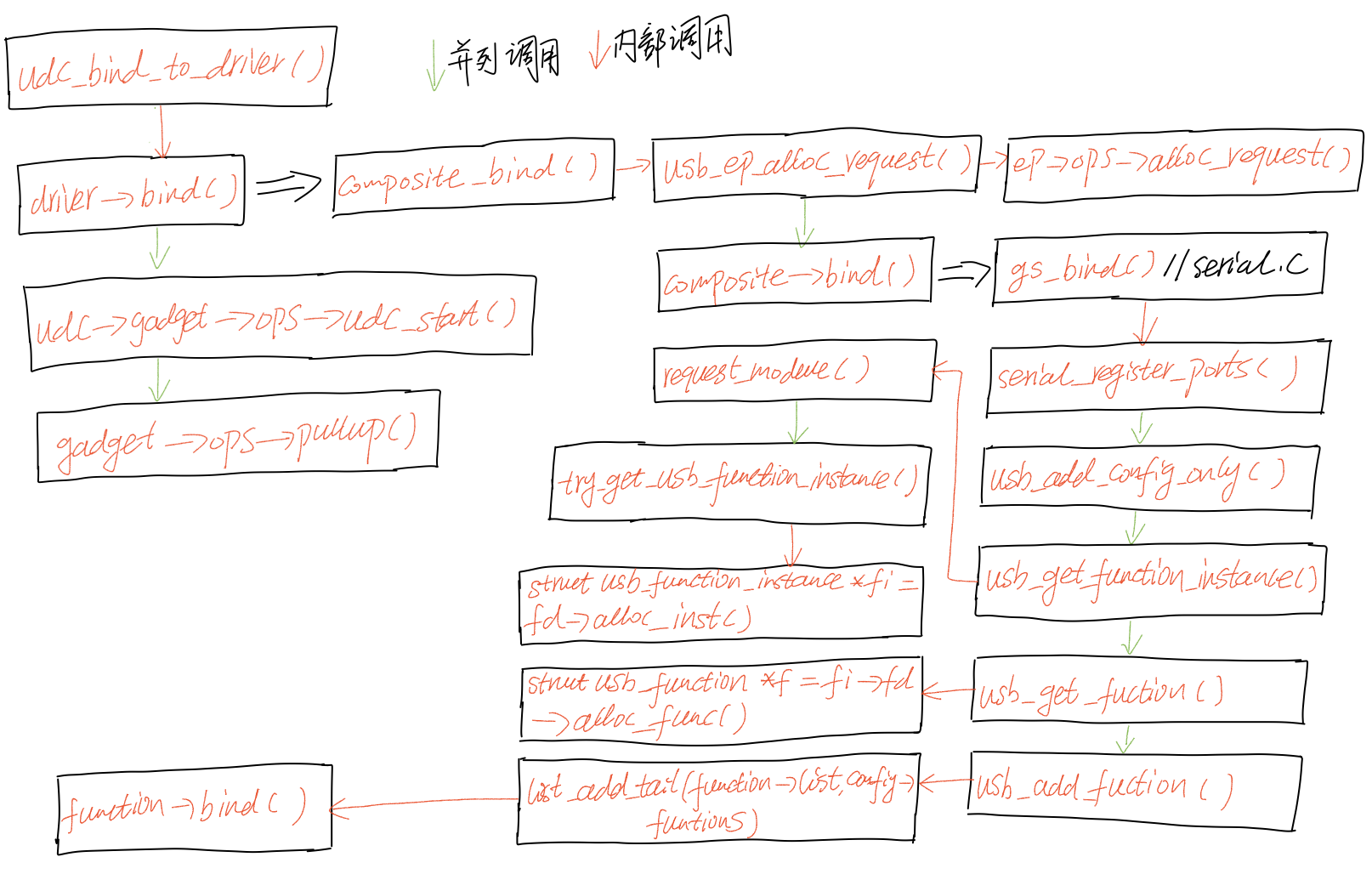
获取到struct usb_function 后最后调用到acm_bind()
/* ACM function driver setup/binding */
static int
acm_bind(struct usb_configuration *c, struct usb_function *f)
{
	struct usb_composite_dev *cdev = c->cdev;
	struct f_acm		*acm = func_to_acm(f);
	struct usb_string	*us;
	int			status;
	struct usb_ep		*ep;

	/* REVISIT might want instance-specific strings to help
	 * distinguish instances ...
	 */

	/* maybe allocate device-global string IDs, and patch descriptors */
	us = usb_gstrings_attach(cdev, acm_strings,
			ARRAY_SIZE(acm_string_defs));
	if (IS_ERR(us))
		return PTR_ERR(us);
	acm_control_interface_desc.iInterface = us[ACM_CTRL_IDX].id;
	acm_data_interface_desc.iInterface = us[ACM_DATA_IDX].id;
	acm_iad_descriptor.iFunction = us[ACM_IAD_IDX].id;

	/* allocate instance-specific interface IDs, and patch descriptors */
	status = usb_interface_id(c, f);
	if (status < 0)
		goto fail;
	acm->ctrl_id = status;
	acm_iad_descriptor.bFirstInterface = status;

	acm_control_interface_desc.bInterfaceNumber = status;
	acm_union_desc .bMasterInterface0 = status;

	status = usb_interface_id(c, f);
	if (status < 0)
		goto fail;
	acm->data_id = status;

	acm_data_interface_desc.bInterfaceNumber = status;
	acm_union_desc.bSlaveInterface0 = status;
	acm_call_mgmt_descriptor.bDataInterface = status;

	status = -ENODEV;

	/* allocate instance-specific endpoints */
	ep = usb_ep_autoconfig(cdev->gadget, &acm_fs_in_desc);
	if (!ep)
		goto fail;
	acm->port.in = ep;

	ep = usb_ep_autoconfig(cdev->gadget, &acm_fs_out_desc);
	if (!ep)
		goto fail;
	acm->port.out = ep;

	ep = usb_ep_autoconfig(cdev->gadget, &acm_fs_notify_desc);
	if (!ep)
		goto fail;
	acm->notify = ep;

	/* allocate notification */
	acm->notify_req = gs_alloc_req(ep,
			sizeof(struct usb_cdc_notification) + 2,
			GFP_KERNEL);
	if (!acm->notify_req)
		goto fail;

	acm->notify_req->complete = acm_cdc_notify_complete;
	acm->notify_req->context = acm;

	/* support all relevant hardware speeds... we expect that when
	 * hardware is dual speed, all bulk-capable endpoints work at
	 * both speeds
	 */
	acm_hs_in_desc.bEndpointAddress = acm_fs_in_desc.bEndpointAddress;
	acm_hs_out_desc.bEndpointAddress = acm_fs_out_desc.bEndpointAddress;
	acm_hs_notify_desc.bEndpointAddress =
		acm_fs_notify_desc.bEndpointAddress;

	acm_ss_in_desc.bEndpointAddress = acm_fs_in_desc.bEndpointAddress;
	acm_ss_out_desc.bEndpointAddress = acm_fs_out_desc.bEndpointAddress;

	status = usb_assign_descriptors(f, acm_fs_function, acm_hs_function,
			acm_ss_function, NULL);
	if (status)
		goto fail;

	dev_dbg(&cdev->gadget->dev,
		"acm ttyGS%d: %s speed IN/%s OUT/%s NOTIFY/%s\n",
		acm->port_num,
		gadget_is_superspeed(c->cdev->gadget) ? "super" :
		gadget_is_dualspeed(c->cdev->gadget) ? "dual" : "full",
		acm->port.in->name, acm->port.out->name,
		acm->notify->name);
	return 0;

fail:
	if (acm->notify_req)
		gs_free_req(acm->notify, acm->notify_req);

	ERROR(cdev, "%s/%p: can't bind, err %d\n", f->name, f, status);

	return status;
}
usb_gstrings_attach(cdev, acm_strings,
			ARRAY_SIZE(acm_string_defs));
上面的函数将struct usb_gadget_string 和struct usb_string 组建为协议中规定的格式。
status = usb_interface_id(c, f);
分配可用的interface id,相关的变量为struct usb_configuration 中的next_interface_id.
ep = usb_ep_autoconfig(cdev->gadget, &acm_fs_in_desc);
	if (!ep)
		goto fail;
	acm->port.in = ep;

	ep = usb_ep_autoconfig(cdev->gadget, &acm_fs_out_desc);
	if (!ep)
		goto fail;
	acm->port.out = ep;

	ep = usb_ep_autoconfig(cdev->gadget, &acm_fs_notify_desc);
	if (!ep)
		goto fail;
	acm->notify = ep;
根据给出的端点描述符选择合适端点,ep_list在controller driver中初始化,ep_list由gadget管理。
//epautoconf.c
struct usb_ep *usb_ep_autoconfig(
	struct usb_gadget		*gadget,
	struct usb_endpoint_descriptor	*desc
)
{
	return usb_ep_autoconfig_ss(gadget, desc, NULL);
}

struct usb_ep *usb_ep_autoconfig_ss(
	struct usb_gadget		*gadget,
	struct usb_endpoint_descriptor	*desc,
	struct usb_ss_ep_comp_descriptor *ep_comp
)
{
	struct usb_ep	*ep;
	u8		type;

	type = desc->bmAttributes & USB_ENDPOINT_XFERTYPE_MASK;

	if (gadget->ops->match_ep) {
		ep = gadget->ops->match_ep(gadget, desc, ep_comp);
		if (ep)
			goto found_ep;
	}

	/* Second, look at endpoints until an unclaimed one looks usable */
	list_for_each_entry (ep, &gadget->ep_list, ep_list) {
		if (usb_gadget_ep_match_desc(gadget, ep, desc, ep_comp))
			goto found_ep;
	}

	/* Fail */
	return NULL;
found_ep:

	/*
	 * If the protocol driver hasn't yet decided on wMaxPacketSize
	 * and wants to know the maximum possible, provide the info.
	 */
	if (desc->wMaxPacketSize == 0)
		desc->wMaxPacketSize = cpu_to_le16(ep->maxpacket_limit);

	/* report address */
	desc->bEndpointAddress &= USB_DIR_IN;
	if (isdigit(ep->name[2])) {
		u8 num = simple_strtoul(&ep->name[2], NULL, 10);
		desc->bEndpointAddress |= num;
	} else if (desc->bEndpointAddress & USB_DIR_IN) {
		if (++gadget->in_epnum > 15)
			return NULL;
		desc->bEndpointAddress = USB_DIR_IN | gadget->in_epnum;
	} else {
		if (++gadget->out_epnum > 15)
			return NULL;
		desc->bEndpointAddress |= gadget->out_epnum;
	}

	/* report (variable) full speed bulk maxpacket */
	if ((type == USB_ENDPOINT_XFER_BULK) && !ep_comp) {
		int size = ep->maxpacket_limit;

		/* min() doesn't work on bitfields with gcc-3.5 */
		if (size > 64)
			size = 64;
		desc->wMaxPacketSize = cpu_to_le16(size);
	}

	ep->address = desc->bEndpointAddress;
	ep->desc = NULL;
	ep->comp_desc = NULL;
	ep->claimed = true;
	return ep;
}
acm->notify_req = gs_alloc_req(ep,
			sizeof(struct usb_cdc_notification) + 2,
			GFP_KERNEL);
	if (!acm->notify_req)
		goto fail;

	acm->notify_req->complete = acm_cdc_notify_complete;
	acm->notify_req->context = acm;
分配struct usb_request, 端点的回调函数定义参考USB gadget(1)----controller driver
/*-------------------------------------------------------------------------*/

/* I/O glue between TTY (upper) and USB function (lower) driver layers */

/*
 * gs_alloc_req
 *
 * Allocate a usb_request and its buffer.  Returns a pointer to the
 * usb_request or NULL if there is an error.
 */
struct usb_request *
gs_alloc_req(struct usb_ep *ep, unsigned len, gfp_t kmalloc_flags)
{
	struct usb_request *req;

	req = usb_ep_alloc_request(ep, kmalloc_flags);

	if (req != NULL) {
		req->length = len;
		req->buf = kmalloc(len, kmalloc_flags);
		if (req->buf == NULL) {
			usb_ep_free_request(ep, req);
			return NULL;
		}
	}

	return req;
}

struct usb_request *usb_ep_alloc_request(struct usb_ep *ep,
						       gfp_t gfp_flags)
{
	struct usb_request *req = NULL;

	req = ep->ops->alloc_request(ep, gfp_flags);

	trace_usb_ep_alloc_request(ep, req, req ? 0 : -ENOMEM);

	return req;
}
void usb_ep_free_request(struct usb_ep *ep,
				       struct usb_request *req)
{
	trace_usb_ep_free_request(ep, req, 0);
	ep->ops->free_request(ep, req);
}
status = usb_assign_descriptors(f, acm_fs_function, acm_hs_function,
			acm_ss_function, NULL);
将相关的描述符拷贝到struct usb_function中。
int usb_assign_descriptors(struct usb_function *f,
		struct usb_descriptor_header **fs,
		struct usb_descriptor_header **hs,
		struct usb_descriptor_header **ss,
		struct usb_descriptor_header **ssp)
{
	struct usb_gadget *g = f->config->cdev->gadget;

	if (fs) {
		f->fs_descriptors = usb_copy_descriptors(fs);
		if (!f->fs_descriptors)
			goto err;
	}
	if (hs && gadget_is_dualspeed(g)) {
		f->hs_descriptors = usb_copy_descriptors(hs);
		if (!f->hs_descriptors)
			goto err;
	}
	if (ss && gadget_is_superspeed(g)) {
		f->ss_descriptors = usb_copy_descriptors(ss);
		if (!f->ss_descriptors)
			goto err;
	}
	if (ssp && gadget_is_superspeed_plus(g)) {
		f->ssp_descriptors = usb_copy_descriptors(ssp);
		if (!f->ssp_descriptors)
			goto err;
	}
	return 0;
err:
	usb_free_all_descriptors(f);
	return -ENOMEM;
}
utilities for usb gadget function
usb gadget function 是做为usb设备来实现上层的特殊功能,usb 目录下u_前缀的文件是实现特定功能的基础和组件。以u_serial为例。
userial_init 中主要分配了struct tty_driver结构,tty_driver是tty终端设备的核心结构。
参考Linux UART Console Driver(1)–硬件设备的注册和UART Driver的注册
static int userial_init(void)
{
	unsigned			i;
	int				status;

	gs_tty_driver = alloc_tty_driver(MAX_U_SERIAL_PORTS);
	if (!gs_tty_driver)
		return -ENOMEM;

	gs_tty_driver->driver_name = "g_serial";
	gs_tty_driver->name = "ttyGS";
	/* uses dynamically assigned dev_t values */

	gs_tty_driver->type = TTY_DRIVER_TYPE_SERIAL;
	gs_tty_driver->subtype = SERIAL_TYPE_NORMAL;
	gs_tty_driver->flags = TTY_DRIVER_REAL_RAW | TTY_DRIVER_DYNAMIC_DEV;
	gs_tty_driver->init_termios = tty_std_termios;

	/* 9600-8-N-1 ... matches defaults expected by "usbser.sys" on
	 * MS-Windows.  Otherwise, most of these flags shouldn't affect
	 * anything unless we were to actually hook up to a serial line.
	 */
	gs_tty_driver->init_termios.c_cflag =
			B9600 | CS8 | CREAD | HUPCL | CLOCAL;
	gs_tty_driver->init_termios.c_ispeed = 9600;
	gs_tty_driver->init_termios.c_ospeed = 9600;

	tty_set_operations(gs_tty_driver, &gs_tty_ops);
	for (i = 0; i < MAX_U_SERIAL_PORTS; i++)
		mutex_init(&ports[i].lock);

	/* export the driver ... */
	status = tty_register_driver(gs_tty_driver);
	if (status) {
		pr_err("%s: cannot register, err %d\n",
				__func__, status);
		goto fail;
	}

	pr_debug("%s: registered %d ttyGS* device%s\n", __func__,
			MAX_U_SERIAL_PORTS,
			(MAX_U_SERIAL_PORTS == 1) ? "" : "s");

	return status;
fail:
	put_tty_driver(gs_tty_driver);
	gs_tty_driver = NULL;
	return status;
}
module_init(userial_init);
gserial_alloc_line() 函数创建gs_port, 添加ttyGS0。
int gserial_alloc_line(unsigned char *line_num)
{
	struct usb_cdc_line_coding	coding;
	struct device			*tty_dev;
	int				ret;
	int				port_num;

	coding.dwDTERate = cpu_to_le32(9600);
	coding.bCharFormat = 8;
	coding.bParityType = USB_CDC_NO_PARITY;
	coding.bDataBits = USB_CDC_1_STOP_BITS;

	for (port_num = 0; port_num < MAX_U_SERIAL_PORTS; port_num++) {
		ret = gs_port_alloc(port_num, &coding);
		if (ret == -EBUSY)
			continue;
		if (ret)
			return ret;
		break;
	}
	if (ret)
		return ret;

	/* ... and sysfs class devices, so mdev/udev make /dev/ttyGS* */

	tty_dev = tty_port_register_device(&ports[port_num].port->port,
			gs_tty_driver, port_num, NULL);
	if (IS_ERR(tty_dev)) {
		struct gs_port	*port;
		pr_err("%s: failed to register tty for port %d, err %ld\n",
				__func__, port_num, PTR_ERR(tty_dev));

		ret = PTR_ERR(tty_dev);
		port = ports[port_num].port;
		ports[port_num].port = NULL;
		gserial_free_port(port);
		goto err;
	}
	*line_num = port_num;
	gserial_console_init();
err:
	return ret;
}
struct gs_port 结构类似Linux UART Console Driver(1)–硬件设备的注册和UART Driver的注册 中的struct uart_state结构,在串口驱动中底层硬件是uart,struct uart_state 内部包含struct tty_port, struct uart_state构成了串口下层的ringbuf系统。类似的gs_port跟struct uart_state结构类似。
static int
gs_port_alloc(unsigned port_num, struct usb_cdc_line_coding *coding)
{

	struct gs_port	*port;
	int		ret = 0;

	mutex_lock(&ports[port_num].lock);
	if (ports[port_num].port) {
		ret = -EBUSY;
		goto out;
	}

	port = kzalloc(sizeof(struct gs_port), GFP_KERNEL);
	if (port == NULL) {
		ret = -ENOMEM;
		goto out;
	}

	tty_port_init(&port->port);
	spin_lock_init(&port->port_lock);
	init_waitqueue_head(&port->drain_wait);
	init_waitqueue_head(&port->close_wait);

	tasklet_init(&port->push, gs_rx_push, (unsigned long) port); // gs_rx_push 是解说tasklet负责将接收到的usb_request从read_pool

	INIT_LIST_HEAD(&port->read_pool);
	INIT_LIST_HEAD(&port->read_queue);
	INIT_LIST_HEAD(&port->write_pool);

	port->port_num = port_num;
	port->port_line_coding = *coding;

	ports[port_num].port = port;
out:
	mutex_unlock(&ports[port_num].lock);
	return ret;
}

struct gs_port {
	struct tty_port		port;
	spinlock_t		port_lock;	/* guard port_* access */

	struct gserial		*port_usb;

	bool			openclose;	/* open/close in progress */
	u8			port_num;

	struct list_head	read_pool;
	int read_started;
	int read_allocated;
	struct list_head	read_queue;
	unsigned		n_read;
	struct tasklet_struct	push;

	struct list_head	write_pool;
	int write_started;
	int write_allocated;
	struct gs_buf		port_write_buf;
	wait_queue_head_t	drain_wait;	/* wait while writes drain */
	bool                    write_busy;
	wait_queue_head_t	close_wait;

	/* REVISIT this state ... */
	struct usb_cdc_line_coding port_line_coding;	/* 8-N-1 etc */
};





 扫一扫
扫一扫


 2705
2705

 被折叠的 条评论
为什么被折叠?
被折叠的 条评论
为什么被折叠?
 到【灌水乐园】发言





