





 本文介绍了一种使用单调栈求解直方图中最大矩形面积的问题,通过具体实例展示了算法的实现过程,并提供了完整的C++代码实现。
原题链接http://poj.org/problem?id=2559
Description
A histogram is a polygon composed of a sequence of rectangles aligned at a common base line. The rectangles have equal widths but may have different heights. For example, the figure on the left shows the histogram that consists of rectangles with the heights
2, 1, 4, 5, 1, 3, 3, measured in units where 1 is the width of the rectangles:
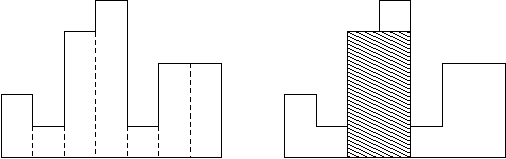
Usually, histograms are used to represent discrete distributions, e.g., the frequencies of characters in texts. Note that the order of the rectangles, i.e., their heights, is important. Calculate the area of the largest rectangle in a histogram that is aligned at the common base line, too. The figure on the right shows the largest aligned rectangle for the depicted histogram.
Usually, histograms are used to represent discrete distributions, e.g., the frequencies of characters in texts. Note that the order of the rectangles, i.e., their heights, is important. Calculate the area of the largest rectangle in a histogram that is aligned at the common base line, too. The figure on the right shows the largest aligned rectangle for the depicted histogram.
Input
The input contains several test cases. Each test case describes a histogram and starts with an integer n, denoting the number of rectangles it is composed of. You may assume that 1<=n<=100000. Then follow n integers h1,...,hn,
where 0<=hi<=1000000000. These numbers denote the heights of the rectangles of the histogram in left-to-right order. The width of each rectangle is 1. A zero follows the input for the last test case.
Output
For each test case output on a single line the area of the largest rectangle in the specified histogram. Remember that this rectangle must be aligned at the common base line.
Sample Input
7 2 1 4 5 1 3 3
4 1000 1000 1000 1000
0
Sample Output
8
4000
tips:
单调栈
思路:
| index | 0 | 1 | 2 | 3 | 4 | 5 | 6 | 7 | 8 |
| height | 0 | 2 | 1 | 4 | 5 | 1 | 3 | 3 | 0 |
| 栈内容(上面栈底) | (0,0) | (0,0) (2,1) | (0,0) (1,1) | (0,0) (1,1) (4,3) | (0,0) (1,1) (4,3) (5,4) | (0,0) (1,1) (1,3) | (0,0) (1,1) (1,3) (3,6) | (0,0) (1,1) (1,3) (3,6) (3,7) |
代码:
#include <stdio.h>
#include <stack>
using namespace std;

struct SNode{
	long long height;
	int startIdx;
	SNode(long long h, int idx):height(h), startIdx(idx){}
};

long long heightArr[100000];

long long getMaxArea(int num){
	long long maxArea = 0;
	stack<SNode> stk;
	stk.push(SNode(0, 0));

	for(int i = 0; i <= num; i++){
		long long curh = 0;
		if(i < num){
			curh = heightArr[i];
		}
		int curStartIdx = i + 1;
		while(curh < stk.top().height){
			SNode t = stk.top();
			curStartIdx = t.startIdx;
			long long curArea = t.height * (i + 1 - t.startIdx);
			if(curArea > maxArea) maxArea = curArea;
			stk.pop();
		}
		stk.push(SNode(curh, curStartIdx));
	}
	return maxArea;
}

int main(){
	int num;
	while(scanf("%d", &num) != EOF && num){
		for(int i=0; i< num; i++){
			scanf("%lld", heightArr + i);
		}
		printf("%lld\n", getMaxArea(num));
	}
	return 0;
}





 扫一扫
扫一扫


 658
658

 被折叠的 条评论
为什么被折叠?
被折叠的 条评论
为什么被折叠?
 到【灌水乐园】发言





