


 本文深入解析了Java编译器中使用的访问者模式,详细介绍了JCTree.Visitor接口及其在javac中的应用。从Enter、MemberEnter到Attr等阶段,访问者模式如何遍历语法树,实现语法节点的处理和转换。
这一篇重点来总结下javac的访问者模式,其定义的访问者接口为JCTree.Visitor,具体如下:
 /** A generic visitor class for trees.
     */
    public static abstract class Visitor {
        public void visitTopLevel(JCCompilationUnit that)    { visitTree(that); }
        public void visitImport(JCImport that)               { visitTree(that); }
        public void visitClassDefinition(JCClassDeclaration that)          { visitTree(that); }
        public void visitMethodDefinition(JCMethodDeclaration that)        { visitTree(that); }
        public void visitVariableDefinition(JCVariableDeclaration that)         { visitTree(that); }
        public void visitSkip(JCSkip that)                   { visitTree(that); }
        public void visitBlock(JCBlock that)                 { visitTree(that); }
        public void visitDoLoop(JCDoWhileLoop that)          { visitTree(that); }
        public void visitWhileLoop(JCWhileLoop that)         { visitTree(that); }
        public void visitForLoop(JCForLoop that)             { visitTree(that); }
        public void visitForeachLoop(JCEnhancedForLoop that) { visitTree(that); }
        public void visitLabelled(JCLabeledStatement that)   { visitTree(that); }
        public void visitSwitch(JCSwitch that)               { visitTree(that); }
        public void visitCase(JCCase that)                   { visitTree(that); }
        public void visitSynchronized(JCSynchronized that)   { visitTree(that); }
        public void visitTry(JCTry that)                     { visitTree(that); }
        public void visitCatch(JCCatch that)                 { visitTree(that); }
        public void visitConditional(JCConditional that)     { visitTree(that); }
        public void visitIf(JCIf that)                       { visitTree(that); }
        public void visitExec(JCExpressionStatement that)    { visitTree(that); }
        public void visitBreak(JCBreak that)                 { visitTree(that); }
        public void visitContinue(JCContinue that)           { visitTree(that); }
        public void visitReturn(JCReturn that)               { visitTree(that); }
        public void visitThrow(JCThrow that)                 { visitTree(that); }
        public void visitAssert(JCAssert that)               { visitTree(that); }
        public void visitApply(JCMethodInvocation that)      { visitTree(that); }
        public void visitNewClass(JCNewClass that)           { visitTree(that); }
        public void visitNewArray(JCNewArray that)           { visitTree(that); }
        public void visitParenthesis(JCParenthesis that)               { visitTree(that); }
        public void visitAssign(JCAssignment that)               { visitTree(that); }
        public void visitAssignOperator(JCAssignOperator that)           { visitTree(that); }
        public void visitUnary(JCUnary that)                 { visitTree(that); }
        public void visitBinary(JCBinary that)               { visitTree(that); }
        public void visitTypeCast(JCTypeCast that)           { visitTree(that); }
        public void visitTypeTest(JCInstanceOf that)         { visitTree(that); }
        public void visitIndexed(JCArrayAccess that)         { visitTree(that); }
        public void visitSelect(JCFieldAccess that)          { visitTree(that); }
        public void visitIdentifier(JCIdentifier that)                 { visitTree(that); }
        public void visitLiteral(JCLiteral that)             { visitTree(that); }
        public void visitTypeIdentifier(JCPrimitiveTypeTree that) { visitTree(that); }
        public void visitTypeArray(JCArrayTypeTree that)     { visitTree(that); }
        public void visitTypeApply(JCTypeApply that)         { visitTree(that); }
        public void visitTypeUnion(JCTypeUnion that)         { visitTree(that); }
        public void visitTypeParameter(JCTypeParameter that) { visitTree(that); }
        public void visitWildcard(JCWildcard that)           { visitTree(that); }
        public void visitTypeBoundKind(TypeBoundKind that)   { visitTree(that); }
        public void visitAnnotation(JCAnnotation that)       { visitTree(that); }
        public void visitModifiers(JCModifiers that)         { visitTree(that); }
        public void visitErroneous(JCErroneous that)         { visitTree(that); }
        public void visitLetExpr(LetExpression that)               { visitTree(that); }
        public void visitTree(JCTree that)                   { Assert.error(); }
    }
在从Java源代码生成class类的过程中,主要经历的过程
其中实现这个接口的类有:
(1)Enter

visitTree(JCTree)方法是一个空实现,说明了Enter类只处理JCCompilationUnit,JCClassDeclaration和TypeParameter语法节点。
(2)MemberEnter
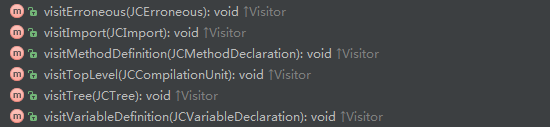
visitTree(JCTree)方法同样是一个空实现 ,主要处理的语法节点为JCCompilationUnit,JCImport,JCMethodDeclaration与JCVariableDeclaration语法节点。
(3)Attr
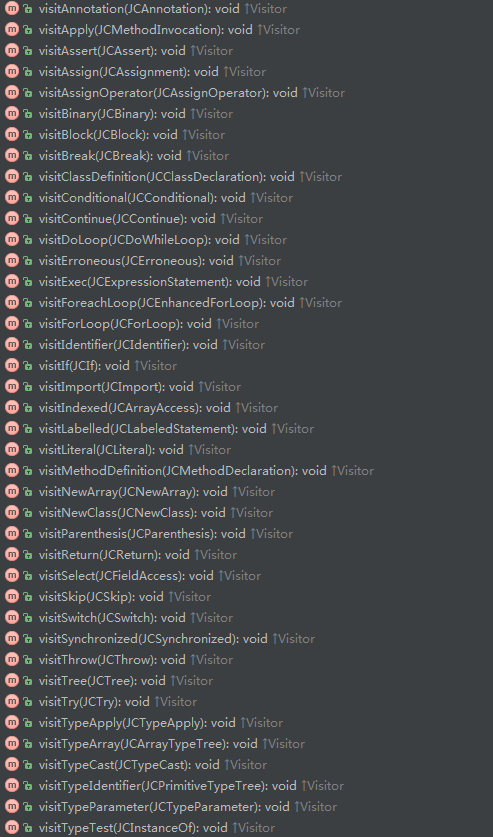
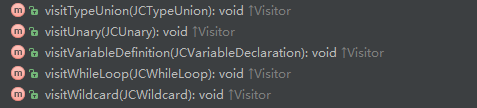
在Attr中开始对各个语法节点进行了标记。
(4)TreeScanner(Flow继承实现了 TreeScanner)
这个类就是对各个语法节点进行简单的遍历实现,遍历某个语法节点下的方法如下:
  /** Visitor method: Scan a single node.
     */
    public void scan(JCTree tree) {
        if(tree!=null){
            tree.accept(this);
        }
    }

    /** Visitor method: scan a list of nodes.
     */
    public void scan(List<? extends JCTree> trees) {
        if (trees != null){
            for (List<? extends JCTree> l = trees; l.nonEmpty(); l = l.tail){
                scan(l.head);
            }
        }
    }
继承这个类进行实现的一些类主要有Flow,还有一些内部类和匿名类。
(5)TreeTranslator
直接继承了这个类的有
1、TranslateTypes This pass translates Generic Java to conventional Java
2、Lower This pass translates away some syntactic sugar: inner classes,class literals, assertions, foreach loops, etc.
主要的实现如下:
public class TreeTranslator extends JCTree.Visitor {

    /** Visitor result field: a tree
     */
    protected JCTree result;

    /** Visitor method: Translate a single node.
     */
    @SuppressWarnings("unchecked")
    public <T extends JCTree> T translate(T tree) {
        if (tree == null) {
            return null;
        } else {
            tree.accept(this);
            JCTree result = this.result;
            this.result = null;
            return (T)result; // XXX cast
        }
    }

    /** Visitor method: translate a list of nodes.
     */
    public <T extends JCTree> List<T> translate(List<T> trees) {
        if (trees == null){
            return null;
        }
        for (List<T> l = trees; l.nonEmpty(); l = l.tail) {
            l.head = translate(l.head);
        }
        return trees;
    }

    /**  Visitor method: translate a list of variable definitions.
     */
    public List<JCVariableDeclaration> translateVarDefs(List<JCVariableDeclaration> trees) {
        for (List<JCVariableDeclaration> l = trees; l.nonEmpty(); l = l.tail)
            l.head = translate(l.head);
        return trees;
    }

    /**  Visitor method: translate a list of type parameters.
     */
    public List<JCTypeParameter> translateTypeParams(List<JCTypeParameter> trees) {
        for (List<JCTypeParameter> l = trees; l.nonEmpty(); l = l.tail)
            l.head = translate(l.head);
        return trees;
    }

    /**  Visitor method: translate a list of case parts of switch statements.
     */
    public List<JCCase> translateCases(List<JCCase> trees) {
        for (List<JCCase> l = trees; l.nonEmpty(); l = l.tail)
            l.head = translate(l.head);
        return trees;
    }

    /**  Visitor method: translate a list of catch clauses in try statements.
     */
    public List<JCCatch> translateCatchers(List<JCCatch> trees) {
        for (List<JCCatch> l = trees; l.nonEmpty(); l = l.tail)
            l.head = translate(l.head);
        return trees;
    }

    /**  Visitor method: translate a list of catch clauses in try statements.
     */
    public List<JCAnnotation> translateAnnotations(List<JCAnnotation> trees) {
        for (List<JCAnnotation> l = trees; l.nonEmpty(); l = l.tail)
            l.head = translate(l.head);
        return trees;
    }

   // Visitor Method省略

}
(6)Gen
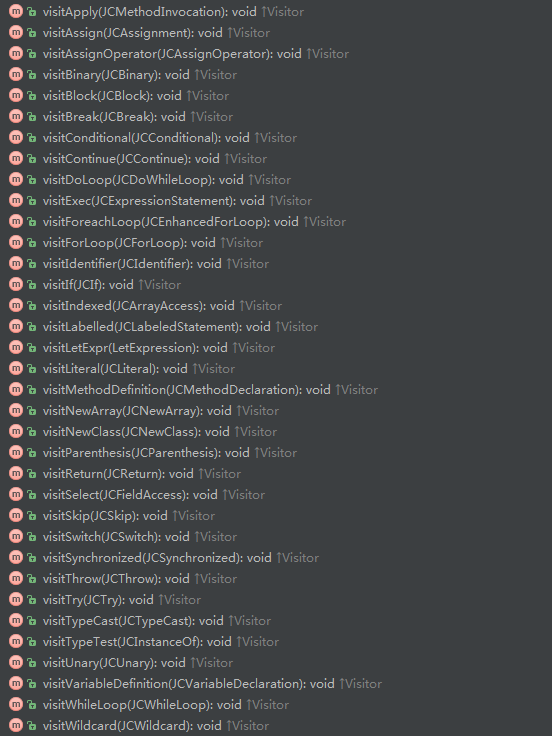
生成最终的class类时需要访问的一些语法节点。
(7)Type.Visitor<R, S>, Symbol.Visitor<String, Locale>
类型Type中定义的访问者模式:
 /**
     * A visitor for types.  A visitor is used to implement operations
     * (or relations) on types.  Most common operations on types are
     * binary relations and this interface is designed for binary
     * relations, that is, operations on the form
     * Type × S → R.
     * <!-- In plain text: Type x S -> R -->
     *
     * @param <R> the return type of the operation implemented by this
     * visitor; use Void if no return type is needed.
     * @param <S> the type of the second argument (the first being the
     * type itself) of the operation implemented by this visitor; use
     * Void if a second argument is not needed.
     */
    public interface Visitor<R,S> {
        R visitClassType(ClassType t, S s);
        R visitWildcardType(WildcardType t, S s);
        R visitArrayType(ArrayType t, S s);
        R visitMethodType(MethodType t, S s);
        R visitPackageType(PackageType t, S s);
        R visitTypeVar(TypeVar t, S s);
        R visitCapturedType(CapturedType t, S s);
        R visitForAll(ForAll t, S s);
        R visitUndeterminedVar(UndeterminedVar t, S s);
        R visitErrorType(ErrorType t, S s);
        R visitType(Type t, S s);
    }
符号类中定义的访问者模式接口如下:
/**
     * A visitor for symbols.  A visitor is used to implement operations
     * (or relations) on symbols.  Most common operations on types are
     * binary relations and this interface is designed for binary
     * relations, that is, operations on the form
     * Symbol × P → R.
     * <!-- In plain text: Type x P -> R -->
     *
     * @param <R> the return type of the operation implemented by this
     * visitor; use Void if no return type is needed.
     * @param <P> the type of the second argument (the first being the
     * symbol itself) of the operation implemented by this visitor; use
     * Void if a second argument is not needed.
     */
    public interface Visitor<R,P> {
        R visitClassSymbol(ClassSymbol s, P arg);
        R visitMethodSymbol(MethodSymbol s, P arg);
        R visitPackageSymbol(PackageSymbol s, P arg);
        R visitOperatorSymbol(OperatorSymbol s, P arg);
        R visitVarSymbol(VarSymbol s, P arg);
        R visitTypeSymbol(TypeSymbol s, P arg);
        R visitSymbol(Symbol s, P arg);
    }
(8)TreePretty
剩下的(5)和(6)对定义出的visitorXXX()方法都有实现。





 扫一扫
扫一扫


 3532
3532

 被折叠的 条评论
为什么被折叠?
被折叠的 条评论
为什么被折叠?
 到【灌水乐园】发言





