


Multi-modal系列论文研读目录
第一篇:《Elevating Fake News Detection Through Deep Neural Networks, Encoding Fused Multi-Modal Features》
文章目录
1.论文题目含义
通过深度神经网络、编码融合的多模态特征提升假新闻检测
2.ABSTRACT(摘要)
Textual content was initially the main focus of traditional methods for detecting fake news,and these methods have yielded appointed results. However, with the exponential growth of social media platforms, there has been a significant shift towards visual content. Consequently, traditional detection methods have become inadequate for completely detecting fake news. This paper proposes a model for detecting fake news using multi-modal features. The model involves feature extraction, feature fusion, dimension reduction, and classification as its main processes. To extract various textual features, a pre-trained BERT, gated recurrent unit (GRU), and convolutional neural network (CNN) are utilized. For extracting image features, ResNet-CBAM is used, followed by the fusion of multi-type features. The dimensionality of fused features is reduced using an auto-encoder, and the FLN classifier is then applied to the encoded features to detect instances of fake news. Experimental findings on two multi-modal datasets, Weibo and Fakeddit, demonstrate that the proposed model effectively detects fake news from multi-modal data, achieving 88% accuracy with Weibo and 98% accuracy with Fakeddit. This shows that the proposed model is preferable to previous works and more effective with the large dataset.
翻译:文本内容是最初的传统方法检测假新闻的主要焦点,这些方法已经取得了指定的结果。然而,随着社交媒体平台的指数增长,视觉内容已经发生了重大转变。因此,传统的检测方法已经不足以完全检测假新闻。提出了一种基于多模态特征的虚假新闻检测模型。该模型包括特征提取、特征融合、降维和分类等主要过程。为了提取各种文本特征,使用了预训练的BERT,门控递归单元(GRU)和卷积神经网络(CNN)。对于图像特征的提取,使用ResNet-CBAM,其次是多种类型的特征的融合。使用自动编码器降低融合特征的维度,然后将FLN分类器应用于编码特征以检测假新闻的实例。在微博和Fakeddit两个多模态数据集上的实验结果表明,该模型可以有效地从多模态数据中检测假新闻,微博的准确率达到88%,Fakeddit的准确率达到98%。这表明,该模型是优于以前的作品,更有效的大数据集。
3.INDEX TERMS(索引词)
Social media platforms, fake news detection, multi-model features, deep learning, fusion,auto-encoder, dimensionality reduction.
社交媒体平台,假新闻检测,多模型特征,深度学习,融合,自动编码器,降维。
4.INTRODUCTION(引言)
-
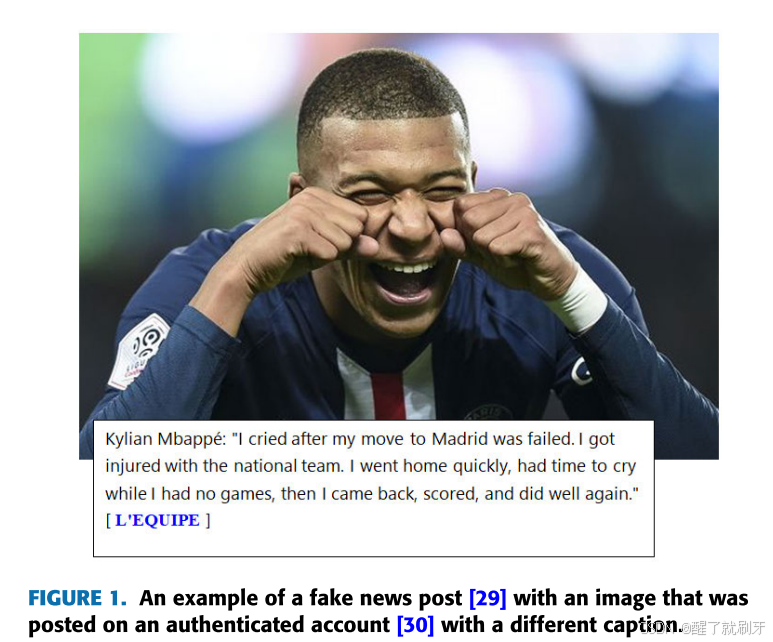
In today’s digital age, the rapid spread of information through social media and online platforms has revolutionized how we consume news. However, this exceptional proliferation of information has simultaneously facilitated the propagation of disinformation, thereby developing the prevalent issue of bogus news. Fake news consists of intentionally contrived or misleading information that is presented as authentic news, intending to deceive and manipulate public sentiment or profit, and exploiting the followers of establishments that have a large fan base through the distribution of this misinformation. For example, Kylian Mbappe’s fake contract, as shown in Figure 1. The proliferation of fake news poses significant challenges to society, affecting political discourse, and public perception, and even influencing critical decision-making processes. For example, there were numerous fabrications in the wake of the 2020 U.S. presidential election. Many voters who were preoccupied with election news erroneously believed that election fraud had occurred, with 40 percent ofthem preserving that Biden’s election was illegal [1]. As the impact of fake news continues to grow, there is an urgent need to develop robust and reliable methods for its detection.在当今的数字时代,信息通过社交媒体和在线平台的快速传播彻底改变了我们消费新闻的方式。然而,这种信息的异常扩散同时也促进了虚假信息的传播,从而形成了虚假新闻的普遍问题。假新闻包括故意人为或误导性的信息,这些信息被呈现为真实的新闻,意图欺骗和操纵公众情绪或利润,并通过传播这些错误信息来利用拥有大量粉丝基础的机构的追随者。例如,Kylian Mbappe的假合同,如图1所示。假新闻的泛滥对社会构成了重大挑战,影响了政治。负责协调本稿审查并批准出版的副主编是张建康。话语和公众的看法,甚至影响关键的决策过程。例如,在2020年美国总统大选之后有许多捏造。许多专注于选举新闻的选民错误地认为发生了选举舞弊,其中40%的人认为拜登的选举是非法的。随着假新闻的影响不断扩大,迫切需要开发强大且可靠的检测方法。
-
Fake news detection (FND) is an interdisciplinary domainthat combines expertise in natural language processing(NLP), machine learning (ML), data analysis, and medialiteracy. The primary goal is to identify and distinguishbetween legitimate news articles and fabricated, misleading,or biased content.假新闻检测(FND)是一个跨学科领域,结合了自然语言处理(NLP),机器学习(ML),数据分析和媒体素养的专业知识。主要目标是识别和区分合法的新闻文章和捏造的,误导性的或有偏见的内容。
-
ML algorithms play a pivotal role in fake news detection,leveraging vast amounts of labeled data to learn patterns and features that distinguish between trustworthy and deceptive information [2]. These algorithms can analyze textual content, metadata, user behavior, and the source’s credibility to make informed judgments about the veracity of news articles. Moreover, with the advancement ofdeep learning techniques, researchers and practitioners are continually developing sophisticated models capable of handling the dynamic and evolving nature of fake news. Deep neural networks can automatically extract complex patterns, enabling the detection ofsubtle linguistic cues and context-specific signals that might indicate the presence of fake news. Despite the ongoing efforts, FND remains a challenging task due to the adaptive tactics employed by misinformation propagators. The detection process needs to be agile, able to adjust and improve as new forms of misinformation emerge. In this pursuit, collaboration between academia, industry, and policymakers is vital to developing comprehensive strategies and systems to combat the fake news epidemic effectively. By implementing effective detection techniques and media literacy advertisements, we can enable individuals to evaluate information critically and foster a society that is better informed and more resilient to the threats posed by misinformation.ML算法在假新闻检测中发挥着关键作用,它利用大量标记数据来学习区分可信信息和欺骗性信息的模式和特征[2]。这些算法可以分析文本内容、元数据、用户行为和来源的可信度,从而对新闻文章的真实性做出明智的判断。此外,随着深度学习技术的进步,研究人员和从业人员正在不断开发能够处理假新闻动态和不断变化性质的复杂模型。深度神经网络可以自动提取复杂的模式,从而能够检测到可能表明假新闻存在的微妙语言线索和特定于上下文的信号。尽管正在进行的努力,FND仍然是一个具有挑战性的任务,由于自适应策略采用的错误信息传播者。检测过程需要灵活,能够随着新形式的错误信息的出现而进行调整和改进。在这一过程中,学术界、产业界和政策制定者之间的合作对于制定全面的战略和系统以有效打击假新闻流行至关重要。通过实施有效的检测技术和媒体素养广告,我们可以使个人能够批判性地评估信息,并促进一个更好地了解和更能抵御错误信息所带来对社会的威胁。
-
In this research paper, we delve into the techniques, methodologies, and challenges associated with FND. We explore the latest advancements in ML and NLP, discussing how these technologies can be harnessed to protect the integrity of information in the digital era. By understanding the landscape of fake news and the tools for its identification, we take a significant step toward fostering a more trustworthy and reliable information ecosystem. This paper is composed of multi-type feature extracting modules and a feature fusion module, then adopts an attention mechanism to reduce the dimensionality of fusion features. The feature extraction modules include text feature extractors and a visual feature extractor.在这篇研究论文中,我们深入研究了与FND相关的技术,方法和挑战。我们探索ML和NLP的最新进展,讨论如何利用这些技术来保护数字时代的信息完整性。通过了解假新闻及其识别工具的情况,我们朝着建立一个更值得信赖和可靠的信息生态系统迈出了重要的一步。该方法由多类特征提取模块和特征融合模块组成,并采用注意力机制对融合后的特征进行降维。特征提取模块包括文本特征提取器和视觉特征提取器。
-
A pre-trained BERT module to extract contextual features, the deep neural network convolutional neural network (CNN) and a gated recurrent unit (GRU) to extract spatial and sequential features subsequently. ResNet-50 combined with the CBAM attention mechanism for extracting the visual feature. The concatenate module will fuse the text and image features to get fusion features. An auto-encoder reduces the dimensionality of fusion feature, then fed the reduction features into a fast learning network classifier to get detection results. The model integrates the features of multiple models more fully so that it can learn the deeper correlation between the models, which will be conducive to improving the performance of detection tasks. The main contributions of this paper are mentioned below: • Employed a novel stacked model of state-of-the-art multi-modal deep neural networks for efficiently classifying between fake and real news. • The deep learning ensemble model is proposed by leveraging the power of deep neural networks to extract multi-type features and then fuse these features. • Adopted structured multi-modal datasets that contain pairs of texts and images to get more features in order to elevate the fake news detection. • Dimensionality reduction of the fused feature via the auto-encoder to enhance the classifier results.预训练的BERT模块用于提取上下文特征,深度神经网络卷积神经网络(CNN)和门控递归单元(GRU)用于随后提取空间和顺序特征。ResNet-50结合CBAM注意机制进行视觉特征提取。拼接模块将文本特征和图像特征进行融合,得到融合特征。自动编码器对融合特征进行降维处理,然后将降维后的特征输入快速学习网络分类器,得到检测结果。该模型更充分地融合了多个模型的特征,能够更深层次地学习模型之间的相关性,有利于提高检测任务的性能。本文的主要贡献如下:(1)采用了最先进的多模态深度神经网络的新型堆叠模型,用于有效地对假新闻和真实的新闻进行分类。(2)深度学习集成模型通过利用深度神经网络的能力来提取多类型特征,然后融合这些特征。(3)采用包含文本和图像对的结构化多模态数据集,以获得更多特征,从而提高假新闻检测。(4)经由自动编码器的融合特征的模糊性降低以增强分类器结果。
-
The following parts of this work are structured as follows: A literature review has been provided in Section II. We have presented and discussed the materials and methodology of the proposed model in Section III. In Section IV
 最低0.47元/天 解锁文章






 扫一扫
扫一扫


 1066
1066

 被折叠的 条评论
为什么被折叠?
被折叠的 条评论
为什么被折叠?
 到【灌水乐园】发言





