POJ 1826 The Best Farm

【TCN回归预测】TCN时间卷积神经网络数据回归预测(多输入单输出)【含Matlab源码 2317期】 TCN时间卷积神经网络数据回归预测 完整的代码,方可运行;可提供运行操作视频!适合小白! 阅读详情
The Best Farm
Time Limit: 3000MS Memory Limit: 30000K
Total Submissions: 1519 Accepted: 455

Description

Background
In a fight against invaders, farmer William get the farmers all around the country together to help the king beat the invaders. So the king decided to award farmer William a great farm after the winning of the war.
Problem
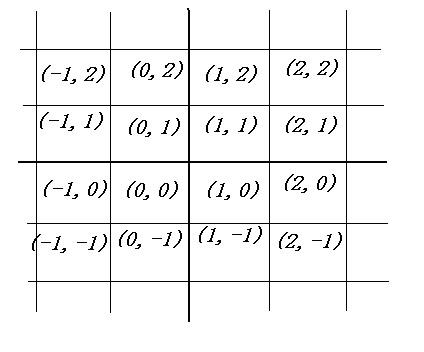
The king divides his country as a A*B grid and labels each 1*1 square with a pair of integers. Refer to the following picture as example:

Nevertheless, not all the squares are available. Some have been awarded to others, and some have been destroyed in the war. So the king only list the available 1*1 squares, and let farm William choose some from them. Meanwhile, William can’t choose all of the squares. He can only choose some of them, so that the squares can form a connected area, to build up his farm. A connected area is defined as following:
1. A connected area is made up of some 1*1 squares;
2. From any of these 1*1 squares, one can walk to any other 1*1 square belonged to this area without entering some square that is not in this area;
3. When standing in a square, one can walk into the adjacent squares in four directions: north, south, east, and west.
In addition, every square available has a value. William should choose to build up a farm (connected area) that is the most valuable. In other words, William should choose some of the square forming a connected area, in which the sum of the value of squares is the largest.
Your task in this problem is to find out the largest value.

Input

The input consists of several test cases. In the first line of each test case, there are one positive integers N (1<=N<=200000), indicating the number of available squares. The following N lines contain the information of the N squares, one per line. In one line, there are three integers x y v separated by one blank. (x, y) is the location of this square, and v is its value. All the x and y lie in the range of signed 16-bit integer. The value v is a nonnegative integer that is less than 10000. The test case starting with one zero is the final test case and has no output.

Output

For each test case, print your answer, the largest value with which William can build up his farm, in one line without any redundant spaces.

Sample Input

1
0 0 1
6
0 1 1
0 0 1
1 0 1
2 2 2
2 1 2
2 -1 1
0

Sample Output

1
4

Source

Atlas of rruucc@POJ


使用 Python 构建 Reddit 热帖爬虫:抓取热门讨论帖和评论 在现代互联网中,Reddit 被誉为全球最大、最活跃的讨论平台之一,汇聚了各种主题的帖子、评论和社交互动。因此,抓取 Reddit 上的热门帖子和评论可以为我们提供一个丰富的文本数据源,可以用于情感分析、话题建模、趋势分析等应用。Reddit 提供了官方的 API,可以让开发者获取包括帖子、评论、用户信息等在内的各种数据。我们可以结合上述方法,抓取多个热门帖子,并将每个帖子的标题、作者、发布时间和评论内容保存到一个数据结构中。每个帖子的对象包含了丰富的信息,如标题、内容、发布时间、作者等。 阅读详情

相关推荐

使用TEA5767和stm32制作一台数字FM收音机

本节我们来使用stm32控制一款集成收音机芯片TEA5767,来制作一台FM收音机。 TEA5767是一款低功耗立体声收音IC,接收频率76MHz~108MHz(适应日本/美国/欧洲各FM频段选择)并可以使用软件进行静音和消除噪音。 主要电性能指标:工作电压:2.5V~5.0V,工作电流10mA,立体声分离度30dB,信噪比60dB,输出信号电平75mV。支持I2C总线通信、3-wire总线。 1)硬件设计 TEA5767芯片外围需要搭配较多的电阻、电容、电感、晶振等器件,而且高频电路的PCB设

小白白学电子 1万+

Poj 1826 The Best Farm (floodfill + Hash)

题意:给出N个单位方块的坐标以及权值,求出其中所有四连通块中最大的权值和 思路:很基础的floodfill模型,就是这次坐标范围比较大,不能直接存。使用了hash来处理。网上还有排序等其他方法。 BFS速度较慢,1500ms左右,DFS 500ms左右 关于Hash时模值为什么选择素数这里有一篇分析,涨姿势了:为什么一般hashtable的桶数会取一个素数_罗自荣_新浪博客 #in

whyorwhnt的专栏 1439

Python数据分析案例——宏观经济指标与沪深指数实证研究分析

沪深300指数与宏观经济指标关联性研究:2015-2024实证分析 摘要:本文基于2015-2024年月度数据,采用多元回归方法分析宏观经济指标对沪深300指数的影响。研究发现,市场情绪(SEN)、美国利率(STY)、美元指数(DXY)、狭义货币供应量(M1)和CPI对指数具有显著解释力(P<0.05),而GDP、LPR等传统指标影响不显著。模型解释力达62%(R²=0.62),表明A股短期走势更受资金流动、投资者心理和国际金融条件驱动。研究为投资者提供了除基本面外的市场预判指标,建议关注M1增速、美

weixin_50902344的博客 1404

POJ 1826 The Best Farm 笔记

A * B的土地,坐标如图。有N块荒地,挑选出上下左右连续的一片,已知每块荒地坐标和价值。求总价值最高的一片荒地。

woniupengpeng的专栏 309

微信DAT图片解密全攻略:一键转换JPG/PNG/GIF

本文详细解析了微信电脑版中DAT图片的加密原理与存储路径,并提供了从定位文件到使用专业工具进行一键解密的完整操作指南。通过简单的步骤,用户可将加密的DAT文件无损还原为JPG、PNG或GIF格式,有效解决无法直接查看聊天图片的难题,同时兼顾了隐私清理与磁盘空间管理。

hill8的博客 1366

YOLOv8首发优化:遥感目标检测 | 专为低质量遥感图像设计的边缘 - 高斯聚合(EGA)模块,解决低空间分辨率、传感器噪声、目标模糊、低光照退化和部分遮挡等限制

一种轻量级网络,其创新性地整合了专为低质量遥感图像设计的边缘 - 高斯聚合(EGA)模块。

①答疑群聊服务;②YOLO大模型知识问答系统;③计算机视觉论文生成智能体; 492

POJ 3985 Knight's Problem bfs + 剪枝

题意:在无限大的棋盘上给定起点和终点的坐标,然后给定n(0 题解:bfs是肯定的,但是裸的bfs会T,可以想象任意一个最短步数形成的路径任意交换两个选择的向量形成的路径是不一样的,那么一定能找到在路径中离           l:(sx,sy)-> (tx,ty)直线最近的路径,所以只要找到这个路径即可,可以将所有背离起点终点和离 l 距离超过最大向量的点不入队,这样搜到

Uhh, call me zacky NOW!!! 2506

一文快速教你如何下载国自然模版

5. 成功进入“相关文件查看”页面后,点击左侧的“项目申请文件“,如果你此次申请的是“面上项目”,选择对应的下拉框,找到对应的模版下载即可。6. 🫑们发现,在当前页面点击“青年科学基金项目”,左侧出现的是“原国家杰出青年科学基金项目”。7. 进入下一页后,点击“青年科学基金项目”,便可以在右侧找到🫑们要找的模版啦。2. 成功登陆后,点击1处的“首页”,在首页界面,再点击2处的“项目批准”。8. 点击上图3处的“文件详情”,就可以找到可以下载的模版啦(如下图)。3. 从“项目批准”进入后,点击“管理”。

薰珞婷紫小亭子的博客 2400

poj 2018_Best Cow Fences (求数列中一个字段和最大问题,字段的长度不小于L)

想要理解这个问题我们需要先掌握几个要点: 1、对于一个序列,求一个字段它的和最大,没有“长度不小于L的限制”问题。 问题分析见:https://blog.csdn.net/qq_35937273/article/details/82799942 2、对于一个序列,求一个字段它的和最大,字段的长度不小于L的问题。 字段和可以转化成为前缀和相减的形式,也就是说sumi=(a1+a2+...+a...

Lacon的BOKO 817

基于STM32的浴室环境智能控制系统设计

摘要:本文设计了一款基于STM32F103的智能卫浴系统,通过多传感器协同检测浴室环境参数。系统采用DS18B20检测环境与卫浴温度,DHT11监测湿度,MQ-135检测空气质量,光敏电阻测量光照强度,D203S人体热释电模块检测人员存在。当检测到异常参数时,系统自动启动相应调节功能:温度异常时控制加热/制冷继电器,湿度过高时启动通风除湿,空气质量差时进行换气,光照不足且有人时自动开灯。系统支持按键、蓝牙APP和语音三种控制方式,可手动设置参数阈值、切换防雾模式、控制音乐播放等功能。实验结果表明,该系统能有

3254968421的博客 485

低功耗边缘设备部署指南:YOLO26 INT8量化与TensorRT加速全流程

将YOLO26 INT8部署到低功耗边缘设备,核心原则是“校准为王、敏感层精准回退、端到端验证”。校准集≥500张,来自真实推理场景,未经训练增强校准集预处理与推理pipeline逐行对齐trtexec命令必带--fp16作为fallback量化后用polygraphy定位敏感层,而非盲猜仅回退必要层(通常2-3个),保留INT8收益在真实部署场景测试集上验证mAP,不以COCO为准C++部署使用异步推理+双缓冲nsys profiling确认无传输瓶颈。

专注于Python爬虫开发,分享爬虫技巧、项目实战与反爬经验,使用Scrapy、BeautifulSoup等工具,解决数据抓取难题。 213

URAL 1826 Minefield

题目链接:UGAL 1826 Minefield 算是个想法题吧,问了别人才做出来。

fobdddf的专栏 777

【数据集】全球陆地表面反照率Albedo

【数据集】全球陆地表面反照率Albedo

WW、forever的博客 1454

GOOGLE的一道笔试题—求给定连通无环无向图可以生成的最小高度树

/*最近看到一道谷歌笔试题,“已知一颗无向无环连通图T的所有顶点和边的信息,现需要将其转换为一棵树,要求树的深度最小,请设计一个算法找到所有满足要求的树的根结点,并分析时空复杂度(描述算法即可,无需代码)”其实就是给定一个无向连通图,求以哪些顶点为根可以得到深度最小的树,思路比较简单,主要有两个步骤:(1)首先选取1号结点作为树根,进行一遍DFS,在DFS时计算每个节点

bobten2008的专栏 3707

深度学习工具包 DeepLearningToolbox

深度学习工具包Deprecation notice.-----This toolbox is outdated and no longer maintained.There are much better tools available for deep learning than this toolbox, e.g. [Theano](http://deeplearning.net/software/theano/), [torch](http://torch.ch/) or [tensorflow](http://www.tensorflow.org/)I would suggest you use one of the tools mentioned above rather than use this toolbox.Best, Rasmus.DeepLearnToolbox================A Matlab toolbox for Deep Learning.Deep Learning is a new subfield of machine learning that focuses on learning deep hierarchical models of data.It is inspired by the human brain's apparent deep (layered, hierarchical) architecture.A good overview of the theory of Deep Learning theory is[Learning Deep Architectures for AI](http://www.iro.umontreal.ca/~bengioy/papers/ftml_book.pdf)For a more informal introduction, see the following videos by Geoffrey Hinton and Andrew Ng.* [The Next Generation of Neural Networks](http://www.youtube.com/watch?v=AyzOUbkUf3M) (Hinton, 2007)* [Recent Developments in Deep Learning](http://www.youtube.com/watch?v=VdIURAu1-aU) (Hinton, 2010)* [Unsupervised Feature Learning and Deep Learning](http://www.youtube.com/watch?v=ZmNOAtZIgIk) (Ng, 2011)If you use this toolbox in your research please cite [Prediction as a candidate for learning deep hierarchical models of data](http://www2.imm.dtu.dk/pubdb/views/publication_details.php?id=6284)```@MASTERSTHESIS\{IMM2012-06284, author = "R. B. Palm", title = "Prediction as a candidate for learning deep hierarchical models of data", year = "2012",}```Contact: rasmusbergpalm at gmail dot comDirectories included in the toolbox-----------------------------------`NN/` - A library for Feedforward Backpropagation Neural Networks`CNN/` - A library for Convolutional Neural Networks`DBN/` - A library for Deep Belief Networks`SAE/` - A library for Stacked Auto-Encoders`CAE/` - A library for Convolutional Auto-Encoders`util/` - Utility functions used by the libraries`data/` - Data used by the examples`tests/` - unit tests to verify toolbox is workingFor references on each library check REFS.mdSetup-----1. Download.2. addpath(genpath('DeepLearnToolbox'));Example: Deep Belief Network---------------------```matlabfunction test_example_DBNload mnist_uint8;train_x = double(train_x) / 255;test_x = double(test_x) / 255;train_y = double(train_y);test_y = double(test_y);%% ex1 train a 100 hidden unit RBM and visualize its weightsrand('state',0)dbn.sizes = [100];opts.numepochs = 1;opts.batchsize = 100;opts.momentum = 0;opts.alpha = 1;dbn = dbnsetup(dbn, train_x, opts);dbn = dbntrain(dbn, train_x, opts);figure; visualize(dbn.rbm{1}.W'); % Visualize the RBM weights%% ex2 train a 100-100 hidden unit DBN and use its weights to initialize a NNrand('state',0)%train dbndbn.sizes = [100 100];opts.numepochs = 1;opts.batchsize = 100;opts.momentum = 0;opts.alpha = 1;dbn = dbnsetup(dbn, train_x, opts);dbn = dbntrain(dbn, train_x, opts);%unfold dbn to nnnn = dbnunfoldtonn(dbn, 10);nn.activation_function = 'sigm';%train nnopts.numepochs = 1;opts.batchsize = 100;nn = nntrain(nn, train_x, train_y, opts);[er, bad] = nntest(nn, test_x, test_y);assert(er < 0.10, 'Too big error');```Example: Stacked Auto-Encoders---------------------```matlabfunction test_example_SAEload mnist_uint8;train_x = double(train_x)/255;test_x = double(test_x)/255;train_y = double(train_y);test_y = double(test_y);%% ex1 train a 100 hidden unit SDAE and use it to initialize a FFNN% Setup and train a stacked denoising autoencoder (SDAE)rand('state',0)sae = saesetup([784 100]);sae.ae{1}.activation_function = 'sigm';sae.ae{1}.learningRate = 1;sae.ae{1}.inputZeroMaskedFraction = 0.5;opts.numepochs = 1;opts.batchsize = 100;sae = saetrain(sae, train_x, opts);visualize(sae.ae{1}.W{1}(:,2:end)')% Use the SDAE to initialize a FFNNnn = nnsetup([784 100 10]);nn.activation_function = 'sigm';nn.learningRate = 1;nn.W{1} = sae.ae{1}.W{1};% Train the FFNNopts.numepochs = 1;opts.batchsize = 100;nn = nntrain(nn, train_x, train_y, opts);[er, bad] = nntest(nn, test_x, test_y);assert(er < 0.16, 'Too big error');```Example: Convolutional Neural Nets---------------------```matlabfunction test_example_CNNload mnist_uint8;train_x = double(reshape(train_x',28,28,60000))/255;test_x = double(reshape(test_x',28,28,10000))/255;train_y = double(train_y');test_y = double(test_y');%% ex1 Train a 6c-2s-12c-2s Convolutional neural network %will run 1 epoch in about 200 second and get around 11% error. %With 100 epochs you'll get around 1.2% errorrand('state',0)cnn.layers = { struct('type', 'i') %input layer struct('type', 'c', 'outputmaps', 6, 'kernelsize', 5) %convolution layer struct('type', 's', 'scale', 2) %sub sampling layer struct('type', 'c', 'outputmaps', 12, 'kernelsize', 5) %convolution layer struct('type', 's', 'scale', 2) %subsampling layer};cnn = cnnsetup(cnn, train_x, train_y);opts.alpha = 1;opts.batchsize = 50;opts.numepochs = 1;cnn = cnntrain(cnn, train_x, train_y, opts);[er, bad] = cnntest(cnn, test_x, test_y);%plot mean squared errorfigure; plot(cnn.rL);assert(er<0.12, 'Too big error');```Example: Neural Networks---------------------```matlabfunction test_example_NNload mnist_uint8;train_x = double(train_x) / 255;test_x = double(test_x) / 255;train_y = double(train_y);test_y = double(test_y);% normalize[train_x, mu, sigma] = zscore(train_x);test_x = normalize(test_x, mu, sigma);%% ex1 vanilla neural netrand('state',0)nn = nnsetup([784 100 10]);opts.numepochs = 1; % Number of full sweeps through dataopts.batchsize = 100; % Take a mean gradient step over this many samples[nn, L] = nntrain(nn, train_x, train_y, opts);[er, bad] = nntest(nn, test_x, test_y);assert(er < 0.08, 'Too big error');%% ex2 neural net with L2 weight decayrand('state',0)nn = nnsetup([784 100 10]);nn.weightPenaltyL2 = 1e-4; % L2 weight decayopts.numepochs = 1; % Number of full sweeps through dataopts.batchsize = 100; % Take a mean gradient step over this many samplesnn = nntrain(nn, train_x, train_y, opts);[er, bad] = nntest(nn, test_x, test_y);assert(er < 0.1, 'Too big error');%% ex3 neural net with dropoutrand('state',0)nn = nnsetup([784 100 10]);nn.dropoutFraction = 0.5; % Dropout fraction opts.numepochs = 1; % Number of full sweeps through dataopts.batchsize = 100; % Take a mean gradient step over this many samplesnn = nntrain(nn, train_x, train_y, opts);[er, bad] = nntest(nn, test_x, test_y);assert(er < 0.1, 'Too big error');%% ex4 neural net with sigmoid activation functionrand('state',0)nn = nnsetup([784 100 10]);nn.activation_function = 'sigm'; % Sigmoid activation functionnn.learningRate = 1; % Sigm require a lower learning rateopts.numepochs = 1; % Number of full sweeps through dataopts.batchsize = 100; % Take a mean gradient step over this many samplesnn = nntrain(nn, train_x, train_y, opts);[er, bad] = nntest(nn, test_x, test_y);assert(er < 0.1, 'Too big error');%% ex5 plotting functionalityrand('state',0)nn = nnsetup([784 20 10]);opts.numepochs = 5; % Number of full sweeps through datann.output = 'softmax'; % use softmax outputopts.batchsize = 1000; % Take a mean gradient step over this many samplesopts.plot = 1; % enable plottingnn = nntrain(nn, train_x, train_y, opts);[er, bad] = nntest(nn, test_x, test_y);assert(er < 0.1, 'Too big error');%% ex6 neural net with sigmoid activation and plotting of validation and training error% split training data into training and validation datavx = train_x(1:10000,:);tx = train_x(10001:end,:);vy = train_y(1:10000,:);ty = train_y(10001:end,:);rand('state',0)nn = nnsetup([784 20 10]); nn.output = 'softmax'; % use softmax outputopts.numepochs = 5; % Number of full sweeps through dataopts.batchsize = 1000; % Take a mean gradient step over this many samplesopts.plot = 1; % enable plottingnn = nntrain(nn, tx, ty, opts, vx, vy); % nntrain takes validation set as last two arguments (optionally)[er, bad] = nntest(nn, test_x, test_y);assert(er < 0.1, 'Too big error');```[![Bitdeli Badge](https://d2weczhvl823v0.cloudfront.net/rasmusbergpalm/deeplearntoolbox/trend.png)](https://bitdeli.com/free "Bitdeli Badge")

SAP B1中文培訓教材_SDK

公司内部培训资料,对开发工具 ,DIAPI, UIAPI,Add-ON有详细解说

POJ 1143 Number Game

/*http://acm.pku.edu.cn/JudgeOnline/problem?id=1143 博弈论(DFS + 状态记忆表 + 位运算), 假定一个走的人是A,第二个走的人是B A在当前状态下一定能够取胜的条件是:当前状态下存在一个数字,对于当A取走 这个数字后的状态,B不管怎么取都得输(即B不能够绝对取胜)  有了上面的分析就很容易看出这是一道博弈题,最终会形

bobten2008的专栏 2922

最新的sdio 4.0 spec 协议标准 带书签 高清完整PDF版

Part-E1-SDIO-Specification-Ver4.00-Final-120220.pdf:最新的sdio 4.0 spec 协议标准 带书签 高清完整PDF版,包括SDIO 接口的外设,SDIO 接口官方协议等。

POJ 1639 Picnic Planning

 /*这题调得快吐血了,做得真辛苦这题主要就是求最小限度生成树,即给定一棵树,在某个节点上加上这个节点的最大度数,然后求一棵满足这样条件的树且最终的权值和最小。这道题就是在根节点Park上做度数限定,然后求最小限度生成树最小限度生成树的求法与MST(最小生成树密不可分)主要思路有以下几个步骤1)将根节点从图中去除掉2)对去除根节点的图求MST,注意这里去除根后的图可能是

bobten2008的专栏 1864

win10 跳过U8环境检测的IE WebControls.rar

win10 安装u8的时候 提示IE WebControls 不通过,这个工具可以欺骗u8的检查。 跳过U8环境检测的IE WebControls。提示导入失败后,重新检测通过。

POJ Dreisam Equations

DFS + 表达式求值,输入处理很恶心 #include #include #define MAX_N 100using namespace std;int exp[MAX_N + 1];int curExp[MAX_N + 1];int expLen, expVal, curVal;int opType[3] = {-1, -2, -6};bool

bobten2008的专栏 1586

POJ 1632 Vase collection

 Vase collectionTime Limit: 1000MS Memory Limit: 10000KTotal Submissions: 1536 Accepted: 552DescriptionMr Cheng is a collector of old Chinese porcelain, more spec

bobten2008的专栏 1517

POJ 1186 方程的解数

 方程的解数Time Limit: 15000MS Memory Limit: 128000KTotal Submissions: 4000 Accepted: 1339Case Time Limit: 5000MSDescription已知一个n元高次方程: 其中:x1, x2,...,xn是未知数

bobten2008的专栏 1425

POJ 1103 Maze

/* dfs判断环,建图需要技巧,图变成了三维的(h * w * 2)第三维的2用来表示一个格子被/或者/分 成的两块 核心就是判断环,但是由于这题特殊性使得判断环比较简单;利用分别遍历h * w * 2个点,遍历到的点 设置为visited, 当遇到遍历初始点时且这个初始点不是前驱则表示找到一条环 注意一定要判断是否是前驱,否则会产生判断错误*/#

bobten2008的专栏 1398

POJ 1635 Subway tree systems

 /*主要是根据输入串建树,然后对树DFS,重新获得一个排序后的01串。对两个输入串分别运用上述方法分别得到两个排序后的01串,如果两个串相等则same,否则different关键在于DFS时对子树返回的01串进行存储和排序,然后重组比如对于0100101100100111和0011000111010101,重组后分别变成:0001101100101101和0001110011

bobten2008的专栏 1385

POJ 1078

http://acm.pku.edu.cn/JudgeOnline/problem?id=1078这题是典型的DFS回溯题,主要意思是给定两个整数,要求分别对这两个数进行因子分解,因子必须是100以内且不能重复。问,这两个整数是否存在不相交的因子集,例如:24和12,分别可以分解为2 * 12, 3 * 4,所以存在;而49和343就不行了,49不能分解(否则有7重复了),343只

bobten2008的专栏 1382

POJ 2044 Weather Forecast

/*深度优先搜索,需要记忆状态,状态的记忆包括四个角到目前为止没有下雨的时间+云当前所在的位置+当前的天数,一开始写错了一个地方害我调了N久,最近为啥没状态*/#include #define MAX_N 370#define MAX_S 80000using namespace std;struct day{    int state;}day

bobten2008的专栏 1272

POJ 1816 Wild Words

/*http://acm.pku.edu.cn/JudgeOnline/problem?id=1816trie树下的DFS, 感觉非常好的一道题,能说明很多问题*/#include #include #define MAX_M 100000using namespace std;//输入的pattern数以及待匹配的单词数int pNum, strNum

bobten2008的专栏 1206

POJ 1128 Frame Stacking

/*http://acm.pku.edu.cn/JudgeOnline/problem?id=1128DFS回溯实现拓扑排序*/#include #include #include #include #define MAX_N 32#define MAX_L 26using namespace std;char mapv[MAX_N + 1][M

bobten2008的专栏 1104

POJ 1124 Oh, Those Achin' Feet

http://acm.pku.edu.cn/JudgeOnline/problem?id=1124/*    利用DFS回溯求所有最短路径(最短路径可能不止一条)    行走的时候只有当下一个点是终点或者下一点是街道时才可以继续走到下一个点    注意剪枝    注意entrance/exit不参与load,只有街道参与load,即最终结果里凡是非街道结点都要输出0   

bobten2008的专栏 1065
上一篇: POJ 1830 开关问题
下一篇: POJ 1811 Prime Test
bobten2008
博客等级 码龄18年 153粉丝 157原创
评论
成就一亿技术人!
拼手气红包6.0元
还能输入1000个字符
 
 条评论被折叠 查看
添加红包

请填写红包祝福语或标题

个

红包个数最小为10个

元

红包金额最低5元

当前余额3.43元 前往充值 >
需支付:10.00元
成就一亿技术人!
领取后你会自动成为博主和红包主的粉丝 规则
hope_wisdom
发出的红包
实付元
使用余额支付
点击重新获取
扫码支付
钱包余额 0

抵扣说明:

1.余额是钱包充值的虚拟货币,按照1:1的比例进行支付金额的抵扣。
2.余额无法直接购买下载,可以购买VIP、付费专栏及课程。

余额充值