



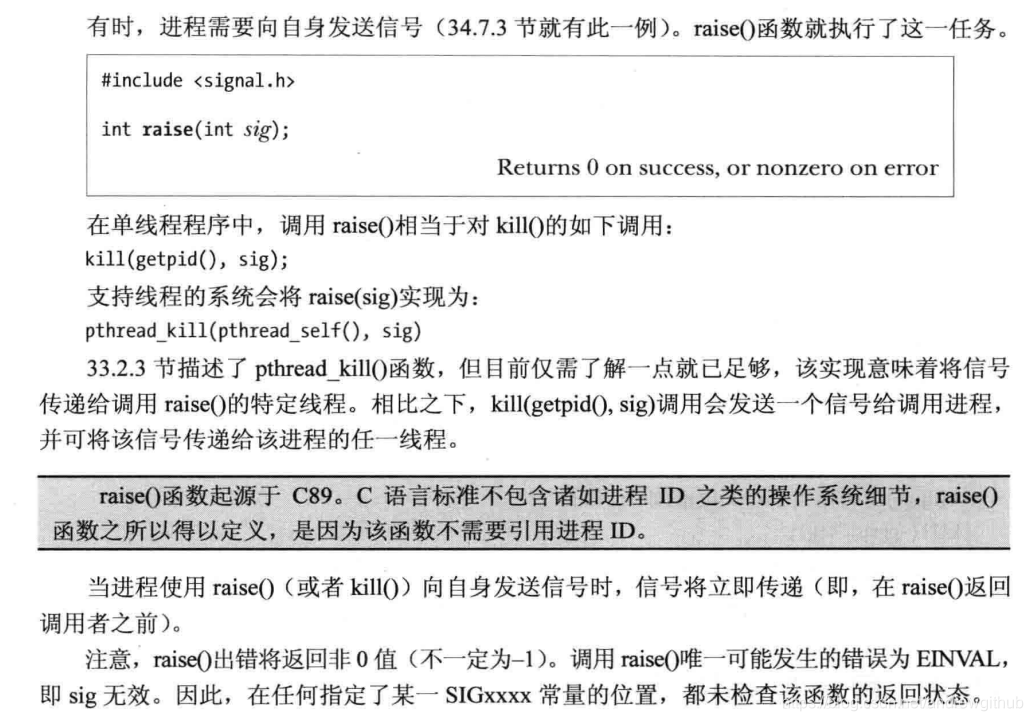
 本文介绍如何使用raise()函数在进程或线程中发送信号,以及使用kill()函数检查进程存在并发送信号的方法。在单线程程序中,raise()等同于kill(getpid(),sig),而在多线程程序中,它等同于pthread_kill(pthread_self(),sig)。此外,还提供了一个使用kill()函数发送信号并分析返回状态的示例。
NAME
       raise - send a signal to the caller

SYNOPSIS
       #include <signal.h>

       int raise(int sig);

DESCRIPTION
       The  raise()  function  sends  a signal to the calling process or thread.  In a
       single-threaded program it is equivalent to

           kill(getpid(), sig);

       In a multithreaded program it is equivalent to

           pthread_kill(pthread_self(), sig);

       If the signal causes a handler to be called, raise() will return only after the
       signal handler has returned.
使用kill()调用
/*************************************************************************\
* Copyright (C) Michael Kerrisk, 2018. *
* *
* This program is free software. You may use, modify, and redistribute it *
* under the terms of the GNU General Public License as published by the *
* Free Software Foundation, either version 3 or (at your option) any *
* later version. This program is distributed without any warranty. See *
* the file COPYING.gpl-v3 for details. *
\*************************************************************************/
/* Listing 20-3 */
/* t_kill.c
Send a signal using kill(2) and analyze the return status of the call.
*/
#include <signal.h>
#include "tlpi_hdr.h"
int
main(int argc, char *argv[])
{
int s, sig;
if (argc != 3 || strcmp(argv[1], "--help") == 0)
usageErr("%s pid sig-num\n", argv[0]);
sig = getInt(argv[2], 0, "sig-num");
s = kill(getLong(argv[1], 0, "pid"), sig);
if (sig != 0) {
if (s == -1)
errExit("kill");
} else { /* Null signal: process existence check */
if (s == 0) {
printf("Process exists and we can send it a signal\n");
} else {
if (errno == EPERM)
printf("Process exists, but we don't have "
"permission to send it a signal\n");
else if (errno == ESRCH)
printf("Process does not exist\n");
else
errExit("kill");
}
}
exit(EXIT_SUCCESS);
}
```\

显示信号描述





 扫一扫
扫一扫


 1740
1740

 被折叠的 条评论
为什么被折叠?
被折叠的 条评论
为什么被折叠?
 到【灌水乐园】发言





