






 本文详细介绍了Poisson方程的定义、特点及在物理学领域的广泛应用。着重阐述了解决带4个同质边界条件的方程的具体步骤,包括分离变量、边界条件转换、双线性方程组求解等关键环节。此外,还讨论了带有4个非同质边界条件的一般情况,通过分解问题、解决子问题和组合解决方案来求解。
Poisson Equation
Contents[hide] |
Poisson's Equation[edit]
Definition[edit]

Description[edit]
Appears in almost every field of physics.
Solution to Case with 4 Homogeneous Boundary Conditions[edit]
Let's consider the following example, where  and the Dirichlet boundary conditions are as follows:
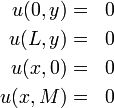
In order to solve this equation, let's consider that the solution to the homogeneous equation will allow us to obtain a system of basis functions that satisfy the given boundary conditions. We start with the Laplace equation: 
Step 1: Separate Variables[edit]
Consider the solution to the Poisson equation as  Separating variables as in the solution to the Laplace equation yields:


Step 2: Translate Boundary Conditions[edit]
As in the solution to the Laplace equation, translation of the boundary conditions yields:
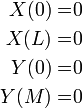
Step 3: Solve Both SLPs[edit]
Because all of the boundary conditions are homogeneous, we can solve both SLPs separately.


Step 4: Solve Non-homogeneous Equation[edit]
Consider the solution to the non-homogeneous equation as follows:
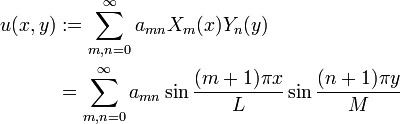
We substitute this into the Poisson equation and solve:
![\begin{align}F(x,y)& = u_{xx}+u_{yy} \\& = \sum_{m,n=0}^\infty \left \{ a_{mn}\left \lbrack -\frac{(m+1)^2\pi^2}{L^2} \right \rbrack \sin \frac{(m+1)\pi x}{L} \sin \frac{(n+1)\pi y}{M} \right \} +\left \{ a_{mn}\left \lbrack -\frac{(n+1)^2\pi^2}{M^2} \right \rbrack \sin \frac{(m+1)\pi x}{L} \sin \frac{(n+1)\pi y}{M} \right \} \\& = \sum_{m,n=0}^\infty \underbrace{\left [ -a_{mn} \left ( \frac{(m+1)^2\pi^2}{L^2}+\frac{(n+1)^2\pi^2}{M^2} \right ) \right ]}_{A_{mn}} \sin \frac{(m+1)\pi x}{L} \sin \frac{(n+1)\pi y}{M}\end{align}](http://upload.wikimedia.org/wikiversity/en/math/0/7/4/07408f441e6fc6895088fc6abecdce83.png)
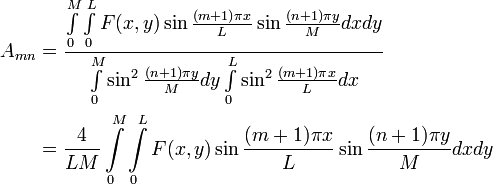
![a_{mn}=-\frac{4}{LM\left [ \frac{(m+1)^2\pi^2}{L^2} + \frac{(n+1)^2\pi^2}{M^2} \right ]}\int\limits_0^M \int \limits_0^L F(x,y) \sin \frac{(m+1)\pi x}{L} \sin \frac{(n+1)\pi y}{M} dx dy; m,n=0,1,2,\cdots](http://upload.wikimedia.org/wikiversity/en/math/a/8/6/a86e5fa0962705d94653ccbb92985b33.png)
Solution to General Case with 4 Non-homogeneous Boundary Conditions[edit]
Let's consider the following example, where and the boundary conditions are as follows:

The boundary conditions can be Dirichlet, Neumann or Robin type.
Step 1: Decompose Problem[edit]
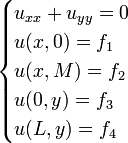
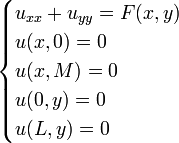
For the Poisson equation, we must decompose the problem into 2 sub-problems and use superposition to combine the separate solutions into one complete solution.
- The first sub-problem is the homogeneous Laplace equation with the non-homogeneous boundary conditions. The individual conditions must retain their type (Dirichlet, Neumann or Robin type) in the sub-problem:
- The second sub-problem is the non-homogeneous Poisson equation with all homogeneous boundary conditions. The individual conditions must retain their type (Dirichlet, Neumann or Robin type) in the sub-problem:
Step 2: Solve Subproblems[edit]
Depending on how many boundary conditions are non-homogeneous, the Laplace equation problem will have to be subdivided into as many sub-problems. The Poisson sub-problem can be solved just as described above.
Step 3: Combine Solutions[edit]
The complete solution to the Poisson equation is the sum of the solution from the Laplace sub-problem  and the homogeneous Poisson sub-problem
  :
:

来源: http://en.wikiversity.org/wiki/Poisson_Equation





 扫一扫
扫一扫


 393
393

 被折叠的 条评论
为什么被折叠?
被折叠的 条评论
为什么被折叠?
 到【灌水乐园】发言





