
package com.zs.boot.controller;

public class Employee implements Comparable<Employee>{

	private int id;
	private String name;
	private int age;
	private double salary;
	private Status status;

	public Employee() {
	}

	public Employee(String name) {
		this.name = name;
	}

	public Employee(String name, int age) {
		this.name = name;
		this.age = age;
	}

	public Employee(int id, String name, int age, double salary) {
		this.id = id;
		this.name = name;
		this.age = age;
		this.salary = salary;
	}

	public Employee(String name, int age, Status status) {
		this.name = name;
		this.age = age;
		this.status = status;
	}

	public Employee(String name, int age, double salary, Status status) {
		this.name = name;
		this.age = age;
		this.salary = salary;
		this.status = status;
	}

	public Employee(int id, String name, int age, double salary, Status status) {
		this.id = id;
		this.name = name;
		this.age = age;
		this.salary = salary;
		this.status = status;
	}

	public Employee(String name, int age, double salary) {
		this.name = name;
		this.age = age;
		this.salary = salary;
	}

	public Status getStatus() {
		return status;
	}

	public void setStatus(Status status) {
		this.status = status;
	}

	public int getId() {
		return id;
	}

	public void setId(int id) {
		this.id = id;
	}

	public String getName() {
		return name;
	}

	public void setName(String name) {
		this.name = name;
	}

	public int getAge() {
		return age;
	}

	public void setAge(int age) {
		this.age = age;
	}

	public double getSalary() {
		return salary;
	}

	public void setSalary(double salary) {
		this.salary = salary;
	}

	public String show() {
		return "测试方法引用!";
	}

	@Override
	public int hashCode() {
		final int prime = 31;
		int result = 1;
		result = prime * result + age;
		result = prime * result + id;
		result = prime * result + ((name == null) ? 0 : name.hashCode());
		long temp;
		temp = Double.doubleToLongBits(salary);
		result = prime * result + (int) (temp ^ (temp >>> 32));
		return result;
	}

	@Override
	public boolean equals(Object obj) {
		if (this == obj)
			return true;
		if (obj == null)
			return false;
		if (getClass() != obj.getClass())
			return false;
		Employee other = (Employee) obj;
		if (age != other.age)
			return false;
		if (id != other.id)
			return false;
		if (name == null) {
			if (other.name != null)
				return false;
		} else if (!name.equals(other.name))
			return false;
		if (Double.doubleToLongBits(salary) != Double.doubleToLongBits(other.salary))
			return false;
		return true;
	}

	@Override
	public String toString() {
		return "Employee [id=" + id + ", name=" + name + ", age=" + age + ", salary=" + salary + ", status=" + status
				+ "]";
	}

	@Override
	public int compareTo(Employee o) {
		if(String.valueOf(this.getAge()).equals(o.getAge())){
			return this.getName().compareTo(o.getName());
		}else{
			return String.valueOf(this.getAge()).compareTo(String.valueOf(o.getAge()));
		}
	}

	public enum Status {
		FREE, BUSY, VOCATION;
	}


}
package com.zs.boot.controller;

import org.junit.Test;

import java.util.*;
import java.util.stream.Collectors;

public class TestStream4API {

    List<Employee> employees = Arrays.asList(
            new Employee("刘德华",48,8000, Employee.Status.FREE),
            new Employee("刘德华1",18,8000, Employee.Status.FREE),
            new Employee("张学友",28,8500, Employee.Status.BUSY),
            new Employee("张学友1",38,8500, Employee.Status.BUSY),
            new Employee("黎明",45,6500, Employee.Status.VOCATION),
            new Employee("郭富城",51,5500, Employee.Status.FREE));

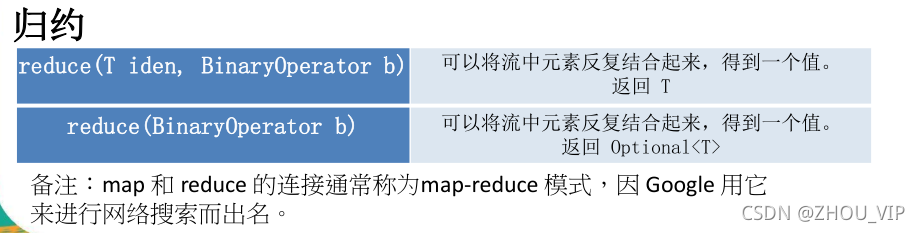
    //归约
    @Test
    public void test3() {
        List<Integer> list = Arrays.asList(1,2,3,4,5,6,7,8,9,10);
        Integer sum = list.stream().reduce(0,(x,y ) -> x + y);
        System.out.println(sum);//55

        //计算所有工资的总和,上面起始值是0,不可能为空,所以用Integer sum,下面用Optional
        //有可能为空的值,封装到Optional中去
        Optional<Double> op = employees.stream().map(Employee::getSalary)
                .reduce(Double::sum);
        System.out.println(op.get());//28500.0

    }


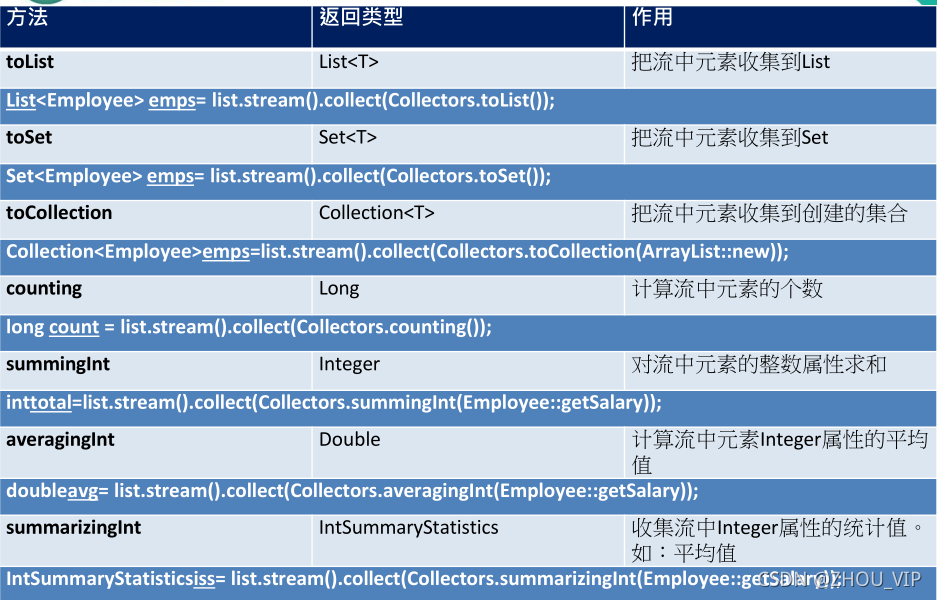
    //收集
    @Test
    public void test4() {
        //收集所有的名字
        /*刘德华
        张学友
        黎明
        郭富城*/
        List<String> list = employees.stream().map(Employee::getName)
                .collect(Collectors.toList());
        list.forEach(System.out::println);

        //如果有重复数据,要进行去重,可以用set
        Set<String> list2 = employees.stream().map(Employee::getName)
                .collect(Collectors.toSet());
        list2.forEach(System.out::println);

        HashSet<String> hs = employees.stream().map(Employee::getName)
                .collect(Collectors.toCollection(HashSet::new));
        hs.forEach(System.out::println);
    }

    @Test
    public void test5() {
        //总个数
        Long count = employees.stream().collect(Collectors.counting());
        System.out.println(count);

        //工资的平均值
        Double avg = employees.stream().collect(Collectors.averagingDouble(Employee::getSalary));
        System.out.println(avg);

        //工资的总和
        Double sum = employees.stream().collect(Collectors.summingDouble(Employee::getSalary));
        System.out.println(sum);

        //最大值
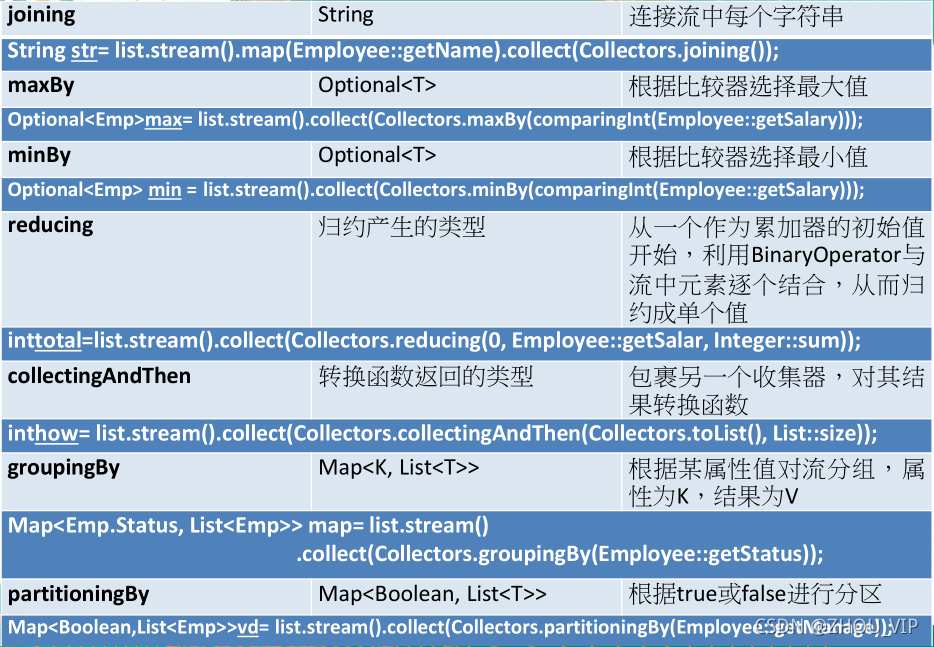
        Optional<Employee> employee = employees.stream().collect(Collectors.maxBy((e1,e2) -> Double.compare(e1.getSalary(),e2.getSalary())));
        System.out.println(employee.get());//Employee [id=0, name=张学友, age=28, salary=8500.0, status=BUSY]

        //最小值,只想看工资
        //方法1,按工资从小到大排序,取第一个
        Optional<Double> db = employees.stream().map(Employee::getSalary).sorted((e1,e2) -> Double.compare(e1,e2)).findFirst();
        System.out.println(db.get());//5500.0
        //方法2
        //Optional<Double> db2 = employees.stream().map(Employee::getSalary).collect(Collectors.minBy(Double::compare));
        //同等写法
        Optional<Double> db2 = employees.stream().map(Employee::getSalary).collect(Collectors.minBy((x1,x2) -> Double.compare(x1,x2)));
        System.out.println(db2.get());//5500.0
    }

    //分组
    @Test
    public void test6() {
        //返回map
       Map<Employee.Status,List<Employee>>  map = employees.stream().collect(Collectors.groupingBy(Employee::getStatus));
        for (Map.Entry<Employee.Status, List<Employee>> statusListEntry : map.entrySet()) {
            Employee.Status key = statusListEntry.getKey();
            List<Employee> employees = statusListEntry.getValue();
            System.out.println(key+"-----"+employees);
        }
        /*FREE-----[Employee [id=0, name=刘德华, age=48, salary=8000.0, status=FREE], Employee [id=0, name=郭富城, age=51, salary=5500.0, status=FREE]]
        BUSY-----[Employee [id=0, name=张学友, age=28, salary=8500.0, status=BUSY]]
        VOCATION-----[Employee [id=0, name=黎明, age=45, salary=6500.0, status=VOCATION]]*/
    }

     //================说明:测试多级分组以及后面的,增加了测试数据,多了刘德华1、张学友1。。。=====================
    //多级分组
    @Test
    public void test7() {
        //返回map
        Map<Employee.Status, Map<String, List<Employee>>> map = employees.stream()
                .collect(Collectors.groupingBy(Employee::getStatus,Collectors.groupingBy(e -> {
                    if(e.getAge() <= 35){
                        return "青年";
                    }else if(e.getAge() <= 50){
                        return "中年";
                    }else{
                        return "老年";
                    }
        })));
        for (Map.Entry<Employee.Status, Map<String, List<Employee>>> statusMapEntry : map.entrySet()) {
               Employee.Status key = statusMapEntry.getKey();
               Map<String, List<Employee>> strMap = statusMapEntry.getValue();
               System.out.println(key+"---------"+strMap);
        }
        /*VOCATION---------{中年=[Employee [id=0, name=黎明, age=45, salary=6500.0, status=VOCATION]]}
        FREE---------{青年=[Employee [id=0, name=刘德华1, age=18, salary=8000.0, status=FREE]], 老年=[Employee [id=0, name=郭富城, age=51, salary=5500.0, status=FREE]], 中年=[Employee [id=0, name=刘德华, age=48, salary=8000.0, status=FREE]]}
        BUSY---------{青年=[Employee [id=0, name=张学友, age=28, salary=8500.0, status=BUSY]], 中年=[Employee [id=0, name=张学友1, age=38, salary=8500.0, status=BUSY]]}*/
    }


    //分区,根据true或false进行分区
    @Test
    public void test8() {
        Map<Boolean,List<Employee>> employeesMap = employees.stream().collect(Collectors.partitioningBy(e ->e.getSalary() >6000));
        for(Map.Entry<Boolean,List<Employee>> MapEntry :employeesMap.entrySet()){
            Boolean b = MapEntry.getKey();
            List<Employee> employeeList = MapEntry.getValue();
            System.out.println(b+"---------"+employeeList);
            /*
            false---------[Employee [id=0, name=郭富城, age=51, salary=5500.0, status=FREE]]
            true---------[Employee [id=0, name=刘德华, age=48, salary=8000.0, status=FREE], Employee [id=0, name=刘德华1, age=18, salary=8000.0, status=FREE], Employee [id=0, name=张学友, age=28, salary=8500.0, status=BUSY], Employee [id=0, name=张学友1, age=38, salary=8500.0, status=BUSY], Employee [id=0, name=黎明, age=45, salary=6500.0, status=VOCATION]]
            */
        }
    }


    @Test
    public void test9() {
        DoubleSummaryStatistics dss = employees.stream().collect(Collectors.summarizingDouble(Employee::getSalary));
        System.out.println(dss.getSum());
        System.out.println(dss.getAverage());
        System.out.println(dss.getMax());
        System.out.println(dss.getMin());
        System.out.println(dss.getCount());
        /*45000.0
        7500.0
        8500.0
        5500.0
        6*/
    }

    @Test
    public void test10(){
        String str = employees.stream().map(Employee::getName).collect(Collectors.joining());
        System.out.println(str);//刘德华刘德华1张学友张学友1黎明郭富城

        String str1 = employees.stream().map(Employee::getName).collect(Collectors.joining(","));
        System.out.println(str1);//刘德华,刘德华1,张学友,张学友1,黎明,郭富城

        String str2 = employees.stream().map(Employee::getName).collect(Collectors.joining(",","===","======"));
        System.out.println(str2);//===刘德华,刘德华1,张学友,张学友1,黎明,郭富城======
    }


    // 定义人名数组
    final String[] names = {"Zebe", "Hebe", "Mary", "July", "David"};
    Stream<String> stream1 = Stream.of(names);
    Stream<String> stream2 = Stream.of(names);
    Stream<String> stream3 = Stream.of(names);
    // 拼接成 [x, y, z] 形式
    String result1 = stream1.collect(Collectors.joining(", ", "[", "]"));
    // 拼接成 x | y | z 形式
    String result2 = stream2.collect(Collectors.joining(" | ", "", ""));
    // 拼接成 x -> y -> z] 形式
    String result3 = stream3.collect(Collectors.joining(" -> ", "", ""));
    System.out.println(result1);
    System.out.println(result2);
    System.out.println(result3);

    程序输出结果如下:
    [Zebe, Hebe, Mary, July, David]
    Zebe | Hebe | Mary | July | David
    Zebe -> Hebe -> Mary -> July -> David

    在JAVA8出现之前,我们通常使用循环的方式来拼接字符串,这样做不仅代码冗长丑陋,而且需要仔细阅读代码才知道代码的功能,例如下面的代码:
    final String[] names = {"Zebe", "Hebe", "Mary", "July", "David"};
    StringBuilder builder = new StringBuilder();
    for (int i = 0; i < names.length; i++) {
        if (builder.length() > 1) {
            builder.append(",");
        }
    builder.append(names[i]);
    }
    System.out.println(builder.toString());


}


 本文通过实例展示了如何使用Java 8 Stream API对员工数据进行高效操作,包括工资汇总、分组统计、过滤等,提升代码简洁性和性能。






 扫一扫
扫一扫


 2293
2293

 被折叠的 条评论
为什么被折叠?
被折叠的 条评论
为什么被折叠?
 到【灌水乐园】发言





