


1.网络模型整体架构
1.1.MobileNet v1网络
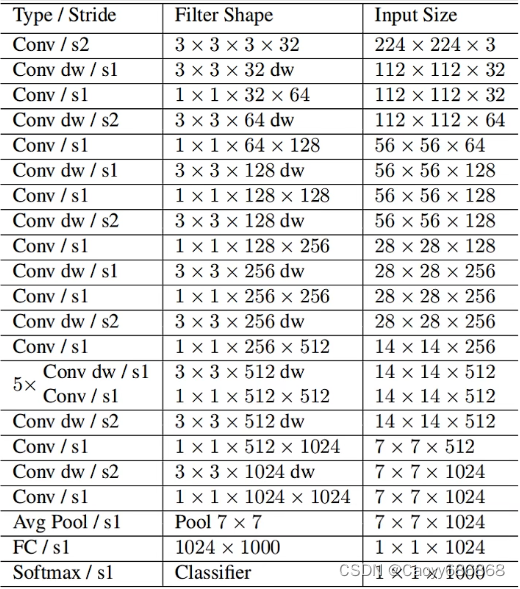
MobileNet v1网络是由Google团队在2017年提出的,专注于移动端或者嵌入式设备中的轻量级CNN网络。相比传统卷积神经网络,在准确率小幅降低的前提下大大减少模型参数与运算量。(相比VGG16准确率减小了0.9%,但模型参数只有VGG的1/32)。网络中的亮点有:
- Depthwise Convolution(大大减少运算量和参数数量)
- 增加超参数α、β
1.2.MobileNet v2网络
MobileNet v2网络时Google团队在2018年提出的,相比MobileNet v1网络,准确率更高,模型更小。网络中的亮点有:
- Inverted Residuals(倒残差结构)
- Linear Bottlenecks
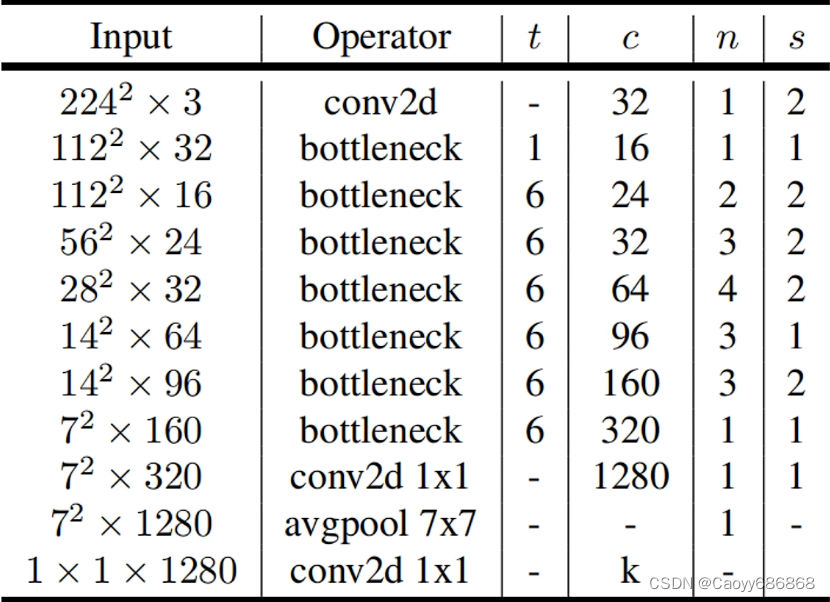
- t是扩展因子
- c是输出特征矩阵深度channel
- n是bottleneck的重复次数
- s是步距(针对第一层,其他为1)
1.3.MobileNet v3网络
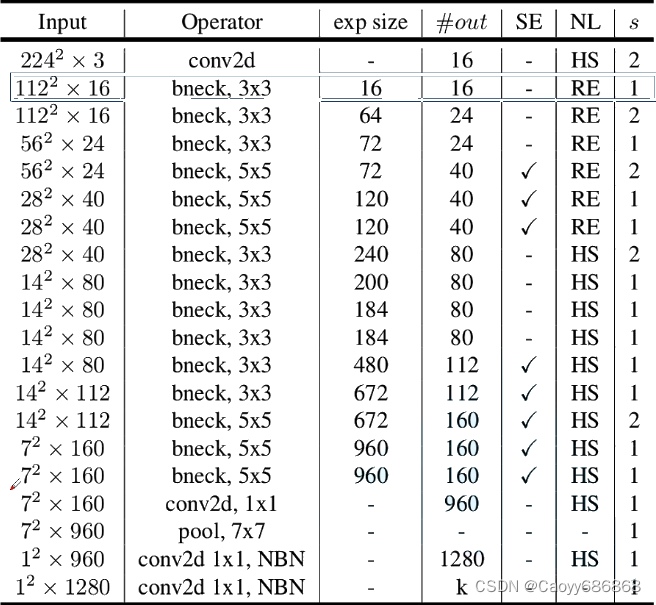
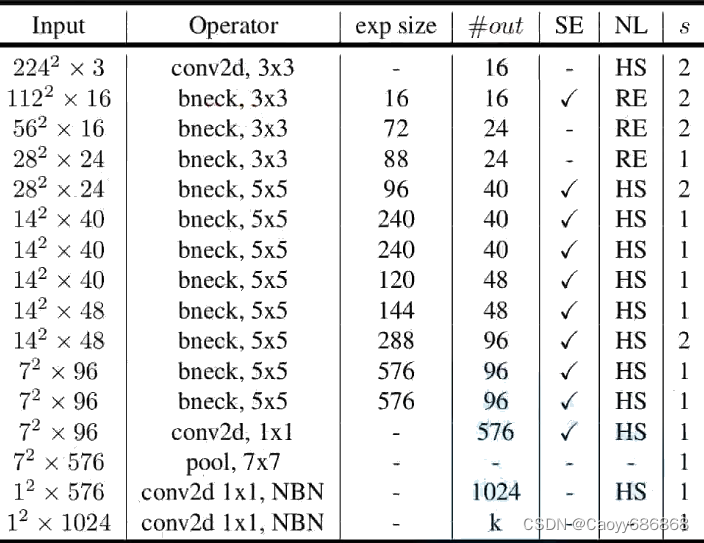
- 更新Block(bneck):加入SE模块,更新了激活函数
- 使用NAS搜索参数(Neural Architecture Search)
- 重新设计耗时层结构:减少第一个卷积层的卷积核个数(32→16),精简Last stage
- 注意:当stride==1且input_channel==output_channel才有shortcut连接
2.网络模型搭建
2.1.MobileNetV2网络
from torch import nn
import torch


def _make_divisible(ch, divisor=8, min_ch=None):
    """
    This function is taken from the original tf repo.
    It ensures that all layers have a channel number that is divisible by 8
    It can be seen here:
    https://github.com/tensorflow/models/blob/master/research/slim/nets/mobilenet/mobilenet.py
    """
    if min_ch is None:
        min_ch = divisor
    new_ch = max(min_ch, int(ch + divisor / 2) // divisor * divisor)
    # Make sure that round down does not go down by more than 10%.
    if new_ch < 0.9 * ch:
        new_ch += divisor
    return new_ch


class ConvBNReLU(nn.Sequential):
    def __init__(self, in_channel, out_channel, kernel_size=3, stride=1, groups=1):
        padding = (kernel_size - 1) // 2
        super(ConvBNReLU, self).__init__(
            nn.Conv2d(in_channel, out_channel, kernel_size, stride, padding, groups=groups, bias=False),
            nn.BatchNorm2d(out_channel),
            nn.ReLU6(inplace=True)
        )


class InvertedResidual(nn.Module):
    def __init__(self, in_channel, out_channel, stride, expand_ratio):
        super(InvertedResidual, self).__init__()
        hidden_channel = in_channel * expand_ratio
        self.use_shortcut = stride == 1 and in_channel == out_channel

        layers = []
        if expand_ratio != 1:
            # 1x1 pointwise conv
            layers.append(ConvBNReLU(in_channel, hidden_channel, kernel_size=1))
        layers.extend([
            # 3x3 depthwise conv
            ConvBNReLU(hidden_channel, hidden_channel, stride=stride, groups=hidden_channel),
            # 1x1 pointwise conv(linear)
            nn.Conv2d(hidden_channel, out_channel, kernel_size=1, bias=False),
            nn.BatchNorm2d(out_channel),
        ])

        self.conv = nn.Sequential(*layers)

    def forward(self, x):
        if self.use_shortcut:
            return x + self.conv(x)
        else:
            return self.conv(x)


class MobileNetV2(nn.Module):
    def __init__(self, num_classes=1000, alpha=1.0, round_nearest=8):
        super(MobileNetV2, self).__init__()
        block = InvertedResidual
        input_channel = _make_divisible(32 * alpha, round_nearest)
        last_channel = _make_divisible(1280 * alpha, round_nearest)

        inverted_residual_setting = [
            # t, c, n, s
            [1, 16, 1, 1],
            [6, 24, 2, 2],
            [6, 32, 3, 2],
            [6, 64, 4, 2],
            [6, 96, 3, 1],
            [6, 160, 3, 2],
            [6, 320, 1, 1],
        ]

        features = []
        # conv1 layer
        features.append(ConvBNReLU(3, input_channel, stride=2))
        # building inverted residual residual blockes
        for t, c, n, s in inverted_residual_setting:
            output_channel = _make_divisible(c * alpha, round_nearest)
            for i in range(n):
                stride = s if i == 0 else 1
                features.append(block(input_channel, output_channel, stride, expand_ratio=t))
                input_channel = output_channel
        # building last several layers
        features.append(ConvBNReLU(input_channel, last_channel, 1))
        # combine feature layers
        self.features = nn.Sequential(*features)

        # building classifier
        self.avgpool = nn.AdaptiveAvgPool2d((1, 1))
        self.classifier = nn.Sequential(
            nn.Dropout(0.2),
            nn.Linear(last_channel, num_classes)
        )

        # weight initialization
        for m in self.modules():
            if isinstance(m, nn.Conv2d):
                nn.init.kaiming_normal_(m.weight, mode='fan_out')
                if m.bias is not None:
                    nn.init.zeros_(m.bias)
            elif isinstance(m, nn.BatchNorm2d):
                nn.init.ones_(m.weight)
                nn.init.zeros_(m.bias)
            elif isinstance(m, nn.Linear):
                nn.init.normal_(m.weight, 0, 0.01)
                nn.init.zeros_(m.bias)

    def forward(self, x):
        x = self.features(x)
        x = self.avgpool(x)
        x = torch.flatten(x, 1)
        x = self.classifier(x)
        return x
2.2.MobileNetV3网络
from typing import Callable, List, Optional

import torch
from torch import nn, Tensor
from torch.nn import functional as F
from functools import partial


def _make_divisible(ch, divisor=8, min_ch=None):
    """
    This function is taken from the original tf repo.
    It ensures that all layers have a channel number that is divisible by 8
    It can be seen here:
    https://github.com/tensorflow/models/blob/master/research/slim/nets/mobilenet/mobilenet.py
    """
    if min_ch is None:
        min_ch = divisor
    new_ch = max(min_ch, int(ch + divisor / 2) // divisor * divisor)
    # Make sure that round down does not go down by more than 10%.
    if new_ch < 0.9 * ch:
        new_ch += divisor
    return new_ch


class ConvBNActivation(nn.Sequential):
    def __init__(self,
                 in_planes: int,
                 out_planes: int,
                 kernel_size: int = 3,
                 stride: int = 1,
                 groups: int = 1,
                 norm_layer: Optional[Callable[..., nn.Module]] = None,
                 activation_layer: Optional[Callable[..., nn.Module]] = None):
        padding = (kernel_size - 1) // 2
        if norm_layer is None:
            norm_layer = nn.BatchNorm2d
        if activation_layer is None:
            activation_layer = nn.ReLU6
        super(ConvBNActivation, self).__init__(nn.Conv2d(in_channels=in_planes,
                                                         out_channels=out_planes,
                                                         kernel_size=kernel_size,
                                                         stride=stride,
                                                         padding=padding,
                                                         groups=groups,
                                                         bias=False),
                                               norm_layer(out_planes),
                                               activation_layer(inplace=True))


class SqueezeExcitation(nn.Module):
    def __init__(self, input_c: int, squeeze_factor: int = 4):
        super(SqueezeExcitation, self).__init__()
        squeeze_c = _make_divisible(input_c // squeeze_factor, 8)
        self.fc1 = nn.Conv2d(input_c, squeeze_c, 1)
        self.fc2 = nn.Conv2d(squeeze_c, input_c, 1)

    def forward(self, x: Tensor) -> Tensor:
        scale = F.adaptive_avg_pool2d(x, output_size=(1, 1))
        scale = self.fc1(scale)
        scale = F.relu(scale, inplace=True)
        scale = self.fc2(scale)
        scale = F.hardsigmoid(scale, inplace=True)
        return scale * x


class InvertedResidualConfig:
    def __init__(self,
                 input_c: int,
                 kernel: int,
                 expanded_c: int,
                 out_c: int,
                 use_se: bool,
                 activation: str,
                 stride: int,
                 width_multi: float):
        self.input_c = self.adjust_channels(input_c, width_multi)
        self.kernel = kernel
        self.expanded_c = self.adjust_channels(expanded_c, width_multi)
        self.out_c = self.adjust_channels(out_c, width_multi)
        self.use_se = use_se
        self.use_hs = activation == "HS"  # whether using h-swish activation
        self.stride = stride

    @staticmethod
    def adjust_channels(channels: int, width_multi: float):
        return _make_divisible(channels * width_multi, 8)


class InvertedResidual(nn.Module):
    def __init__(self,
                 cnf: InvertedResidualConfig,
                 norm_layer: Callable[..., nn.Module]):
        super(InvertedResidual, self).__init__()

        if cnf.stride not in [1, 2]:
            raise ValueError("illegal stride value.")

        self.use_res_connect = (cnf.stride == 1 and cnf.input_c == cnf.out_c)

        layers: List[nn.Module] = []
        activation_layer = nn.Hardswish if cnf.use_hs else nn.ReLU

        # expand
        if cnf.expanded_c != cnf.input_c:
            layers.append(ConvBNActivation(cnf.input_c,
                                           cnf.expanded_c,
                                           kernel_size=1,
                                           norm_layer=norm_layer,
                                           activation_layer=activation_layer))

        # depthwise
        layers.append(ConvBNActivation(cnf.expanded_c,
                                       cnf.expanded_c,
                                       kernel_size=cnf.kernel,
                                       stride=cnf.stride,
                                       groups=cnf.expanded_c,
                                       norm_layer=norm_layer,
                                       activation_layer=activation_layer))

        if cnf.use_se:
            layers.append(SqueezeExcitation(cnf.expanded_c))

        # project
        layers.append(ConvBNActivation(cnf.expanded_c,
                                       cnf.out_c,
                                       kernel_size=1,
                                       norm_layer=norm_layer,
                                       activation_layer=nn.Identity))

        self.block = nn.Sequential(*layers)
        self.out_channels = cnf.out_c
        self.is_strided = cnf.stride > 1

    def forward(self, x: Tensor) -> Tensor:
        result = self.block(x)
        if self.use_res_connect:
            result += x

        return result


class MobileNetV3(nn.Module):
    def __init__(self,
                 inverted_residual_setting: List[InvertedResidualConfig],
                 last_channel: int,
                 num_classes: int = 1000,
                 block: Optional[Callable[..., nn.Module]] = None,
                 norm_layer: Optional[Callable[..., nn.Module]] = None):
        super(MobileNetV3, self).__init__()

        if not inverted_residual_setting:
            raise ValueError("The inverted_residual_setting should not be empty.")
        elif not (isinstance(inverted_residual_setting, List) and
                  all([isinstance(s, InvertedResidualConfig) for s in inverted_residual_setting])):
            raise TypeError("The inverted_residual_setting should be List[InvertedResidualConfig]")

        if block is None:
            block = InvertedResidual

        if norm_layer is None:
            norm_layer = partial(nn.BatchNorm2d, eps=0.001, momentum=0.01)

        layers: List[nn.Module] = []

        # building first layer
        firstconv_output_c = inverted_residual_setting[0].input_c
        layers.append(ConvBNActivation(3,
                                       firstconv_output_c,
                                       kernel_size=3,
                                       stride=2,
                                       norm_layer=norm_layer,
                                       activation_layer=nn.Hardswish))
        # building inverted residual blocks
        for cnf in inverted_residual_setting:
            layers.append(block(cnf, norm_layer))

        # building last several layers
        lastconv_input_c = inverted_residual_setting[-1].out_c
        lastconv_output_c = 6 * lastconv_input_c
        layers.append(ConvBNActivation(lastconv_input_c,
                                       lastconv_output_c,
                                       kernel_size=1,
                                       norm_layer=norm_layer,
                                       activation_layer=nn.Hardswish))
        self.features = nn.Sequential(*layers)
        self.avgpool = nn.AdaptiveAvgPool2d(1)
        self.classifier = nn.Sequential(nn.Linear(lastconv_output_c, last_channel),
                                        nn.Hardswish(inplace=True),
                                        nn.Dropout(p=0.2, inplace=True),
                                        nn.Linear(last_channel, num_classes))

        # initial weights
        for m in self.modules():
            if isinstance(m, nn.Conv2d):
                nn.init.kaiming_normal_(m.weight, mode="fan_out")
                if m.bias is not None:
                    nn.init.zeros_(m.bias)
            elif isinstance(m, (nn.BatchNorm2d, nn.GroupNorm)):
                nn.init.ones_(m.weight)
                nn.init.zeros_(m.bias)
            elif isinstance(m, nn.Linear):
                nn.init.normal_(m.weight, 0, 0.01)
                nn.init.zeros_(m.bias)

    def _forward_impl(self, x: Tensor) -> Tensor:
        x = self.features(x)
        x = self.avgpool(x)
        x = torch.flatten(x, 1)
        x = self.classifier(x)

        return x

    def forward(self, x: Tensor) -> Tensor:
        return self._forward_impl(x)


def mobilenet_v3_large(num_classes: int = 1000,
                       reduced_tail: bool = False) -> MobileNetV3:
    """
    Constructs a large MobileNetV3 architecture from
    "Searching for MobileNetV3" <https://arxiv.org/abs/1905.02244>.

    weights_link:
    https://download.pytorch.org/models/mobilenet_v3_large-8738ca79.pth

    Args:
        num_classes (int): number of classes
        reduced_tail (bool): If True, reduces the channel counts of all feature layers
            between C4 and C5 by 2. It is used to reduce the channel redundancy in the
            backbone for Detection and Segmentation.
    """
    width_multi = 1.0
    bneck_conf = partial(InvertedResidualConfig, width_multi=width_multi)
    adjust_channels = partial(InvertedResidualConfig.adjust_channels, width_multi=width_multi)

    reduce_divider = 2 if reduced_tail else 1

    inverted_residual_setting = [
        # input_c, kernel, expanded_c, out_c, use_se, activation, stride
        bneck_conf(16, 3, 16, 16, False, "RE", 1),
        bneck_conf(16, 3, 64, 24, False, "RE", 2),  # C1
        bneck_conf(24, 3, 72, 24, False, "RE", 1),
        bneck_conf(24, 5, 72, 40, True, "RE", 2),  # C2
        bneck_conf(40, 5, 120, 40, True, "RE", 1),
        bneck_conf(40, 5, 120, 40, True, "RE", 1),
        bneck_conf(40, 3, 240, 80, False, "HS", 2),  # C3
        bneck_conf(80, 3, 200, 80, False, "HS", 1),
        bneck_conf(80, 3, 184, 80, False, "HS", 1),
        bneck_conf(80, 3, 184, 80, False, "HS", 1),
        bneck_conf(80, 3, 480, 112, True, "HS", 1),
        bneck_conf(112, 3, 672, 112, True, "HS", 1),
        bneck_conf(112, 5, 672, 160 // reduce_divider, True, "HS", 2),  # C4
        bneck_conf(160 // reduce_divider, 5, 960 // reduce_divider, 160 // reduce_divider, True, "HS", 1),
        bneck_conf(160 // reduce_divider, 5, 960 // reduce_divider, 160 // reduce_divider, True, "HS", 1),
    ]
    last_channel = adjust_channels(1280 // reduce_divider)  # C5

    return MobileNetV3(inverted_residual_setting=inverted_residual_setting,
                       last_channel=last_channel,
                       num_classes=num_classes)


def mobilenet_v3_small(num_classes: int = 1000,
                       reduced_tail: bool = False) -> MobileNetV3:
    """
    Constructs a large MobileNetV3 architecture from
    "Searching for MobileNetV3" <https://arxiv.org/abs/1905.02244>.

    weights_link:
    https://download.pytorch.org/models/mobilenet_v3_small-047dcff4.pth

    Args:
        num_classes (int): number of classes
        reduced_tail (bool): If True, reduces the channel counts of all feature layers
            between C4 and C5 by 2. It is used to reduce the channel redundancy in the
            backbone for Detection and Segmentation.
    """
    width_multi = 1.0
    bneck_conf = partial(InvertedResidualConfig, width_multi=width_multi)
    adjust_channels = partial(InvertedResidualConfig.adjust_channels, width_multi=width_multi)

    reduce_divider = 2 if reduced_tail else 1

    inverted_residual_setting = [
        # input_c, kernel, expanded_c, out_c, use_se, activation, stride
        bneck_conf(16, 3, 16, 16, True, "RE", 2),  # C1
        bneck_conf(16, 3, 72, 24, False, "RE", 2),  # C2
        bneck_conf(24, 3, 88, 24, False, "RE", 1),
        bneck_conf(24, 5, 96, 40, True, "HS", 2),  # C3
        bneck_conf(40, 5, 240, 40, True, "HS", 1),
        bneck_conf(40, 5, 240, 40, True, "HS", 1),
        bneck_conf(40, 5, 120, 48, True, "HS", 1),
        bneck_conf(48, 5, 144, 48, True, "HS", 1),
        bneck_conf(48, 5, 288, 96 // reduce_divider, True, "HS", 2),  # C4
        bneck_conf(96 // reduce_divider, 5, 576 // reduce_divider, 96 // reduce_divider, True, "HS", 1),
        bneck_conf(96 // reduce_divider, 5, 576 // reduce_divider, 96 // reduce_divider, True, "HS", 1)
    ]
    last_channel = adjust_channels(1024 // reduce_divider)  # C5

    return MobileNetV3(inverted_residual_setting=inverted_residual_setting,
                       last_channel=last_channel,
                       num_classes=num_classes)
3.网络模型训练
import os
import sys
import json
import torch
import torch.nn as nn
import torch.optim as optim
from torchvision import transforms,datasets
from tqdm import tqdm

from model_v2 import MobileNetV2

def main():
    device = torch.device("cuda:0"if torch.cuda.is_available() else "cpu")
    print("using {} device.".format(device))

    batch_size = 16
    epochs = 5

    data_transform = {
        "train":transforms.Compose([
            transforms.RandomResizedCrop(224),
            transforms.RandomHorizontalFlip(),
            transforms.ToTensor(),
            transforms.Normalize([0.485, 0.456, 0.406], [0.229, 0.224, 0.225])
        ]),
        "val":transforms.Compose([
            transforms.Resize(256),
            transforms.CenterCrop(224),
            transforms.ToTensor(),
            transforms.Normalize([0.485, 0.456, 0.406],[0.229, 0.224, 0.225])
        ])
    }

    data_root = os.path.abspath(os.path.join(os.getcwd(), "../.."))  # get data root path
    image_path = os.path.join(data_root,"000000\pytorch_图像分类\deep-learning-for-image-processing-master\data_set","flower_data")

    assert os.path.exists(image_path),"{} path does not exist.".format(image_path)
    train_dataset = datasets.ImageFolder(root=os.path.join(image_path,"train"),transform=data_transform["train"])
    train_num = len(train_dataset)

    # {'daisy':0, 'dandelion':1, 'roses':2, 'sunflower':3, 'tulips':4}
    flower_list = train_dataset.class_to_idx
    cla_dict = dict((val,key) for key,val in flower_list.items())
    # write dict into json file
    json_str = json.dumps(cla_dict,indent=4)
    with open ('class_indices.json','w') as json_file:
        json_file.write(json_str)

    nw = min([os.cpu_count(),batch_size if batch_size > 1 else 0,8]) # number of workers
    print("Using {} dataloader workers every process.".format(nw))

    train_loader = torch.utils.data.DataLoader(
        train_dataset,
        batch_size,
        shuffle=True,
        num_workers=nw
    )
    validate_dataset = datasets.ImageFolder(root=os.path.join(image_path,"val"),transform=data_transform["val"])
    val_num = len(validate_dataset)
    validate_loader = torch.utils.data.DataLoader(
        validate_dataset,
        batch_size,
        shuffle=False,
        num_workers=nw
    )

    print("using {} images for training,{} images for validation.".format(train_num,val_num))

    # create model
    net = MobileNetV2(num_classes=5)

    # load pretrain weights
    # download url: https://download.pytorch.org/models/mobilenet_v2-b0353104.pth
    model_weight_path = "./mobilenet_v2.pth"
    assert os.path.exists(model_weight_path),"file {} does not exist.".format(model_weight_path)
    pre_weights = torch.load(model_weight_path,map_location='cpu')

    # delete classifier weights
    pre_dict = {k:v for k,v in pre_weights.items() if net.state_dict()[k].numel() == v.numel()}
    missing_keys,unexpect_keys = net.load_state_dict(pre_dict,strict=False)

    # freeze features weights
    for param in net.features.parameters():
        param.requires_grad = False

    net.to(device)

    # define loss function
    loss_function = nn.CrossEntropyLoss()

    # construct an optimizer
    params = [p for p in net.parameters() if p.requires_grad]
    optimizer = optim.Adam(params,lr=0.0001)

    best_acc = 0.0
    save_path = './MobileNetV2.pth'
    train_steps = len(train_loader)
    # print(train_steps)
    for epoch in range(epochs):
        # train
        net.train()
        running_loss = 0.0
        train_bar = tqdm(train_loader,file=sys.stdout)
        for step,data in enumerate(train_bar):
            images,labels = data
            optimizer.zero_grad()
            logits = net(images.to(device))
            loss = loss_function(logits,labels.to(device))
            loss.backward()
            optimizer.step()

            # print statistics
            running_loss += loss.item()

            train_bar.desc = "train epoch[{}/{}] loss:{:.3f}".format(epoch+1,epochs,loss)

        # validate
        net.eval()
        acc = 0.0 # accumalate accurate number / epoch
        with torch.no_grad():
            val_bar = tqdm(validate_loader,file=sys.stdout)
            for val_data in val_bar:
                val_images,val_labels = val_data
                outputs = net(val_images.to(device))
                # loss = loss_function(outputs,val_labels)
                predict_y = torch.max(outputs,dim=1)[1]
                acc += torch.eq(predict_y,val_labels.to(device)).sum().item()

                val_bar.desc = "valid epoch[{}/{}]".format(epoch+1,epochs)

        val_accurate = acc/val_num
        print("[epoch %d] train loss:%.3f val_accuracy:%.3f"%(epoch+1,running_loss/train_steps,val_accurate))

        if val_accurate > best_acc:
            best_acc = val_accurate
            torch.save(net.state_dict(),save_path)

    print("Finished Training!!")

if __name__ == "__main__":
    main()
4.模型检验
import os
import json
import torch
from PIL import Image
from torchvision import transforms
import matplotlib.pyplot as plt
from model_v2 import MobileNetV2

def main():
    device = torch.device("cuda:0" if torch.cuda.is_available() else "cpu")
    print("use {} device.".format(device))

    data_transform = transforms.Compose([
        transforms.Resize(256),
        transforms.CenterCrop(224),
        transforms.ToTensor(),
        transforms.Normalize([0.485, 0.456, 0.406],[0.229, 0.224, 0.225])
    ])

    # load image
    img_path = "./tulip.jpg"
    assert os.path.exists(img_path),"file:'{}'does not exist.".format(img_path)
    img = Image.open(img_path)
    plt.imshow(img)

    #[N,C,H,W]
    img = data_transform(img)
    # expand batch dimension
    img = torch.unsqueeze(img,dim=0)

    # read class indict
    json_path = "./class_indices.json"
    assert os.path.exists(json_path),"file:'{}'does not exist.".format(json_path)

    with open(json_path,'r') as f:
        class_indict = json.load(f)

    # create model
    model = MobileNetV2(num_classes=5).to(device)
    # load model weights
    model_weight_path = "./MobileNetV2.pth"
    assert os.path.exists(model_weight_path),"file:'{}'does not exist.".format(model_weight_path)
    model.load_state_dict(torch.load(model_weight_path,map_location=device))

    model.eval()
    with torch.no_grad():
        # predict class
        output = torch.squeeze(model(img.to(device))).cpu()
        predict = torch.softmax(output,dim=0)
        predict_cla = torch.argmax(predict).numpy()

    print_res = "class:{} prob:{:.3}".format(class_indict[str(predict_cla)],predict[predict_cla].numpy())

    plt.title(print_res)
    for i in range(len(predict)):
        print("class:{:10} prob:{:.3f}".format(class_indict[str(i)],predict[i].numpy()))

    plt.show()

if __name__ == "__main__":
    main()

 1万+


 扫一扫


 被折叠的 条评论
为什么被折叠?
 到【灌水乐园】发言


