



 本文探讨了图搜索的基础概念,包括BFS和DFS的比较、启发式搜索(如贪心最佳优先搜索)的应用,以及Dijkstra和A*算法在处理边成本问题上的优势。通过理解配置空间和状态空间图,学习如何在机械臂运动规划中有效利用这些方法来寻找最优路径。
Graph Search
包含以下四部分:
- Graph Search Basis
- Dijkstra and A*
- Jump Point Search
- Homework
Graph Search Basis
Configuration Space
C-空间: 可以阅读机器人学书籍学习,该知识针对机械臂这类高维空间里的运动规划很重要。
思想: 简单而言,就是为了将机器人描述为空间(不一定是欧式空间,可以是非欧式空间的表达)中的一个点。
Search-based Method
• Graphs have nodes and edges.
• State space graph: a mathematical representation of a search algorithm.
- For every search problem, there’s a corresponding state space graph.
- Connectivity between nodes in the graph is represented by (directed
or undirected) edges.
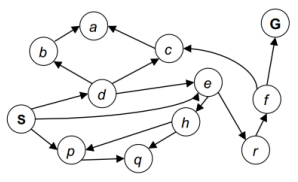
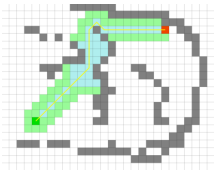
使用栅格地图表示图,栅格地图本身可以作为图:
Grid-based graph: use grid as vertices and grid connections as edges
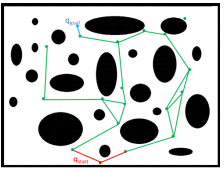
使用PRM采样生成图:
Graph Search Overview
The search always start from start state X s X_{s} Xs
- Searching the graph produces a search tree
- Back-tracing a node in the search tree gives us a path from the start state to that node
- For many problems we can never actually build the whole tree, too large or inefficient – we only want to reach the goal node asap.
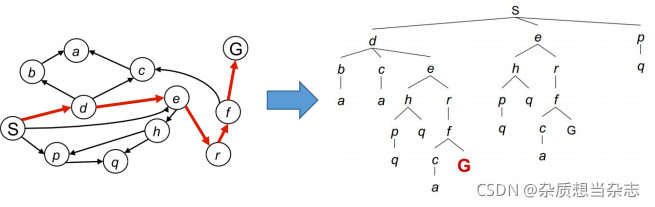
将图转换为树结构
算法三个步骤:
• Maintain a container to store all the nodes to be visited
• The container is initialized with the start state Xs
• Loop
	1. Visit:Remove a node from the container according to some pre-defined score function
		- Visit a node
	2. Expansion: Obtain all neighbors of the node
		- Discover all its neighbors
	3. Add:Push them (neighbors) into the container
• End Loop
算法的三个问题:
• Question 1: When to end the loop?
- Possible option: End the loop when the container is empty
- 除了上述的,可以采取不同的终止条件,比如到达目的地。
• Question 2: What if the graph is cyclic?
- When a node is removed from the container (expanded / visited), it should never be added back to the container again
- 因此,在程序中,除了维护一个储存将来所有可能会访问的节点的container,还维护一个储存已访问点的container。
• Question 3: In what way to remove the right node such that
the goal state can be reached as soon as possible, which
results in less expansion of the graph node.
- 解决这个问题就是我们算法的关键:效率,快速。
Graph Traversal
图的遍历是算法的基础。
目前常见的两种算法是深度优先搜索和宽度优先搜索。
Breadth First Search (BFS) vs. Depth First Search (DFS)
两种遍历方法对比如下:
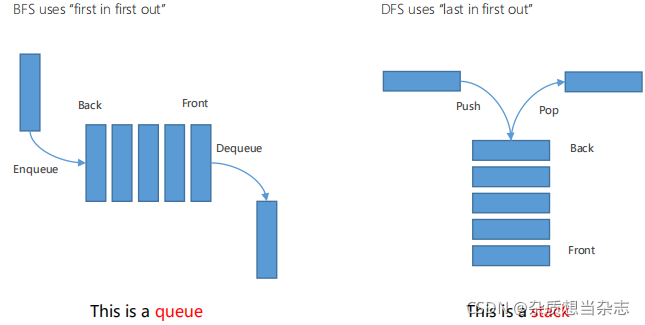
BFS的容器模型是队列(queue),遵循先进先出原则。所以,先进的节点会先出来。
DFS的容器模型是栈(stack),遵循后进先出原则。所以,后进的节点会先出来。
Depth First Search (DFS)
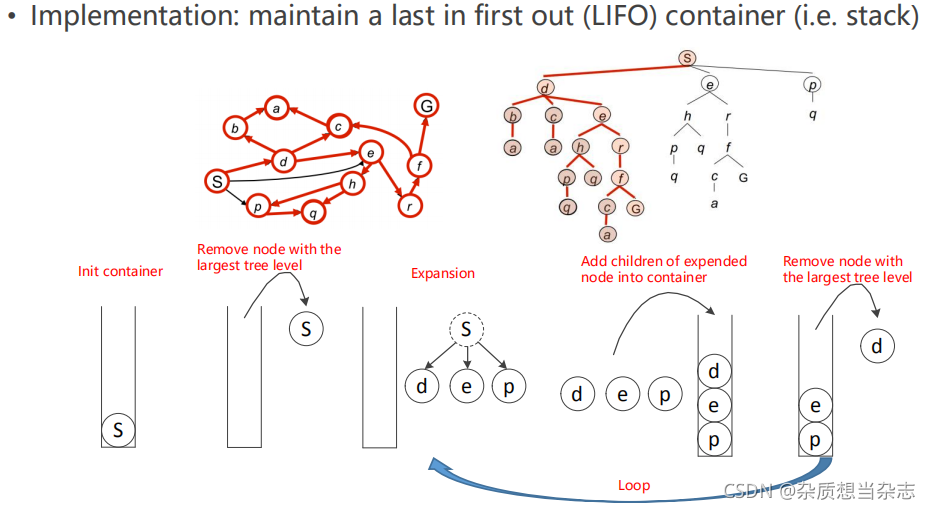
DFS在搜索中的原理
Breadth First Search (BFS)
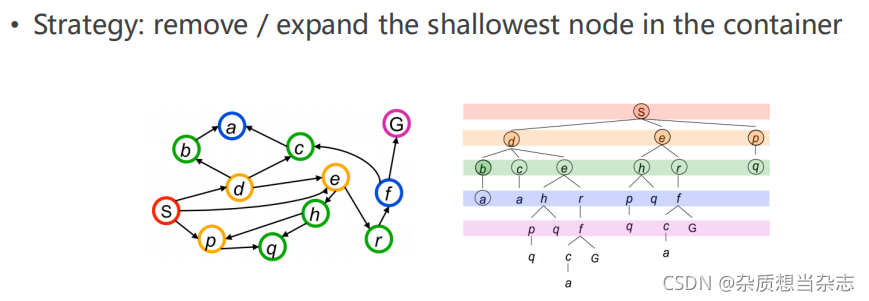
BFS在搜索中的原理
BFS vs. DFS: which one is useful?
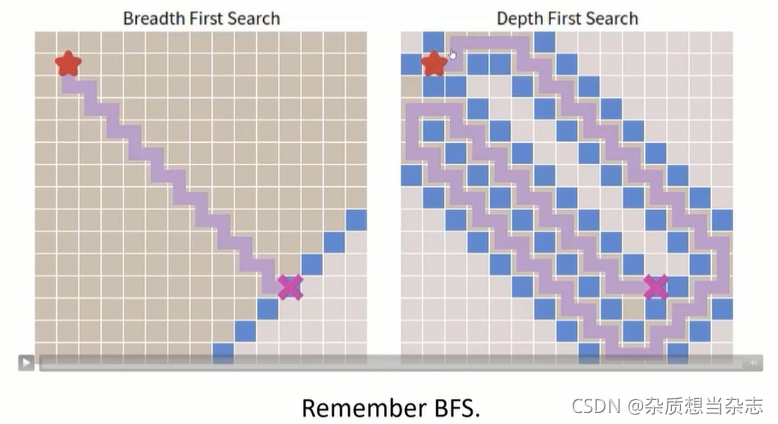
DFS vs. BFS在搜索中的对比
- BFS在遍历到目标时,可通过回溯找到最短路径。为什么是最短路径?从图BFS在搜索中的原理 可知,BFS从顶层逐层搜索下层,因此,最终回溯到的路径将是最短的。
- DFS “一路走到黑”,搜索到目标时便停止搜索,当存在多条目标路径时,很有可能搜索出来的目标路径是非优的甚至很差。
- 因此,后面的算法会以BFS为基础遍历节点。
Heuristic search
启发式算法,以贪心算法为例。
启发式算法与DFS、BFS区别:
- BFS and DFS pick the next node off the frontiers based on which was “first in” or “last in”.
- Greedy Best First picks the “best” node according to
some rule, called aheuristic.
Greedy Best First Search
- Definition: A heuristic is a
guessof how close you are to the target. - guess: 在找到解之前,我们无法得知实际的最近距离,所以,只是一种当下猜想。
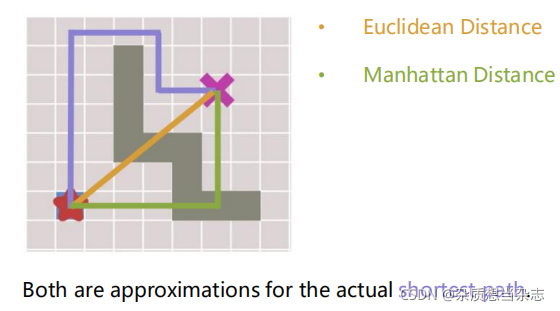
对于上图,加入我们想要猜测期待到最短的距离,通常可以采用两种方法 - 欧氏距离(Euclidean Distance):直线
- 曼哈顿距离(Manhattan Distance):▲x + ▲y
启发式算法的好处:
- A heuristic guides you in the right direction.
- A heuristic should be easy to compute.
问题:
如何设计一个好用的启发式函数呢?
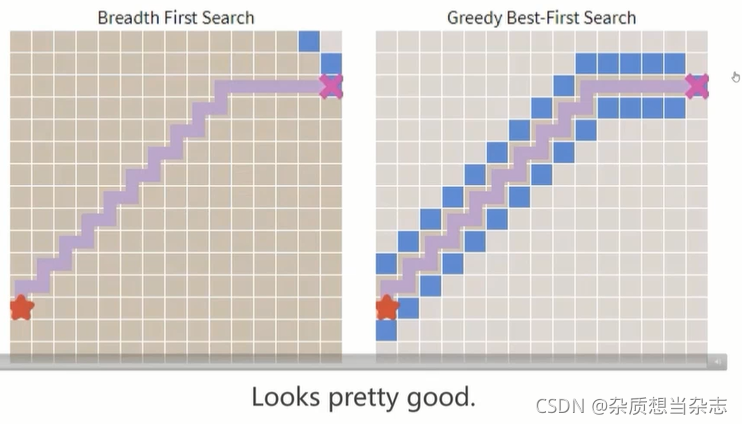
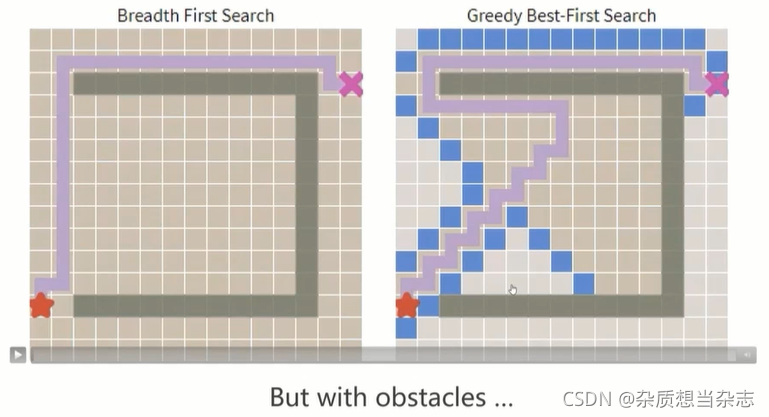
对比上面两种情况来看,在复杂情况下(障碍物)贪心算法不一定能找到很好的路径。但这并不意味着贪心算法毫无用处,我们仍然可以借鉴它的思想设计出更好的启发式算法。
Dijkstra and A*
Costs on Actions
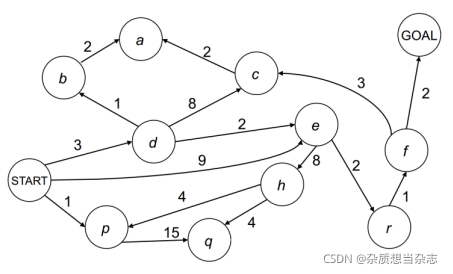
- A practical search problem has a cost “C” from a node to its neighbor
• Length, time, energy, etc. - When all weight are 1, BFS finds the optimal solution
- For general cases, how to find the least-cost path as soon as possible?
在之前的算法里,我们没有考虑边的代价问题。为了解决这个问题,提出了Dijkstra and A*算法。





 扫一扫
扫一扫


 2711
2711

 被折叠的 条评论
为什么被折叠?
被折叠的 条评论
为什么被折叠?
 到【灌水乐园】发言





