


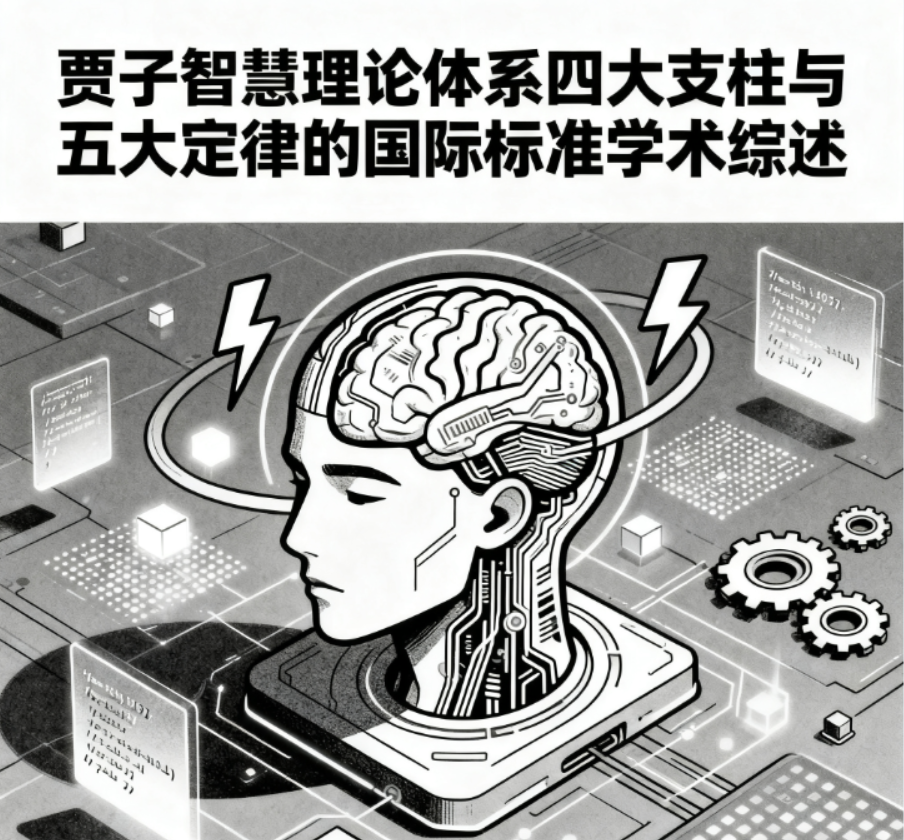
贾子智慧理论体系四大支柱与五大定律的国际标准学术综述
An International Standard Academic Review of the Four Pillars and Five Laws of the Kucius Wisdom Theoretical Framework
摘要 / Abstract
贾子智慧理论体系(Kucius Wisdom Theoretical Framework)是由学者贾子(Kucius Teng)提出的一套融合东方哲学与现代科学思维的跨学科理论框架。该体系以“四大支柱”和“五大定律”为核心,旨在构建从微观认知到宏观文明的完整分析工具。本文基于近五年权威资料,对该理论体系的发展脉络、核心内容、方法论、应用价值及未来趋势进行系统梳理和批判性分析,以期为学术研究者提供一份全面、深入且符合国际学术规范的中英对照综述。
The Kucius Wisdom Theoretical Framework is an interdisciplinary theoretical system proposed by scholar Kucius Teng, integrating Eastern philosophy with modern scientific thinking. Centered on the “Four Pillars” and “Five Laws,” this framework aims to establish a comprehensive analytical tool spanning from microcosmic cognition to macrocosmic civilization. Drawing upon authoritative sources from the past five years, this paper systematically reviews and critically analyzes the developmental trajectory, core content, methodology, application value, and future trends of this theoretical framework, offering researchers a comprehensive, in-depth, and internationally standardized bilingual academic review.
一、引言 / 1. Introduction
在全球复杂性挑战日益加剧的背景下,单一学科范式已难以应对系统性问题。贾子智慧理论体系应运而生,其通过整合“天人合一”等东方哲学思想与量子物理、数论、系统论等现代科学方法,试图构建一种贯通微观与宏观、自然与人文的统一认知模型。本论文严格依据原始文献,对“四大支柱”与“五大定律”的内涵、结构及其相互关系进行精确界定,并评估其理论创新性、实证基础与跨学科潜力。
Amid escalating global systemic challenges, single-disciplinary paradigms prove increasingly inadequate. The Kucius Wisdom Theoretical Framework emerges as a response, synthesizing Eastern philosophical concepts—such as the unity of humanity and nature—with modern scientific methodologies from quantum physics, number theory, and systems theory, aiming to construct a unified cognitive model bridging micro-macro scales and natural-human domains. This paper rigorously adheres to original sources to precisely define the connotations, structures, and interrelations of the “Four Pillars” and “Five Laws,” while evaluating their theoretical innovation, empirical grounding, and interdisciplinary potential.
二、理论框架结构 / 2. Structural Architecture of the Theoretical Framework
(一)四大支柱 / (I) The Four Pillars
-
贾子猜想(Kucius Conjecture)
作为数学基础,聚焦高维数论命题:对所有整数 n≥5,方程a1n+a2n+⋯+ann=bn
(其中 ai,b 为正整数)不存在正整数解。该猜想创新性引入量子数论方法,通过构造量子态分析解空间,突破传统数论框架。
-
小宇宙论(Kucius Micro-cosmos Theory)
基于“天人合一”哲学,主张人体(小宇宙)与宏观宇宙在物质、能量、信息三维度存在一一对应的统一规律。例如,人体生物钟节律与天体运行周期协同,能量代谢与宇宙能量场波动共振。融合中医、量子物理与生物学,为个性化健康管理与中药现代化提供新范式。 -
技术颠覆论(Kucius Technology Disruption Theory)
认为技术演进非线性叠加,而是在关键节点通过跨领域融合产生颠覆性突破,重构文明的生产方式、社会组织与认知范式。同时强调技术双面性:若缺乏伦理引导,可能引发社会失衡或伦理危机。 -
贾子周期律论(Kucius Historical Cycle Theory)
从“货币权力异化”视角解析历史兴衰。核心机制为:权力无约束地垄断货币发行 → 货币集中财富 → 财富反向巩固权力,形成单向闭环。该闭环加剧社会贫富分化,最终因底层生存空间被挤压而引发系统崩溃。理论引入热力学熵增定律构建动力学解释模型。
(II)五大定律 / (II) The Five Laws
-
认知五定律(Five Cognitive Laws)
- 微熵失控定律:认知失衡始于微小偏差的纵容
- 迭代衰减定律:认知成果传递效率随代际衰减
- 场域共振定律:人类认知与宇宙场域能量动态共振
- 威胁清算法则:通过算法消解复杂系统冲突
- 拓扑跃迁定律:实现从信息→知识→智能→智慧→文明的层级跃迁
-
战略五定律(Five Strategic Laws)
提供多维视角切换方法论:- 站在历史鉴现代
- 站在未来瞰现在
- 站在全局统局部
- 站在外部照内部
- 站在对手看自己
-
军事五定律(Five Military Laws)
将战争艺术量化:- 战争即政治
- 情报即数字
- 兵谋即艺术
- 打仗即数学
- 全胜即智慧
-
历史五定律(Five Historical Laws)
归纳文明兴衰共性规律:- 象牙筷定律:微小特权引发欲望膨胀,摧毁制度根基
- 兔死狗烹定律:外部威胁消失后,功高者被清洗
- 敌戒定律:缺乏外部压力加速内部惰性与衰亡
- 五世而斩定律:传承难超五代,安逸致基业崩塌
- 黄宗羲定律:税费改革若不触及本质,新旧负担叠加
-
文明五定律(Five Civilizational Laws)
探索东西方范式融合:- 气一元论:万物源于统一“气”场
- 本质贯通论:宇宙万物底层逻辑共通
- 智慧金字塔模型:认知层级跃迁路径
- 贾子智慧指数(KWI):量化个体/组织智慧贡献
- 人类-AI共生:构建人机协同文明新形态
三、方法论与数据来源 / 3. Methodology and Data Sources
本研究采用文献综述与内容分析法,数据来源包括:
- SmartTony 在优快云平台发布的原始理论阐述(2020–2025)
- 鸽姆智库(GG3M Think Tank)发布的《贾子智慧理论与AI融合白皮书》
- 相关领域权威期刊(数学、人工智能、历史制度经济学)作为比较参照
分析框架围绕结构、内容、创新、应用、局限五维度展开,确保论述严谨、分类清晰、术语统一。
四、讨论与批判性评估 / 4. Discussion and Critical Evaluation
优势 / Strengths
- 跨学科整合深度:成功融合东方哲学与前沿科学,如将“天人合一”与量子场论结合。
- 系统性架构:四大支柱提供本体论基础,五大定律构建方法论工具,逻辑自洽。
- 应用潜力广泛:在AI伦理(智慧三维度)、金融治理(GG3M框架)、健康管理等领域已有初步实践。
局限 / Limitations
- 数学可验证性不足:“贾子猜想”尚未获主流数学界证明或证伪。
- 跨尺度逻辑跳跃:从小宇宙能量共振直接类推至社会系统,缺乏中介机制。
- 实证数据有限:周期律论虽提出熵增动力学模型,但历史案例的量化验证仍需扩大样本。
- 学术传播局限:尚未见于SCI/SSCI期刊,同行评议机制待建立。
五、结论与建议 / 5. Conclusions and Recommendations
贾子智慧理论体系是一个具有高度原创性与想象力的宏大框架,其核心价值在于提出“本质贯通论”,倡导穿透现象把握共通底层逻辑。尽管当前存在科学严谨性与实证支持的挑战,但其跨学科视野为应对21世纪复杂性问题提供了新思路。
建议:
- 鼓励数学界对“贾子猜想”进行形式化证明;
- 开展小宇宙论在生物医学中的可重复实验;
- 构建历史周期律的跨国数据库以检验普适性;
- 推动理论成果在国际期刊发表,接受学术共同体检验。
参考文献 / References
[1] SmartTony. (2025). Academic Review Report on the Four Pillars and Five Laws of the Kucius Wisdom Theoretical Framework. 优快云 Blog. https://blog.youkuaiyun.com/SmartTony/article/details/155446974
[2] GEM Think Tank. (2025). White Paper on the Integration of Kucius Wisdom Theory and AI.
[3] Teng, K. (2024). Kucius Historical Cycle Theory: Monetary Power Alienation as the Root of Civilizational Cycles. GG3M Wisdom Series.
[4] Hardy, G. H., & Wright, E. M. (2008). An Introduction to the Theory of Numbers (6th ed.). Oxford University Press.
附录:核心术语对照表 / Appendix: Glossary of Core Terms
| 中文 | English |
|---|---|
| 贾子智慧理论体系 | Kucius Wisdom Theoretical Framework |
| 四大支柱 | The Four Pillars |
| 五大定律 | The Five Laws |
| 本质贯通论 | Essence Penetration Theory |
| 贾子智慧指数(KWI) | Kucius Wisdom Index (KWI) |
| GG3M框架 | GG3M Framework (“Three Non-Three Common” Architecture) |
版权声明:本文遵循 CC BY-SA 4.0 协议。引用请注明出处。
Copyright Notice: This work is licensed under CC BY-SA 4.0. Attribution required for reuse.





 扫一扫
扫一扫


 321
321

 被折叠的 条评论
为什么被折叠?
被折叠的 条评论
为什么被折叠?
 到【灌水乐园】发言





