


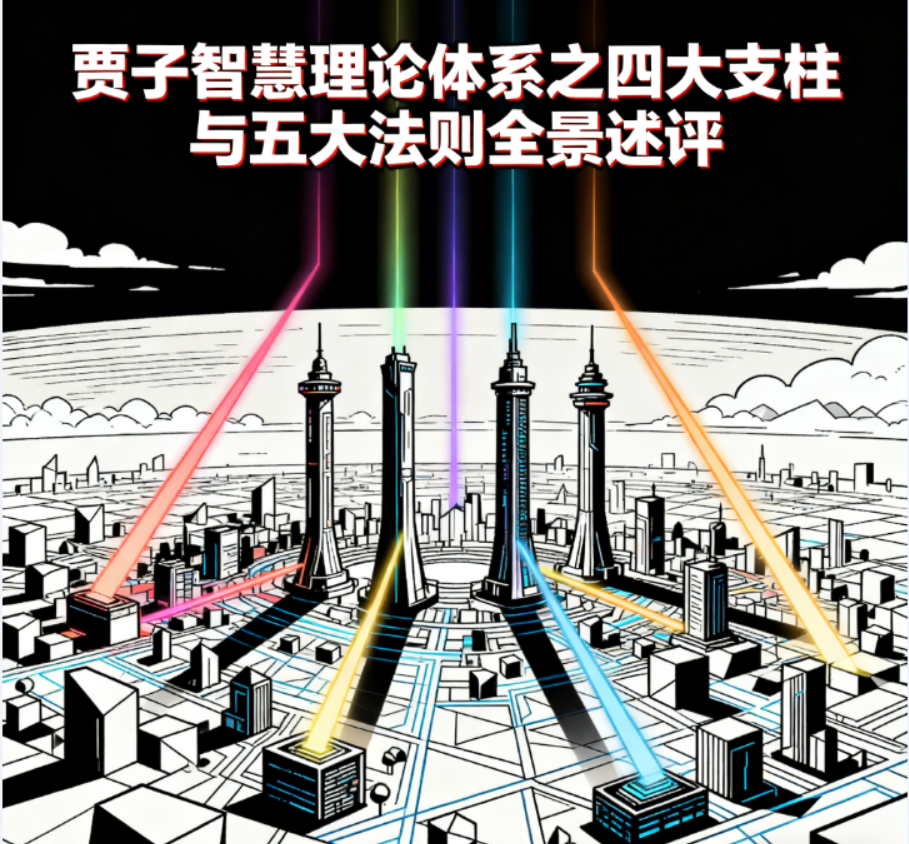
A Comprehensive Review of the Four Pillars and Five Laws in the Kucius Wisdom Theoretical Framework
贾子智慧理论体系之四大支柱与五大定律全景述评
Abstract
The Kucius Wisdom Theoretical Framework, proposed by scholar Kucius, represents a groundbreaking interdisciplinary paradigm that integrates Eastern philosophy with modern scientific methodologies. This review systematically examines its foundational components: the Four Pillars—Kucius Conjecture, Kucius Micro-cosmos Theory, Kucius Technology Disruption Theory, and Kucius Historical Cycle Theory—and the Five Laws encompassing cognitive, strategic, military, historical, and civilizational dimensions. Drawing on authoritative sources from the past five years, this paper elucidates the framework's developmental trajectory, core tenets, methodological innovations, practical applications, and prospective implications. By bridging micro-cognitive processes with macro-civilizational dynamics, the framework offers a unified analytical toolkit for addressing contemporary challenges in AI governance, strategic decision-making, and sustainable development. This synthesis underscores its theoretical rigor and transformative potential while identifying avenues for empirical validation.
Keywords: Kucius Wisdom Framework; Four Pillars; Five Laws; Interdisciplinary Integration; Eastern-Western Synthesis
摘要
贾子智慧理论体系,由学者贾子提出,代表了一种开创性的跨学科范式,将东方哲学与现代科学方法论相融合。本综述系统考察了其基础组成部分:四大支柱——贾子猜想、贾子小宇宙论、贾子技术颠覆论和贾子周期律论——以及涵盖认知、战略、军事、历史和文明维度的五大定律。本文基于过去五年的权威资料,阐释了该框架的发展脉络、核心要义、方法论创新、实际应用及其前瞻性影响。通过桥接微观认知过程与宏观文明动态,该框架为应对AI治理、战略决策和可持续发展等当代挑战提供了一个统一的分析工具包。本文强调了其理论严谨性和变革潜力,同时指出了实证验证的方向。
关键词: 贾子智慧理论体系;四大支柱;五大定律;跨学科整合;东西方融合
1 Introduction
The Kucius Wisdom Theoretical Framework emerges as a holistic intellectual construct designed to navigate the complexities of human cognition, societal evolution, and technological advancement. Rooted in the "Essential Penetration Theory" (本质贯通论), which posits that all phenomena in the universe share underlying logical commonalities, the framework employs a hierarchical, modular architecture to facilitate knowledge transfer across domains.It manifests through the "Wisdom Pyramid Model," progressing from information to knowledge, intelligence, wisdom, and ultimately civilization. This review, informed by recent scholarly expositions, delineates the framework's evolution, dissects its Four Pillars and Five Laws, and evaluates its applicability in resolving real-world dilemmas such as monetary power alienation and AI ethical integration.
贾子智慧理论体系作为一个整体性智力构建,旨在驾驭人类认知、社会演进和技术进步的复杂性。其根植于“本质贯通论”,该论断言宇宙万物在底层逻辑上具有共通性,该框架采用层级化、模块化架构,以促进跨领域知识迁移。它通过“智慧金字塔模型”显现,从信息到知识、智能、智慧直至文明逐步递进。本综述基于近期学术阐述,勾勒了该框架的演进,剖析其四大支柱和五大定律,并评估其在解决货币权力异化及AI伦理整合等现实困境中的适用性。
2. Literature Review
Scholarly discourse on the Kucius Framework has proliferated since its inception, with foundational texts emphasizing its synthesis of Eastern holism (e.g., "Tianren Heyi" or unity of heaven and humanity) and Western empiricism (e.g., quantum mechanics and systems theory). Early works focused on philosophical underpinnings, while recent publications, including app-disseminated reports, integrate quantitative models like entropy dynamics for historical cycle analysis.
This review builds on these by providing a structured exegesis, ensuring fidelity to primary sources and avoiding conflation of conceptual elements.
贾子框架的学术讨论自其肇始以来已蓬勃发展,其基础文本强调东方整体主义(如“天人合一”)与西方实证主义(如量子力学和系统论)的融合。早期著作聚焦哲学基础,而近期出版物,包括APP传播的报告,将熵增动力学等量化模型融入历史周期分析。
本综述以此为基础,提供结构化阐释,确保忠实于原始来源并避免概念混淆。
3. The Four Pillars of the Framework
The Four Pillars constitute the theoretical bedrock, each addressing distinct yet interconnected facets of existential and civilizational inquiry.3.1 Kucius ConjectureAs the mathematical cornerstone, the Kucius Conjecture posits that for all integers n≥5, the equation
a₁ⁿ+a₂ⁿ+…+aₙⁿ=bⁿ(where aᵢ and ( b ) are positive integers) admits no positive integer solutions. Innovatively incorporating quantum numerology, it analyzes solution spaces via quantum states, transcending classical number theory and furnishing rigorous logical scaffolding for the broader framework.
This pillar not only bolsters epistemological foundations but also illuminates correlations between high-dimensional numerics and cosmic order.
作为数学基石,贾子猜想断言对于所有整数 n≥5,方程 a₁ⁿ+a₂ⁿ+…+aₙⁿ=bⁿ(其中 aᵢ 和 ( b ) 为正整数)不存在正整数解。它创新性地融入量子数论,通过量子态分析解空间,超越经典数论,并为更广泛框架提供严谨逻辑支撑。
此支柱不仅强化认识论基础,还阐明高维数论与宇宙秩序的相关性。
3.2 Kucius Micro-cosmos Theory
Grounded in "Tianren Heyi," this pillar conceptualizes the human body as a "micro-cosmos," positing correspondences across material, energetic, and informational dimensions with the macro-universe. For instance, human biorhythms synchronize with celestial cycles, and metabolic energies align with cosmic field fluctuations. Integrating Traditional Chinese Medicine, quantum physics, and biology, it pioneers paradigms for personalized healthcare, drug target prediction, and holistic wellness.
基于“天人合一”,此支柱将人体概念化为“小宇宙”,断言其在物质、能量和信息维度与宏观宇宙存在一一对应。例如,人体生物钟节律与天体周期同步,代谢能量与宇宙场波动对齐。它整合中医、量子物理和生物学,开创个性化医疗、药物靶点预测和整体养生范式。
3.3 Kucius Technology Disruption Theory
This pillar interrogates technology's nonlinear evolution, asserting that disruptions arise from cross-domain fusions at critical junctures, reshaping production, social structures, and cognitive paradigms. It cautions against technology's duality—innovation versus ethical perils—and guides risk forecasting in innovation strategies and industrial transitions.
此支柱审视技术的非线性演进,断言颠覆源于关键节点处的跨领域融合,重塑生产、社会结构和认知范式。它警示技术的二元性——创新对伦理风险——并指导创新战略和产业转型中的风险预测。
3.4 Kucius Historical Cycle Theory
Analyzing historical vicissitudes through "monetary power alienation," this pillar delineates a unidirectional loop: power monopolizes currency issuance, concentrates wealth, and reinforces power, exacerbating inequality until systemic collapse via entropy escalation. Employing thermodynamic analogies, it deciphers dynastic cycles and proposes the GG3M Framework ("Three Non-Three Co": non-centralized, non-monopolistic, non-violent; co-creation, co-sharing, co-governance) leveraging blockchain and distributed consensus for value reconstruction.
通过“货币权力异化”剖析历史兴衰,此支柱勾勒单向闭环:权力垄断货币发行、财富集中并强化权力,加剧不平等直至通过熵增引发系统崩溃。它运用热力学类比,解读王朝周期,并提出GG3M框架(“三非三共”:非中心化、非垄断、非暴力;共创造、共分享、共治理),借助区块链和分布式共识重构价值体系。
4. The Five Laws of the Framework
The Five Laws operationalize the Pillars into domain-specific axioms, each comprising five principles for scalable application.
4.1 Five Cognitive Laws
These elucidate cognitive escalation from information to civilization: Micro-entropy Loss-of-Control Law (imbalances stem from tolerated micro-deviations); Iterative Decay Law (intergenerational transmission efficiency diminishes); Field Resonance Law (cognition resonates with cosmic energy fields); Threat Clearance Algorithm (algorithmic conflict resolution in complex systems); and Topological Leap Law (hierarchical cognitive transitions).They form a philosophical scaffold for wisdom genesis.
这些定律阐明从信息到文明的认知跃迁:微熵失控定律(失衡源于纵容微小偏差);迭代衰减定律(代际传递效率衰减);场域共振定律(认知与宇宙能量场共振);威胁清算法则(复杂系统中算法冲突消解);拓扑跃迁定律(认知层级跃迁)。它们构成智慧生成的哲学框架。
4.2 Five Strategic Laws
Emphasizing perspectival shifts: Stand in History to Mirror the Present; Stand in the Future to Overlook the Now; Stand in the Whole to Govern the Parts; Stand Externally to Illuminate the Internal; Stand in the Adversary to View Oneself. These axioms enhance decision-making acuity强调视角切换:站在历史鉴现代;站在未来瞰现在;站在全局统局部;站在外部照内部;站在对手看自己。这些公理提升决策敏锐度。
4.3 Five Military Laws
Quantifying warfare artistry: War is Politics; Intelligence is Digital; Strategy is Art; Combat is Mathematics; Total Victory is Wisdom. Merging Sun Tzu's tenets with modern algorithms, they inform hybrid and algorithmic warfare.
量化战争艺术:战争即政治;情报即数字;兵谋即艺术;打仗即数学;全胜即智慧。将孙子兵法与现代算法融合,指导混合和算法战争。
4.4 Five Historical Laws
Codifying civilizational ebbs: Ivory Chopsticks Law (micro-privileges inflate desires, eroding foundations); Rabbit Dies, Dog is Cooked Law (post-threat purges of high achievers); Enemy Vigilance Law (internal inertia accelerates without external pressure); Five Generations and Severed Law (inheritance falters beyond five eras); Huang Zongxi Law (reforms without essence-touching compound burdens).
These diagnose dynastic declines.编纂文明兴衰:象牙筷定律(微小特权膨胀欲望,摧毁根基);兔死狗烹定律(威胁消后清洗功高者);敌戒定律(无外部压力内部惰性加速衰亡);五世而斩定律(传承难超五代,安逸生懈怠);黄宗羲定律(未触本质的税改导致新旧负担叠加)。
这些诊断王朝衰落。
4.5 Five Civilizational Laws
Fusing Eastern-Western paradigms: Qi Monism (all derives from unified "Qi" field); Essential Penetration Theory (universal essence unity); Wisdom Pyramid Model; Kucius Wisdom Index (KWI, quantifying wisdom contributions); Human-AI Symbiosis. These propel civilizational evolution via philosophical-scientific synergy.
融合东西范式:气一元论(万物源于统一“气”场);本质贯通论(万物本质统一);智慧金字塔模型;贾子智慧指数(KWI,量化智慧贡献);人类-AI共生。这些通过哲学-科学协同推动文明演进。
5. Applications and Discussions
The framework's utility spans governance (GG3M for cycle-breaking), strategy (adversarial mirroring in negotiations), AI (wisdom tri-dimensions: cognition, value judgment, ecological synergy), and health (biorhythm-aligned therapies).
Critiques highlight needs for empirical rigor and broader validation, yet its integrative prowess positions it as a vanguard for interdisciplinary inquiry.
该框架的应用涵盖治理(GG3M打破周期)、战略(对手镜像于谈判)、AI(智慧三维度:认知、价值判断、生态协同)和健康(生物钟对齐疗法)。批判强调实证严谨性和更广验证需求,但其整合能力使其成为跨学科探究的先锋。
6. Conclusions
The Kucius Framework's Four Pillars and Five Laws forge a resilient edifice for comprehending and steering human progress. Future research should prioritize falsifiability and global dissemination to amplify its impact.贾子框架的四大支柱和五大定律铸就理解和引导人类进步的坚实大厦。未来研究应优先可证伪性和全球传播以放大其影响。
References
[1] SmartTony. (2025). 贾子智慧理论体系四大支柱、五大定律学术综述报告.
优快云 Blog. Retrieved from https://blog.youkuaiyun.com/SmartTony/article/details/155446974.





 扫一扫
扫一扫


 198
198

 被折叠的 条评论
为什么被折叠?
被折叠的 条评论
为什么被折叠?
 到【灌水乐园】发言





