



1 C++中的函数模板简介
函数模板:
- 一种特殊的函数可用不同类型进行调用。
- 看起来和普通函数很相似,区别是类型可被参数化。
- 函数模板是泛型编程在C++中的应用方式之一,是C++中重要的代码复用方式。
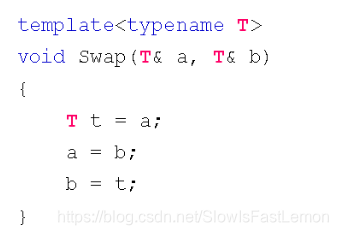
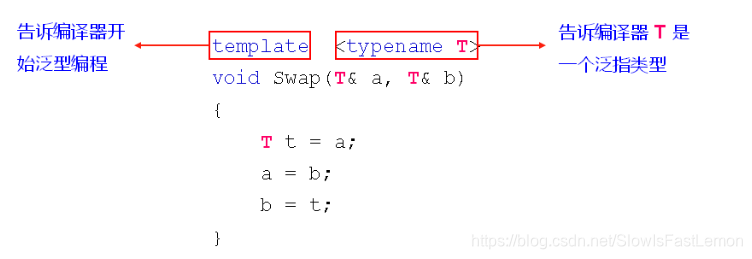
函数模板语法规则: - template关键字用于声明开始进行泛型编程。
- typename关键字用于声明泛指类型。
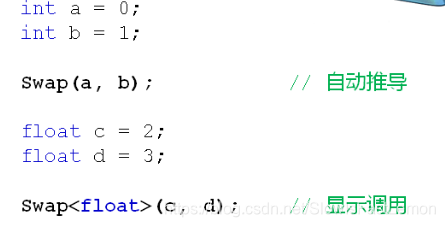
函数模板的使用:
- 自动类型推导调用。
- 具体类型显示调用。
函数模板使用示例:
#include <iostream>
#include <string>

using namespace std;

template < typename T >
void Swap(T& a, T& b)
{
    T c = a;
    a = b;
    b = c;
}

template < typename T >
void Sort(T a[], int len)
{
    for(int i=0; i<len; i++)
    {
        for(int j=i; j<len; j++)
        {
            if( a[i] > a[j] )
            {
                Swap(a[i], a[j]);
            }
        }
    }
}

template < typename T >
void Println(T a[], int len)
{
    for(int i=0; i<len; i++)
    {
        cout << a[i] << ", ";
    }

    cout << endl;
}

int main()
{
    int a[5] = {5, 3, 2, 4, 1};

    Println(a, 5);
    Sort(a, 5);
    Println(a, 5);

    string s[5] = {"Java", "C++", "Pascal", "Ruby", "Basic"};

    Println(s, 5);
    Sort(s, 5);
    Println(s, 5);

    return 0;
}
2 函数模板深入理解
编译器从函数模板通过具体类型产生不同的函数,编译器会对函数模板进行两次编译:
- 对模板代码本身进行编译。
- 对参数替换后的代码进行编译。
注意事项:函数模板本身不允许隐式类型转换。
- 自动推导类型时,必须严格匹配。
- 显示类型指定时,能够进行隐式类型转换。
函数模板的本质示例程序:
#include <iostream>
#include <string>

using namespace std;

class Test
{
    Test(const Test&);
public:
    Test()
    {
    }
};

template < typename T >
void Swap(T& a, T& b)
{
    T c = a;
    a = b;
    b = c;
}

typedef void(FuncI)(int&, int&);
typedef void(FuncD)(double&, double&);
typedef void(FuncT)(Test&, Test&);

int main()
{
    FuncI* pi = Swap;    // 编译器自动推导 T 为 int
    FuncD* pd = Swap;    // 编译器自动推导 T 为 double
    // FuncT* pt = Swap;    // 编译器自动推导 T 为 Test

    cout << "pi = " << reinterpret_cast<void*>(pi) << endl;
    cout << "pd = " << reinterpret_cast<void*>(pd) << endl;
    // cout << "pt = " << reinterpret_cast<void*>(pt) << endl;

    return 0;
}
3 多参数函数模板
函数模板可以定义任意多个不同的类型参数:
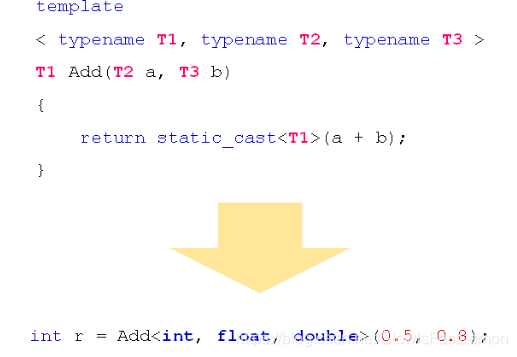
对于多参数函数模板:
- 无法自动推导返回值类型。
- 可以从左向右部分指定类型参数。
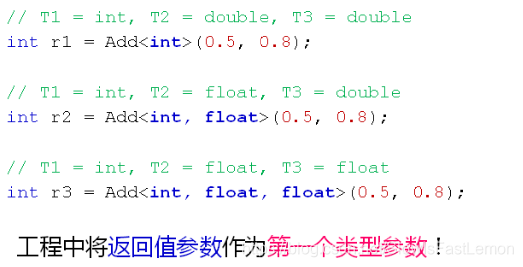
编程实验:多参数函数模板
#include <iostream>
#include <string>

using namespace std;

template
< typename T1, typename T2, typename T3 >
T1 Add(T2 a, T3 b)
{
    return static_cast<T1>(a + b);
}


int main()
{
    // T1 = int, T2 = double, T3 = double
    int r1 = Add<int>(0.5, 0.8);

    // T1 = double, T2 = float, T3 = double
    double r2 = Add<double, float>(0.5, 0.8);

    // T1 = float, T2 = float, T3 = float
    float r3 = Add<float, float, float>(0.5, 0.8);

    cout << "r1 = " << r1 << endl;     // r1 = 1
    cout << "r2 = " << r2 << endl;     // r2 = 1.3
    cout << "r3 = " << r3 << endl;     // r3 = 1.3

    return 0;
}
4 函数重载遇到函数模板
函数模板可以像普通函数一样被重载:
- C++编译器有限考虑普通函数。
- 如果函数模板可以产生一个更好的匹配,那么选择模板。
- 可以通过空模板实参列表限定编译器只匹配模板。
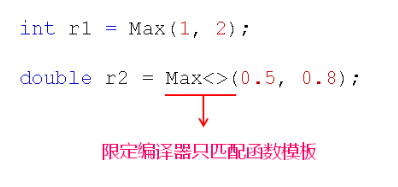
实例分析:重载函数模板
#include <iostream>
#include <string>

using namespace std;


template < typename T >
T Max(T a, T b)
{
    cout << "T Max(T a, T b)" << endl;

    return a > b ? a : b;
}

int Max(int a, int b)
{
    cout << "int Max(int a, int b)" << endl;

    return a > b ? a : b;
}

template < typename T >
T Max(T a, T b, T c)
{
    cout << "T Max(T a, T b, T c)" << endl;

    return Max(Max(a, b), c);
}

int main()
{
    int a = 1;
    int b = 2;

    cout << Max(a, b) << endl;                   // 普通函数 Max(int, int)

    cout << Max<>(a, b) << endl;                 // 函数模板 Max<int>(int, int)

    cout << Max(3.0, 4.0) << endl;               // 函数模板 Max<double>(double, double)

    cout << Max(5.0, 6.0, 7.0) << endl;          // 函数模板 Max<double>(double, double, double)

    cout << Max('a', 100) << endl;               // 普通函数 Max(int, int)

    return 0;
}
5 函数模板的特化
函数模板只支持类型参数完全特化:
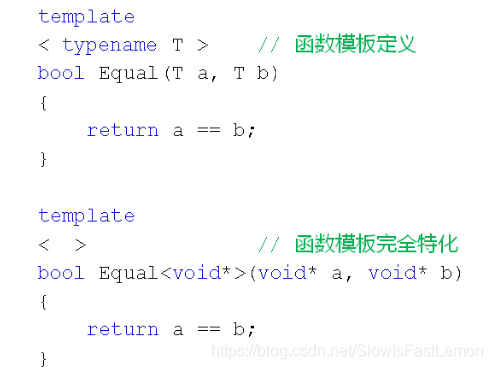
工程中的建议:当需要重载函数模板时,有限考虑使用模板特化;当模板特化无法满足需求时,再使用函数重载!
编程实验:函数模板的特化
#include <iostream>
#include <string>

using namespace std;

template
< typename T1, typename T2 >
class Test
{
public:
    void add(T1 a, T2 b)
    {
        cout << "void add(T1 a, T2 b)" << endl;
        cout << a + b << endl;
    }
};

/*
template
<  >
class Test < void*, void* >    // 当 T1 == void* 并且 T2 == void* 时
{
public:
    void add(void* a, void* b)
    {
        cout << "void add(void* a, void* b)" << endl;
        cout << "Error to add void* param..." << endl;
    }
};
*/

class Test_Void
{
public:
    void add(void* a, void* b)
    {
        cout << "void add(void* a, void* b)" << endl;
        cout << "Error to add void* param..." << endl;
    }
};

template
< typename T >
bool Equal(T a, T b)
{
    cout << "bool Equal(T a, T b)" << endl;

    return a == b;
}

template
< >
bool Equal<double>(double a, double b)
{
    const double delta = 0.00000000000001;
    double r = a - b;

    cout << "bool Equal<double>(double a, double b)" << endl;

    return (-delta < r) && (r < delta);
}

bool Equal(double a, double b)
{
    const double delta = 0.00000000000001;
    double r = a - b;

    cout << "bool Equal(double a, double b)" << endl;

    return (-delta < r) && (r < delta);
}

int main()
{
    cout << Equal( 1, 1 ) << endl;
    cout << Equal(0.001, 0.001) << endl;	// 优先使用普通函数
    cout << Equal<>( 0.001, 0.001 ) << endl;

    return 0;
}
6 数值型模板参数
模板参数可以是数值型参数(非类型参数):
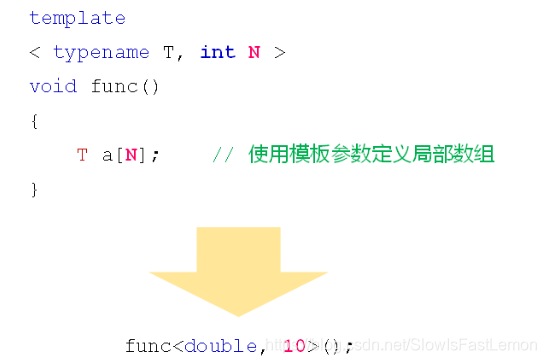
数值型模板参数的限制:
- 变量不能作为模板参数。
- 浮点数不能作为模板参数。
- 类对象不能作为模板参数。
本质:模板参数是在编译阶段被处理的单元,因此,在编译阶段必须准确无误的唯一确定。
利用数值型模板参数求解如下问题:最高效的求解1 + 2 + 3 + 4 + … + N的值:
#include <iostream>
#include <string>

using namespace std;

template
< typename T, int N >
void func()
{
    T a[N] = {0};

    for(int i=0; i<N; i++)
    {
        a[i] = i;
    }

    for(int i=0; i<N; i++)
    {
        cout << a[i] << endl;
    }
}

template
< int N >
class Sum
{
public:
    static const int VALUE = Sum<N-1>::VALUE + N;
};

template
< >
class Sum < 1 >
{
public:
    static const int VALUE = 1;
};


int main()
{
    cout << "1 + 2 + 3 + ... + 10 = " << Sum<10>::VALUE << endl;
    cout << "1 + 2 + 3 + ... + 100 = " << Sum<100>::VALUE << endl;

    return 0;
}
参考资料:





 扫一扫
扫一扫


 917
917

 被折叠的 条评论
为什么被折叠?
被折叠的 条评论
为什么被折叠?
 到【灌水乐园】发言





