


 本文深入探讨Kotlin协程的withContext使用、CommonPool创建原理及协程取消机制,包括async与await的运用。

协程虽然是微线程,但是并不会和某一个特定的线程绑定,它可以在A线程中执行,并经过某一个时刻的挂起(suspend),等下次调度到恢复执行的时候,很可能会在B线程中执行。
一. withContext
与 launch、async、runBlocking 类似 withContext 也属于 Coroutine builders。不过与他们不同的是,其他几个都是创建一个新的协程,而 withContext 不会创建新的协程。withContext 允许更改协程的执行线程,withContext 在使用时需要传递一个 CoroutineContext 。
launch {val result1 = withContext(CommonPool) {delay(2000)1}val result2 = withContext(CommonPool) {delay(1000)2}val result = result1 + result2println(result)}Thread.sleep(5000)
执行结果:
3
withContext 可以有返回值,这一点类似 async。async 创建的协程通过 await() 方法将值返回。而 withContext 可以直接返回。
launch {val result1 = async {delay(2000)1}val result2 = async {delay(1000)2}val result = result1.await() + result2.await()println(result)}Thread.sleep(5000)
执行结果:
3
二. 共享线程池
在上述的例子中,withContext 使用了 CommonPool。CommonPool 继承了 CoroutineDispatcher,表示使用线程池来执行协程的任务。
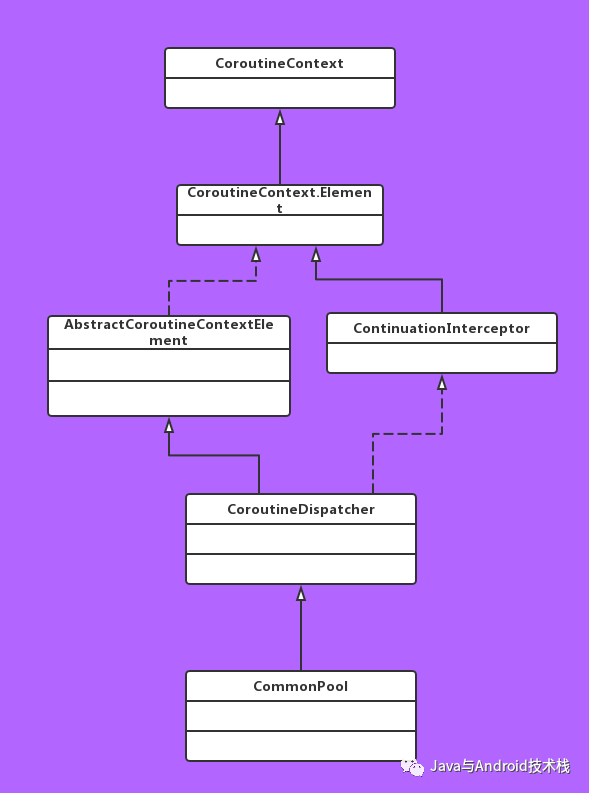
CommonPool 有点类似于 RxJava 的 Schedulers.computation(),主要是用于CPU密集型的计算任务。
CommonPool 使用 pool 来执行 block。
override fun dispatch(context: CoroutineContext, block: Runnable) =try { (pool ?: getOrCreatePoolSync()).execute(timeSource.trackTask(block)) }catch (e: RejectedExecutionException) {timeSource.unTrackTask()DefaultExecutor.execute(block)}
如果 pool 为空,则调用 getOrCreatePoolSync() 方法来创建 pool。
@Synchronizedprivate fun getOrCreatePoolSync(): Executor =pool ?: createPool().also { pool = it }
此时,createPool() 方法是正在创建 pool 的方法。
首先,安全管理器不为空的话,使用 createPlainPool() 来创建 pool。 否则,尝试创建一个 ForkJoinPool,不行的话还是使用 createPlainPool() 来创建 pool。
private fun createPool(): ExecutorService {if (System.getSecurityManager() != null) return createPlainPool()val fjpClass = Try { Class.forName("java.util.concurrent.ForkJoinPool") }?: return createPlainPool()if (!usePrivatePool) {Try { fjpClass.getMethod("commonPool")?.invoke(null) as? ExecutorService }?.let { return it }}Try { fjpClass.getConstructor(Int::class.java).newInstance(parallelism) as? ExecutorService }?. let { return it }return createPlainPool()}
createPlainPool() 会使用 Executors.newFixedThreadPool() 来创建线程池。
private fun createPlainPool(): ExecutorService {val threadId = AtomicInteger()return Executors.newFixedThreadPool(parallelism) {Thread(it, "CommonPool-worker-${threadId.incrementAndGet()}").apply { isDaemon = true }}}
CommonPool 的创建原理大致了解之后,通过源码发现 CoroutineContext 默认的 CoroutineDispatcher 就是 CommonPool。
/*** This is the default [CoroutineDispatcher] that is used by all standard builders like* [launch], [async], etc if no dispatcher nor any other [ContinuationInterceptor] is specified in their context.** It is currently equal to [CommonPool], but the value is subject to change in the future.*/@Suppress("PropertyName")public actual val DefaultDispatcher: CoroutineDispatcher = CommonPool
常见的 CoroutineDispatcher 还可以通过 ThreadPoolDispatcher 的 newSingleThreadContext()、newFixedThreadPoolContext()来创建,以及Executor 的扩展函数 asCoroutineDispatcher() 来创建。
在 Android 中,还可以使用UI。它顾名思义,在 Android 主线程上调度执行。
三. 可取消的协程
Job、Deferred 对象都可以取消任务。
3.1 cancel()
使用 cancel() 方法:
val job = launch {delay(1000)println("Hello World!")}job.cancel()println(job.isCancelled)Thread.sleep(2000)
执行结果:
true
true表示job已经被取消了,并没有打印"Hello World!"
3.2 cancelAndJoin()
使用 cancelAndJoin() 方法:
runBlocking<Unit> {val job = launch {repeat(100) { i ->println("count time: $i")delay(500)}}delay(2100)job.cancelAndJoin()}
执行结果:
count time: 0count time: 1count time: 2count time: 3count time: 4
cancelAndJoin() 等价于使用了 cancel() 和 join()。
join() 方法用于等待已启动协程的完成,并且它不会传播其异常。 但是,崩溃的子协程也会取消其父协程,并带有相应的异常。
3.3 检查协程的取消标记
如果一个协程一直在执行计算,没有去检查取消标记,它就无法取消。即使调用了cancel() 或者 cancelAndJoin()。
runBlocking<Unit> {val startTime = System.currentTimeMillis()val job = launch {var tempTime = startTimevar i = 0while (i < 100) {if (System.currentTimeMillis() >= tempTime) {println("count time: ${i++}")tempTime += 500L}}}delay(2100)job.cancelAndJoin()}
上述代码仍然会打印100次。
如果使用 isActive检查取消标记,则Job 或 Deferred 的任务可以被取消:
runBlocking<Unit> {val startTime = System.currentTimeMillis()val job = launch {var tempTime = startTimevar i = 0while (isActive) {if (System.currentTimeMillis() >= tempTime) {println("count time: ${i++}")tempTime += 500L}}}delay(2100)job.cancelAndJoin()}
执行结果:
count time: 0count time: 1count time: 2count time: 3count time: 4
isActive 是 CoroutineScope 的属性:
package kotlinx.coroutines.experimentalimport kotlin.coroutines.experimental.*import kotlin.internal.*/*** Receiver interface for generic coroutine builders, so that the code inside coroutine has a convenient* and fast access to its own cancellation status via [isActive].*/public interface CoroutineScope {/*** Returns `true` when this coroutine is still active (has not completed and was not cancelled yet).** Check this property in long-running computation loops to support cancellation:* ```* while (isActive) {* // do some computation* }* ```** This property is a shortcut for `coroutineContext.isActive` in the scope when* [CoroutineScope] is available.* See [coroutineContext][kotlin.coroutines.experimental.coroutineContext],* [isActive][kotlinx.coroutines.experimental.isActive] and [Job.isActive].*/public val isActive: Boolean/*** Returns the context of this coroutine.** @suppress: **Deprecated**: Replaced with top-level [kotlin.coroutines.experimental.coroutineContext].*/@Deprecated("Replace with top-level coroutineContext",replaceWith = ReplaceWith("coroutineContext",imports = ["kotlin.coroutines.experimental.coroutineContext"]))@LowPriorityInOverloadResolution@Suppress("INVISIBLE_MEMBER", "INVISIBLE_REFERENCE")public val coroutineContext: CoroutineContext}
总结:
本文介绍了三个部分:withContext的使用,CommonPool的创建以及如何取消协程。其中,还捎带介绍了 async 和 await 的使用。
该系列的相关文章:
关注【Java与Android技术栈】
更多精彩内容请关注扫码:





 扫一扫
扫一扫


 8055
8055

 被折叠的 条评论
为什么被折叠?
被折叠的 条评论
为什么被折叠?
 到【灌水乐园】发言





