



 文章介绍了如何计算一个正整数序列中所有元素对的最小公倍数(LCM)的最大公除数(GCD)。给定一个序列a,通过计算每个元素与其他所有元素的LCM,然后找出这些LCM的GCD,可以得到最终的GCD。代码示例展示了如何使用Java实现这一算法,包括计算前缀和后缀GCD数组,以及最终的GCD结果。
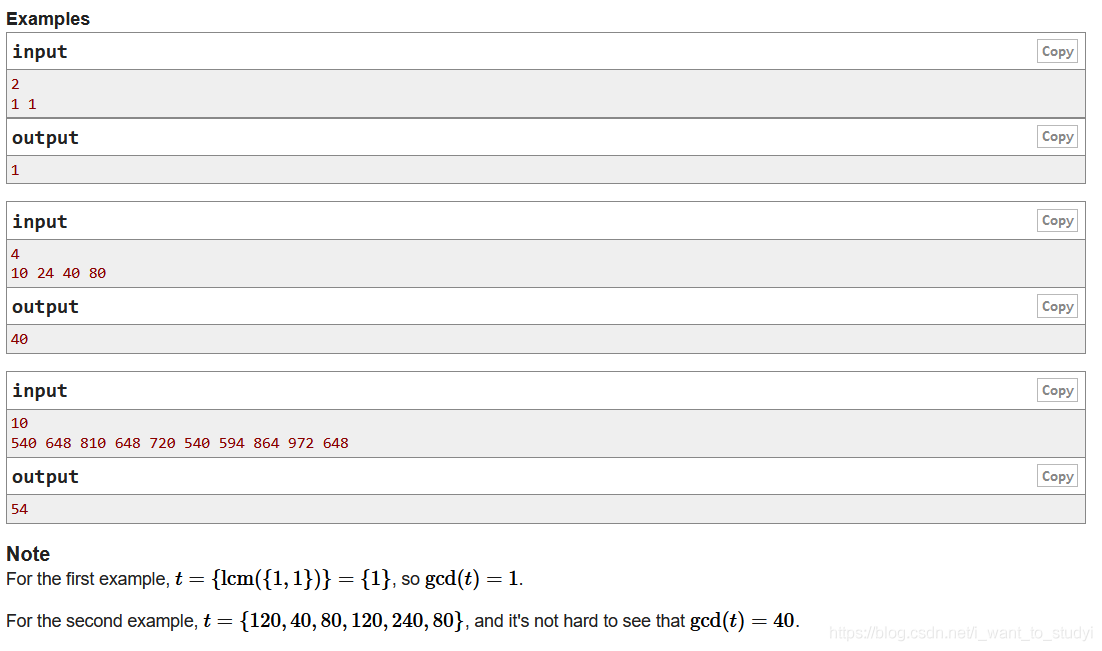
题意:
对于正整数的多集合a={a0,a1,...,ak},定义s的最大公除数(GCD)和最小公倍数(LCM)如下。
gcd(a)是最大的正整数x,使得s中的所有整数都能在x上被除。
lcm(a)是最小的正整数x,它能被s中的所有整数整除。
例如,gcd({8,12})=4,gcd({12,18,6})=6和lcm({4,6})=12。注意,对于任何正整数x,gcd({x})=lcm({x})=x。
Orac有一个长度为n的序列,他想出了一个多集t={lcm({ai,aj}) | i<j},并要求你为他找到gcd(t)的值。换句话说,你需要计算给定序列中所有元素对的LCM的GCD。
先说结论:(红字)
已知数组a = {a0,a1,...,an - 1}
已知gcd0 = gcd{ lcm(a0,a1) , lcm(a0,a2),lcm(a0,a3), ... ,lcm(a0,an-1) }
=gcd(a0,lcm(a1,a2,…,an-1))
gcd1 = gcd{ lcm(a1,a2) , lcm(a1,a2),lcm(a1,a3), ... ,lcm(a1,an-1) }
=gcd(a1,lcm(a2,a3,…,an-1))
gcd2 = gcd{ lcm(a2,a3),lcm(a2,a4),…,lcm(a2,an-1) }
=gcd(a2,lcm(a3,a4,…,an-1))
........
gcdi = gcd{ lcm(ai,ai+ 1),lcm(ai,ai+2),…,lcm(ai,an-1) }
=gcd(ai,lcm(ai+1,ai+2…an-1))
推出res=gcd(gcd1,gcd2,…,gcdn)
代码:
import java.io.BufferedReader;
import java.io.BufferedWriter;
import java.io.IOException;
import java.io.InputStreamReader;
import java.io.OutputStreamWriter;
import java.io.PrintWriter;
import java.math.BigInteger;
import java.nio.file.attribute.AclEntryFlag;
import java.security.AlgorithmConstraints;
import java.sql.Struct;
import java.text.CollationElementIterator;
import java.text.DateFormatSymbols;
import java.util.*;
import java.util.stream.Collectors;


public class Main
{
    static PrintWriter pw = new PrintWriter(new BufferedWriter(new OutputStreamWriter(System.out)));
    static int N = (int)1e5;
    static math_myself math_me = new math_myself();
    static int a[] = new int[N]; // 原数组
    static int prefixgcd[] = new int[N]; // 前缀gcd数组
    static int suffixgcd[] = new int[N]; // 后缀gcd数组

    public static void main(String[] args ) throws IOException
    {
        int n = rd.nextInt();
        for(int i = 0 ; i < n ; i ++)  a[i] = rd.nextInt();

        // 计算前缀gcd数组
        prefixgcd[0] = a[0];
        for(int i = 1 ; i < n ; i ++)  prefixgcd[i] = math_me.gcd(prefixgcd[i - 1],a[i]);

        // 计算后缀gcd数组
        suffixgcd[n - 1] = a[n - 1];
        for(int i = n - 2 ; i >= 0 ; i --)  suffixgcd[i] = math_me.gcd(suffixgcd[i + 1],a[i]);

        int res = 0;
        for(int i = 0 ; i < n ; i ++)   res = math_me.gcd(res,math_me.lcm(suffixgcd[i + 1],a[i]));

        pw.println(res);
        pw.flush();
    }
}

class rd
{
    static BufferedReader reader = new BufferedReader(new InputStreamReader(System.in));
    static StringTokenizer tokenizer = new StringTokenizer("");

    static String nextLine() throws IOException   { return reader.readLine(); }

    static String next() throws IOException
    {
        while (!tokenizer.hasMoreTokens())  tokenizer = new StringTokenizer(reader.readLine());
        return tokenizer.nextToken();
    }

    static int nextInt() throws IOException  { return Integer.parseInt(next()); }

    static double nextDouble() throws IOException { return Double.parseDouble(next()); }

    static long nextLong() throws IOException  { return Long.parseLong(next());}

    static BigInteger nextBigInteger() throws IOException
    {
        BigInteger d = new BigInteger(rd.nextLine());
        return d;
    }
}

class PII
{
    int x,y;
    public PII(int x ,int y)
    {
        this.x = x;
        this.y = y;
    }
}

class math_myself
{
    int gcd(int a,int b)
    {
        if(b == 0)  return a;
        else return gcd(b,a % b);
    }

    int lcm(int a,int b)
    {
        return a * b / gcd(a, b);
    }

    // 求n的所有约数
    List get_factor(int n)
    {
        List<Long> a = new ArrayList<>();
        for(long i = 1; i <= Math.sqrt(n) ; i ++)
        {
            if(n % i == 0)
            {
                a.add(i);
                if(i != n / i)  a.add(n / i);  // // 避免一下的情况:x = 16时,i = 4 ,x / i = 4的情况,这样会加入两种情况  ^-^复杂度能减少多少是多少
            }
        }

        // 相同因子去重,这个方法,完美
        a = a.stream().distinct().collect(Collectors.toList());

        // 对因子排序(升序)
        Collections.sort(a);

        return a;
    }
}





 扫一扫
扫一扫


 457
457

 被折叠的 条评论
为什么被折叠?
被折叠的 条评论
为什么被折叠?
 到【灌水乐园】发言





