


 本文介绍了使用C++编程语言实现LRU(Least Recently Used)缓存淘汰算法的方法,通过结合双向链表和哈希表的数据结构来高效地进行操作。尽管代码质量有待提升,但实验结果显示了该实现的有效性。
C++,双向链表+哈希表结构(代码写的烂,求轻喷)
//LRU缓存结构
//哈希表+双向链表的结构
//链表中存放缓存<K,V>的值


#include <iostream>
#include <list>
#include <unordered_map>

using namespace std;


struct Node {
	int m_key;
	int m_value;
	Node(int key, int value) :m_key(key), m_value(value) {}
};

class LRUCache {
private:
	int m_cap;
	list<Node> m_list;
	unordered_map<int, list<Node>::iterator> m_map;

public:
	LRUCache(int capacity = 5) {
		this->m_cap = capacity;
	}

	int get(int key) {
		auto it = m_map.find(key);

		//没有找到,返回-1
		if (it == m_map.end())
			return -1;

		//如果找到了,返回对应的值,并把对应的链表中<K,V>对提到链表头部
		Node node = *(m_map[key]);
		m_list.erase(m_map[key]);
		m_list.push_front(node);
		m_map[key] = m_list.begin();
		return node.m_value;
	}

	void put(int key, int value) {
		auto it = m_map.find(key);

		if (it == m_map.end()) {  //没找到
			if (m_list.size() == m_cap) { //list满了要删除队尾的Node
				auto lastnode = m_list.back();
				m_map.erase(lastnode.m_key);

				m_list.pop_back();
			}

			m_list.push_front(Node(key, value));//新结点插到队头

			m_map[key] = m_list.begin();
		}
		else {  //找到了
			m_list.erase(m_map[key]);           //删除旧结点
			m_list.push_front(Node(key,value)); //更新新结点到队头

			m_map[key] = m_list.begin();
		}
	}

	void print() {
		if (m_list.empty()) {
			cout << "LRU为空" << endl;
			return;
		}
		for (auto num : m_list) {
			cout << "[K=" << num.m_key << " V=" << num.m_value << "]" << " ";
		}
		cout << endl;
	}
};


int main() {
	LRUCache lru;
	lru.put(2, 100); lru.print();
	lru.put(3, 200); lru.print();
	lru.put(4, 300); lru.print();

	cout << "lru.get(2)=" << lru.get(2) << endl; lru.print();
	lru.put(6, 500); lru.print();
	lru.put(7, 800); lru.print();
	lru.put(8, 900); lru.print();


	return 0;
}
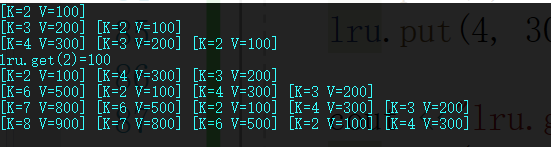
实验结果:





 扫一扫
扫一扫


 794
794


 到【灌水乐园】发言



