


 本文是GAN(生成对抗网络)的全面入门总结,涵盖GAN的动机、基本原理、评估方法、发展历程及应用。从原始GAN到DCGAN、WGAN、SN-GAN等改进版,深入探讨了GAN的训练技巧、模式塌陷问题及其解决方案。此外,还讨论了条件生成如CycleGAN和无监督特征提取方法如InfoGAN。
阅读提醒:中英文混杂
1. Introduction to GAN
1.1 Motivation
Generative models:
-
explicit models: Likelihood-based models ( autoregressive and flows/VAE)
-
implicit models: sample z → sample x, learning the deep neural network without explicit density estimation
1.2 GAN (original GAN) [Goodfellow, NIPS, 2014]
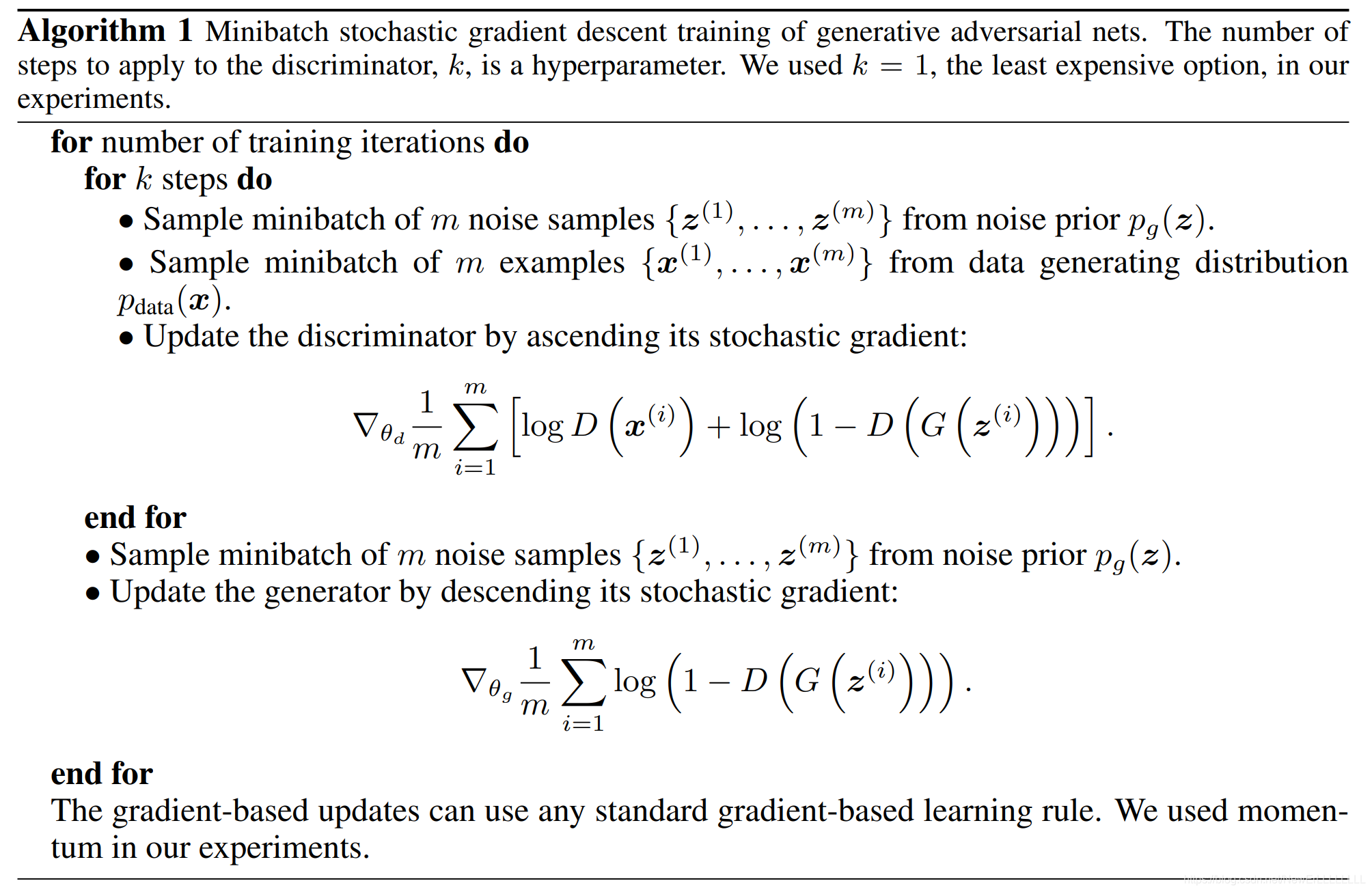
G captures the data distribution, D estimates the divergence between p d a t a p_{data} pdata and p G p_G pG.
m i n G m a x D V ( G , D ) V ( G , D ) = E x ∼ p d a t a [ log D ( x ) ] + E z ∼ p z [ log ( 1 − D ( G ( z ) ) ) ] min_Gmax_D V(G,D) \\ V(G,D) = \mathbb{E}_{x\sim p_{data}}[\log D(x)] + \mathbb{E}_{z\sim p_{z}}[\log (1-D(G(z)))] minGmaxDV(G,D)V(G,D)=Ex∼pdata[logD(x)]+Ez∼pz[log(1−D(G(z)))]
D尽力区别原始数据与生成数据的区别,形成一个二分类器;G给D提供负样本,并且尽力期骗D使D犯错。
# last layer of D is nn.Sigmoid()
criterion=nn.BCELoss()
# Discriminator
f_loss = criterion(netD(fake_img.detach()), f_l)
r_loss = criterion(netD(real_img.detach()), r_l)
D_loss = (f_loss+r_loss)/2
# Generator
G_loss = criterion(netD(fake_img), r_l)  # 注意用的是real的label
Limitations:
- unstable convergence
- vanishing gradient
- more collapse
1.3 Evaluation
Parzen-Window density estimator (Kernel density estimator)
- 只适用于低维
- could be unreliable
Inception Score (IS)
I S ( x ) = exp ( H ( y ) − H ( y ∣ x ) ) IS(x) = \exp(H(y)-H(y|x)) IS(x)=exp(H(y)−H(y∣x))
- IS 越大越好:希望 H ( y ) H(y) H(y)越大越好,表明生成图片的种类越多;希望 H ( y ∣ x ) H(y|x) H(y∣x)越小越好,表明生成图片 x x x后其类别确定,即能够产生被分类的real image.
- IS 没有充分度量diversity
Frechet Inception Distance (FID)
- FID 越小越好
1.4 GAN theory
1.4.1 Bayes-Optimal Discriminator
用D衡量divergence,小的divergence是使discriminator很难分辨的东西,这个divergence不必显示表达,而是用一个NN来实现,这个NN就是D。
D ∗ = a r g m a x D V ( G , D ) D ∗ ( x ) = p d a t a ( x ) p d a t a ( x ) + p G ( x ) m a x V ( G , D ) = V ( G , D ∗ ) = − 2 log 2 + 2 J S D ( p d a t a ∣ ∣ p G ) G ∗ = a r g m i n G m a x D V ( G , D ) = a r g m i n G D i v ( p G , p d a t a ) D^*=argmax_DV(G,D) \\ D^*(x) = \frac{p_{data}(x)}{p_{data}(x)+p_{G}(x)}\\ max V(G,D) = V(G,D^*)=-2\log2+2JSD(p_{data}||p_G) \\ G^*=argmin_Gmax_D V(G,D) = argmin_G Div(p_G,p_{data}) D∗=ar
 最低0.47元/天 解锁文章






 扫一扫
扫一扫


 954
954

 被折叠的 条评论
为什么被折叠?
被折叠的 条评论
为什么被折叠?
 到【灌水乐园】发言





