


目录
一,红黑树的介绍
- 红黑树是一种二叉搜索树,但在每个节点上增加一个存储位(表示节点颜色),可以是red或black;
- 通过任何一条从根到叶子的路径上各个节点的着色方式的限制,红黑树确保没有一条路径会比其他路径长出两倍,因而是接近平衡的;
- 保证了在最坏情况下,查找、插入、删除的时间复杂度都为 O(log n);
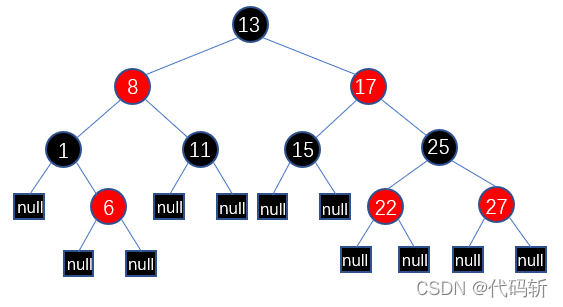
红黑树的性质
- 每个节点不是红色,就是黑色;
- 根节点是黑色的;
- 如一个节点是红色的,则它的两个孩子节点必须是黑色的;
- 对于每个节点,从该节点到其所有后代叶节点的简单路径上,均包含相同数目的黑色节点;
- 每个叶节点都是黑色的(此处的叶节点指的是空节点);
//红黑树节点的定义
enum Color { RED, BLACK };

template<class ValueType>
struct RBTreeNode
{
	RBTreeNode(const ValueType& data = ValueType(), Color color=RED)
		:_pLeft(nullptr)
		,_pRight(nullptr)
		,_pParent(nullptr)
		,_data(data)
		,_color(color)
	{}

	RBTreeNode<ValueType>* _pLeft;
	RBTreeNode<ValueType>* _pRight;
	RBTreeNode<ValueType>* _pParent;
	ValueType _data;
	Color _color;
};
红黑树的结构
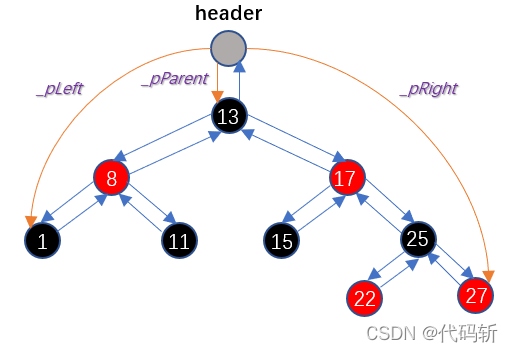
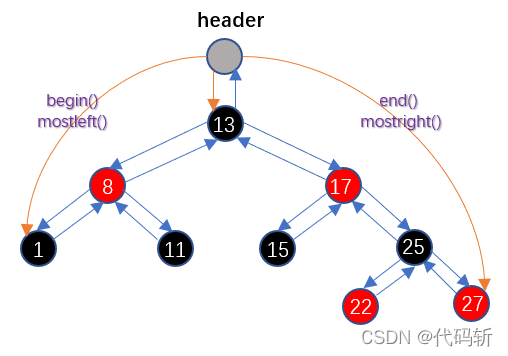
为了后续实现关联式容器简单,红黑树的实现中增加一个头节点;因为根节点必须为黑色,为了与根节点进行区分,将头节点给成黑色,并让头节点的_pParent指向红黑树的根节点,_pLeft指向红黑树中最小的节点,_pRight指向红黑树中最大的节点;
二,红黑树的插入
红黑树是在二叉搜索树的基础上加上其平衡限制条件,红黑树的插入可分为两步:
1,按照二叉搜索树的规则插入新节点;
- 像普通二叉搜索树一样,插入新节点,并着色为红色;
template<class ValueType>
class RBTree
{
	bool Insert(const ValueType& data){
		pNode& pRoot = GetRoot();
		if (pRoot == nullptr){
			pRoot = new Node(data, BLACK);
			pRoot->_pParent = _pHead;
			_pHead->_pParent = pRoot;
		}
		else{
			pRoot->_color = BLACK;
			_pHead->_pLeft = LeftMost();
			_pHead->_pRight = RightMost();
			return true;
		}
	}
private:
	pNode& GetRoot() { return _pHead->_pParent; }
	pNode LeftMost();
	pNode RightMost();
private:
	pNode _pHead;
};
2,检测新节点插入后,红黑树的性质是否遭到破坏;
- 如新插入的节点,其双亲节点颜色是黑色,没有违反红黑树任何性质,则不需要调整;
- 如新插入的节点,其双亲节点颜色为红色时,就违反了性质,此时就需要调整,需分以下情况来分析(约定当前节点为cur,父节点为p,祖父节点为g,叔叔节点为u);
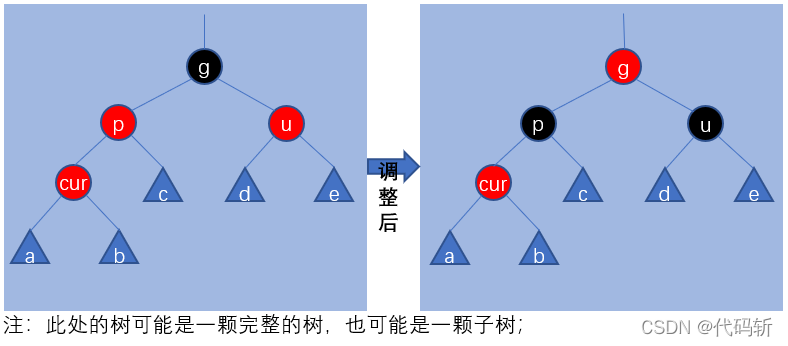
情况一:cur为红,p为红,g为黑,u为红;
解决方法:将p、u改为黑色,g改为红,然后把g当成cur,继续向上调整;
- 如g是根节点,调整完后,需将g改为黑色;
- 如g是子树,g一定有双亲,如该双亲也是红色,需继续向上调整;
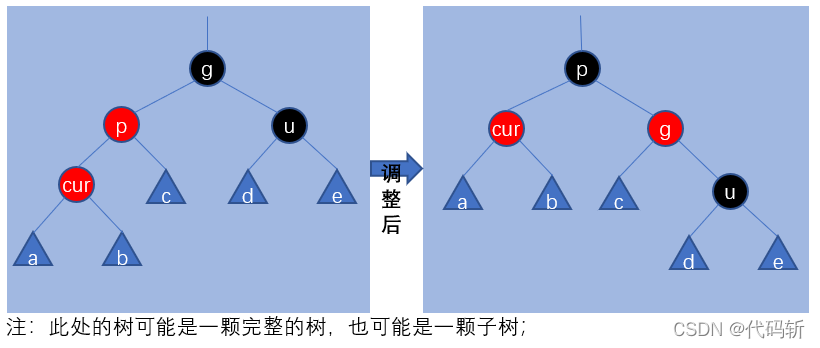
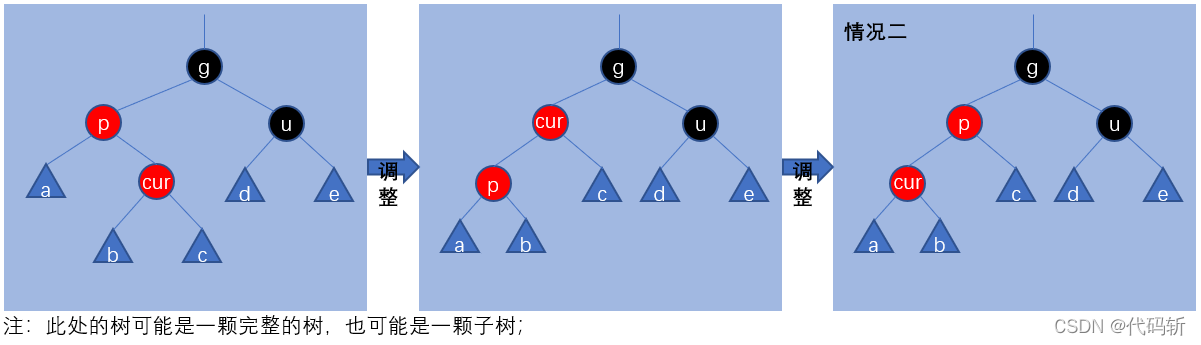
情况二:cur为红,p为红,g为黑,u为黑或不存在,直线型 (Left-Left or Right-Right);
- Left-Left:cur是p的左孩子,p是g的左孩子;
- Right-Right:cur是p的右孩子,p是g的右孩子;
解决方法:将p改为黑色,g改为红,然后对g进行一次右旋(L-L)或进行一次左旋(R-R);
- p为g左孩子,cur为p的左孩子,则进行右单旋;
- p为g右孩子,cur为p的右孩子,则进行左单旋;
- p变黑,g变红;
情况三:cur为红,p为红,g为黑,u为黑或不存在,折线型 (Left-Right or Right-Left);
- Left-Right:cur是p的右孩子,p是g的左孩子;
- Right-Left:cur是p的左孩子,p是g的右孩子;
解决方法:
- p为g的左孩子,cur为p的右孩子,则针对p左单旋;
- p为g的右孩子,cur为p的左孩子,则针对p右单旋;
- 转化为情况2;
三,红黑树的验证及删除
红黑树的验证
- 检测其是否满足二叉搜索树(中序遍历是否为有序序列);
- 检测其是否满足红黑树的性质;
bool IsValidRBTree()
{
	pNode pRoot = GetRoot();
	if (pRoot == nullptr)
		return true;
	if (pRoot->_color == BLACK)
	{
		cout << "违反红黑树根节点必须为黑色" << endl;
		return false;
	}
	size_t blackCount = 0;
	pNode pCur = pRoot;
	while (pCur)
	{
		if (pCur->_color == BLACK)
			blackCount++;
		pCur = pCur->_pLeft;
	}

	size_t k = 0;
	return _IsValidRBTree(pRoot, k, blackCount);
}

bool _IsValidRBTree(pNode pRoot, size_t k, const size_t blackCount)
{
	if (pRoot == nullptr)
	{
		if (blackCount != k)
		{
			cout << "违反性质每条路径中黑色节点个数必须相同" << endl;
			return false;
		}
		return true;
	}

	if (pRoot_color == BLACK)
		k++;

	pNode pParent = pRoot->_pParent;
	if (pParent && pParent->_color == RED && pRoot->_color == RED)
	{
		cout << "违反性质没有连在一起的红色节点" << endl;
		return false;
	}

	return _IsValidRBTree(pRoot->_pLeft, k, const blackCount) &&
		   _IsValidRBTree(pRoot->_pRight, k, const blackCount)
}
红黑树的删除
可参考《算法导论》或《STL源码剖析》;
或参考博客,红黑树 - _Never_ - 博客园;
红黑树与AVL树的比较
- 红黑树和AVL树都是高效的平衡二叉树。增删查改的时间复杂度都为O(logN);
- 红黑树不追求绝对平衡,只需保证最长路径不超过最短路径的2倍,相对而言减低了插入和旋转的次数,所以在经常进行增删的结构中性能比AVL树更优;
- 红黑树实现比较减低,实际运用中红黑树更多;
四,红黑树的应用
- C++ STL库
- set/multiset、map/multimap
- Java库
- Linux内核
- 其他一些库
红黑树模拟实现set/map
红黑树的迭代器(迭代器的好处是方便迭代)
- begin()/end(),STL规定begin()/end()是一段前闭后开的区间,而对于红黑树的遍历得到是有序序列,因此begin()可放在红黑树中最小节点(即最左侧节点)的位置,end()放在最大节点(即最右侧节点)的下一个位置;下一个位置不可给成nullptr,因为对迭代器--操作时需找到最后一个元素,所以最好方式是将end()放在头节点的位置;
- operator++()或operator--()
void Increasement()
{
	if (_pNode->_pRight) //当前节点有右子树,下一个是右子树的最小值
	{
		_pNode = _pNode->_pRight;
		while (_pNode->_pLeft) {
			_pNode = _pNode->_pLeft;
		}
	}
	else //如没有右子树,向上回溯
	{
		pNode pParent = _pNode->_pParent;
		while (pParent->_pRight == _pNode) //当前节点是父节点的右孩子
		{
			_pNode = pParent;
			pParent = _pNode->_pParent;
		}

		if(_pNode->_pRight != pParent) //边界检查
			_pNode = pParent;
	}
}
void Decreasement()
{
//_pNode在head的位置,当迭代器在 end() 位置时,它指向header节点;
if (_pNode->_pParent->_pParent == _pNode && _pNode->_color == RED)
_pNode = _pNode->_pRight;
else if(_pNode->_pLeft) //当前节点有左子树,下一个是左子树的最大值
{
_pNode = _pNode->_pLeft;
while (_pNode->_pRight) {
_pNode = _pNode->_pRight;
}
}
else //如没有左子树,向上回溯
{
pNode pParent = _pNode->_pParent;
while (_pNode == pParent->_pLeft) {
_pNode = pParent;
pParent = _pNode->_pParent;
}
_pNode = pParent;
}
}改造红黑树
//因关联式容器中存储的是键值对<key, value>
//K为key的类型
//ValueType, 如是map,则为pair<K, V>,如是set,则为K
//KeyofValue,通过value来获得key的一个仿函数类
template <class K, class ValueType, class KeyofValue>
class RBTree
{
	typedef RBTreeNode<ValueType> Node;
	typedef Node* pNode;
public:
	typedef RBTreeIterator<ValueType, ValueType*, ValueType&> Iterator;
public:
	RBTree();
	~RBTree();

	Iterator begin() { return Iterator(_pHead->_pLeft); }
	Iterator end() { return Iterator(_pHead); }

	pair<Iterator, bool> Insert(const ValueType& data)
	{
		//插入节点并调整
		return make_pair(Iterator(pNewNode), true);
	}

	void clear();
	Iterator find(const k& key);

	size_t size() const;
	size_t empty() const;

private:
	pNode _pHead;
	size_t _size;
};
set的模拟实现
- set的底层结构就是红黑树,因此在set中直接封装了一颗红黑树;
template<class K>
class set
{
	typedef K ValueType;
	struct KeyOfValue {
		const K& operator()(const ValueType& key) {
			return key;
		}
	};

	typedef RBTree<K, ValueType, KeyOfValue> RBTree;
public:
	typedef typename RBTree::Iterator iterator;
public:
	set() {};

	iterator begin() { return _t.begin() };
	iterator end() { return _t.end() };

	size_t size() const { return _t.size() };
	bool empty() const { return _t.empty() };
	void clear() { return _t.clear() };

	pair<iterator, bool> insert(const ValueType& data) {
		return _t.Insert(data);
	}

	iterator find(const K& key);
private:
	RBTree _t;
}
map的模拟实现
- map的底层结构就是红黑树,因此在map中直接封装了一颗红黑树;
template<class K, class V>
class map
{
	typedef pair(K, V) ValueType;
	struct KeyOfValue {
		const K& operator()(const ValueType& v) {
			return v.first;
		}
	};

	typedef RBTree<K, ValueType, KeyOfValue> RBTree;
public:
	typedef typename RBTree::Iterator iterator;
public:
	map() {};

	iterator begin() { return _t.begin() };
	iterator end() { return _t.end() };

	size_t size() const { return _t.size() };
	bool empty() const { return _t.empty() };
	void clear() { return _t.clear() };

	V& operator[](const K& key) {
		return (*(_t.Insert(ValueType(key, V())))).first).second;
	}
	const V& operator[](const K& key)const;

	pair<iterator, bool> insert(const ValueType& data) {
		return _t.Insert(data);
	}

	iterator find(const K& key) {
		return _t.find(key);
	}
private:
	RBTree _t;
}


 1万+


 扫一扫


 被折叠的 条评论
为什么被折叠?
 到【灌水乐园】发言


