



 本文探讨了构成优秀研究论文标题的关键要素,包括预测内容、吸引读者兴趣、反映写作风格及包含关键词等。此外还提供了实用建议,如保持简洁、避免行业术语和不必要的词汇。
Characteristics of a Good Research Title
根据修辞学学者Hairston和Keene的说法,为一篇论文制定一个好的标题涉及到确保研究的标题实现以下四个目标
- It should predict the content of the research paper.
- It should be interesting to the reader.
- It should reflect the tone of the writing.
- It should contain important keywords that will make it easier to be located during a keyword search.
Tips for Writing an Effective Research Paper Title
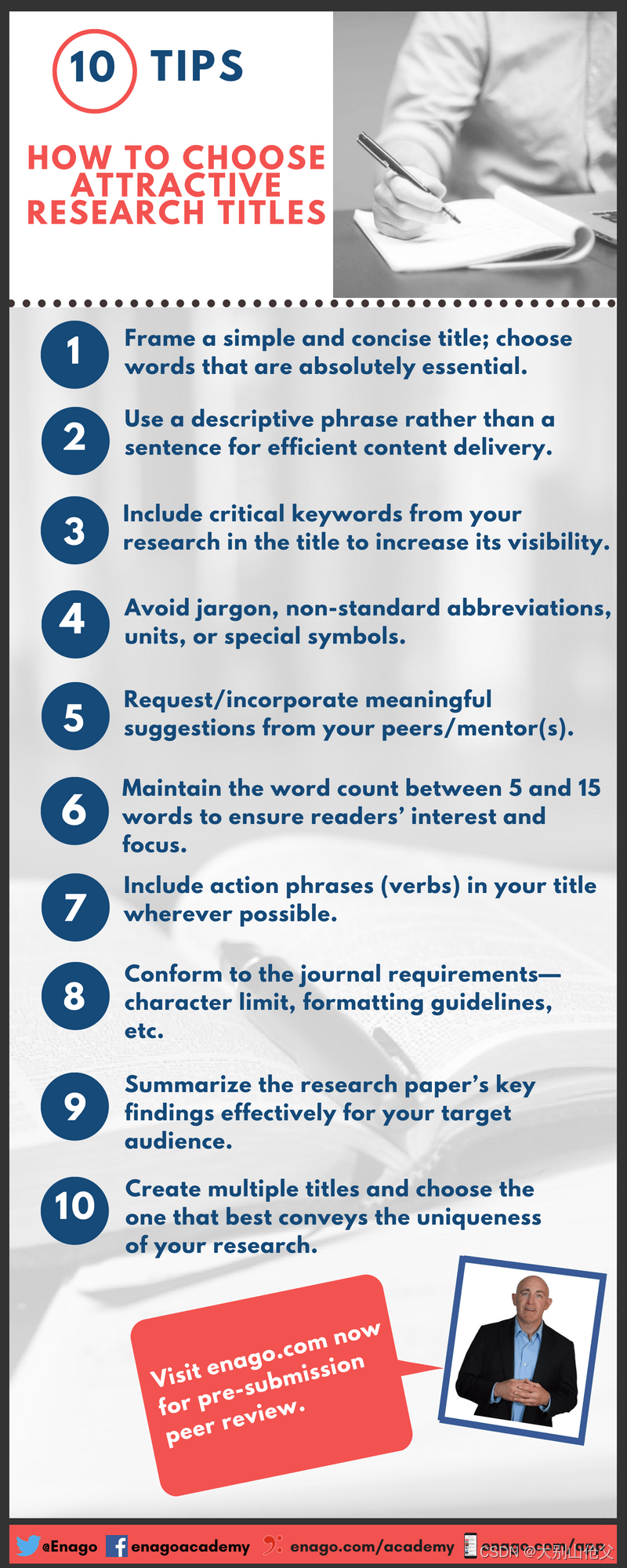
当你写一个研究标题时,你可以使用上面列出的四个标准作为指导。这里有一些其他的技巧,你可以使用,以确保你的标题将是一个有效的研究论文配方的一部分。
- Make sure your research title describes (a) the topic, (b) the method, © the sample, and (d) the results of your study.
- Avoid unnecessary words and jargons. Keep the title statement as concise as possible. You want a title that will be comprehensible even to people who are not experts in your field.
- Make sure your title is between 5 and 15 words in length.
- If you are writing a title for a university assignment or for a particular academic journal, verify that your title conforms to the standards and requirements for that outlet. For example, many journals require that titles fall under a character limit, including spaces. Many universities require that titles take a very specific form, limiting your creativity.
- Use a descriptive phrase to convey the purpose of your research efficiently.
- Most importantly, use critical keywords in the title to increase the discoverability of your article.
A Handy List of Don’ts
- The period generally has no place in a title (even a declarative phrase can work without a period)
- Likewise, any kind of dashes to separates title parts (however, hyphens to link words is fine)
- Chemical formula, like H2O, CH4, etc. (instead use their common or generic names)
- Avoid roman numerals (e.g., III, IX, etc.)
- Semi-colons, as in “;” (the colon, however, is very useful to make two-part titles)
- The taxonomic hierarchy of species of plants, animals, fungi, etc. is not needed
- Abbreviations (except for RNA, DNA which is standard now and widely known)
- Initialisms and acronyms (e.g., “Ca” may get confused with CA, which denotes cancer)
- Avoid question marks (this tends to decrease citations, but posing a question is useful in economics and philosophy papers or when the results are not so clear-cut as hoped for)
- Uncommon words (a few are okay, but too many can influence altmetric scoring)
- Numerical exponents, or units (e.g. km-1 or km/hr)
- Vague terms (e.g., “with” could be re-written with a more specific verb; “amongst” rectified by simpler word ordering)
- Cryptic/complex drug names (use the generic name if allowed to)
- Obvious or non-specific openings with a conjunction: e.g., “Report on”, “A Study of”, “Results of”, “An Experimental Investigation of”, etc. (these don’t contribute meaning!)
- Italics, unless it is used for the species names of studied organisms
- Shorten scientific names (not coli, but write instead Escherichia coli)
- Keep it short. Aim for 50 to 100 characters, but not more (shorter titles are cited more often) or less than 13 words





 扫一扫
扫一扫


 被折叠的 条评论
为什么被折叠?
被折叠的 条评论
为什么被折叠?
 到【灌水乐园】发言





