



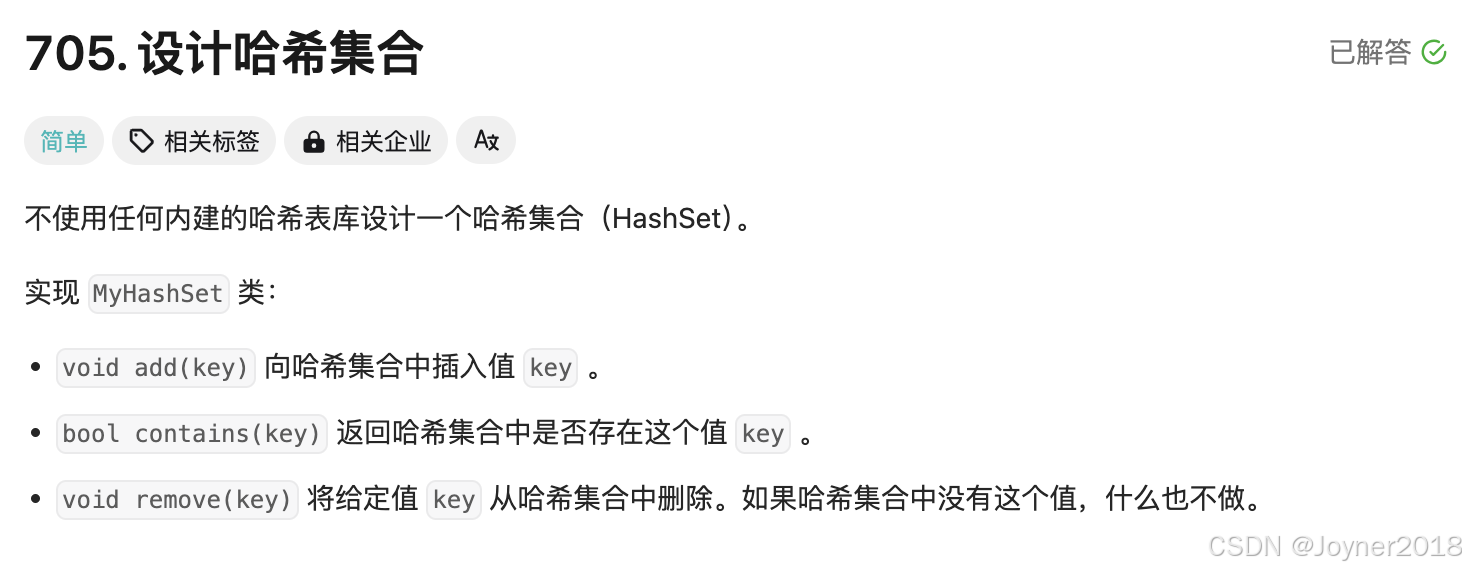

这里是一个使用链地址法(chaining)实现的 MyHashSet,不依赖任何内建的哈希表库:
class MyHashSet:
    def __init__(self, capacity=1000):
        """
        Initialize the HashSet with a given capacity.
        """
        self.capacity = capacity
        self.buckets = [[] for _ in range(self.capacity)]

    def _hash(self, key):
        """
        Compute the hash value of the key.
        """
        return key % self.capacity

    def add(self, key):
        """
        Insert key into the HashSet.
        """
        hash_value = self._hash(key)
        if key not in self.buckets[hash_value]:
            self.buckets[hash_value].append(key)

    def contains(self, key):
        """
        Return whether the key is in the HashSet.
        """
        hash_value = self._hash(key)
        return key in self.buckets[hash_value]

    def remove(self, key):
        """
        Remove key from the HashSet.
        """
        hash_value = self._hash(key)
        if key in self.buckets[hash_value]:
            self.buckets[hash_value].remove(key)
设计思路:
-
哈希函数: 采用简单的取模运算
key % capacity来计算索引,确保键值能够均匀分布在capacity个桶中。 -
桶结构: 采用列表数组
self.buckets来存储数据,每个桶是一个独立的链表(列表)。 -
添加操作 (
add): 计算哈希值并插入到对应的桶中,若该值已存在,则不重复插入。 -
查找操作 (
contains): 计算哈希值,并检查该值是否在对应的桶中。 -
删除操作 (
remove): 计算哈希值并从相应的桶中移除该值。
该实现的平均时间复杂度接近 O(1),在最坏情况下(所有键值冲突)可能达到 O(n)。





 扫一扫
扫一扫


 1123
1123

 被折叠的 条评论
为什么被折叠?
被折叠的 条评论
为什么被折叠?
 到【灌水乐园】发言





