



Why RACH ? (What is the functionality of RACH ?)
For sure, it is not for confusing you ?, RACH has very important functionality especially in LTE (and in WCDMA as well). The main purpose of RACH can be described as follows.
i) Achieve UP link synchronization between UE and eNB
ii) Obtain the resource for Message 3 (e.g, RRC Connection Request)
上行下行同步:
- In LTE (in WCDMA as well), the synchronization in downlink (Transmitter = eNB, Reciever = UE), this synchronization is achieved by the special synchronization channel (special physical signal pattern). his downlink sync signal gets broadcasted to everybody and it is get transmitted all the time with a certain interval.
- However in Uplink(Transmitter = UE, Reciever = eNB), it is not efficient (actually waste of energy and causing a lot of interference to other UEs) if UE is using this kind of broadcasting/always-on synchronization mechanism. You may easily understand this kind of problem. In case of uplink, this synchronization process should meet following criteria.
- The synchronization process should happen only when there is immediate necessity.
- The synchronization should be dedicated to only a specific UE.
When RACH Process occurs ?
LTE, RACH process happens in following situation (3GPP specification, 10.1.5 Random Access Procedure of 36.300 )
       i) Initial access from RRC_IDLE
       ii) RRC Connection Re-establishment procedure
       iii) Handover (Contention Based or Non Contetion Based)
       iv) DL data arrival during RRC_CONNECTED requiring random access procedure
           E.g. when UL synchronisation status is  non-synchronised
       v) UL data arrival during RRC_CONNECTED requiring random access procedure
           E.g. when UL synchronisation status is "non-synchronised" or there are no PUCCH resources for SR available.
       vi) For positioning purpose during RRC_CONNECTED requiring random access procedure;
           E.g. when timing advance is needed for UE positioning
Two types of RACH process : Contention-based and Contention-free
Typical ‘Contention Based’ RACH Procedure is as follows :
        i) UE --> NW : RACH Preamble (RA-RNTI, indication for L2/L3 message size)
        ii) UE <-- NW : Random Access Response (Timing Advance, T_C-RNTI, UL grant for L2/L3 message)
        iii) UE --> NW : L2/L3 message
        iv) Message for early contention resolution
Now let’s assume that a contention happened at step i). For example, two UEs sent PRACH. In this case, both of the UE will recieve the same T_C-RNTI and resource allocation at step ii). And as a result, both UE would send L2/L3 message through the same resource allocation(meaning with the same time/frequency location) to NW at step iii). What would happen when both UE transmit the exact same information on the exact same time/frequency location ? One possibility is that these two signal act as interference to each other and NW decode neither of them. In this case, none of the UE would have any response (HARQ ACK) from NW and they all think that RACH process has failed and go back to step i). The other possibility would be that NW could successfully decode the message from only one UE and failed to decode it from the other UE. In this case, the UE with the successful L2/L3 decoding on NW side will get the HAR啊啊Q ACK from Network. This HARQ ACK process for step iii) message is called “contention resolution” process.
Typical ‘Contention Free’ RACH Procedure is as follows :
        i) UE <--NW : RACH Preamble (PRACH) Assignment
        ii) UE --> NW : RACH Preamble (RA-RNTI, indication for L2/L3 message size)
        iii) UE <--NW : Random Access Response (Timing Advance, C-RNTI, UL grant for L2/L3 message)
How the information is encoded into PRACH (RACH Preamble) ?
The information in PRACH Preamble is represented by purely physical properties. The physical properties that forms the information in PRACH are as follows.
            i) PRACH Preamble transmission Timing (t_id)
            ii) Location of PRACH transmission in frequency domain (f_id)
            iii) Sequence of the whole I/Q data of PRACH signal (one example shown below)
需要补充两点知识:
- IQ信号
- zadoff-chu序列
选择暂时隔过去的细节:
- 提取RA_RNTI算法
- 提权preamble-index算法

Exactly when and Where a UE transmit RACH ?
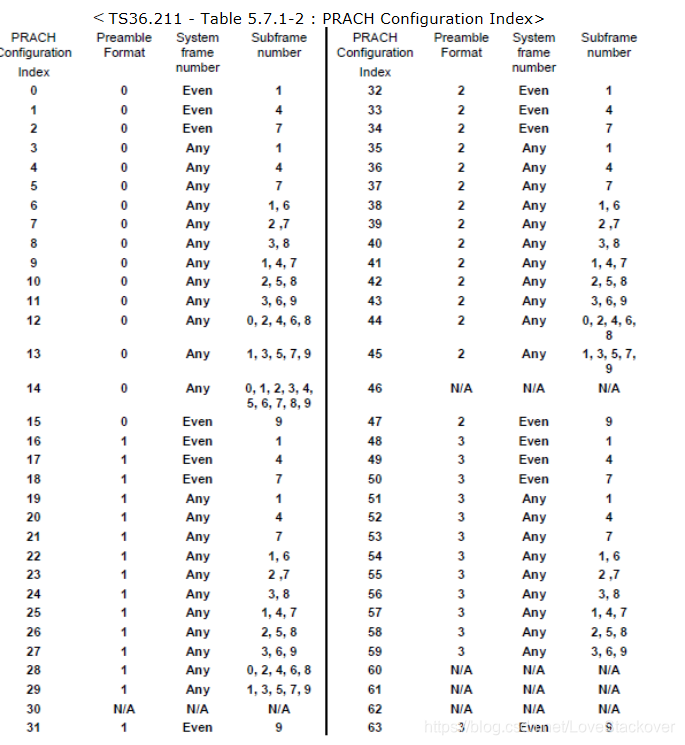
The, how PRACH Configuration Index is determined ? It is determined by SIB2 parameter prach-ConfigIndex.
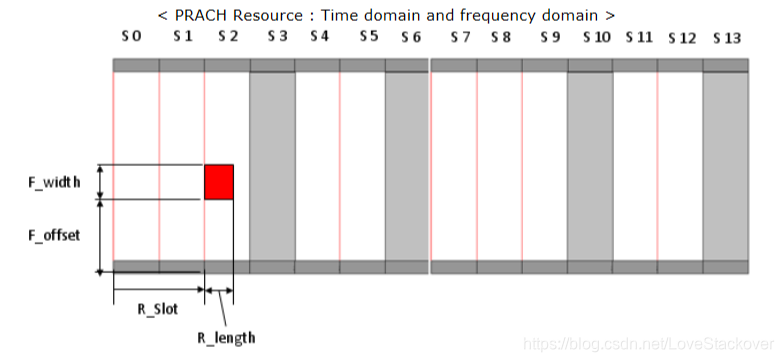
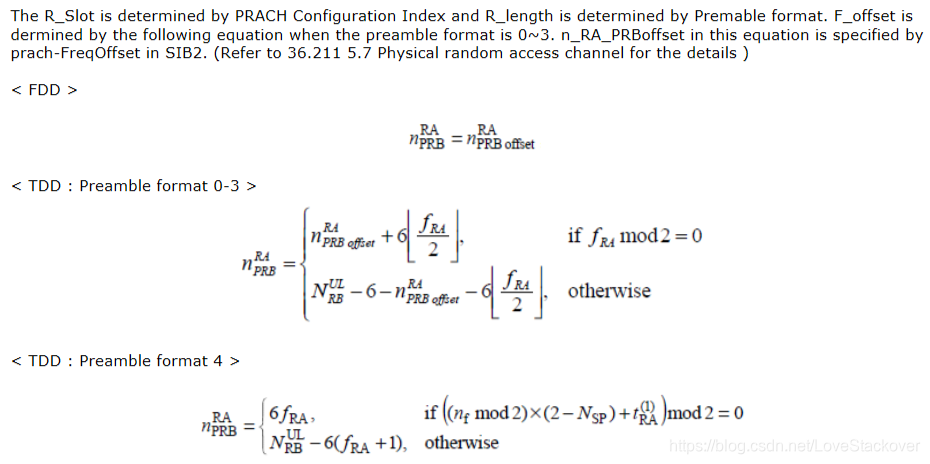 这里需要补充资源分配方式,PRB\RB\VRB的相关概念,区分集中式和分布式?
What is preamble format ?
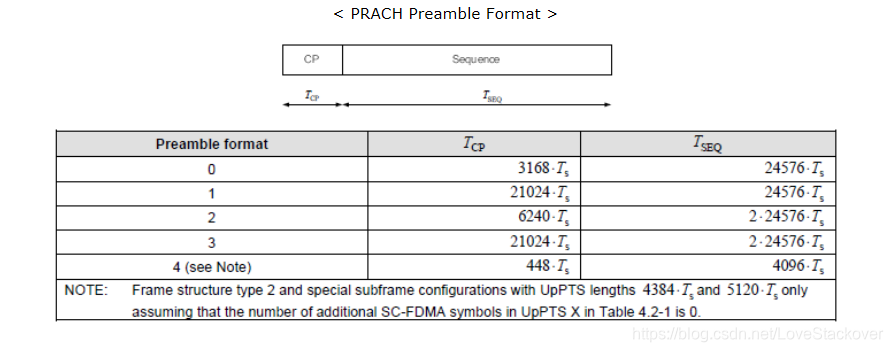
You would see that the length of PRACH preamble varies depending on the preamble format. For example, the length of PRACH with preamble format 0 is (3186 + 24567) Samples. (As you know, one sample (Ts) is 1/30.72 (=0.03255) us. It is defined as 1/(15000 x 2048) seconds (=0.03255 us) in 36.211 4 Frame structure).
至于为什么TS中有2048,需要回归基本的DFT/FFT的目的,再根据协议内容进行进行分析理解。





 扫一扫
扫一扫


 4536
4536

 被折叠的 条评论
为什么被折叠?
被折叠的 条评论
为什么被折叠?
 到【灌水乐园】发言





