






 本文介绍了一种基于卷积神经网络(CNN)进行年龄和性别识别的方法,并提供了详细的实现步骤与模型结构。该模型是在Adience数据集上训练得到的。
Age and Gender Classification Using Convolutional Neural Networks - Demo
数据地址:
主要任务点:
按照例程实现实际模型的运用,这是动手实现的第一个caffe应用,理解了大体轮廓与应用过程。
import os
import numpy as np
import matplotlib.pyplot as plt
import sys
import caffe

caffe_root = '/home/kangyemeng/caffe/'
sys.path.insert(0,caffe_root + 'python')

plt.rcParams['figure.figsize'] = (10,10)
plt.rcParams['image.interpolation'] = 'nearest'
plt.rcParams['image.cmap'] = 'gray'

#loading the mean image
mean_filename = '/home/kangyemeng/AgeGenderDeepLearning/models/mean.binaryproto'
proto_data = open(mean_filename,'rb').read()
a = caffe.io.caffe_pb2.BlobProto.FromString(proto_data)
mean = caffe.io.blobproto_to_array(a)[0]

#loading the age network
age_net_pretrained = '/home/kangyemeng/AgeGenderDeepLearning/models/age_net.caffemodel'
age_net_model_file = '/home/kangyemeng/AgeGenderDeepLearning/models/model_and_data/deploy_age.prototxt'
age_net = caffe.Classifier(age_net_model_file,age_net_pretrained,
                           mean = mean,
                           channel_swap = (2,1,0),
                           raw_scale = 255,
                           image_dims=(256,256))

#loading the gender network
gender_net_pretrained='/home/kangyemeng/AgeGenderDeepLearning/models/age_net.caffemodel'
gender_net_model_file='/home/kangyemeng/AgeGenderDeepLearning/models/model_and_data/deploy_age.prototxt'
gender_net = caffe.Classifier(gender_net_model_file, gender_net_pretrained,
                       mean=mean,
                       channel_swap=(2,1,0),
                       raw_scale=255,
                       image_dims=(256,256))

#labels
age_list=['(0, 2)','(4, 6)','(8, 12)','(15, 20)','(25, 32)','(38, 43)','(48, 53)','(60, 100)']
gender_list=['Male','Female']

#reading and plotting the input image
example_image = '/home/kangyemeng/AgeGenderDeepLearning/models/model_and_data/timg10.jpg'
input_image = caffe.io.load_image(example_image)
_ = plt.imshow(input_image)    #服务器端绘图无法显示,原因还不知道。。。。?!

#age prediction
prediction = age_net.predict([input_image])
print 'predicted age:',age_list[prediction[0].argmax()]

#gender prediction
prediction = gender_net.predict([input_image])
print 'predicted gender:',gender_list[prediction[0].argmax()]
本文使用的网络结构为根据AlexNet删减得来,具体结构如下
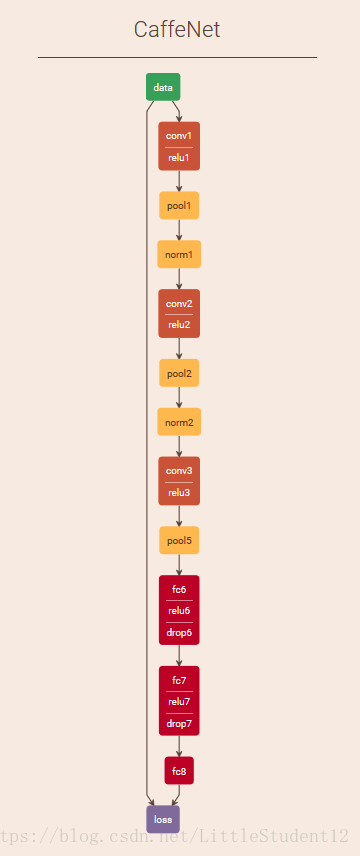
name: "CaffeNet"
layers {
  name: "data"
  type: DATA
  top: "data"
  top: "label"
  data_param {
    source: "/home/ubuntu/AdienceFaces/lmdb/Test_fold_is_4/gender_train_lmdb"
    backend: LMDB
    batch_size: 50
  }
  transform_param {
    crop_size: 227
    mean_file: "/home/ubuntu/AdienceFaces/mean_image/Test_folder_is_4/mean.binaryproto"
    mirror: true
  }
  include: { phase: TRAIN }
}
layers {
  name: "data"
  type: DATA
  top: "data"
  top: "label"
  data_param {
    source:  "/home/ubuntu/AdienceFaces/lmdb/Test_fold_is_4/gender_val_lmdb"
    backend: LMDB
    batch_size: 50
  }
  transform_param {
    crop_size: 227
    mean_file: "/home/ubuntu/AdienceFaces/mean_image/Test_folder_is_4/mean.binaryproto"
    mirror: false
  }
  include: { phase: TEST }
}
layers {
  name: "conv1"
  type: CONVOLUTION
  bottom: "data"
  top: "conv1"
  blobs_lr: 1
  blobs_lr: 2
  weight_decay: 1
  weight_decay: 0
  convolution_param {
    num_output: 96
    kernel_size: 7
    stride: 4
    weight_filler {
      type: "gaussian"
      std: 0.01
    }
    bias_filler {
      type: "constant"
      value: 0
    }
  }
}
layers {
  name: "relu1"
  type: RELU
  bottom: "conv1"
  top: "conv1"
}
layers {
  name: "pool1"
  type: POOLING
  bottom: "conv1"
  top: "pool1"
  pooling_param {
    pool: MAX
    kernel_size: 3
    stride: 2
  }
}
layers {
  name: "norm1"
  type: LRN
  bottom: "pool1"
  top: "norm1"
  lrn_param {
    local_size: 5
    alpha: 0.0001
    beta: 0.75
  }
}
layers {
  name: "conv2"
  type: CONVOLUTION
  bottom: "norm1"
  top: "conv2"
  blobs_lr: 1
  blobs_lr: 2
  weight_decay: 1
  weight_decay: 0
  convolution_param {
    num_output: 256
    pad: 2
    kernel_size: 5
    weight_filler {
      type: "gaussian"
      std: 0.01
    }
    bias_filler {
      type: "constant"
      value: 1
    }
  }
}
layers {
  name: "relu2"
  type: RELU
  bottom: "conv2"
  top: "conv2"
}
layers {
  name: "pool2"
  type: POOLING
  bottom: "conv2"
  top: "pool2"
  pooling_param {
    pool: MAX
    kernel_size: 3
    stride: 2
  }
}
layers {
  name: "norm2"
  type: LRN
  bottom: "pool2"
  top: "norm2"
  lrn_param {
    local_size: 5
    alpha: 0.0001
    beta: 0.75
  }
}
layers {
  name: "conv3"
  type: CONVOLUTION
  bottom: "norm2"
  top: "conv3"
  blobs_lr: 1
  blobs_lr: 2
  weight_decay: 1
  weight_decay: 0
  convolution_param {
    num_output: 384
    pad: 1
    kernel_size: 3
    weight_filler {
      type: "gaussian"
      std: 0.01
    }
    bias_filler {
      type: "constant"
      value: 0
    }
  }
}
layers{
  name: "relu3"
  type: RELU
  bottom: "conv3"
  top: "conv3"
}
layers {
  name: "pool5"
  type: POOLING
  bottom: "conv3"
  top: "pool5"
  pooling_param {
    pool: MAX
    kernel_size: 3
    stride: 2
  }
}
layers {
  name: "fc6"
  type: INNER_PRODUCT
  bottom: "pool5"
  top: "fc6"
  blobs_lr: 1
  blobs_lr: 2
  weight_decay: 1
  weight_decay: 0
  inner_product_param {
    num_output: 512
    weight_filler {
      type: "gaussian"
      std: 0.005
    }
    bias_filler {
      type: "constant"
      value: 1
    }
  }
}
layers {
  name: "relu6"
  type: RELU
  bottom: "fc6"
  top: "fc6"
}
layers {
  name: "drop6"
  type: DROPOUT
  bottom: "fc6"
  top: "fc6"
  dropout_param {
    dropout_ratio: 0.5
  }
}
layers {
  name: "fc7"
  type: INNER_PRODUCT
  bottom: "fc6"
  top: "fc7"
  blobs_lr: 1
  blobs_lr: 2
  weight_decay: 1
  weight_decay: 0
  inner_product_param {
    num_output: 512
    weight_filler {
      type: "gaussian"
      std: 0.005
    }
    bias_filler {
      type: "constant"
      value: 1
    }
  }
}
layers {
  name: "relu7"
  type: RELU
  bottom: "fc7"
  top: "fc7"
}
layers {
  name: "drop7"
  type: DROPOUT
  bottom: "fc7"
  top: "fc7"
  dropout_param {
    dropout_ratio: 0.5
  }
}
layers {
  name: "fc8"
  type: INNER_PRODUCT
  bottom: "fc7"
  top: "fc8"
  blobs_lr: 10
  blobs_lr: 20
  weight_decay: 1
  weight_decay: 0
  inner_product_param {
    num_output: 2
    weight_filler {
      type: "gaussian"
      std: 0.01
    }
    bias_filler {
      type: "constant"
      value: 0
    }
  }
}
layers {
  name: "accuracy"
  type: ACCURACY
  bottom: "fc8"
  bottom: "label"
  top: "accuracy"
  include: { phase: TEST }
}
layers {
  name: "loss"
  type: SOFTMAX_LOSS
  bottom: "fc8"
  bottom: "label"
  top: "loss"
}
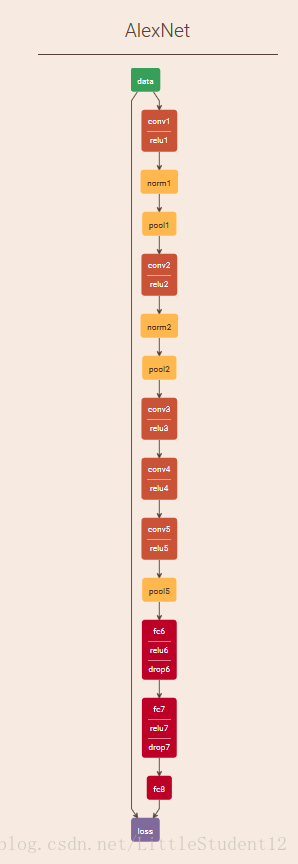
原始AlexNet如下所示






 扫一扫
扫一扫


 3745
3745

 被折叠的 条评论
为什么被折叠?
被折叠的 条评论
为什么被折叠?
 到【灌水乐园】发言





