




引言
这篇博客将MobileNet中使用的各种Block提取出来,以便之后用于其他地方。
MobileNet V1
理论
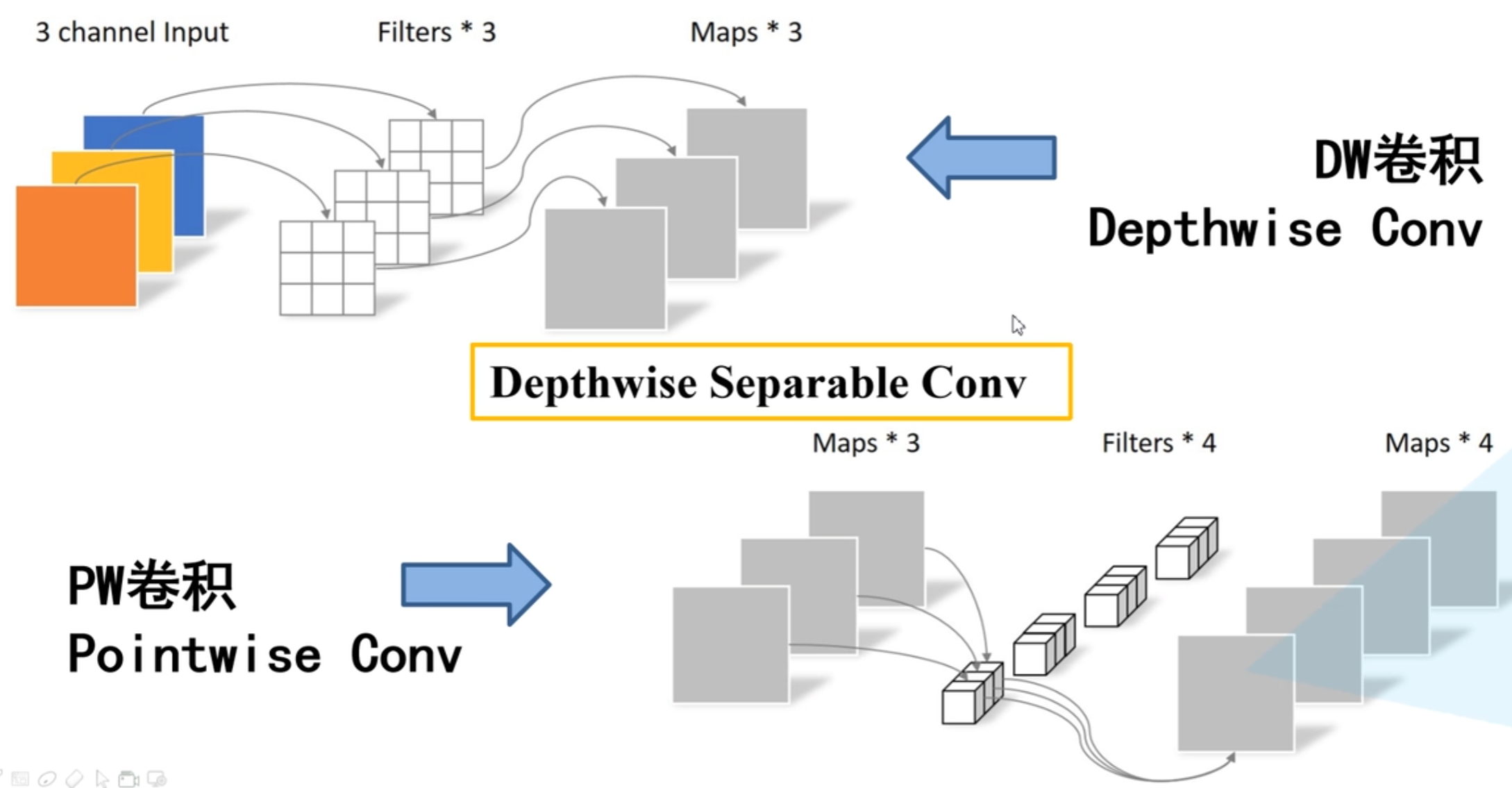
在V1版本中关键是提出了DWConv与PWConv来减低参数量。
DW卷积:只有一个卷积核,其中的每个卷积矩阵都对应着输入数据中的一个通道,输入通道数=输出通道数。在pytorch中,是通过设置nn.Conv2d中的groups参数实现的,让groups=in_channel。同时要设置padding参数来保证stride=1时尺寸不改变。
PW卷积:一个普通的1x1卷积,用于调整通道数。通常与DW卷积配合,来实现普通卷积的功能。
pytorch代码
from torch import nn
padding = (kernel_size - 1) // 2  # 不会修改分辨率
DWConv = nn.Conv2d(in_channel,in_channel,kernel_size,stride,padding=padding,groups=in_channel)
PWConv = nn.Conv2d(in_channel,out_channel,kernel_size=1)
MobileNet V2
理论
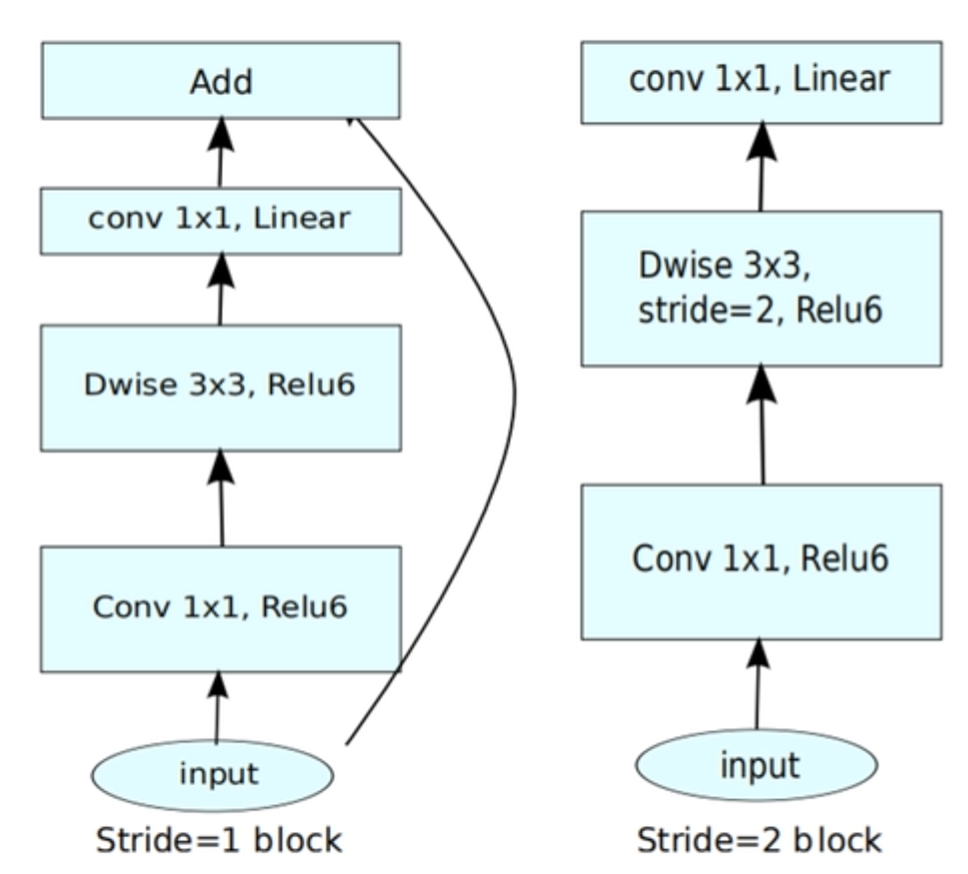
在MobileNetV2中,关键的是提出了倒残差结构。
先通过一个1x1的卷积来升维,然后通过一个3x3的DW卷积,最后通过一个1x1的卷积来降维。
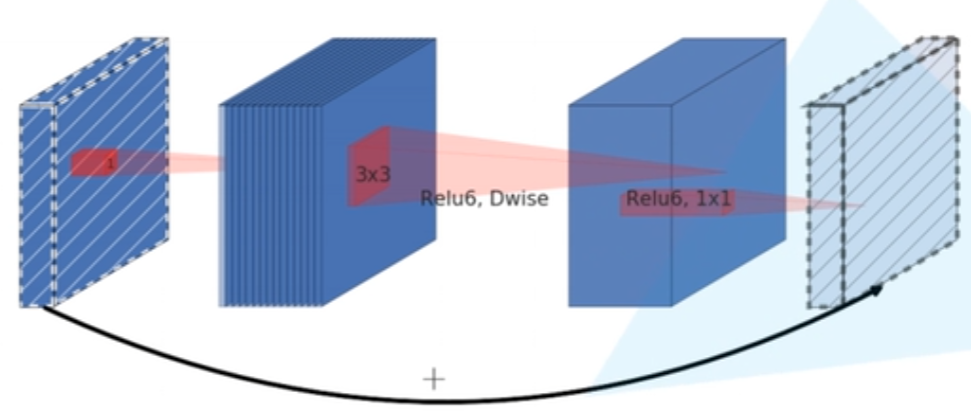
其中若in_channel==out_channel且DW卷积的stride=1,则会使用shortcut分支。
并且第一个1x1卷积与DW卷积会使用Relu6=
m
i
n
(
m
a
x
(
x
,
0
)
,
6
)
min(max(x,0),6)
min(max(x,0),6)激活函数。
pytorch代码
import torch.nn as nn

'''
包含了卷积、归一化与ReLU6的卷积模块
可以用于构造第一个1x1卷积与Dw卷积
'''
class ConvBNRELU6(nn.Module):
    def __init__(self, in_channel, out_channel, kernel_size=3, stride=1, groups=1):
        super(ConvBNRELU6, self).__init__()
        padding = (kernel_size - 1) // 2  # stride=1时,不会修改分辨率
        self.conv = nn.Sequential(
            # 通过groups来实现DW卷积
            nn.Conv2d(in_channel, out_channel, kernel_size, stride=stride, padding=padding, groups=groups, bias=False),
            nn.BatchNorm2d(out_channel),
            nn.ReLU6(inplace=True)
        )

    def forward(self, x):
        x = self.conv(x)
        return x

class BlockV2(nn.Module):
    def __init__(self, in_channel, out_channel, kernel_size, stride, expand_ratio):
        super(BlockV2, self).__init__()
        hidde_channel = in_channel * expand_ratio  # 升维后的维度
        self.Conv1 = ConvBNRELU6(in_channel, hidde_channel, 1, 1)  # 第一个1x1卷积
        self.DWConv = ConvBNRELU6(hidde_channel, hidde_channel, kernel_size, stride, hidde_channel)  # DW卷积
        self.Conv2 = nn.Sequential(  # 第二个1x1卷积
            nn.Conv2d(hidde_channel, out_channel, 1, 1, bias=False),
            nn.BatchNorm2d(out_channel)
        )
        self.shortcut = stride == 1 and in_channel == out_channel  # 判断是否使用shortcut分支

    def forward(self, x):
        y = self.Conv1(x)
        y = self.DWConv(x)
        y = self.Conv2(x)
        if self.shortcut:
            y = y + x  # 残差连接
        return y
MobileNetV3
理论
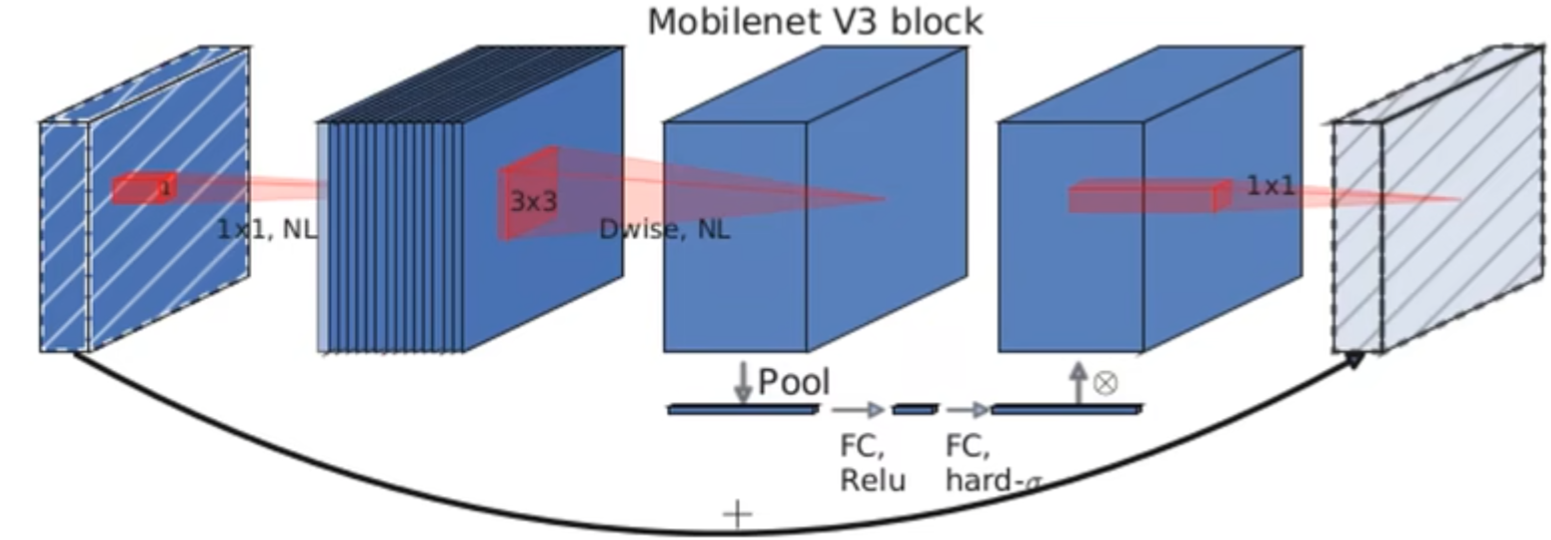
MobileNetV3相比于V2,在DW卷积与1x1卷积之间增加了SE(Squeeze-and-Excitation)注意力机制
SE注意力机制
SE注意力机制
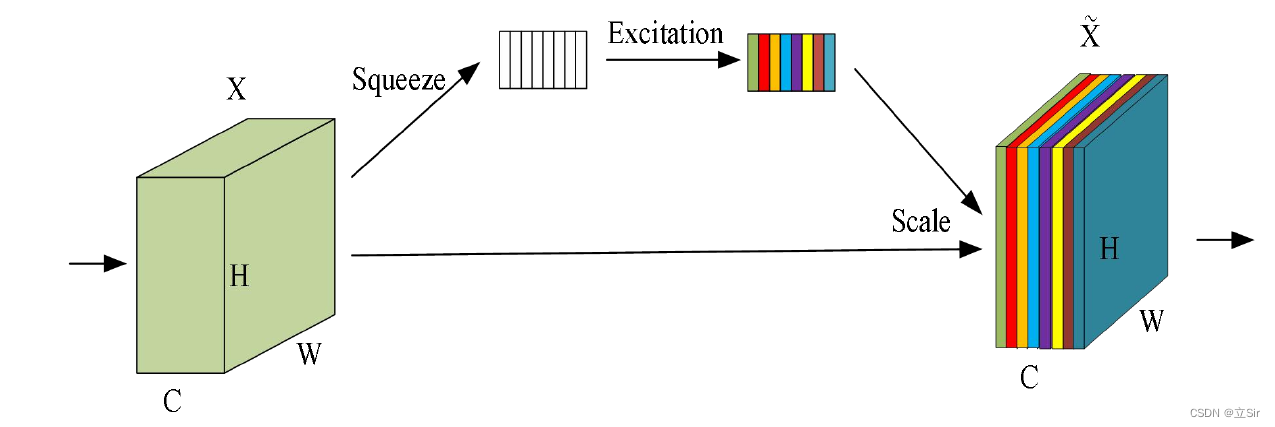
SE注意力机制(Squeeze-and-Excitation Networks)在通道维度增加注意力机制,关键操作是squeeze和excitation。
通过SE,获取到特征图的每个通道的重要程度,然后用这个重要程度去给每个特征赋予一个权重值,从而让神经网络重点关注某些特征通道。
实现步骤:
(1)Squeeze:通过全局平均池化,将每个通道的二维数据压缩为1个数。[C,H,W]->[C,1,1]
(2)Excitation:此步骤是为了得到各个通道之间的相关性,为每个通道生成一个权重值。论文中是通过两个全连接层与激活函数来实现,其中第一个全连接层会将通道数变为原本的1/4,第二个全连接层再恢复为原样。
输出的权重个数与输入特征图的通道数相同。[C,1,1]->[C,1,1]
(3)Scale:将前面得到的归一化权重通过乘法加权到每个通道的特征上。[C,H,W]*[C,1,1]==>[C,1,1]
pytorch代码实现
SE注意力机制
这里通过一个1x1的卷积层来代替全连接层
"""保证除法后的结果为divisor的整数倍"""
def make_divisible(channel, divisor=8, min_ch=None):
    if min_ch is None:
        min_ch = divisor
    new_ch = max(min_ch, int(channel + divisor / 2) // divisor * divisor)
    if new_ch < 0.9 * channel:
        new_ch += divisor
    return new_ch

class SE(nn.Module):
    def __init__(self, in_channel, squeeze_factor=4):
        super(SE, self).__init__()
        hidde_channel = make_divisible(in_channel // squeeze_factor)  # 计算降维后的维度
        self.se = nn.Sequential(  # 注意力模块
            nn.AdaptiveAvgPool2d((1, 1)),  # 动态平均池化,每个通道都变为1x1
            nn.Conv2d(in_channel, hidde_channel, 1),  # 1x1卷积
            nn.ReLU(inplace=True),
            nn.Conv2d(hidde_channel, in_channel, 1),
            nn.Hardsigmoid(inplace=True)
        )

    def forward(self, x):
        y = self.se(x)
        return y * x
Block
"""
可以指定归一化与激活函数的卷积模块
默认为BatchNorm2d与ReLU6
"""
class ConvNormActive(nn.Module):
    def __init__(self, in_channel, out_channel, kernel_size=3, stride=1, groups=1,
                 norm_layer=nn.BatchNorm2d, active_layer=nn.ReLU6):
        super(ConvNormActive, self).__init__()
        padding = (kernel_size - 1) // 2  # stride=1时,不会修改分辨率
        self.conv = nn.Sequential(
            # 通过groups来实现DW卷积
            nn.Conv2d(in_channel, out_channel, kernel_size, stride=stride, padding=padding, groups=groups, bias=False),
            norm_layer(out_channel),
            active_layer(inplace=True)
        )

    def forward(self, x):
        x = self.conv(x)
        return x

class BlockV3(nn.Module):
    def __init__(self, in_channel, out_channel, kernel_size, stride, expand_ratio):
        super(BlockV3, self).__init__()
        self.SE = SE(in_channel)  # 注意力机制
        hidde_channel = in_channel * expand_ratio
        self.Conv1 = ConvNormActive(in_channel, hidde_channel, 1, 1)  # 第一个1x1卷积
        self.DWConv = ConvNormActive(hidde_channel, hidde_channel, kernel_size, stride, hidde_channel)  # DW卷积
        self.Conv2 = nn.Sequential(  # 第二个1x1卷积
            nn.Conv2d(hidde_channel, out_channel, 1, 1, bias=False),
            nn.BatchNorm2d(out_channel)
        )
        self.shortcut = stride == 1 and in_channel == out_channel

    def forward(self, x):
        y = self.Conv1(x)
        y = self.DWConv(y)
        y = self.SE(y)
        y = self.Conv2(y)

        if self.shortcut:
            y = y + x  # 残差连接
        return y






 扫一扫
扫一扫


 2万+
2万+

 被折叠的 条评论
为什么被折叠?
被折叠的 条评论
为什么被折叠?
 到【灌水乐园】发言





