



import numpy as np
import tensorflow as tf
import matplotlib as plt

def addlayer(inputs, insize, outsize, activefunction=None):
    Weight = tf.Variable(tf.random_normal([insize, outsize]))
    biases = tf.Variable(tf.zeros([1, outsize]) + 0.1)
    Wx_plus_b = tf.matmul(inputs,Weight) + biases
    if activefunction is None:
        outputs = Wx_plus_b
    else:
        outputs = activefunction(Wx_plus_b)
    return outputs

x_data = np.linspace(-1,1,300)[:, np.newaxis]
nosic = np.random.normal(0, 0.05, x_data.shape)
y_data = np.square(x_data)- 0.5 + nosic

xs = tf.placeholder(tf.float32,[None,1])
ys = tf.placeholder(tf.float32,[None,1])

l1 = addlayer(xs, 1, 10, activefunction=tf.nn.relu)
prediction = addlayer(l1,10,1,activefunction=None)

loss = tf.reduce_mean(tf.reduce_sum(tf.square(ys - prediction),reduction_indices=[1]))

train_step = tf.train.GradientDescentOptimizer(0.1).minimize(loss)

init = tf.initialize_all_variables()

sess = tf.Session()
sess.run(init)

fig = plt.figure()
ax = fig.add_subplot(1,1,1)
ax.scatter(x_data,y_data)
plt.ion()
plt.show()

for i in range(1000):
    sess.run(train_step,feed_dict={xs:x_data,ys:y_data})
    if i % 50 == 0:
       # print(sess.run(loss,feed_dict={xs:x_data,ys:y_data}))
        try:
            ax.lines.remove(lines[0])
        except Exception:
            pass
        prediction_value = sess.run(prediction,feed_dict={xs:x_data})
        lines = ax.plot(x_data,prediction_value,'r-',lw=5)
        plt.pause(0.1)
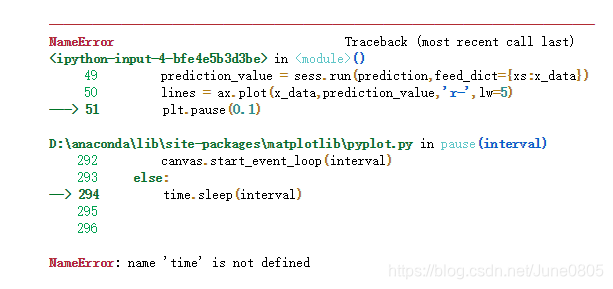
这样直接在JupyterNotebook上运行会报错:NameError:name 'time' is not defined!
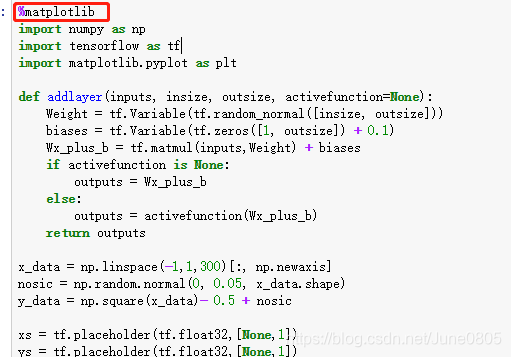
针对这个错误只需要在文件代码开始的位置加一句代码:%matplotlib即可。





 扫一扫
扫一扫


 1617
1617

 被折叠的 条评论
为什么被折叠?
被折叠的 条评论
为什么被折叠?
 到【灌水乐园】发言





