python (5)

MetaTrader5平台 Python MetaTrader 5平台Python 程序端 MetaTrader Python程序包是为有效快速地从MetaTrader 5程序端直接通过处理器通信获得交易所数据而设计的。通过这种途径接收的数据可以进一步用于统计计算和机器学习。 连接 从https://www.python.org/downloads/windows下载最新版Python 安装Python期间,请检查“将Pytho... 阅读详情

栈的工作原理
 入栈 append
 出栈 pop
 栈顶元素 
 栈的长度 len
 栈是否为空 len == 0 

zip&enumerate

zip函数将两个字符串元素一一对应拆分合并成键值对
enumerate函数将一个字符串拆开并按照顺序从0开始对元素编号形成一个对象

tuple 

例;

Users = ('root','westos','redhat')
Passwds = ('123','456','789')

#index slide
print(Users[0])
print(Users[-1])
print(Users[1:])
print(Users[::-1])

#repeat
print(Passwds * 3)

#link
print(Users + ('linux','python'))

#in /not in
print('westos' in Users)
print('westos' not in Users)

#for
for user in Users:
    print(user)

for index,user in enumerate(Users):
    print(index,user)

for user,passwd in zip(Users,Passwds):
    print(user,':',passwd)

 输出

/root/PycharmProjects/westos/venv/bin/python /root/PycharmProjects/westos/test/test1.py
root
redhat
('westos', 'redhat')
('redhat', 'westos', 'root')
('123', '456', '789', '123', '456', '789', '123', '456', '789')
('root', 'westos', 'redhat', 'linux', 'python')
True
False
root
westos
redhat
(0, 'root')
(1, 'westos')
(2, 'redhat')
('root', ':', '123')
('westos', ':', '456')
('redhat', ':', '789')

Process finished with exit code 0

count&index
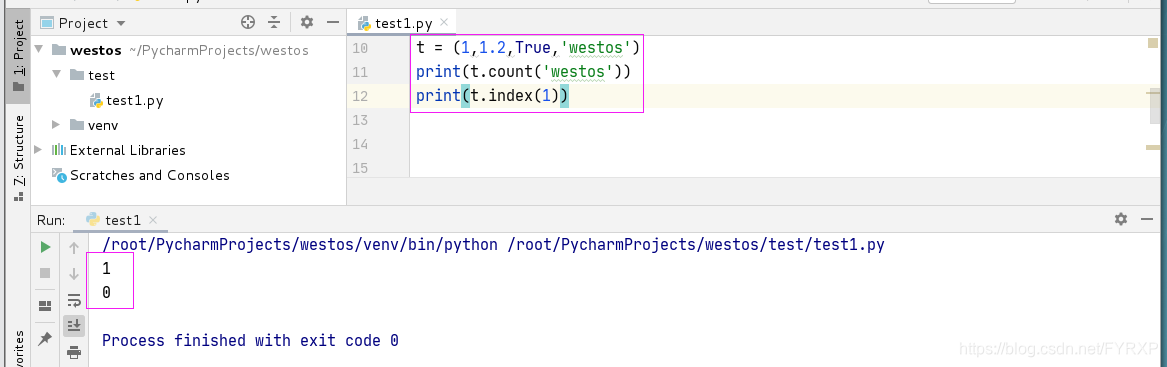
count统计出现的次数

index返回索引

练习

去除最高最低分,求平均分

scores = (100,89,45,78,65)
scoreli = list(scores)
scoreli.sort()
t = tuple(scoreli)
print(t)
minscore,*middlescore,maxscore = t
print(minscore)
print(middlescore)
print(maxscore)
print(sum(middlescore) / len(middlescore))

list和set的区别

s = {1,2,3,1,2,3,4,5}
print(s)
print(type(s))
s1 = {1}
print(s1)
print(type(s1))
s2 = {}
print(type(s2))
s3 = set([])
print(type(s3))
li = [1,2,3,1,2,3]
print(list(set(li)))
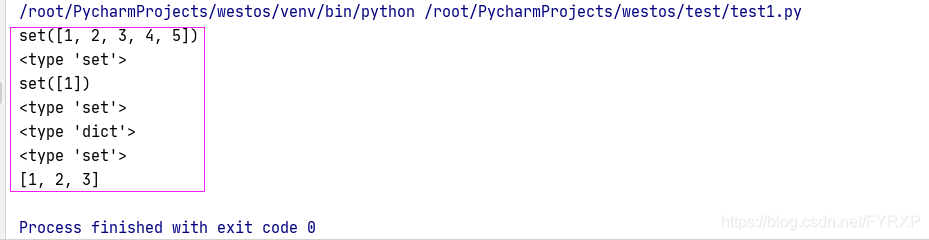
list可以有重复,而set重复值会忽略,list转换为set时只保留不重复的值(对象)
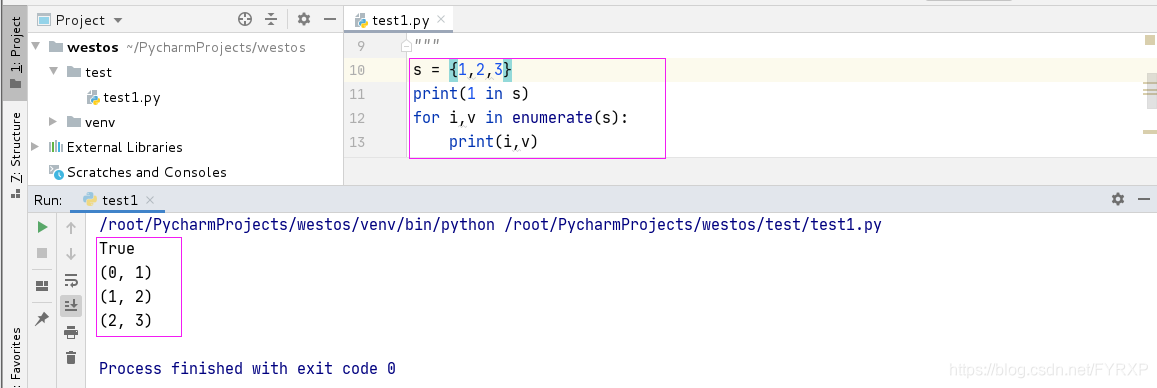
set 不能通过索引获取值
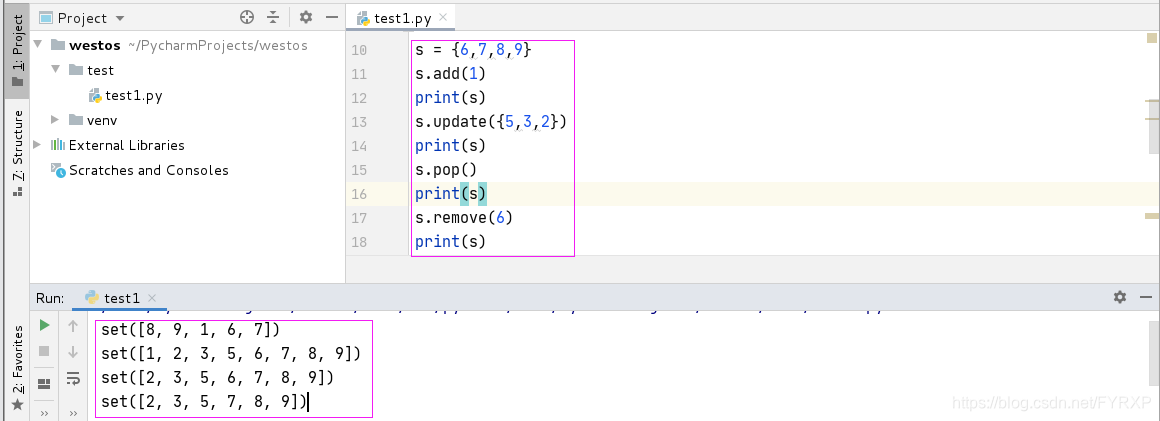
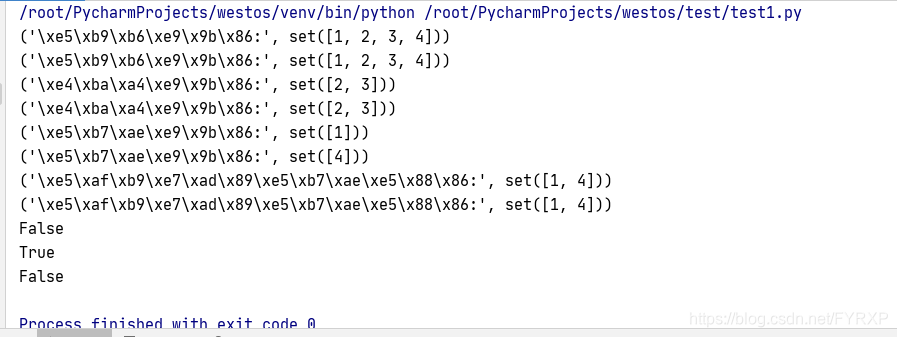
集合的交集,并集等


# 交集,并集,差集
s1 = {1,2,3}
s2 = {2,3,4}
# # 并集
print('并集:',s1.union(s2))
print('并集:',s1 | s2)
# # 交集
print('交集:',s1.intersection(s2))
print('交集:',s1 & s2)
# # 差集
print('差集:',s1.difference(s2)) # s1-(s1&s2)
print('差集:',s2.difference(s1)) # s2-(s1&s2)
# # 对等差分:并集-差集
print('对等差分:',s1.symmetric_difference(s2))
print('对等差分:',s1^s2)
s3 = {1,2}
s4 = {1,2,3}
print(s3.issuperset(s4))
print(s3.issubset(s4))
print(s3.isdisjoint(s4))

输出
练习

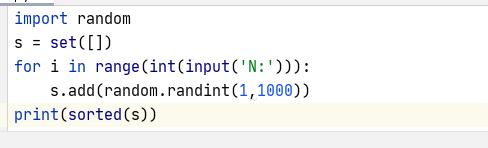
明明想在学校中请一些同学一起做一项问卷调查,为了实验的客观性
他先用计算机生成了N个1~1000之间的随机整数(N<=1000),N是用户输入的,
对于
其中重复的数字,只保留一个,把其余相同的数字去掉,不同的数对应着不>同的学生的学号,然后再把这些
数从小到大排序,按照排好的顺序去找同学做调查,请你协助明明完成“去重
”与排序工作

dict字典
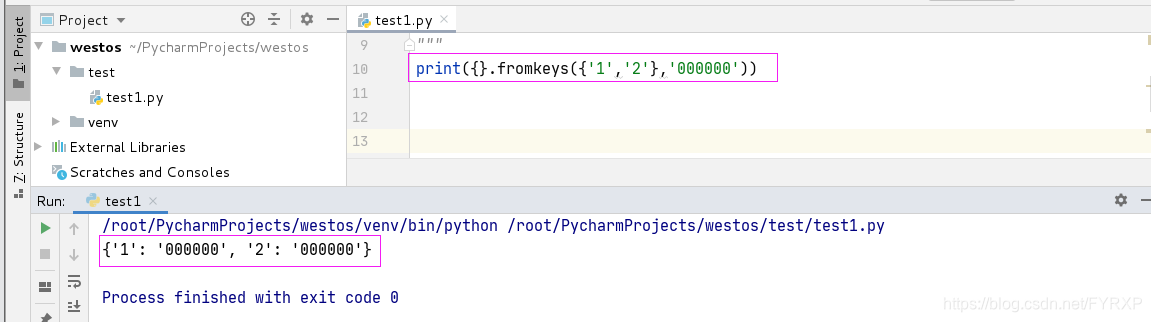
字典没有索引,可以通过key查找对应值
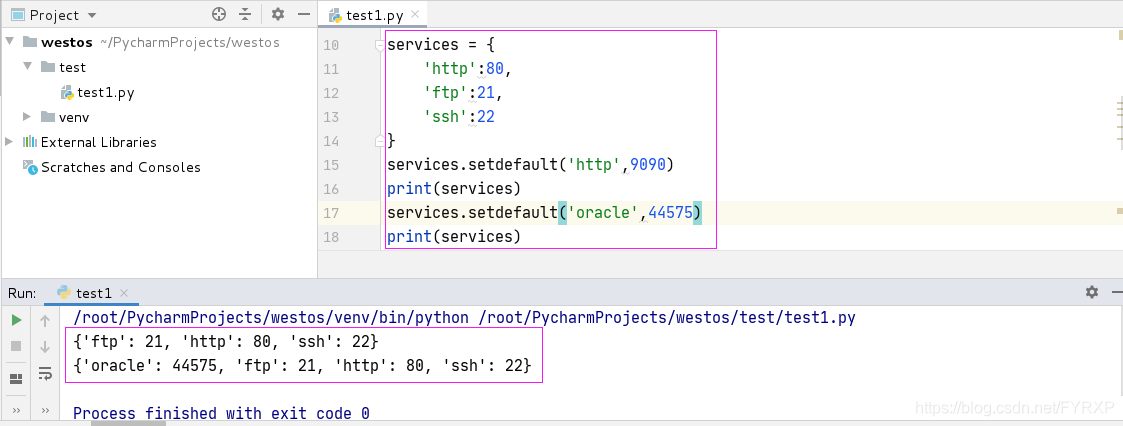
字典中通过setdefault函数无法覆盖修改已经存在的key对应值,可以添加新的键值对

字典中的del(删除) pop(出栈) popitem

services = {
    'http':80,
    'ftp':21,
    'ssh':22
}

del services['http']
print(services)

item = services.pop('ftp')
print(item)
print(services)

item = services.popitem()
print('The last key-value is:',item)
print(services)

services.clear()
print(services)

输出
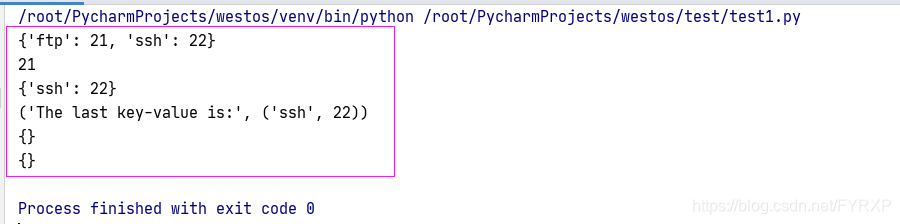
clear清空所有 pop和del删除指定 pop不能删除最后一个元素,可以通过popitem删除
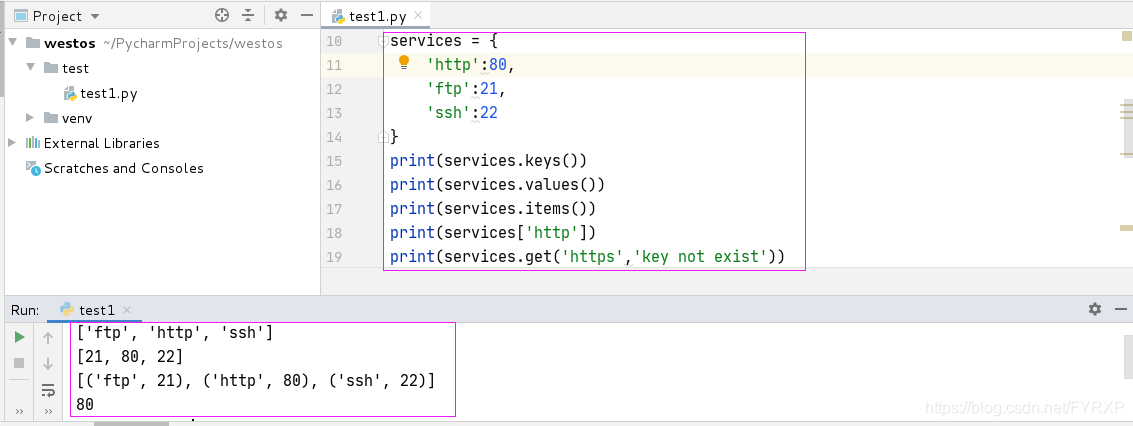
get函数时在找不到对应key时候打印后面的参数“key not exist” 如果没有该参数则默认不打印


练习

 数字重复统计:
    1). 随机生成1000个整数;
    2). 数字的范围[20, 100],
    3). 升序输出所有不同的数字及其每个数字重复的次数;

import random

all_nums = []
for item in range(1000):
    all_nums.append(random.randint(20,100))

# print(all_nums)

sorted_nums = sorted(all_nums)
num_dict = {}

for num in sorted_nums:
    if num in num_dict:
        num_dict[num] += 1
    else:
        num_dict[num] = 1

print(num_dict)

 

利用字典,实现次数统计

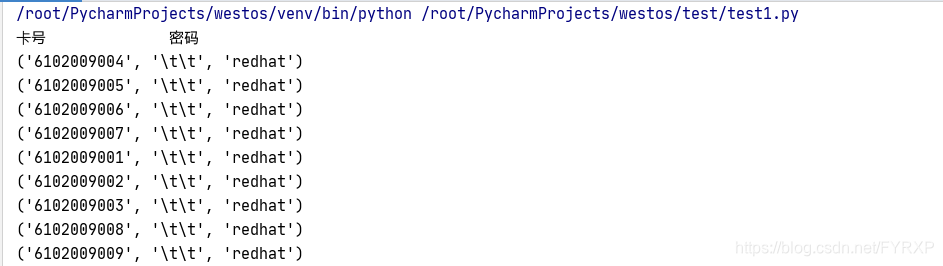
# 1. 随机生成100个卡号;
#     卡号以6102009开头, 后面3位依次是 (001, 002, 003, 100),
# 2. 生成关于银行卡号的字典, 默认每个卡号的初始密码为"redhat";

# 3. 输出卡号和密码信息, 格式如下:
卡号                  密码
6102009001              000000

import random

account_num = []

for i in range(100):
    account_num.append('6102009%.3d' %(i+1))

account_info = {}.fromkeys(account_num,'redhat')

print('卡号\t\t\t\t 密码')
for k,v in account_info.items():
    print(k,'\t\t',v)

 

【Python】PyQt5 PyQt5 不仅仅是一个 Python 模块,它是对 Qt C++ 库的高度封装,让 Python 开发者能够利用 Qt 强大而成熟的跨平台 GUI 框架。要理解 PyQt5,我们首先要理解它所基于的 Qt。Qt 的设计哲学与核心优势:Qt 起源于 C++,其设计之初就秉持着“一次编写,处处运行”(Write Once, Run Anywhere)的理念。它不仅仅是一个 GUI 库,更是一个完整的应用开发框架,包含了网络、数据库、XML/JSON 解析、多媒体、线程、国际化等几乎所有现代应用程序所需的模块。 阅读详情

相关推荐

MetaTrader5 使用python

在安装MetaTrader5 时自动会安装MetaEditor 5 ,双击打开MetaEditor 5。下一步后,会跳转到新界面,这些包不导入,一会也能自己import导入,点击完成。有两种方法,第一种是直接按“F7”,第二种是点击“构建——编译”。然后就可以“工具箱——日志”看到运行结果了,同时MT5也会弹出来。下一步之后,需要给项目取一个名字,尽量英文、数字,不要出现中文。首先点击左上角“新建”,就是红圈里面的那个图标,添加图片注释,不超过 140 字(可选)添加图片注释,不超过 140 字(可选)

yangsunte的博客 4598

python数据类型之‘集合’

1.集合的定义(set) set1={1,2,3,'hello',(1,2,3)} print(set1,type(set1) set = {1,2,3,'hello',(1,2,3),[1,2,3]} print(set,type(set)) s = {1, 2, 3, 4, 1, 2, 3} print(s, type(s)) 由以上实验我们知道,集合是一个...

forever_wen的博客 690

python3安装PyQt5

环境搭建 python环境 Anaconda Python3.7 https://www.anaconda.com/distribution/ 安装目录 : D:\Anaconda3 添加以下目录到环境变量 D:\Anaconda3 D:\Anaconda3\condabin D:\Anaconda3\Scripts 安装PyQt5,pyqt5-tools,PyQt5-stubs pip ins...

余韵 5095

对等差分(symmetric difference) (△ or ⊕)

为什么80%的码农都做不了架构师?>>> ...

weixin_34319111的博客 418

python PYQT5 uic

uic5 designer.exe C:\software\ANACONDA3\envs\storm_control\Lib\site-packages\pyqt5_tools 有designer.exe,双击designer.exe 打开pyqt5,拖动控件创建一个ui文件保存在某个文件夹下面,比如。 pyuic5.exe 我们用pyqt5创建了一个新的ui后,我们需要把ui文件转成python...

weixin_40662209的博客 4445

Python实现MD5加密

当我们需要对数据进行加密时,一种常见的方式是使用哈希算法。其中,MD5算法是一种较为常见且流行的哈希算法,可以使用Python语言轻松实现。

景天科技苑 1万+

python中集合的常用方法(元素的增加、弹出与删除)+(集合的交集、并集、差集、对等差集与超积)

集合的常用方法 1.增加元素 集合是一个无序的数据类型,所以添加顺序和再集合中的存取顺序不一定一样 1)代码: s = {6,7,8,9} s.add(1) #增加一个元素 print(s) s.update({5,4,3}) #增加多个元素 print(s) 2)结果展示: 2.集合元素的弹出 1)代码: s = {5,1,3,7,9} print(s) s.pop() print(s) s.pop() print(s) 2)结果展示: 3.集合元素的删除 1)

ly_qiu的博客 1567

走马观碑组智能车竞赛:目标板识别算法优化与实战技巧(基于OpenCV)

本文针对智能车竞赛走马观碑组别的核心挑战,深入探讨了基于OpenCV的目标板识别算法优化与实战技巧。文章系统分析了PVC赛道环境下的光照、运动模糊等干扰因素,详细拆解了从红色矩形定位、透视校正到特征提取与分类的完整流程,并提供了工程优化、速度提升及现场调试的实用策略,旨在帮助参赛队伍构建一套在高速运动中既准又快的鲁棒识别系统。

life6的博客 732

Symmetric Difference对等差分

Symmetric Difference 创建一个函数,接受两个或多个数组,返回所给数组的 对等差分(symmetric difference) (△ or ⊕)数组. 给出两个集合 (如集合 A = {1, 2, 3} 和集合 B = {2, 3, 4}), 而数学术语 “对等差分” 的集合就是指由所有只在两个集合其中之一的元素组成的集合(A △ B = C = {1, 4}

寅月星回的博客 3968

MPC-CBF 控制原理详解

假设系统满足如下离散时间动力学模型xt1fxtutxt∈Xut∈Uxt1​fxt​ut​xt​∈Xut​∈Uxtx_txt​:状态变量,定义域为可行状态集X⊆RnX⊆Rnutu_tut​:控制输入,定义域为控制约束集U⊆RmU⊆Rm系统需满足安全约束,由如下控制障碍函数(CBF)hX→RhX→RCx∈X∣hx≥0C:=x∈X∣hx≥。

m0_54691290的博客 1179

Agent 长期记忆三代演进:从 RAG 到 Memory Graph,mem0 / Zep / LangMem / Letta 深度横评

文章摘要 2026年,Agent长期记忆技术迎来关键突破,OpenAI、Anthropic等厂商通过扩大上下文窗口和推出记忆工具,推动长期记忆从工程补丁发展为独立技术层。本文通过分析三代记忆架构演进(RAG→结构化Fact→MemoryGraph)和四大方案(mem0/Zep/LangMem/Letta)的8维度横评,揭示以下核心观点: 长上下文≠长期记忆:128K上下文如同RAM,仍需硬盘式记忆层筛选和结构化存储,避免“Context Rot”导致的准确率下降。 三代架构演进: Gen1(RAG):向量检

LDZKKJ的博客 1412

python——对等差分(symmetric difference)

类型:集合。

m0_62488776的博客 1612

【YOLOv11改进[Backbone]】 使用Ghostnetv2替换Backbone

使用Ghostnetv2替换Backbone

静谧、淡雅 518

python md5_python中md5

广告关闭腾讯云11.11云上盛惠 ,精选热门产品助力上云,云服务器首年88元起,买的越多返的越多,最高返5000元!md5的作用是让大容量信息在用数字签名软件签署私人密钥前被压缩成一种保密的格式(就是把一个任意长度的字节串变换成一定长的十六进制数字串)。 除了md5以外,其中比较有名的还有sha-1、ripemd以及haval等。 python中生成md5# 由于md5模块在python3中被移除...

weixin_39642687的博客 979

ARFoundation系列讲解 - 手部跟踪编程

通过使用ARFoundation的手部跟踪子系统,我们可以轻松地在AR应用程序中实现与用户手部的交互。通过设置AR环境、创建场景和相机、添加手部跟踪功能以及编写相应的脚本,我们可以开始在AR场景中跟踪和操作用户的手部。在Unity中创建一个新场景,并将AR Session组件添加到场景中的一个空对象上。手部跟踪的具体实现可能因AR设备和平台的不同而有所差异,你可能需要根据你的使用情况进行一些适配和调整。当你将手部放入AR场景中时,手部跟踪系统将触发相应的事件,并调用脚本中的回调函数。

2301_79325339的博客 355

人工智能在文学领域的应用:创作无限可能的智能作家

人工智能在文学领域的应用:创作无限可能的智能作家 作者:禅与计算机程序设计艺术 1. 背景介绍 人工智能技术近年来飞速发展,在各个领域都有广泛应用。文学创作作为人类最高级的智力活动之一,也逐渐受到人工智能技术的影响和改变。随着自然语言处理、生成式模型等人工智能

AI天才研究院 1110

python 3.5-python3.5

广告关闭2017年12月,云+社区对外发布,从最开始的技术博客到现在拥有多个社区产品。未来,我们一起乘风破浪,创造无限可能。替换python21212rmusrbinpythonln-svusrlocalbinpython3.5usrbinpython(这样做的目的是在系统任意目录下敲入python调用的都是python3.5的命令,而非系统默认的2. 6.6。 但是这样会导致依赖python2....

weixin_37988176的博客 1059

PCIe Base Specification解析(二)

PCIe事务层,Transaction Layer Specification

Crazzy_M的博客 1291

python md5加密解密_python md5加密解密

md5加密以后的字符串长度我下了一段用JAVA实现MD5加密的算法,不管输入字符串多长,加密后的字符加密后为128位(bit),按照16进制(4位一个16进制数)编码后,就成了32个字符。MD5并不是加密算法zhidao,而是摘要算法。加密算法是可逆的,摘要算法是理专论上不可逆的,详细步骤:md5算法主要应用在密码领域,为了防止明文传输密码的危险Python怎么对用户密码进行MD5加密,或者是单向...

weixin_39589394的博客 3312

QGis二次开发 —— 1.1、ubuntu24.04下搭建QGis3.40.12二次开发环境(附:全部问题解决方法)

QGis二次开发 —— 1.1、ubuntu24.02下搭建QGis3.40.12二次开发环境(附:全部问题解决方法)

251

深度学习工具包 DeepLearningToolbox

深度学习工具包Deprecation notice.-----This toolbox is outdated and no longer maintained.There are much better tools available for deep learning than this toolbox, e.g. [Theano](http://deeplearning.net/software/theano/), [torch](http://torch.ch/) or [tensorflow](http://www.tensorflow.org/)I would suggest you use one of the tools mentioned above rather than use this toolbox.Best, Rasmus.DeepLearnToolbox================A Matlab toolbox for Deep Learning.Deep Learning is a new subfield of machine learning that focuses on learning deep hierarchical models of data.It is inspired by the human brain's apparent deep (layered, hierarchical) architecture.A good overview of the theory of Deep Learning theory is[Learning Deep Architectures for AI](http://www.iro.umontreal.ca/~bengioy/papers/ftml_book.pdf)For a more informal introduction, see the following videos by Geoffrey Hinton and Andrew Ng.* [The Next Generation of Neural Networks](http://www.youtube.com/watch?v=AyzOUbkUf3M) (Hinton, 2007)* [Recent Developments in Deep Learning](http://www.youtube.com/watch?v=VdIURAu1-aU) (Hinton, 2010)* [Unsupervised Feature Learning and Deep Learning](http://www.youtube.com/watch?v=ZmNOAtZIgIk) (Ng, 2011)If you use this toolbox in your research please cite [Prediction as a candidate for learning deep hierarchical models of data](http://www2.imm.dtu.dk/pubdb/views/publication_details.php?id=6284)```@MASTERSTHESIS\{IMM2012-06284, author = "R. B. Palm", title = "Prediction as a candidate for learning deep hierarchical models of data", year = "2012",}```Contact: rasmusbergpalm at gmail dot comDirectories included in the toolbox-----------------------------------`NN/` - A library for Feedforward Backpropagation Neural Networks`CNN/` - A library for Convolutional Neural Networks`DBN/` - A library for Deep Belief Networks`SAE/` - A library for Stacked Auto-Encoders`CAE/` - A library for Convolutional Auto-Encoders`util/` - Utility functions used by the libraries`data/` - Data used by the examples`tests/` - unit tests to verify toolbox is workingFor references on each library check REFS.mdSetup-----1. Download.2. addpath(genpath('DeepLearnToolbox'));Example: Deep Belief Network---------------------```matlabfunction test_example_DBNload mnist_uint8;train_x = double(train_x) / 255;test_x = double(test_x) / 255;train_y = double(train_y);test_y = double(test_y);%% ex1 train a 100 hidden unit RBM and visualize its weightsrand('state',0)dbn.sizes = [100];opts.numepochs = 1;opts.batchsize = 100;opts.momentum = 0;opts.alpha = 1;dbn = dbnsetup(dbn, train_x, opts);dbn = dbntrain(dbn, train_x, opts);figure; visualize(dbn.rbm{1}.W'); % Visualize the RBM weights%% ex2 train a 100-100 hidden unit DBN and use its weights to initialize a NNrand('state',0)%train dbndbn.sizes = [100 100];opts.numepochs = 1;opts.batchsize = 100;opts.momentum = 0;opts.alpha = 1;dbn = dbnsetup(dbn, train_x, opts);dbn = dbntrain(dbn, train_x, opts);%unfold dbn to nnnn = dbnunfoldtonn(dbn, 10);nn.activation_function = 'sigm';%train nnopts.numepochs = 1;opts.batchsize = 100;nn = nntrain(nn, train_x, train_y, opts);[er, bad] = nntest(nn, test_x, test_y);assert(er < 0.10, 'Too big error');```Example: Stacked Auto-Encoders---------------------```matlabfunction test_example_SAEload mnist_uint8;train_x = double(train_x)/255;test_x = double(test_x)/255;train_y = double(train_y);test_y = double(test_y);%% ex1 train a 100 hidden unit SDAE and use it to initialize a FFNN% Setup and train a stacked denoising autoencoder (SDAE)rand('state',0)sae = saesetup([784 100]);sae.ae{1}.activation_function = 'sigm';sae.ae{1}.learningRate = 1;sae.ae{1}.inputZeroMaskedFraction = 0.5;opts.numepochs = 1;opts.batchsize = 100;sae = saetrain(sae, train_x, opts);visualize(sae.ae{1}.W{1}(:,2:end)')% Use the SDAE to initialize a FFNNnn = nnsetup([784 100 10]);nn.activation_function = 'sigm';nn.learningRate = 1;nn.W{1} = sae.ae{1}.W{1};% Train the FFNNopts.numepochs = 1;opts.batchsize = 100;nn = nntrain(nn, train_x, train_y, opts);[er, bad] = nntest(nn, test_x, test_y);assert(er < 0.16, 'Too big error');```Example: Convolutional Neural Nets---------------------```matlabfunction test_example_CNNload mnist_uint8;train_x = double(reshape(train_x',28,28,60000))/255;test_x = double(reshape(test_x',28,28,10000))/255;train_y = double(train_y');test_y = double(test_y');%% ex1 Train a 6c-2s-12c-2s Convolutional neural network %will run 1 epoch in about 200 second and get around 11% error. %With 100 epochs you'll get around 1.2% errorrand('state',0)cnn.layers = { struct('type', 'i') %input layer struct('type', 'c', 'outputmaps', 6, 'kernelsize', 5) %convolution layer struct('type', 's', 'scale', 2) %sub sampling layer struct('type', 'c', 'outputmaps', 12, 'kernelsize', 5) %convolution layer struct('type', 's', 'scale', 2) %subsampling layer};cnn = cnnsetup(cnn, train_x, train_y);opts.alpha = 1;opts.batchsize = 50;opts.numepochs = 1;cnn = cnntrain(cnn, train_x, train_y, opts);[er, bad] = cnntest(cnn, test_x, test_y);%plot mean squared errorfigure; plot(cnn.rL);assert(er<0.12, 'Too big error');```Example: Neural Networks---------------------```matlabfunction test_example_NNload mnist_uint8;train_x = double(train_x) / 255;test_x = double(test_x) / 255;train_y = double(train_y);test_y = double(test_y);% normalize[train_x, mu, sigma] = zscore(train_x);test_x = normalize(test_x, mu, sigma);%% ex1 vanilla neural netrand('state',0)nn = nnsetup([784 100 10]);opts.numepochs = 1; % Number of full sweeps through dataopts.batchsize = 100; % Take a mean gradient step over this many samples[nn, L] = nntrain(nn, train_x, train_y, opts);[er, bad] = nntest(nn, test_x, test_y);assert(er < 0.08, 'Too big error');%% ex2 neural net with L2 weight decayrand('state',0)nn = nnsetup([784 100 10]);nn.weightPenaltyL2 = 1e-4; % L2 weight decayopts.numepochs = 1; % Number of full sweeps through dataopts.batchsize = 100; % Take a mean gradient step over this many samplesnn = nntrain(nn, train_x, train_y, opts);[er, bad] = nntest(nn, test_x, test_y);assert(er < 0.1, 'Too big error');%% ex3 neural net with dropoutrand('state',0)nn = nnsetup([784 100 10]);nn.dropoutFraction = 0.5; % Dropout fraction opts.numepochs = 1; % Number of full sweeps through dataopts.batchsize = 100; % Take a mean gradient step over this many samplesnn = nntrain(nn, train_x, train_y, opts);[er, bad] = nntest(nn, test_x, test_y);assert(er < 0.1, 'Too big error');%% ex4 neural net with sigmoid activation functionrand('state',0)nn = nnsetup([784 100 10]);nn.activation_function = 'sigm'; % Sigmoid activation functionnn.learningRate = 1; % Sigm require a lower learning rateopts.numepochs = 1; % Number of full sweeps through dataopts.batchsize = 100; % Take a mean gradient step over this many samplesnn = nntrain(nn, train_x, train_y, opts);[er, bad] = nntest(nn, test_x, test_y);assert(er < 0.1, 'Too big error');%% ex5 plotting functionalityrand('state',0)nn = nnsetup([784 20 10]);opts.numepochs = 5; % Number of full sweeps through datann.output = 'softmax'; % use softmax outputopts.batchsize = 1000; % Take a mean gradient step over this many samplesopts.plot = 1; % enable plottingnn = nntrain(nn, train_x, train_y, opts);[er, bad] = nntest(nn, test_x, test_y);assert(er < 0.1, 'Too big error');%% ex6 neural net with sigmoid activation and plotting of validation and training error% split training data into training and validation datavx = train_x(1:10000,:);tx = train_x(10001:end,:);vy = train_y(1:10000,:);ty = train_y(10001:end,:);rand('state',0)nn = nnsetup([784 20 10]); nn.output = 'softmax'; % use softmax outputopts.numepochs = 5; % Number of full sweeps through dataopts.batchsize = 1000; % Take a mean gradient step over this many samplesopts.plot = 1; % enable plottingnn = nntrain(nn, tx, ty, opts, vx, vy); % nntrain takes validation set as last two arguments (optionally)[er, bad] = nntest(nn, test_x, test_y);assert(er < 0.1, 'Too big error');```[![Bitdeli Badge](https://d2weczhvl823v0.cloudfront.net/rasmusbergpalm/deeplearntoolbox/trend.png)](https://bitdeli.com/free "Bitdeli Badge")

mt5 python 库

python相关学习资料:https://edu.51cto.com/video/4645.htmlhttps://edu.51cto.com/video/1158.htmlhttps://edu.51cto.com/video/4102.html使用MT5 Python库进行交易自动化 MetaTrader 5(M...

weixin_33308577的博客 1011

NTscan扫描工具

ntscan是一个扫描器,可以扫描没有密码和弱密码的共享,先到配置文件中填写猜测的用户名和密码,扫描过程中右侧出现的是扫描日志。

ue5 更改python版本

ue5 修改python的版本

yn20000227的博客 1731

华为的C语言编程规范.pdf

华为技术有限公司内部技术规范。本规范制定了编写C语言程序的基本原则、规则和建议。从代码的清晰、简洁、可测试、安全、程序效率、可移植各个方面对C语言编程作出了具体指导。

Data-Structures-and-Algorithm-Analysis-in-Java.pdf

作者: Weiss, Mark A. 出版社: Addison Wesley Data Structures and Algorithm Analysis in Java is an “advanced algorithms” book that fits between traditional CS2 and Algorithms Analysis courses. In the old ACM Curriculum Guidelines, this course was known as CS7. This text is for readers who want to learn good programming and algorithm analysis skills simultaneously so that they can develop such programs with the maximum amo...

qt5 python 发布_Python5中的Python Qt5绑定

全部刚刚安装了Anaconda-5,Python3.6,Windows10Pro,64位。在Matplotlib脚本(用于Anaconda-4、python3.5)拒绝处理消息Traceback (most recent call last):File ".\fit_gamma.py", line 5, in import matplotlib.pyplot as pltFile "D:\Anac...

weixin_33603331的博客 337

安装python3.5_安装Python3.5

安装Python3.5

weixin_39903571的博客 426

python md5_Python提取MD5

使用Python的hashlib模块提取MD5,网上参考,觉得这个还不错,可以作为模块直接使用。# -*- coding: utf-8 -*-import hashlibimport sysimport osdef md5hex(word):""" MD5加密算法,返回32位小写16进制符号 """if isinstance(word, unicode):word = word.encode("u...

weixin_39980893的博客 199

MD5原理及Python实现

简介 MD5消息摘要算法一种被广泛使用的密码散列函数,输入长度小于264比特的消息,我的代码也是以小于264比特的消息为例,输出一个128位(16字节)的散列值(hash value),输入信息以512比特的分组为单位处理。 算法流程 附加位填充 初始化链接变量 分组处理 步函数的运算 这个流程描述下来非常符合hash函数的一般模型: 单个点拿出来仔细分析 附加位填充 填充一个1和若干个0使...

0verWatch的博客 9423
上一篇: python (4)
下一篇: python (6)
FYRXP
博客等级 码龄7年 6粉丝 57原创
评论
成就一亿技术人!
拼手气红包6.0元
还能输入1000个字符
 
 条评论被折叠 查看
添加红包

请填写红包祝福语或标题

个

红包个数最小为10个

元

红包金额最低5元

当前余额3.43元 前往充值 >
需支付:10.00元
成就一亿技术人!
领取后你会自动成为博主和红包主的粉丝 规则
hope_wisdom
发出的红包
实付元
使用余额支付
点击重新获取
扫码支付
钱包余额 0

抵扣说明:

1.余额是钱包充值的虚拟货币,按照1:1的比例进行支付金额的抵扣。
2.余额无法直接购买下载,可以购买VIP、付费专栏及课程。

余额充值