



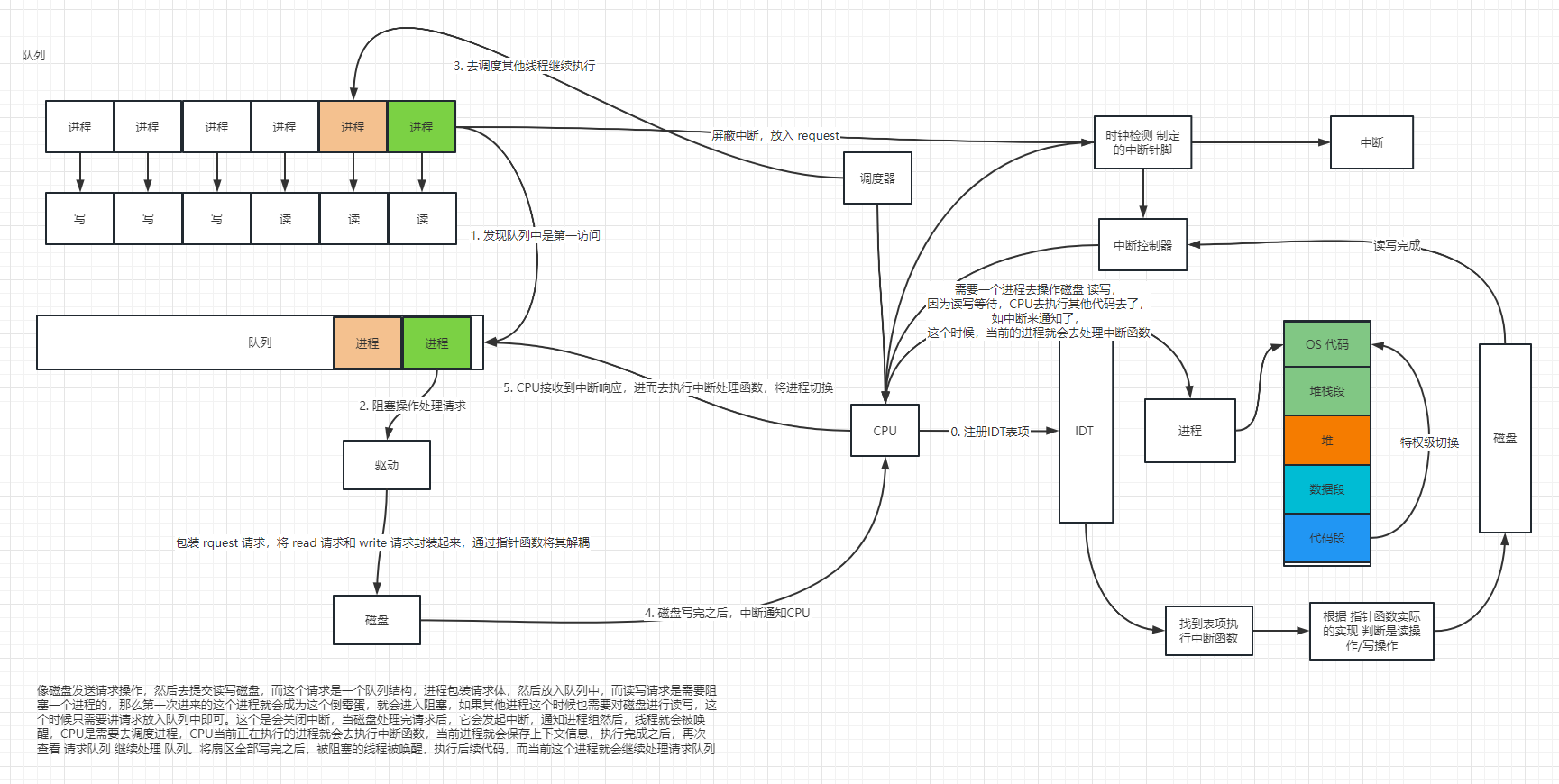
操作系统初始化的时候,会初始化 hd_interrupt(函数指针) 中断处理函数
hd 是硬盘,rd 是软盘
如下我们讨论的是硬盘
write_intr 中断处理写函数指针
read_intr 中断处理读函数指针
end_request 是将处理完当前访问函数完成之后将其唤醒。而后调度器去唤醒进程。
; well, that went ok, I hope. Now we have to reprogram the interrupts :-(
; we put them right after the intel-reserved hardware interrupts, at
; int 0x20-0x2F. There they won't mess up anything. Sadly IBM really
; messed this up with the original PC, and they haven't been able to
; rectify it afterwards. Thus the bios puts interrupts at 0x08-0x0f,
; which is used for the internal hardware interrupts as well. We just
; have to reprogram the 8259's, and it isn't fun.

	mov	al,#0x11		; initialization sequence
	out	#0x20,al		; send it to 8259A-1
	.word	0x00eb,0x00eb		; jmp $+2, jmp $+2
	out	#0xA0,al		; and to 8259A-2
	.word	0x00eb,0x00eb
	mov	al,#0x20		; start of hardware int's (0x20)
	out	#0x21,al
	.word	0x00eb,0x00eb
	mov	al,#0x28		; start of hardware int's 2 (0x28)
	out	#0xA1,al
	.word	0x00eb,0x00eb
	mov	al,#0x04		; 8259-1 is master
	out	#0x21,al
	.word	0x00eb,0x00eb
	mov	al,#0x02		; 8259-2 is slave
	out	#0xA1,al
	.word	0x00eb,0x00eb
	mov	al,#0x01		; 8086 mode for both
	out	#0x21,al
	.word	0x00eb,0x00eb
	out	#0xA1,al
	.word	0x00eb,0x00eb
	mov	al,#0xFF		; mask off all interrupts for now
	out	#0x21,al
	.word	0x00eb,0x00eb
	out	#0xA1,al

void hd_init(void)
{
	blk_dev[MAJOR_NR].request_fn = DEVICE_REQUEST;
	set_intr_gate(0x2E,&hd_interrupt);
	outb_p(inb_p(0x21)&0xfb,0x21);
	outb(inb_p(0xA1)&0xbf,0xA1);
}

#define DEVICE_REQUEST do_hd_request
// 中断处理指令,do_hd 表示是读还是写
_hd_interrupt:
	pushl %eax
	pushl %ecx
	pushl %edx
	push %ds
	push %es
	push %fs
	movl $0x10,%eax
	mov %ax,%ds
	mov %ax,%es
	movl $0x17,%eax
	mov %ax,%fs
	movb $0x20,%al
	outb %al,$0xA0		# EOI to interrupt controller #1
	jmp 1f			# give port chance to breathe
1:	jmp 1f
1:	xorl %edx,%edx
	xchgl _do_hd,%edx // do_hd write_intr/read_intr
	testl %edx,%edx
	jne 1f
	movl $_unexpected_hd_interrupt,%edx
1:	outb %al,$0x20
	call *%edx		# "interesting" way of handling intr.
	pop %fs
	pop %es
	pop %ds
	popl %edx
	popl %ecx
	popl %eax
	iret

// 发送包装请求
void do_hd_request(void)
{
	int i,r;
	unsigned int block,dev;
	unsigned int sec,head,cyl;
	unsigned int nsect;

	INIT_REQUEST;
	dev = MINOR(CURRENT->dev);
	block = CURRENT->sector;
	if (dev >= 5*NR_HD || block+2 > hd[dev].nr_sects) {
		end_request(0);
		goto repeat;
	}
	block += hd[dev].start_sect;
	dev /= 5;
	__asm__("divl %4":"=a" (block),"=d" (sec):"0" (block),"1" (0),
		"r" (hd_info[dev].sect));
	__asm__("divl %4":"=a" (cyl),"=d" (head):"0" (block),"1" (0),
		"r" (hd_info[dev].head));
	sec++;
	nsect = CURRENT->nr_sectors;
	if (reset) {
		reset = 0;
		recalibrate = 1;
		reset_hd(CURRENT_DEV);
		return;
	}
	if (recalibrate) {
		recalibrate = 0;
		hd_out(dev,hd_info[CURRENT_DEV].sect,0,0,0,
			WIN_RESTORE,&recal_intr);
		return;
	}
	if (CURRENT->cmd == WRITE) {
		hd_out(dev,nsect,sec,head,cyl,WIN_WRITE,&write_intr);
		for(i=0 ; i<3000 && !(r=inb_p(HD_STATUS)&DRQ_STAT) ; i++)
			/* nothing */ ;
		if (!r) {
			bad_rw_intr();
			goto repeat;
		}
		port_write(HD_DATA,CURRENT->buffer,256);
	} else if (CURRENT->cmd == READ) {
		hd_out(dev,nsect,sec,head,cyl,WIN_READ,&read_intr);
	} else
		panic("unknown hd-command");
}

static void read_intr(void)
{
	if (win_result()) {
		bad_rw_intr();
		do_hd_request();
		return;
	}
	port_read(HD_DATA,CURRENT->buffer,256);
	CURRENT->errors = 0;
	CURRENT->buffer += 512;
	CURRENT->sector++;
	if (--CURRENT->nr_sectors) {
		do_hd = &read_intr;
		return;
	}
	end_request(1);
	do_hd_request();
}

static void write_intr(void)
{
	if (win_result()) {
		bad_rw_intr();
		do_hd_request();
		return;
	}
	if (--CURRENT->nr_sectors) {
		CURRENT->sector++;
		CURRENT->buffer += 512;
		do_hd = &write_intr;
		port_write(HD_DATA,CURRENT->buffer,256);
		return;
	}
	end_request(1);
	do_hd_request();
}

static void hd_out(unsigned int drive,unsigned int nsect,unsigned int sect,
		unsigned int head,unsigned int cyl,unsigned int cmd,
		void (*intr_addr)(void))
{
	register int port asm("dx");

	if (drive>1 || head>15)
		panic("Trying to write bad sector");
	if (!controller_ready())
		panic("HD controller not ready");
	do_hd = intr_addr;
	outb_p(hd_info[drive].ctl,HD_CMD);
	port=HD_DATA;
	outb_p(hd_info[drive].wpcom>>2,++port);
	outb_p(nsect,++port);
	outb_p(sect,++port);
	outb_p(cyl,++port);
	outb_p(cyl>>8,++port);
	outb_p(0xA0|(drive<<4)|head,++port);
	outb(cmd,++port);
}
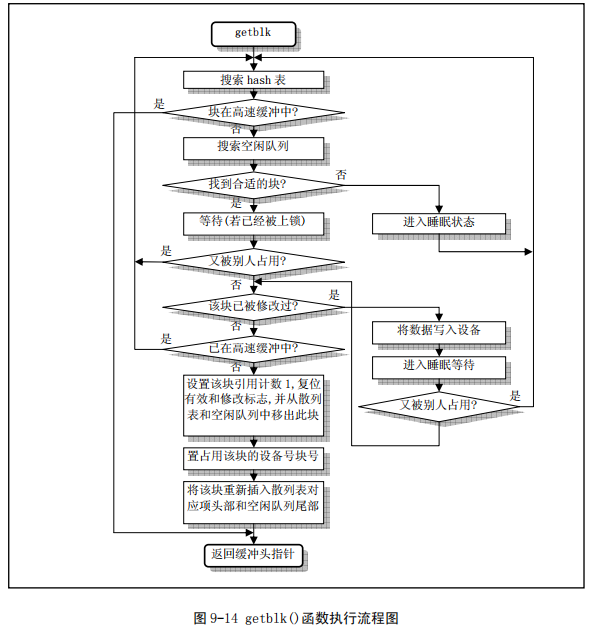
获取一个空闲块
/*
 * Ok, this is getblk, and it isn't very clear, again to hinder
 * race-conditions. Most of the code is seldom used, (ie repeating),
 * so it should be much more efficient than it looks.
 *
 * The algoritm is changed: hopefully better, and an elusive bug removed.
 */
#define BADNESS(bh) (((bh)->b_dirt<<1)+(bh)->b_lock)
struct buffer_head * getblk(int dev,int block)
{
   struct buffer_head * tmp, * bh;

repeat:
   if ((bh = get_hash_table(dev,block)))
      return bh;
   tmp = free_list;
   do {
      if (tmp->b_count)
         continue;
      if (!bh || BADNESS(tmp)<BADNESS(bh)) {
         bh = tmp;
         if (!BADNESS(tmp))
            break;
      }
/* and repeat until we find something good */
   } while ((tmp = tmp->b_next_free) != free_list);
   if (!bh) {
      sleep_on(&buffer_wait);
      goto repeat;
   }
   wait_on_buffer(bh);
   if (bh->b_count)
      goto repeat;
   while (bh->b_dirt) {
      sync_dev(bh->b_dev);
      wait_on_buffer(bh);
      if (bh->b_count)
         goto repeat;
   }
/* NOTE!! While we slept waiting for this block, somebody else might */
/* already have added "this" block to the cache. check it */
   if (find_buffer(dev,block))
      goto repeat;
/* OK, FINALLY we know that this buffer is the only one of it's kind, */
/* and that it's unused (b_count=0), unlocked (b_lock=0), and clean */
   bh->b_count=1;
   bh->b_dirt=0;
   bh->b_uptodate=0;
   remove_from_queues(bh);
   bh->b_dev=dev;
   bh->b_blocknr=block;
   insert_into_queues(bh);
   return bh;
}


/*
 * Why like this, I hear you say... The reason is race-conditions.
 * As we don't lock buffers (unless we are readint them, that is),
 * something might happen to it while we sleep (ie a read-error
 * will force it bad). This shouldn't really happen currently, but
 * the code is ready.
 */
struct buffer_head * get_hash_table(int dev, int block)
{
	struct buffer_head * bh;

	for (;;) {
		if (!(bh=find_buffer(dev,block)))
			return NULL;
		bh->b_count++;
		wait_on_buffer(bh);
		if (bh->b_dev == dev && bh->b_blocknr == block)
			return bh;
		bh->b_count--;
	}
}
如果当前空闲块是否被使用过,如果里面有数据则刷新到磁盘,如果没有返回当前空闲块
/*
* bread() reads a specified block and returns the buffer that contains
* it. It returns NULL if the block was unreadable.
*/
struct buffer_head * bread(int dev,int block)
{
    struct buffer_head * bh;

    if (!(bh=getblk(dev,block)))
       panic("bread: getblk returned NULL\n");
    if (bh->b_uptodate)
       return bh;
    ll_rw_block(READ,bh);
    wait_on_buffer(bh);
    if (bh->b_uptodate)
       return bh;
    brelse(bh);
    return NULL;
}
将当前缓冲区刷新到设备中。
int sync_dev(int dev)
{
    int i;
    struct buffer_head * bh;

    bh = start_buffer;
    for (i=0 ; i<NR_BUFFERS ; i++,bh++) {
       if (bh->b_dev != dev)
          continue;
       wait_on_buffer(bh);
       if (bh->b_dev == dev && bh->b_dirt)
          ll_rw_block(WRITE,bh);
   }
    sync_inodes();
    bh = start_buffer;
    for (i=0 ; i<NR_BUFFERS ; i++,bh++) {
       if (bh->b_dev != dev)
          continue;
       wait_on_buffer(bh);
       if (bh->b_dev == dev && bh->b_dirt)
          ll_rw_block(WRITE,bh);
   }
    return 0;
}


static inline void wait_on_buffer(struct buffer_head * bh)
{
	cli();
	while (bh->b_lock)
		sleep_on(&bh->b_wait);
	sti();
}
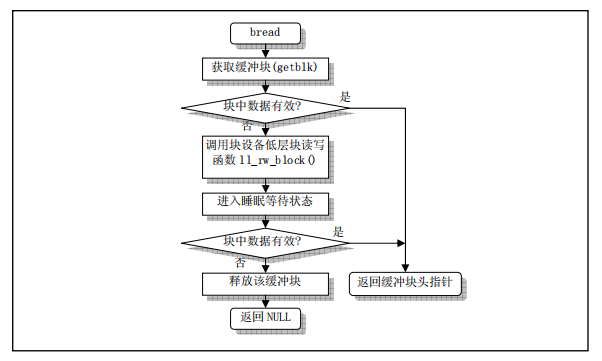
向设备发起读写请求
void ll_rw_block(int rw, struct buffer_head * bh)
{
    unsigned int major;

    if ((major=MAJOR(bh->b_dev)) >= NR_BLK_DEV ||
       !(blk_dev[major].request_fn)) {
       printk("Trying to read nonexistent block-device\n\r");
       return;
   }
    make_request(major,rw,bh);
}
构建请求
static void make_request(int major,int rw, struct buffer_head * bh)
{
    struct request * req;
    int rw_ahead;

    /* WRITEA/READA is special case - it is not really needed, so if the */
    /* buffer is locked, we just forget about it, else it's a normal read */
    if ((rw_ahead = (rw == READA || rw == WRITEA))) {
       if (bh->b_lock)
          return;
       if (rw == READA)
          rw = READ;
       else
          rw = WRITE;
   }
    if (rw!=READ && rw!=WRITE)
       panic("Bad block dev command, must be R/W/RA/WA");
    lock_buffer(bh);
    if ((rw == WRITE && !bh->b_dirt) || (rw == READ && bh->b_uptodate)) {
       unlock_buffer(bh);
       return;
   }
    repeat:
    /* we don't allow the write-requests to fill up the queue completely:
* we want some room for reads: they take precedence. The last third
* of the requests are only for reads.
*/
    if (rw == READ)
       req = request+NR_REQUEST;
    else
       req = request+((NR_REQUEST*2)/3);
    /* find an empty request */
    while (--req >= request)
       if (req->dev<0)
          break;
    /* if none found, sleep on new requests: check for rw_ahead */
    if (req < request) {
       if (rw_ahead) {
          unlock_buffer(bh);
          return;
      }
       sleep_on(&wait_for_request);
       goto repeat;
   }
    /* fill up the request-info, and add it to the queue */
    req->dev = bh->b_dev;
    req->cmd = rw;
    req->errors=0;
    req->sector = bh->b_blocknr<<1;
    req->nr_sectors = 2;
    req->buffer = bh->b_data;
    req->waiting = NULL;
    req->bh = bh;
    req->next = NULL;
    add_request(major+blk_dev,req);
}
向队列中添加请求
/*
* add-request adds a request to the linked list.
* It disables interrupts so that it can muck with the
* request-lists in peace.
*/
static void add_request(struct blk_dev_struct * dev, struct request * req)
{
    struct request * tmp;

    req->next = NULL;
    cli();
    if (req->bh)
       req->bh->b_dirt = 0;
    if (!(tmp = dev->current_request)) {
       dev->current_request = req;
       sti();
       (dev->request_fn)();
       return;
   }
    for ( ; tmp->next ; tmp=tmp->next)
       if ((IN_ORDER(tmp,req) ||
           !IN_ORDER(tmp,tmp->next)) &&
          IN_ORDER(req,tmp->next))
          break;
    req->next=tmp->next;
    tmp->next=req;
    sti();
}
执行设备函数
struct blk_dev_struct {
    void (*request_fn)(void);
    struct request * current_request;
};





 扫一扫
扫一扫


 1759
1759

 被折叠的 条评论
为什么被折叠?
被折叠的 条评论
为什么被折叠?
 到【灌水乐园】发言





