



*************
c++
topic:345. 反转字符串中的元音字母 - 力扣(LeetCode)
*************
See the topic and it is defined as easy level? anazing
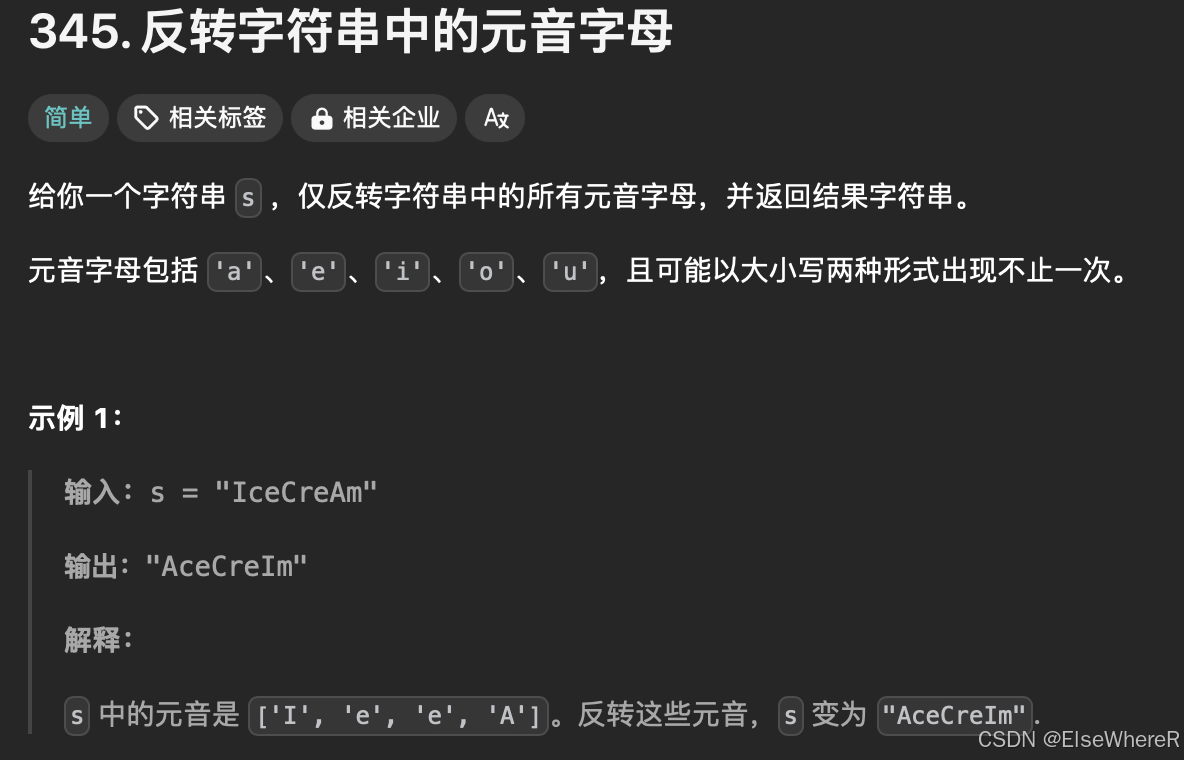
I cannot believe it is an eazy one and have no idea about it. If I were a computer and my job is to change the order of the letters. Then what should I do? I recognize the vowel and number them. Think over and over, use double pointer to solve it.
For example,
| 0 | 1 | 2 | 3 | 4 | 5 | 6 | 7 | |
| s | I | c | e | C | r | e | a | m |
| pointer | ↑i | ↑j |
As people who has participate in primary, they should know the vowel is 'a e i o u'. Let the code know it
class Solution {
public:
    string reverseVowels(string s) {

        // 让程序知道元音字母有哪些
        unordered_set<char> vowels = {'a','e','i','o','u','A','E','I','O','U'};


    }
};
Here hash table is used. unorsered_set is a standard library in c++. unordered_set<char> is often used in scenarios that require fast lookups and insertions, such as checking to see if a character has already appeared, or storing a set of non-repeating characters.
And then set two pointers, left and right. vowels.find(s[left]) tries to find the s[left] character in the vowels container, and if it finds it, returns an iterator pointing to that element; if it doesn't find it, it returns vowels.end(), which is an iterator pointing to the end of the container. This condition checks if s[left] is not in the vowels container. And make sure that left < right.
class Solution {
public:
    string reverseVowels(string s) {
        unordered_set<char> vowels = {'a','e','i','o','u','A','E','I','O','U'};
        int left = 0;
        int right = s.size() - 1;
        while (left < right) {
            // 移动左指针直到找到元音字母
            if (left < right && vowels.find(s[left]) == vowels.end()) {
                left++;
            }
            // 移动右指针直到找到元音字母
            if (left < right && vowels.find(s[right]) == vowels.end()) {
                right--;
            }

    }
};
and if pointers do find the vowes and just swap them:
class Solution {
public:
    string reverseVowels(string s) {

        // 让程序知道元音字母有哪些
        unordered_set<char> vowels = {'a','e','i','o','u','A','E','I','O','U'};

        int left = 0;
        int right = s.size() - 1;
        while (left < right) {
            // 移动左指针直到找到元音字母
            if (left < right && vowels.find(s[left]) == vowels.end()) {
                left++;
            }
            // 移动右指针直到找到元音字母
            if (left < right && vowels.find(s[right]) == vowels.end()) {
                right--;
            }
            // 交换左右指针指向的元音字母
            if (left < right) {
                swap(s[left], s[right]);
                left++;
                right--;
            }
        }
        return s;
    }
};
here in c++, swap is a standard library:
int a = 10;
int b = 20;
swap(a, b); // a 现在是 20,b 现在是 10
std::vector<int> vec1 = {1, 2, 3};
std::vector<int> vec2 = {4, 5, 6};
std::swap(vec1, vec2); // vec1 和 vec2 的内容被交换





 扫一扫
扫一扫


 779
779

 被折叠的 条评论
为什么被折叠?
被折叠的 条评论
为什么被折叠?
 到【灌水乐园】发言





