 美国国家科学基金数据解析


CnOpenData美国国家科学基金数据系统性地收录了由美国国家科学基金会资助的自1900年以来的科研项目全维度数据,覆盖从项目立项、执行到成果管理的完整生命周期。数据囊括了奖项编号、项目标题、摘要、资助金额、执行周期、参与机构及研究人员等超过25个核心字段,构建了一套完整、透明且可追溯的联邦科研资助信息体系,为洞察美国乃至全球前沿科研布局与资源配置提供了权威的数据窗口。
数据特点:
- 数据权威性:数据源自美国国家科学基金会官方发布,作为美国基础科研资助的核心机构,其数据规范严谨,字段定义清晰,确保了数据的公信力与学术价值。
- 信息全景性:数据维度丰富,不仅包含项目内容(标题、摘要),更完整记录了资助管理全流程(金额拨付、日期修订、国会选区)、执行主体(获奖者、研究人员历史、唯一实体标识符)及项目归类(NSF项目集、程序代码),支持从微观到宏观的多层次分析。
潜在应用场景:
- 科研政策研究:分析科研经费的学科分布、地域流向与机构竞争格局;评估特定技术领域(如人工智能、生物技术)的投资强度与发展趋势。
- 数据驱动决策:助力投资机构发现前沿技术赛道与潜在合作团队;为政府及咨询机构制定科技产业政策、优化研发投入结构提供证据支持。
本数据库通过高度结构化的方式,整合了美国国家级科研资助的核心元数据。其标准化、多维度的特性,使其成为支撑科研管理学、科学社会学、科技政策研究与创新经济学等领域实证研究的战略性基础资源。
数据规模
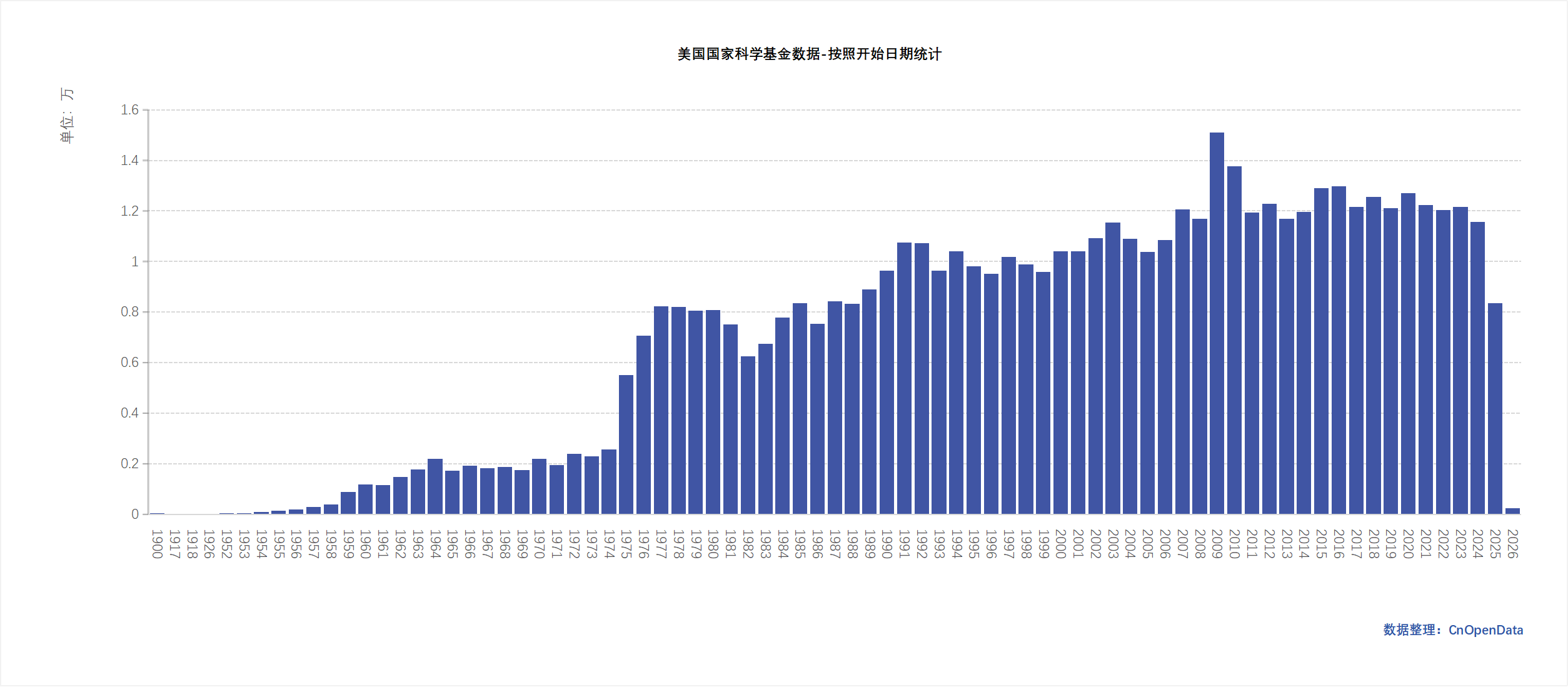
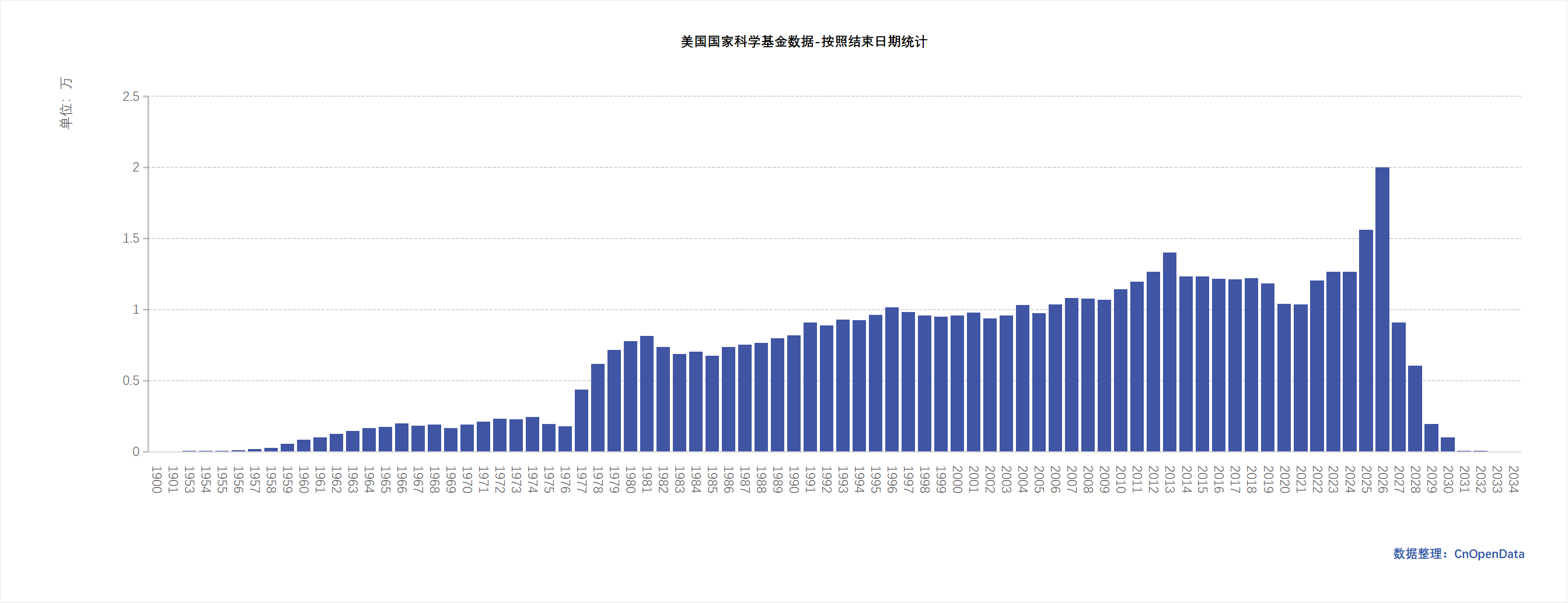
时间区间
按开始日期:1900-2025.9
字段展示
| 美国国家科学基金数据字段-英文版 | 美国国家科学基金数据字段-中文版 |
|---|---|
| award_number | 奖项编号 |
| title | 标题 |
| abstract | 摘要 |
| nsf_org | NSF机构 |
| recipient | 获奖者 |
| award_instrument | 奖项类型 |
| program_manager | 项目主管 |
| start_date | 开始日期 |
| end_date | 结束日期 |
| initial_amendment_date | 首次修订日期 |
| latest_amendment_date | 最新修订日期 |
| total_intended_award_amount | 计划资助总额 |
| total_awarded_amount_to_date | 迄今授予总额 |
| funds_obligated_to_date | 迄今拨付资金 |
| history_of_investigator | 研究人员历史记录 |
| recipient_sponsored_research_office | 获奖者科研管理办公室 |
| sponsor_congressional_district | 资助国会选区 |
| primary_place_of_performance | 主要执行地点 |
| primary_place_of_performance_congressional_district | 主要执行地国会选区 |
| unique_entity_identifier | 唯一实体标识符 |
| parent_uei | 母实体UEI |
| nsf_programs | NSF项目集 |
| primary_program_source | 主要项目来源 |
| program_reference_codes | 项目参考代码 |
| program_element_codes | 项目要素代码 |
| awarding_agency | 授予机构 |
| funding_agency_code | 资助机构代码 |
| assistance_listing_numbers | 资助项目目录编号 |
样本数据
| award_number | title | abstract | nsf_org | recipient | award_instrument | program_manager | start_date | end_date | initial_amendment_date | latest_amendment_date | total_intended_award_amount | total_awarded_amount_to_date | funds_obligated_to_date | history_of_investigator | recipient_sponsored_research_office | sponsor_congressional_district | primary_place_of_performance | primary_place_of_performance_congressional_district | unique_entity_identifier | parent_uei | nsf_programs | primary_program_source | program_reference_codes | program_element_codes | awarding_agency | funding_agency_code | assistance_listing_numbers |
|---|---|---|---|---|---|---|---|---|---|---|---|---|---|---|---|---|---|---|---|---|---|---|---|---|---|---|---|
| 奖项编号 | 标题 | 摘要 | NSF机构 | 获奖者 | 奖项类型 | 项目主管 | 开始日期 | 结束日期 | 首次修订日期 | 最新修订日期 | 计划资助总额 | 迄今授予总额 | 迄今拨付资金 | 研究人员历史记录 | 获奖者科研管理办公室 | 资助国会选区 | 主要执行地点 | 主要执行地国会选区 | 唯一实体标识符 | 母实体UEI | NSF项目集 | 主要项目来源 | 项目参考代码 | 项目要素代码 | 授予机构 | 资助机构代码 | 资助项目目录编号 |
| 1341304 | Collaborative Research: Understanding the Evolution of High-latitude Permo-Triassic Paleoenvironments and their Vertebrate Communities. | Around 252 million years ago, a major mass extinction wiped out upwards of 90% of species on Earth. Coincident with this extinction, the Antarctic portion of the supercontinent of Pangea transitioned to a warmer climatic regime and became devoid of glaciers. Little is known about the survivors of the extinction in Antarctica, although it has been hypothesized that the continent's high latitude location shielded it from the worst of the extinction's effects. The Shackleton Glacier region is the best place to study this extinction in Antarctica because it exposes an abundance of correct age rocks and relevant fossils were found there in the 1960s and 1980s. For this research, paleontologists will study fossil vertebrates that span from about 260 to 240 million years ago to understand how life evolved at high latitudes in the face of massive climate change. In addition, geologists will use fossil soils and fossil plant matter to more precisely reconstruct the climate of Antarctica across this extinction boundary. These data will allow for a more complete understanding of ancient climates and how Antarctic life compared to that at lower latitudes. Undergraduate and graduate students will be actively involved in this research. Public engagement in Antarctic science will be accomplished at several natural history museums. This three-year project will examine the evolution of Permo-Triassic paleoenvironments and their vertebrate communities by conducting fieldwork in the Shackleton Glacier region of Antarctica. The team will characterize the Permo-Triassic boundary within Shackleton area strata and correlate it to other stratigraphic successions in the region (e.g. via stable carbon isotope stratigraphy of fossilized plant organic matter). The researchers will use multiple types of data to assess the paleoenvironment, including: 1) paleosol morphology; 2) paleosol geochemistry; 3) pedogenic organic matter; and 4) fossil wood chronology and stable isotopes. The Fremouw Formation of Antarctica preserves the highest paleolatitude (~70° S) tetrapod fauna of the entire Triassic and thus has the potential to shed important light on the evolution of polar life during the early Mesozoic. The biology of Triassic vertebrates from Antarctica will be compared to conspecifics from lower paleolatitudes through analysis of growth in bone and tusk histology. An interdisciplinary approach will be used to address relationships between environmental change, faunal composition, and biogeographic patterns in the context of the high-latitude strata preserved in the Buckley and Fremouw formations in the Shackleton Glacier region. | OPP Office of Polar Programs (OPP) | UNIVERSITY OF WASHINGTON | Standard Grant | Michael E. Jackson OPP Office of Polar Programs (OPP) GEO Directorate for Geosciences | September 1, 2016 | August 31, 2022 (Estimated) | August 30, 2016 | April 29, 2021 | $320,365.00 | $320,365.00 | FY 2016 = $320,365.00 | Christian Sidor (Principal Investigator) casidor@u.washington.edu | University of Washington 4333 BROOKLYN AVE NE SEATTLE WA US 98195-1016 (206)543-4043 | 07 | University of Washington WA US 98195-1800 | 07 | HD1WMN6945W6 | ANT Earth Sciences | 0100XXXXDB NSF RESEARCH & RELATED ACTIVIT | 511200 | 4900 | 4900 | 47.078 | ||
| 1341376 | Collaborative Research: Understanding the Evolution of High-latitude Permo-Triassic Paleoenvironments and their Vertebrate Communities. | Around 252 million years ago, a major mass extinction wiped out upwards of 90% of species on Earth. Coincident with this extinction, the Antarctic portion of the supercontinent of Pangea transitioned to a warmer climatic regime and became devoid of glaciers. Little is known about the survivors of the extinction in Antarctica, although it has been hypothesized that the continent?s more polar location shielded it from the worst of the extinction?s effects. The Shackleton Glacier region is the best place to study this extinction in Antarctica because it exposes the correct age rocks in abundance and relevant fossils were found there in the 1960s and 1980s. For this research, paleontologists will study fossil vertebrates that span from about 260?240 million years ago to understand how life evolved at high latitudes in the face of massive climate change. In addition, geologists will use fossil soils and fossil plant matter to more precisely understand the climate of Antarctica across this extinction boundary. These data will allow for a more complete understanding of ancient climates and how Antarctic life compared to that at lower latitudes. Undergraduate and graduate students will be actively involved in this research. Public engagement in Antarctic science will be accomplished at several natural history museums. This three-year project will examine the evolution of Permo-Triassic paleoenvironments and their vertebrate communities by conducting fieldwork in the Shackleton Glacier region of Antarctica. The team will characterize the Permo-Triassic boundary within Shackleton area strata and correlate it to other stratigraphic successions in the region (e.g. via stable carbon isotope stratigraphy of fossilized plant organic matter). The researchers will use multiple types of data to assess the paleoenvironment, including: 1) paleosol morphology; 2) paleosol geochemistry; 3) pedogenic organic matter; and 4) fossil wood chronology and stable isotopes. The Fremouw Formation of Antarctica preserves the highest paleolatitude (~70° S) tetrapod fauna of the entire Triassic and thus has the potential to shed important light on the evolution of polar life during the early Mesozoic. The biology of Triassic vertebrates from Antarctica will be compared to conspecifics from lower paleolatitudes through analysis of growth in bone and tusk histology. An interdisciplinary approach will be used to address relationships between environmental change, faunal composition, and biogeographic patterns in the context of the high-latitude strata preserved in the Buckley and Fremouw formations in the Shackleton Glacier region. | OPP Office of Polar Programs (OPP) | SOUTHERN METHODIST UNIVERSITY | Standard Grant | Michael E. Jackson OPP Office of Polar Programs (OPP) GEO Directorate for Geosciences | September 1, 2016 | August 31, 2020 (Estimated) | August 30, 2016 | August 30, 2016 | $214,892.00 | $214,892.00 | FY 2016 = $214,892.00 | Neil Tabor (Principal Investigator) ntabor@mail.smu.edu | Southern Methodist University 6425 BOAZ ST RM 130 DALLAS TX US 75205-1902 (214)768-4708 | 24 | Southern Methodist University 3225 Daniel Road Dallas TX US 75275-0395 | 32 | D33QGS3Q3DJ3 | S88YPE3BLV66 | ANT Earth Sciences | 0100XXXXDB NSF RESEARCH & RELATED ACTIVIT | 511200 | 4900 | 4900 | 47.078 | |
| 1341475 | Collaborative Research: Understanding the Evolution of High-latitude Permo-Triassic Paleoenvironments and their Vertebrate Communities. | Around 252 million years ago, a major mass extinction wiped out upwards of 90% of species on Earth. Coincident with this extinction, the Antarctic portion of the supercontinent of Pangea transitioned to a warmer climatic regime and became devoid of glaciers. Little is known about the survivors of the extinction in Antarctica, although it has been hypothesized that the continent?s more polar location shielded it from the worst of the extinction?s effects. The Shackleton Glacier region is the best place to study this extinction in Antarctica because it exposes the correct age rocks in abundance and relevant fossils were found there in the 1960s and 1980s. For this research, paleontologists will study fossil vertebrates that span from about 260?240 million years ago to understand how life evolved at high latitudes in the face of massive climate change. In addition, geologists will use fossil soils and fossil plant matter to more precisely understand the climate of Antarctica across this extinction boundary. These data will allow for a more complete understanding of ancient climates and how Antarctic life compared to that at lower latitudes. Undergraduate and graduate students will be actively involved in this research. Public engagement in Antarctic science will be accomplished at several natural history museums. This three-year project will examine the evolution of Permo-Triassic paleoenvironments and their vertebrate communities by conducting fieldwork in the Shackleton Glacier region of Antarctica. The team will characterize the Permo-Triassic boundary within Shackleton area strata and correlate it to other stratigraphic successions in the region (e.g. via stable carbon isotope stratigraphy of fossilized plant organic matter). The researchers will use multiple types of data to assess the paleoenvironment, including: 1) paleosol morphology; 2) paleosol geochemistry; 3) pedogenic organic matter; and 4) fossil wood chronology and stable isotopes. The Fremouw Formation of Antarctica preserves the highest paleolatitude (~70° S) tetrapod fauna of the entire Triassic and thus has the potential to shed important light on the evolution of polar life during the early Mesozoic. The biology of Triassic vertebrates from Antarctica will be compared to conspecifics from lower paleolatitudes through analysis of growth in bone and tusk histology. An interdisciplinary approach will be used to address relationships between environmental change, faunal composition, and biogeographic patterns in the context of the high-latitude strata preserved in the Buckley and Fremouw formations in the Shackleton Glacier region. | OPP Office of Polar Programs (OPP) | LOS ANGELES COUNTY MUSEUM OF NATURAL HISTORY FOUNDATION | Standard Grant | Michael E. Jackson OPP Office of Polar Programs (OPP) GEO Directorate for Geosciences | September 1, 2016 | August 31, 2022 (Estimated) | August 30, 2016 | June 24, 2021 | $162,800.00 | $195,348.00 | FY 2016 = $162,800.00 FY 2020 = $32,548.00 | Nathan Smith (Principal Investigator) nsmith@nhm.org | Los Angeles County Museum of Natural History Foundation 900 EXPOSITION BLVD LOS ANGELES CA US 90007-4057 (213)763-3331 | 37 | Natural History Museum of Los Angeles County 900 Exposition Blvd Los Angeles CA US 90007-4057 | 37 | UKB4JJ1M1647 | ANT Earth Sciences | 0100XXXXDB NSF RESEARCH & RELATED ACTIVIT | 097Z | 511200 | 4900 | 4900 | 47.078 | |
| 1341629 | Collaborative Research: The Role of Glacial History on the Structure and Functioning of Ecological Communities in the Shackleton Glacier Region of the Transantarctic Mountains | The project will characterize the functional, taxonomic, biotic and abiotic drivers of soil ecosystems in the Trans Antarctic Mountains (one of the most remote and harsh terrestrial landscapes on the planet). The work will utilize new high-throughput DNA and RNA sequencing technologies to identify members of the microbial communities and determine if the microbial community structures are independent of local environmental heterogeneities. In addition the project will determine if microbial diversity and function are correlated with time since the last glacial maximum (LGM). The expected results will greatly contribute to our knowledge regarding rates of microbial succession and help define the some of the limits to life and life-maintaining processes on Earth. The project will analyze genomes and RNA derived from these genomes to describe the relationships between biodiversity and ecosystem functioning from soils above and below LGM elevations and to correlate these with the environmental drivers associated with their development during the last ~18,000 years. The team will identify the taxonomic diversity and the functional genetic composition within a broad suite of soil biota and examine their patterns of assembly and distribution within the framework of their geological legacies. The project will mentor participants from undergraduate students to postdoctoral researchers and prepare them to effectively engage in research to meet their career aspirations. The project will contribute to ongoing public education efforts through relationships with K-12 teachers and administrators- to include University-Public School partnerships. Less formal activities include public lecture series and weblogs aimed at providing information on Antarctic polar desert ecosystems to the general public. Targeted classrooms near each PI's institution will participate in online, real-time discussions about current topics in Antarctic ecosystems research. | OPP Office of Polar Programs (OPP) | THE REGENTS OF THE UNIVERSITY OF COLORADO | Standard Grant | Michael E. Jackson OPP Office of Polar Programs (OPP) GEO Directorate for Geosciences | September 1, 2016 | August 31, 2020 (Estimated) | August 17, 2016 | August 17, 2016 | $275,757.00 | $275,757.00 | FY 2016 = $275,757.00 | Noah Fierer (Principal Investigator) noah.fierer@colorado.edu Rob Knight (Co-Principal Investigator) | University of Colorado at Boulder 3100 MARINE ST Boulder CO US 80309-0001 (303)492-6221 | 02 | University of Colorado at Boulder 3100 Marine Street Boulder CO US 80303-1058 | 02 | SPVKK1RC2MZ3 | ANT Organisms & Ecosystems | 0100XXXXDB NSF RESEARCH & RELATED ACTIVIT | 9150 | 511100 | 4900 | 4900 | 47.078 | |
| 1341631 | Collaborative Research: The Role of Glacial History on the Structure and Functioning of Ecological Communities in the Shackleton Glacier Region of the Transantarctic Mountains | The project will characterize the functional, taxonomic, biotic and abiotic drivers of soil ecosystems in the Trans Antarctic Mountains (one of the most remote and harsh terrestrial landscapes on the planet). The work will utilize new high-throughput DNA and RNA sequencing technologies to identify members of the microbial communities and determine if the microbial community structures are independent of local environmental heterogeneities. In addition the project will determine if microbial diversity and function are correlated with time since the last glacial maximum (LGM). The expected results will greatly contribute to our knowledge regarding rates of microbial succession and help define the some of the limits to life and life-maintaining processes on Earth. The project will analyze genomes and RNA derived from these genomes to describe the relationships between biodiversity and ecosystem functioning from soils above and below LGM elevations and to correlate these with the environmental drivers associated with their development during the last ~18,000 years. The team will identify the taxonomic diversity and the functional genetic composition within a broad suite of soil biota and examine their patterns of assembly and distribution within the framework of their geological legacies. The project will mentor participants from undergraduate students to postdoctoral researchers and prepare them to effectively engage in research to meet their career aspirations. The project will contribute to ongoing public education efforts through relationships with K-12 teachers and administrators- to include University-Public School partnerships. Less formal activities include public lecture series and weblogs aimed at providing information on Antarctic polar desert ecosystems to the general public. Targeted classrooms near each PI's institution will participate in online, real-time discussions about current topics in Antarctic ecosystems research. | OPP Office of Polar Programs (OPP) | OHIO STATE UNIVERSITY, THE | Standard Grant | Michael E. Jackson OPP Office of Polar Programs (OPP) GEO Directorate for Geosciences | September 1, 2016 | August 31, 2020 (Estimated) | August 17, 2016 | May 31, 2019 | $96,941.00 | $114,413.00 | FY 2016 = $96,941.00 FY 2018 = $5,020.00 FY 2019 = $12,452.00 | W. Berry Lyons (Principal Investigator) lyons.142@osu.edu | OHIO STATE UNIVERSITY, THE 1960 KENNY RD COLUMBUS OH US 43210-1016 (614)688-8735 | 03 | Ohio State University 1090 Carmack Road Columbus OH US 43210-1002 | 03 | DLWBSLWAJWR1 | MN4MDDMN8529 | ANT Organisms & Ecosystems, Polar Special Initiatives | 0100XXXXDB NSF RESEARCH & RELATED ACTIVIT | 9150, 7183 | 511100, 017Y00 | 4900 | 4900 | 47.078 |
| 1341645 | Collaborative Research: Understanding the Evolution of High-latitude Permo-Triassic Paleoenvironments and their Vertebrate Communities. | Around 252 million years ago, a major mass extinction wiped out upwards of 90% of species on Earth. Coincident with this extinction, the Antarctic portion of the supercontinent of Pangea transitioned to a warmer climatic regime and became devoid of glaciers. Little is known about the survivors of the extinction in Antarctica, although it has been hypothesized that the continent?s more polar location shielded it from the worst of the extinction?s effects. The Shackleton Glacier region is the best place to study this extinction in Antarctica because it exposes the correct age rocks in abundance and relevant fossils were found there in the 1960s and 1980s. For this research, paleontologists will study fossil vertebrates that span from about 260?240 million years ago to understand how life evolved at high latitudes in the face of massive climate change. In addition, geologists will use fossil soils and fossil plant matter to more precisely understand the climate of Antarctica across this extinction boundary. These data will allow for a more complete understanding of ancient climates and how Antarctic life compared to that at lower latitudes. Undergraduate and graduate students will be actively involved in this research. Public engagement in Antarctic science will be accomplished at several natural history museums. This three-year project will examine the evolution of Permo-Triassic paleoenvironments and their vertebrate communities by conducting fieldwork in the Shackleton Glacier region of Antarctica. The team will characterize the Permo-Triassic boundary within Shackleton area strata and correlate it to other stratigraphic successions in the region (e.g. via stable carbon isotope stratigraphy of fossilized plant organic matter). The researchers will use multiple types of data to assess the paleoenvironment, including: 1) paleosol morphology; 2) paleosol geochemistry; 3) pedogenic organic matter; and 4) fossil wood chronology and stable isotopes. The Fremouw Formation of Antarctica preserves the highest paleolatitude (~70° S) tetrapod fauna of the entire Triassic and thus has the potential to shed important light on the evolution of polar life during the early Mesozoic. The biology of Triassic vertebrates from Antarctica will be compared to conspecifics from lower paleolatitudes through analysis of growth in bone and tusk histology. An interdisciplinary approach will be used to address relationships between environmental change, faunal composition, and biogeographic patterns in the context of the high-latitude strata preserved in the Buckley and Fremouw formations in the Shackleton Glacier region. | OPP Office of Polar Programs (OPP) | FIELD MUSEUM OF NATURAL HISTORY | Standard Grant | Michael E. Jackson OPP Office of Polar Programs (OPP) GEO Directorate for Geosciences | September 1, 2016 | December 31, 2019 (Estimated) | August 30, 2016 | August 30, 2016 | $130,151.00 | $130,151.00 | FY 2016 = $68,865.00 | Peter Makovicky (Principal Investigator) pmakovicky@fieldmuseum.org | Field Museum of Natural History 1400 S LAKE SHORE DR CHICAGO IL US 60605-2827 (312)665-7240 | 07 | Field Museum of Natural History 1400 S Lake Shore Drive Chicago IL US 60605-2827 | 07 | CBHQF44BQYN5 | ANT Earth Sciences | 0100XXXXDB NSF RESEARCH & RELATED ACTIVIT | 511200 | 4900 | 4900 | 47.078 | ||
| 1341648 | Collaborative Research: The Role of Glacial History on the Structure and Functioning of Ecological Communities in the Shackleton Glacier Region of the Transantarctic Mountains | The project will characterize the functional, taxonomic, biotic and abiotic drivers of soil ecosystems in the Trans Antarctic Mountains (one of the most remote and harsh terrestrial landscapes on the planet). The work will utilize new high-throughput DNA and RNA sequencing technologies to identify members of the microbial communities and determine if the microbial community structures are independent of local environmental heterogeneities. In addition the project will determine if microbial diversity and function are correlated with time since the last glacial maximum (LGM). The expected results will greatly contribute to our knowledge regarding rates of microbial succession and help define the some of the limits to life and life-maintaining processes on Earth. The project will analyze genomes and RNA derived from these genomes to describe the relationships between biodiversity and ecosystem functioning from soils above and below LGM elevations and to correlate these with the environmental drivers associated with their development during the last ~18,000 years. The team will identify the taxonomic diversity and the functional genetic composition within a broad suite of soil biota and examine their patterns of assembly and distribution within the framework of their geological legacies. The project will mentor participants from undergraduate students to postdoctoral researchers and prepare them to effectively engage in research to meet their career aspirations. The project will contribute to ongoing public education efforts through relationships with K-12 teachers and administrators- to include University-Public School partnerships. Less formal activities include public lecture series and weblogs aimed at providing information on Antarctic polar desert ecosystems to the general public. Targeted classrooms near each PI's institution will participate in online, real-time discussions about current topics in Antarctic ecosystems research. | OPP Office of Polar Programs (OPP) | COLORADO STATE UNIVERSITY | Standard Grant | Karla Heidelberg OPP Office of Polar Programs (OPP) GEO Directorate for Geosciences | September 1, 2016 | August 31, 2021 (Estimated) | August 17, 2016 | June 4, 2020 | $114,864.00 | $114,864.00 | FY 2016 = $114,864.00 | Diana Wall (Principal Investigator) diana.wall@colostate.edu | Colorado State University 601 S HOWES ST FORT COLLINS CO US 80521-2807 (970)491-6355 | 02 | Colorado State University 200 W. Lake St Fort Collins CO US 80521-4593 | 02 | LT9CXX8L19G1 | ANT Organisms & Ecosystems | 0100XXXXDB NSF RESEARCH & RELATED ACTIVIT | 9150 | 511100 | 4900 | 4900 | 47.078 | |
| 1341736 | Collaborative Research: The Role of Glacial History on the Structure and Functioning of Ecological Communities in the Shackleton Glacier Region of the Transantarctic Mountains | The project will characterize the functional, taxonomic, biotic and abiotic drivers of soil ecosystems in the Trans Antarctic Mountains (one of the most remote and harsh terrestrial landscapes on the planet). The work will utilize new high-throughput DNA and RNA sequencing technologies to identify members of the microbial communities and determine if the microbial community structures are independent of local environmental heterogeneities. In addition the project will determine if microbial diversity and function are correlated with time since the last glacial maximum (LGM). The expected results will greatly contribute to our knowledge regarding rates of microbial succession and help define the some of the limits to life and life-maintaining processes on Earth. The project will analyze genomes and RNA derived from these genomes to describe the relationships between biodiversity and ecosystem functioning from soils above and below LGM elevations and to correlate these with the environmental drivers associated with their development during the last ~18,000 years. The team will identify the taxonomic diversity and the functional genetic composition within a broad suite of soil biota and examine their patterns of assembly and distribution within the framework of their geological legacies. The project will mentor participants from undergraduate students to postdoctoral researchers and prepare them to effectively engage in research to meet their career aspirations. The project will contribute to ongoing public education efforts through relationships with K-12 teachers and administrators- to include University-Public School partnerships. Less formal activities include public lecture series and weblogs aimed at providing information on Antarctic polar desert ecosystems to the general public. Targeted classrooms near each PI's institution will participate in online, real-time discussions about current topics in Antarctic ecosystems research. | OPP Office of Polar Programs (OPP) | BRIGHAM YOUNG UNIVERSITY | Standard Grant | Michael E. Jackson OPP Office of Polar Programs (OPP) GEO Directorate for Geosciences | September 1, 2016 | December 31, 2021 (Estimated) | August 17, 2016 | May 21, 2021 | $360,781.00 | $360,781.00 | FY 2016 = $360,781.00 | Byron Adams (Principal Investigator) bjadams@byu.edu | Brigham Young University A-153 ASB PROVO UT US 84602-1128 (801)422-3360 | 03 | Brigham Young University AY | JWSYC7RUMJD1 | ANT Organisms & Ecosystems | 0100XXXXDB NSF RESEARCH & RELATED ACTIVIT | 9150 | 511100 | 4900 | 4900 | 47.078 | ||
| 1403203 | CI TraCS Research Starter Supplement: Utilizing Graphics Processing Units for Dynamic Rupture Earthquake Simulations | Not Available | OAC Office of Advanced Cyberinfrastructure (OAC) | NAVAL POSTGRADUATE SCHOOL | Interagency Agreement | Ashok Srinivasan OAC Office of Advanced Cyberinfrastructure (OAC) CSE Directorate for Computer and Information Science and Engineering | July 1, 2016 | June 30, 2018 (Estimated) | July 5, 2016 | June 22, 2017 | $49,680.00 | $49,680.00 | FY 2016 = $49,680.00 | Jeremy Kozdon (Principal Investigator) jekozdon@nps.edu | Naval Postgraduate School 1 UNIVERSITY CIR MONTEREY CA US 93943-5098 (831)656-2271 | 19 | Naval Postgraduate School 1 University Circle Monterey CA US 93943-5098 | 19 | CEPCN5K7EKU8 | NW2RJN8TQQW1 | EDUCATION AND WORKFORCE | 01001617DB NSF RESEARCH & RELATED ACTIVIT | 7231 | 736100 | 4900 | 4900 | 47.070 |
| 1442386 | A Proposal of the Renewal of the Banff International Research Station for Mathematical Innovation and Discovery (BIRS) | Abstract Award: DMS 1442386, Principal Investigator: Nassif Ghoussoub Established in 2003, the Banff International Research Station (BIRS) is a North American research institute that addresses the imperatives of collaborative research and cross-disciplinary synergy, by facilitating intense and prolonged interactions among mathematical scientists from around the world. BIRS unique infrastructure ensures a creative environment for the exchange of ideas, knowledge, and methods within the mathematical sciences and their vast array of applications in science and engineering. BIRS embraces all aspects of quantitative and analytic research. Its programs span almost every aspect of pure, applied, computational, and industrial mathematics, as well as statistics and computer science. Its workshops involve physicists, biologists, engineers, economists, and financial analysts. BIRS main mode of operation is to annually competitively select and run 48 weekly workshops, each hosting 42 researchers. The extraordinary response to the opportunities at BIRS leads to extremely high quality workshops. This award supports the participation of more than 4,200 US-based mathematical scientists in the stations activities for the period 2016-20. | DMS Division Of Mathematical Sciences | THE UNIVERSITY OF BRITISH COLUMBIA | Continuing Grant | Pedro Embid DMS Division Of Mathematical Sciences MPS Directorate for Mathematical and Physical Sciences | August 15, 2016 | July 31, 2023 (Estimated) | August 17, 2016 | May 23, 2022 | $3,865,000.00 | $3,865,000.00 | FY 2016 = $773,000.00 FY 2017 = $773,000.00 FY 2018 = $1,546,000.00 FY 2019 = $773,000.00 | Malabika Pramanik (Principal Investigator) malabika@math.ubc.ca Nassif Ghoussoub (Former Principal Investigator) | University of British Columbia 224-6328 MEMORIAL RD VANCOUVER BC CA V6T 1-Z2 (604)822-8595 | Banff International Research Station TCPL, 107 Tunnel Mountain Drive Banff CA | SJR5MQHSLWT6 | SJR5MQHSLWT6 | MATHEMATICAL SCIENCES RES INST | 01001617DB NSF RESEARCH & RELATED ACTIVIT 01001718DB NSF RESEARCH & RELATED ACTIVIT 01001819DB NSF RESEARCH & RELATED ACTIVIT 01001920DB NSF RESEARCH & RELATED ACTIVIT 01002021DB NSF RESEARCH & RELATED ACTIVIT | 733300 | 4900 | 4900 | 47.049 | |||
| 1443144 | Collaborative Research: A High-sensitivity Beryllium-10 Record from an Ice Core at South Pole | This project will acquire measurements of the concentration of beryllium-10 (10Be) from an ice core from the South Pole, Antarctica. An isotope of the element beryllium, 10Be, is produced in the atmosphere by high-energy protons (cosmic rays) that enter Earth's atmosphere from space. It is removed from the atmosphere by settling or by scavenging by rain or snowfall. Hence, concentrations of 10Be in snow at the South Pole reflect the production rate of 10Be in the atmosphere. Because the rate of production of 10Be over Antarctica depends primarily on the strength of the Sun's magnetic field, measurements of 10Be in the South Pole ice core will provide a record of changes in solar activity. The South Pole ice core will reach an age of 40,000 years at the bottom. The project will result in measurements of 10Be at annual resolution for the last 100 years and selected periods in the more distant past, such as the Maunder Minimum, a period during the late 17th century during which no sunspots were observed, or the last glacial cold period, about 20,000 years ago. A climate model that can simulate the production of 10Be in the atmosphere, it's transport through the atmosphere, and its deposition at the snow surface in Antarctica will be used to aid in using the 10Be data to determine past changes in solar activity from decadal to millennial scale, and in turn to evaluate the role of the Sun in Earth?s climate from a new perspective. The production of 10Be in Earth's atmosphere results from the spallation of oxygen and nitrogen in the atmosphere by cosmic rays. Cosmic ray variations in the high latitudes are primarily modulated by solar variability. Time-series records of 10Be from ice cores are therefore important for deriving variations in solar activity through time, which is fundamental to understanding climate variability. Deposition of 10Be to the ice surface is also influenced by variability in atmospheric circulation and deposition processes, and South Pole is the best available location for minimizing the influence of variable atmospheric circulation on 10Be deposition. To date, only one record of 10Be exists from South Pole; that record is widely used in solar forcing estimates used in climate models, but covers only the last millennium and ends in CE 1982. We will obtain 10Be concentration measurements in a 1500-m, 40000-year long ice core from the South Pole. This will extend the existing record both further back in time and forward to the present, providing overlap with the modern instrumental record of solar and climate variability. High resolution (annual to biannual) measurements will be made in targeted areas of interest, including the last 100 years, the Maunder Minimum (CE 1650-1715), and the last glacial maximum. The novel data will be used in conjunction with climate model experiments that incorporate 10Be production, transport, and deposition physics. Together, data and modeling will create an updated record of atmospheric 10Be production and hence of solar activity. | OPP Office of Polar Programs (OPP) | UNIVERSITY OF WASHINGTON | Continuing Grant | Paul Cutler pcutler@nsf.gov (703)292-4961 OPP Office of Polar Programs (OPP) GEO Directorate for Geosciences | May 1, 2016 | April 30, 2020 (Estimated) | April 21, 2016 | May 11, 2018 | $209,720.00 | $209,720.00 | FY 2016 = $61,977.00 FY 2017 = $92,983.00 FY 2018 = $54,760.00 | Eric Steig (Principal Investigator) steig@uw.edu | University of Washington 4333 BROOKLYN AVE NE SEATTLE WA US 98195-1016 (206)543-4043 | 07 | University of Washington WA US 98105-5020 | 07 | HD1WMN6945W6 | ANT Glaciology | 0100XXXXDB NSF RESEARCH & RELATED ACTIVIT | 511600 | 4900 | 4900 | 47.078 | ||
| 1443248 | Collaborative Research: High-resolution Reconstruction of Holocene Deglaciation in the Southern Ross Embayment | The response of the Antarctic Ice Sheet to future climatic changes is recognized as the greatest uncertainty in projections of future sea level. An understanding of past ice fluctuations affords insight into ice-sheet response to climate and sea-level change and thus is critical for improving sea-level predictions. This project will examine deglaciation of the southern Ross Sea over the past few thousand years to document oscillations in Antarctic ice volume during a period of relatively stable climate and sea level. We will help quantify changes in ice volume, improve understanding of the ice dynamics responsible, and examine the implications for future sea-level change. The project will train future scientists through participation of graduate students, as well as undergraduates who will develop research projects in our laboratories. Previous research indicates rapid Ross Sea deglaciation as far south as Beardmore Glacier early in the Holocene epoch (which began approximately 11,700 years before present), followed by more gradual recession. However, deglaciation in the later half of the Holocene remains poorly constrained, with no chronological control on grounding-line migration between Beardmore and Scott Glaciers. Thus, we do not know if mid-Holocene recession drove the grounding line rapidly back to its present position at Scott Glacier, or if the ice sheet withdrew gradually in the absence of significant climate forcing or eustatic sea level change. The latter possibility raises concerns for future stability of the Ross Sea grounding line. To address this question, we will map and date glacial deposits on coastal mountains that constrain the thinning history of Liv and Amundsen Glaciers. By extending our chronology down to the level of floating ice at the mouths of these glaciers, we will date their thinning history from glacial maximum to present, as well as migration of the Ross Sea grounding line southwards along the Transantarctic Mountains. High-resolution dating will come from Beryllium-10 surface-exposure ages of erratics collected along elevation transects, as well as Carbon-14 dates of algae within shorelines from former ice-dammed ponds. Sites have been chosen specifically to allow close comparison of these two dating methods, which will afford constraints on Antarctic Beryllium-10 production rates. | OPP Office of Polar Programs (OPP) | UNIVERSITY OF MAINE SYSTEM | Standard Grant | Paul Cutler pcutler@nsf.gov (703)292-4961 OPP Office of Polar Programs (OPP) GEO Directorate for Geosciences | August 1, 2016 | July 31, 2019 (Estimated) | July 25, 2016 | July 25, 2016 | $165,146.00 | $165,146.00 | FY 2016 = $165,146.00 | Brenda Hall (Principal Investigator) Brendah@Maine.edu | University of Maine 5717 CORBETT HALL ORONO ME US 04469-5717 (207)581-1484 | 02 | University of Maine 311 Bryand Global Sciences Orono ME US 04469-5717 | 02 | PB3AJE5ZEJ59 | ANT Glaciology | 0100XXXXDB NSF RESEARCH & RELATED ACTIVIT | 9150 | 511600 | 4900 | 4900 | 47.078 | |
| 1443342 | Collaborative Research: East Antarctic Glacial Landscape Evolution (EAGLE): A Study using Combined Thermochronology, Geochronology and Provenance Analysis | Antarctica is almost entirely covered by ice, in places over two miles thick. This ice hides a landscape that is less well known than the surface of Mars and represents one of Earth's last unexplored frontiers. Ice-penetrating radar images provide a remote glimpse of this landscape including ice-buried mountains larger than the European Alps and huge fjords twice as deep as the Grand Canyon. The goal of this project is to collect sediment samples derived from these landscapes to determine when and under what conditions these features formed. Specifically, the project seeks to understand the landscape in the context of the history and dynamics of the overlying ice sheet and past mountain-building episodes. This project accomplishes this goal by analyzing sand collected during previous sea-floor drilling expeditions off the coast of Antarctica. This sand was supplied from the continent interior by ancient rivers when it was ice-free over 34 million year ago, and later by glaciers. The project will also study bedrock samples from rare ice-free parts of the Transantarctic Mountains. The primary activity is to apply multiple advanced dating techniques to single mineral grains contained within this sand and rock. Different methods and minerals yield different dates that provide insight into how Antarctica?s landscape has eroded over the many tens of millions of years during which sand was deposited offshore. The dating techniques that are being developed and enhanced for this study have broad application in many branches of geoscience research and industry. The project makes cost-effective use of pre-existing sample collections housed at NSF facilities including the US Polar Rock Repository, the Gulf Coast Core Repository, and the Antarctic Marine Geology Research Facility. The project will contribute to the STEM training of two graduate and two undergraduate students, and includes collaboration among four US universities as well as international collaboration between the US and France. The project also supports outreach in the form of a two-week open workshop giving ten students the opportunity to visit the University of Arizona to conduct STEM-based analytical work and training on Antarctic-based projects. Results from both the project and workshop will be disseminated through presentations at professional meetings, peer-reviewed publications, and through public outreach and media. The main objective of this project is to reconstruct a chronology of East Antarctic subglacial landscape evolution to understand the tectonic and climatic forcing behind landscape modification, and how it has influenced past ice sheet inception and dynamics. Our approach focuses on acquiring a record of the cooling and erosion history contained in East Antarctic-derived detrital mineral grains and clasts in offshore sediments deposited both before and after the onset of Antarctic glaciation. Samples will be taken from existing drill core and marine sediment core material from offshore Wilkes Land (100°E-160°E) and the Ross Sea. Multiple geo- and thermo-chronometers will be employed to reconstruct source region cooling history including U-Pb, fission-track, and (U-Th)/He dating of zircon and apatite, and 40Ar/39Ar dating of hornblende, mica, and feldspar. This offshore record will be augmented and tested by applying the same methods to onshore bedrock samples in the Transantarctic Mountains obtained from the US Polar Rock Repository and through fieldwork. The onshore work will additionally address the debated incision history of the large glacial troughs that cut the range, now occupied by glaciers draining the East Antarctic Ice Sheet. This includes collection of samples from several age-elevation transects, apatite 4He/3He thermochronometry, and Pecube thermo-kinematic modeling. Acquiring an extensive geo- and thermo-chronologic database will also provide valuable new information on the poorly known ice-hidden geology and tectonics of subglacial East Antarctica that has implications for improving supercontinent reconstructions and understanding continental break-up. | OPP Office of Polar Programs (OPP) | TRUSTEES OF INDIANA UNIVERSITY | Standard Grant | Michael E. Jackson OPP Office of Polar Programs (OPP) GEO Directorate for Geosciences | September 15, 2016 | August 31, 2022 (Estimated) | September 6, 2016 | May 21, 2021 | $33,732.00 | $33,732.00 | FY 2016 = $33,732.00 | Kathy Licht (Principal Investigator) klicht@iu.edu | Indiana University 107 S INDIANA AVE BLOOMINGTON IN US 47405-7000 (317)278-3473 | 09 | Indiana University-Purdue University at Indianapolis 723 W Michigan St. Indianapolis IN US 46202-5191 | 07 | YH86RTW2YVJ4 | ANT Earth Sciences | 0100XXXXDB NSF RESEARCH & RELATED ACTIVIT | 511200 | 4900 | 4900 | 47.078 | ||
| 1443690 | Collaborative Research: Southern Plateau Ice-sheet Characterization and Evolution of the Central Antarctic Plate (SPICECAP) | Non-technical description: East Antarctica holds a vast, ancient ice sheet. The bedrock hidden beneath this ice sheet may provide clues to how today's continents formed, while the ice itself contains records of Earth's atmosphere from distant eras. New drilling technologies are now available to allow for direct sampling of these materials from more than two kilometers below the ice surface. However, getting this material will require knowing where to look. The Southern Plateau Ice-sheet Characterization and Evolution of the Central Antarctic Plate (SPICECAP) project will use internationally collected airborne survey data to search East Antarctica near the South Pole for key locations that will provide insight into Antarctica's geology and for locating the oldest intact ice on Earth. Ultimately, scientists are interested in obtaining samples of the oldest ice to address fundamental questions about the causes of changes in the timing of ice-age conditions from 40,000 to 100,000 year cycles. SPICECAP data analysis will provide site survey data for future drilling and will increase the overall understanding of Antarctica's hidden ice and geologic records. The project involves international collaboration and leveraging of internationally collected data. The SPICECAP project will train new interdisciplinary scientists at the undergraduate, graduate, and postdoctoral levels. Technical description: This study focuses on processing and interpretation of internationally collected aerogeophysical data from the Southern Plateau of the East Antarctic Ice Sheet. The data include ice penetrating radar data, laser altimetry, gravity and magnetics. The project will provide information on geological trends under the ice, the topography and character of the ice/rock interface, and the stratigraphy of the ice. The project will also provide baseline site characterization for future drilling. Future drilling sites and deep ice cores for old ice require that the base of the ice sheet be frozen to the bed (i.e. no free water at the interface between rock and ice) and the assessment will map the extent of frozen vs. thawed areas. Specifically, three main outcomes are anticipated for this project. First, the study will provide an assessment of the viability of Titan Dome, a subglacial highland region located near South Pole, as a potential old ice drilling prospect. The assessment will include determining the hydraulic context of the bed by processing and interpreting the radar data, ice sheet mass balance through time by mapping englacial reflectors in the ice and connecting them to ice stratigraphy in the recent South Pole, and ice sheet geometry using laser altimetry. Second, the study will provide an assessment of the geological context of the Titan Dome region with respect to understanding regional geologic boundaries and the potential for bedrock sampling. For these two goals, we will use data opportunistically collected by China, and the recent PolarGAP dataset. Third, the study will provide an assessment of the risk posture for RAID site targeting in the Titan Dome region, and the Dome C region. This will use a high-resolution dataset the team collected previously at Dome C, an area similar to the coarser resolution data collected at Titan Dome, and will enable an understanding of what is missed by the wide lines spacing at Titan Dome. Specifically, we will model subglacial hydrology with and without the high resolution data, and statistically examine the detection of subglacial mountains (which could preserve old ice) and subglacial lakes (which could destroy old ice), as a function of line spacing. | OPP Office of Polar Programs (OPP) | UNIVERSITY OF TEXAS AT AUSTIN | Standard Grant | Michael E. Jackson OPP Office of Polar Programs (OPP) GEO Directorate for Geosciences | June 1, 2017 | May 31, 2021 (Estimated) | April 19, 2017 | July 9, 2020 | $357,358.00 | $428,418.00 | FY 2017 = $357,358.00 FY 2020 = $71,060.00 | Duncan Young (Principal Investigator) duncan@ig.utexas.edu Donald Blankenship (Co-Principal Investigator) | University of Texas at Austin 110 INNER CAMPUS DR AUSTIN TX US 78712-1139 (512)471-6424 | 25 | University of Texas Institute for Geophysics 10100 Burnet Rd., ROC/Bldg. 196 Austin TX US 78758-4445 | 37 | V6AFQPN18437 | ANT Earth Sciences | 0100XXXXDB NSF RESEARCH & RELATED ACTIVIT | 097Z | 511200 | 4900 | 4900 | 47.078 | |
| 1543412 | Methylmercury in Antarctic Krill Microbiomes. | Marine food webs can concentrate monomethylmercury (MMHg), a neurotoxin in mammals, in upper trophic level consumers. Despite their remoteness, coastal Antarctic marine ecosystems accumulate and biomagnify MMHg to levels observed at lower latitudes and in the Arctic. Marine sediments and other anoxic habitats in the oceans are typical areas where methylation of mercury occurs and these are likely places where MMHg is being produced. Krill, and more specifically their digestive tracts, may be a previously unaccounted for site where the production of MMHg may be occurring in the Antarctic. If monomethylmercury production is occurring in krill, current views regarding bioaccumulation in the food web and processes leading to the production and accumulation of mercury in the Antarctic Ocean could be better informed, if not transformed. This project will conduct a preliminary assessment of the krill gut microbiomes, the microbiome's genomic content and potential for production of monomethyl mercury by detecting the genes involved in mercury transformations. By analyzing the krill gut microbiome, the project will provide insights regarding animal-microbe interactions and their potential role in globally important biogeochemical cycles. This project will conduct a preliminary assessment of the krill gut microbiomes, the microbiomes genomic content and potential for production of monomethylmercury. The diversity and metabolic profiles of microorganisms in krill digestive tracts will be evaluated using massively parallel Illumina DNA sequencing technology to produce 16S rRNA gene libraries and assembled whole metagenomes. The project will also quantify the abundance and expression of Hg methylation genes, hgcAB, and identify their taxonomic affiliations in the microbiome communities. Environmental metagenomes, 16S rRNA gene inventories produced from this project will provide the polar science community with valuable databases and experimental tools with which to examine coastal Antarctic microbial ecology and biogeochemistry. The project will seek to provide a wider window into the diversity of extremophile microbial communities and the identification of potentially unique and useful bioactive compounds. In addition to public education and outreach. This project will train graduate students and provide educational and outreach opportunities at the participating institutions | OPP Office of Polar Programs (OPP) | RUTGERS, THE STATE UNIVERSITY | Standard Grant | Jennifer Burns OPP Office of Polar Programs (OPP) GEO Directorate for Geosciences | August 15, 2017 | November 30, 2018 (Estimated) | August 15, 2017 | August 27, 2018 | $49,572.00 | $49,572.00 | FY 2017 = $49,572.00 | John Reinfelder (Principal Investigator) reinfelder@envsci.rutgers.edu Tamar Barkay (Co-Principal Investigator) Jeffra Schaefer (Co-Principal Investigator) | Rutgers University New Brunswick 3 RUTGERS PLZ NEW BRUNSWICK NJ US 08901-8559 (848)932-0150 | 12 | Rutgers University New Brunswick NJ US 08901-8559 | 12 | M1LVPE5GLSD9 | ANT Organisms & Ecosystems | 0100XXXXDB NSF RESEARCH & RELATED ACTIVIT | 511100 | 4900 | 4900 | 47.078 | ||
| 1545116 | CPS: TTP Option: Synergy: Traffic Operating System for Smart Cities | Each commuter in the United States lost on average $818 in 2015 due to congestion. More than 66% of congestion happens on city streets. The situation is steadily getting worse as the number of cars on roads increases and is expected to double by 2050. Solving the mobility problem by building new roads is not feasible. Instead, we need to use emerging technologies such as intelligent transportation systems; connected vehicles and autonomous vehicles; and new services, e.g. car sharing, ride on demand, last mile delivery services, to improve transportation efficiency on city streets. To that end, we are developing Traffic Operating System (TOS) that utilizes the existing computation, communication and automotive technologies and facilitates the deployment of new ones. TOS will increase the throughput of the urban transportation network; reduce intersection accidents by preventing red-light running and rear end collisions; and make traffic behavior more predictable, reliable and efficient. Regions that invest in a TOS could see a return on their investment in reduced transportation network and infrastructure costs, and in enhanced business and economic growth. This project will advance research in several areas of Technology for and Engineering of Cyber-Physical System (CPS). We will develop new design, analysis, and verification tools for TOS, which will embody the scientific principles of CPS, rely on extensive use of heterogeneous sensors, large-scale data collection and processing, and will actively control the dynamics of a transportation network. We will field-test traffic estimation and prediction models using sensor measurement and signal timing data from the cities of Pasadena, Sierra Madre and Arcadia in Southern California. Field test of the combined vehicle-level and traffic-flow-level control, using actual connected vehicles and vehicle-to-infrastructure (V2I) communication with a signalized intersection, will be conducted in the transition to practice (TTP) component of our project. The synergistic combination of research activities will yield novel scientific, technological and practical engineering implementation results in the design, state estimation, forecasting and control of CPS that involve transportation flows on networks. The investigators in this project plan to develop, simulate and test, through targeted vehicle and roadway infrastructure field test experiments, a traffic operating system that organizes existing computation, communication and automotive technologies to: (1) minimize congestion by increasing traffic throughput; (2) enhance safety by reducing driver errors through the use of cooperative adaptive cruise control (CACC) strategies that significantly increase arterial traffic throughput while preserving safety; and (3) contain the cost of parking by minimizing the number of idle vehicles and the number of vehicles searching for parking. These goals are achieved through integration of traffic measurements with the traffic management on vehicle, road link and network levels, making effective use of a dynamic traffic model and simulation. The project will demonstrate how three levels of traffic control are interconnected and we will develop new simulation and control design techniques that receive each other's output as feedback signals. | CNS Division Of Computer and Network Systems | REGENTS OF THE UNIVERSITY OF CALIFORNIA, THE | Continuing Grant | Ralph Wachter rwachter@nsf.gov (703)292-8950 CNS Division Of Computer and Network Systems CSE Directorate for Computer and Information Science and Engineering | July 1, 2017 | June 30, 2021 (Estimated) | June 23, 2017 | September 13, 2018 | $1,099,914.00 | $1,099,914.00 | FY 2017 = $687,637.00 FY 2018 = $412,277.00 | Roberto Horowitz (Principal Investigator) horowitz@me.berkeley.edu John Hedrick (Co-Principal Investigator) Pravin Varaiya (Co-Principal Investigator) Murat Arcak (Co-Principal Investigator) | University of California-Berkeley 1608 4TH ST STE 201 BERKELEY CA US 94710-1749 (510)643-3891 | 12 | University of California-Berkeley CA US 94704-5940 | 12 | GS3YEVSS12N6 | CPS-Cyber-Physical Systems | 01001718DB NSF RESEARCH & RELATED ACTIVIT 01001819DB NSF RESEARCH & RELATED ACTIVIT 01001718RB NSF RESEARCH & RELATED ACTIVIT | 8237, 8236, 7918 | 791800 | 4900 | 4900 | 47.070 | |
| 1547263 | Accomplishment Based Renewal: Transforming the paleointensity experiment and application to the paleointensity database | The geomagnetic field has been dropping rapidly over the past century (8%)leaving some worried that it could collapse into what is known as a 'transitional state' with a strength of ~10% of the present field. Such an event would pose severe danger to the planet's electrical grid and satellites requiring some advanced planning. The likelihood of this happening is presently unknown as human measurements of the magnetic field strength span only the last ~150 years and fundamental questions regarding the average field strength of the geomagnetic field and its variation through time remain despite decades of effort. This project will serve to support the research of several students (both undergraduate and graduate), one of whom is an under-represented minority female. In addition, it will provide funding for a female computer programmer to continue efforts on improving the software supporting online materials including a textbook and a complete software package (PmagPy) that integrates smoothly with the MagIC database, (http://earthref.org/MAGIC/books/Tauxe/Essentials and http://earthref.org/PmagPy/cookbook respectively). The signal of an axial geomagnetic dipole, whereby the field strength doubles from the equator to the poles, is readily apparent in the present field but no such clear dipolar signal exists in the paleointensity database from the last five million years. There are several possible explanations for this troubling failure: 1) combining data from different ages with possibly different average intensities leads to an inappropriate comparison of field states, 2) there is a depression of field strength at high latitude, perhaps reflecting the role of the 'tangent cylinder' or 3) there is noise and/or bias introduced by poor selection criteria or poor experimental design. The latter is a likely explanation as published data from the 1960 flow on Hawaii display the entire range of intensity values observed on the Earth's surface today, yet they should all have one distinct value. The PI has developed new experimental methods, better field strategies and a new approach to data selection that will allow the team to obtain accurate estimates of the ancient field strength to improve our understanding of the intensity behavior in Earth's past. The PI plans a comprehensive field campaign to collect samples targeting the most promising material for paleointensity study. These will be analyzed using the most robust experimental protocol and subjected to rigorous selection criteria proven to reject inaccurate results, leading to both accurate and precise paleointensity estimates. The PI will also complete a long term aging experiment of thermal remanence to investigate the contribution of bias (and noise) of non-single domain material in the database, with an eye toward improving the experiment and data selection procedures leading to higher accuracy in paleointensity estimates. | EAR Division Of Earth Sciences | UNIVERSITY OF CALIFORNIA SAN DIEGO | Continuing Grant | Robin Reichlin EAR Division Of Earth Sciences GEO Directorate for Geosciences | February 15, 2017 | January 31, 2021 (Estimated) | January 19, 2017 | January 31, 2019 | $395,544.00 | $432,852.00 | FY 2017 = $125,000.00 FY 2018 = $167,308.00 FY 2019 = $140,544.00 | Lisa Tauxe (Principal Investigator) ltauxe@ucsd.edu | University of California-San Diego Scripps Inst of Oceanography 8622 DISCOVERY WAY # 116 LA JOLLA CA US 92093-1500 (858)534-1293 | 50 | UCSD Scripps Inst of Oceanography San Diego CA US 92093-0244 | 50 | QJ8HMDK7MRM3 | QJ8HMDK7MRM3 | Geophysics, Instrumentation & Facilities | 01001718DB NSF RESEARCH & RELATED ACTIVIT 01001819DB NSF RESEARCH & RELATED ACTIVIT 01001920DB NSF RESEARCH & RELATED ACTIVIT | 1031 | 157400, 158000 | 4900 | 4900 | 47.050 |
| 1547842 | RESEARCH-PGR: Deciphering the molecular basis of elite red alder lines and their Frankia alni symbionts | Red alder is a hardwood tree of economic importance in the Pacific Northwest, exceeding the annual value of the dominant softwood species Douglas-fir. Red alder is used for quality cabinetry, utensils and handles, and as a biomass/biofuels crop. It grows in inhospitable environments and on unproductive land, meaning that it does not compete with food production. Demand for saplings suitable for planting currently greatly exceeds supply. With better understanding of its genetics, scientists would be able to breed trees that grow faster and in more inhospitable environments. This would expand the area available for growing, and increase the annual yield for timber and biomass fuel. Additionally, red alder does not require nitrogen fertilizers. It achieves this by harnessing Frankia, a microbe, to provide the nitrogen for it. The relationship between the tree and the microbe requires scientific study. Some Frankia strains are better than others, and some combinations of tree and microbial strains are well suited to certain environments. This project seeks to understand how the red alder genetics, soil type, Frankia strain, and other bacteria in the soil interact to promote tree growth. The result will be the ability to develop new tree strains suited to certain environments, to expand planting to meet growing demand. The project includes training opportunities for students (high school through graduate level) and supports a high school summer innovation academy that targets underserved students. It promotes access to research by native and Hispanic underrepresented groups. Red alder (Alnus rubra Bong.), has significant economic importance, yet is an orphan in terms of scientific understanding of its genetic variability and its relationship with its nitrogen-fixing symbiont Frankia alni. This project will create an omics-based resource upon which to base a breeding and improvement program, aimed at improving tolerance to abiotic stresses and growth in marginal land area. Objectives are to create the following: (1) a de novo genome reference assembly of an elite high-performing red alder clone, using PacBio sequencing and BioNano physical mapping, (2) reference genome sequences and epigenomic signatures of the five Frankia strains that result in the best tree performance and symbiosis, using PacBio sequencing with epigenetic modifications determined using the SMRTanalysis suite,(3) a dense set of molecular markers to enable accelerated predictive breeding and improvement, through genotyping of 350 tree lines using the TASSEL-GBS pipeline, and (4) measurements of interactions among tree genotype, rhizosphere microbiome, root transcriptome, symbiont (and other endophyte) transcriptomes, and their impacts on juvenile tree growth on good and marginal soils, through 16s rRNA surveys of rhizosphere microbial communities. The project includes a summer science outreach program for underserved high school students. | IOS Division Of Integrative Organismal Systems | NATIONAL CENTER FOR GENOME RESOURCES | Continuing Grant | Gerald Schoenknecht IOS Division Of Integrative Organismal Systems BIO Directorate for Biological Sciences | January 15, 2017 | December 31, 2022 (Estimated) | January 11, 2017 | April 25, 2022 | $1,877,585.00 | $1,904,985.00 | FY 2017 = $1,272,292.00 FY 2018 = $605,293.00 FY 2022 = $27,400.00 | Callum Bell (Principal Investigator) cjb@ncgr.org Norman Lewis (Co-Principal Investigator) Laurence Davin (Co-Principal Investigator) Barrington Herman (Co-Principal Investigator) | National Center for Genome Resources 2935 RODEO PARK DR E SANTA FE NM US 87505-6303 (505)982-7840 | 03 | National Center for Genome Resources 2935 Rodeo Park Drive E Santa Fe NM US 87505-6303 | 03 | ET8RBMXCF117 | Plant Genome Research Project | 01002223DB NSF RESEARCH & RELATED ACTIVIT 01001718DB NSF RESEARCH & RELATED ACTIVIT 01001819DB NSF RESEARCH & RELATED ACTIVIT | 1329, 7577, 7744, 8038, 9109, 9150, 9179, 9251, BIOT | 132900 | 4900 | 4900 | 47.074 | |
| 1550843 | Collaborative Research: Leveraging domain repositories in Flyover Country, a mobile app for geoscience outreach, data discovery, and visualization | This project will continue to develop a mobile app, Flyover Country (FC), that will bring information about relevant points of interest (POI) and map data to the user while flying, and also driving or hiking, without the need for in-flight Wi-Fi, by downloading a strip of data based on the flightpath before the user boards the plane. GPS (Global Positioning System), which functions in airplane mode, allows precise flight tracking, making prompts for POI viewing timely and relevant. With around 4.5 million people flying every day, the potential audience for FC is huge, as is its potential for geoscience outreach. The app will directly feed high-quality geoscience information to the user at the very point when curiosity is stimulated, and could thus improve public science literacy as well as inspiring and supporting the development of a generation of geoscientists. FC could also readily be adapted for use in STEM education, and will be structured so as to provide a platform for the exposure of all types of geospatial geoscience data, forming new infrastructure for education and research. Flyover Country (FC) is an open-source Android and iOS mobile application for geoscience outreach and education. Its key features are (1) delimitation of an area of interest to a traveler (e.g., a flight path, driving route, or hiking trail); (2) selection of georeferenced data within the delimited area via API calls to data repositories; (3) caching of these datasets on the user?s smartphone local storage; (4) exposure and promotion of points of interest (POI) by a location-aware service as the user approaches the POI. Work proposed here extends FC?s functionality to the geoscience research community as a data discovery tool that can be readily used in the field to instantly and dynamically provide context to new measurements. Novel visualization strategies for stratigraphic and multivariate data, as well as authorship and provenance networks, will further enhance researcher efficiency. | EAR Division Of Earth Sciences | UNIVERSITY OF ARIZONA | Continuing Grant | Raleigh Martin ramartin@nsf.gov (703)292-7199 EAR Division Of Earth Sciences GEO Directorate for Geosciences | January 15, 2017 | December 31, 2019 (Estimated) | January 9, 2017 | June 11, 2018 | $139,026.00 | $139,026.00 | FY 2017 = $81,354.00 FY 2018 = $57,672.00 | Andrew Zaffos (Principal Investigator) azaffos@email.arizona.edu Gary Hudman (Former Principal Investigator) | University of Arizona 845 N PARK AVE RM 538 TUCSON AZ US 85721 (520)626-6000 | 07 | USGIN Foundation, Inc. 416 W Congress St Tucson AZ US 85701-1381 | 07 | ED44Y3W6P7B9 | GEOINFORMATICS | 01001718DB NSF RESEARCH & RELATED ACTIVIT 01001819DB NSF RESEARCH & RELATED ACTIVIT | 725500 | 4900 | 4900 | 47.050 | ||
| 1550855 | Collaborative Research: Leveraging domain repositories in Flyover Country, a mobile app for geoscience outreach, data discovery, and visualization | This project will continue to develop a mobile app, Flyover Country (FC), that will bring information about relevant points of interest (POI) and map data to the user while flying, and also driving or hiking, without the need for in-flight Wi-Fi, by downloading a strip of data based on the flightpath before the user boards the plane. GPS (Global Positioning System), which functions in airplane mode, allows precise flight tracking, making prompts for POI viewing timely and relevant. With around 4.5 million people flying every day, the potential audience for FC is huge, as is its potential for geoscience outreach. The app will directly feed high-quality geoscience information to the user at the very point when curiosity is stimulated, and could thus improve public science literacy as well as inspiring and supporting the development of a generation of geoscientists. FC could also readily be adapted for use in STEM education, and will be structured so as to provide a platform for the exposure of all types of geospatial geoscience data, forming new infrastructure for education and research. Flyover Country (FC) is an open-source Android and iOS mobile application for geoscience outreach and education. Its key features are (1) delimitation of an area of interest to a traveler (e.g., a flight path, driving route, or hiking trail); (2) selection of georeferenced data within the delimited area via API calls to data repositories; (3) caching of these datasets on the user?s smartphone local storage; (4) exposure and promotion of points of interest (POI) by a location-aware service as the user approaches the POI. Work proposed here extends FC?s functionality to the geoscience research community as a data discovery tool that can be readily used in the field to instantly and dynamically provide context to new measurements. Novel visualization strategies for stratigraphic and multivariate data, as well as authorship and provenance networks, will further enhance researcher efficiency. | EAR Division Of Earth Sciences | UNIVERSITY OF WISCONSIN SYSTEM | Continuing Grant | Raleigh Martin ramartin@nsf.gov (703)292-7199 EAR Division Of Earth Sciences GEO Directorate for Geosciences | January 15, 2017 | December 31, 2019 (Estimated) | January 9, 2017 | March 8, 2019 | $162,778.00 | $162,778.00 | FY 2017 = $43,679.00 FY 2018 = $80,293.00 FY 2019 = $38,806.00 | Simon Goring (Principal Investigator) goring@wisc.edu Robert Roth (Co-Principal Investigator) | University of Wisconsin-Madison 21 N PARK ST STE 6301 MADISON WI US 53715-1218 (608)262-3822 | 02 | University of Wisconsin-Madison WI US 53715-1218 | 02 | LCLSJAGTNZQ7 | GEOINFORMATICS | 01001718DB NSF RESEARCH & RELATED ACTIVIT 01001819DB NSF RESEARCH & RELATED ACTIVIT 01001920DB NSF RESEARCH & RELATED ACTIVIT | 725500 | 4900 | 4900 | 47.050 | ||
| 1550913 | Collaborative Research: Leveraging domain repositories in Flyover Country, a mobile app for geoscience outreach, data discovery, and visualization | This project will continue to develop a mobile app, Flyover Country (FC), that will bring information about relevant points of interest (POI) and map data to the user while flying, and also driving or hiking, without the need for in-flight Wi-Fi, by downloading a strip of data based on the flightpath before the user boards the plane. GPS (Global Positioning System), which functions in airplane mode, allows precise flight tracking, making prompts for POI viewing timely and relevant. With around 4.5 million people flying every day, the potential audience for FC is huge, as is its potential for geoscience outreach. The app will directly feed high-quality geoscience information to the user at the very point when curiosity is stimulated, and could thus improve public science literacy as well as inspiring and supporting the development of a generation of geoscientists. FC could also readily be adapted for use in STEM education, and will be structured so as to provide a platform for the exposure of all types of geospatial geoscience data, forming new infrastructure for education and research. Flyover Country (FC) is an open-source Android and iOS mobile application for geoscience outreach and education. Its key features are (1) delimitation of an area of interest to a traveler (e.g., a flight path, driving route, or hiking trail); (2) selection of georeferenced data within the delimited area via API calls to data repositories; (3) caching of these datasets on the user?s smartphone local storage; (4) exposure and promotion of points of interest (POI) by a location-aware service as the user approaches the POI. Work proposed here extends FC?s functionality to the geoscience research community as a data discovery tool that can be readily used in the field to instantly and dynamically provide context to new measurements. Novel visualization strategies for stratigraphic and multivariate data, as well as authorship and provenance networks, will further enhance researcher efficiency. | EAR Division Of Earth Sciences | REGENTS OF THE UNIVERSITY OF MINNESOTA | Continuing Grant | Raleigh Martin ramartin@nsf.gov (703)292-7199 EAR Division Of Earth Sciences GEO Directorate for Geosciences | January 15, 2017 | December 31, 2021 (Estimated) | January 9, 2017 | March 15, 2019 | $574,324.00 | $574,324.00 | FY 2017 = $538,044.00 FY 2019 = $36,280.00 | Shane Loeffler (Principal Investigator) loeff081@d.umn.edu Reed McEwan (Co-Principal Investigator) Amy Myrbo (Former Principal Investigator) Shane Loeffler (Former Co-Principal Investigator) | University of Minnesota-Twin Cities 2221 UNIVERSITY AVE SE STE 100 MINNEAPOLIS MN US 55414-3074 (612)624-5599 | 05 | University of Minnesota-Twin Cities 310 Pillsbury Dr. S.E. Minneapolis MN US 55455-2070 | 05 | KABJZBBJ4B54 | XC-Crosscutting Activities Pro, GEOINFORMATICS | 01001718DB NSF RESEARCH & RELATED ACTIVIT 01001920DB NSF RESEARCH & RELATED ACTIVIT | 722200, 725500 | 4900 | 4900 | 47.050 | ||
| 1556396 | Importance of Acclimatory and Adaptive Response to the Environment | Part 1: How animals survive and prosper under changing environmental conditions depends on both their physiological responses and adaptive changes in their genes. Physiological responses include changes in the metabolic rates and the proteins that affect metabolism during the animal's lifetime. These reversible, non-genetic changes buffer an individual's health in a changing environment. Yet, there are limits to these physiological responses, and animals may evolve genetic changes that affect their metabolism and enhance their survival. This research investigates the interaction between physiological and adaptive changes to better understand the mechanisms affecting health and fitness. This research takes advantage of new DNA sequencing technologies to define 10,000s of genetic differences among environments and relate these to measures of gene expression. The data from this research will inform society about the genes and gene expression that enhances health in a variety of environments. Included in this research is the training of undergraduate and high-school students from a diversity of economic and social backgrounds. Part 2:To enhance our ability to predict responses to climate change, we need to understand the relative importance of acclimatory responses and the potential for adaptive divergence. Although there are several good vertebrate models for thermal adaptive divergence among taxa and many acclimation response examples, few studies examine the interaction between acclimatory responses and adaptive divergence. To examine this interaction, this research first measures derived changes in metabolism and the effect of thermal acclimation and then uses the variation in these measures to interrogate the importance of mRNA and DNA variation. Two major goals of this proposed research are to utilize genotyping by sequencing to provide tens of thousands of single nucleotide polymorphisms and apply RNA-Seq to measure most expressed genes to determine if 1) nucleotide divergence among the three thermal effluent populations share similar adaptive divergence and 2) acclimatory and adaptive changes in mRNA expression affect the same loci. Our predictions are that acclimatory and adaptive changes in mRNA expression involve different genes, that many loci can effect a change in metabolism and thus different populations will have different mRNA expression patterns that statistically explain the variation in metabolism, and similarly, that the SNPs associated with changes in mRNA expression or metabolism will differ in different populations. These predictions suggest that because the loci involved in physiological responses are different from those affected by adaptive divergence, there is greater potential for adaptive change than if the same loci were involved. Additionally, we predict that there are many different ways to achieve a change in metabolism, which means that there are many different polymorphic loci that selection can act on. Providing the data to support or reject these hypotheses would enhance our understanding of evolutionary physiology and thus significantly influence our ability to predict climate change effects on species' abundance and survival. | IOS Division Of Integrative Organismal Systems | UNIVERSITY OF MIAMI | Continuing Grant | Theodore Morgan tmorgan@nsf.gov (703)292-7868 IOS Division Of Integrative Organismal Systems BIO Directorate for Biological Sciences | April 15, 2017 | March 31, 2023 (Estimated) | January 19, 2017 | July 22, 2019 | $723,527.00 | $723,527.00 | FY 2017 = $146,990.00 FY 2018 = $208,693.00 FY 2019 = $367,844.00 | Marjorie Oleksiak (Principal Investigator) moleksiak@rsmas.miami.edu Douglas Crawford (Co-Principal Investigator) | University of Miami 1251 MEMORIAL DR CORAL GABLES FL US 33146-2509 (305)421-4089 | 27 | University of Miami/RSMAS 4600 Rickenbacker Causeway Miami FL US 33149-1031 | 27 | KXN7HGCF6K91 | VNZZYCJ55TC4 | Integrtv Ecological Physiology | 01001718DB NSF RESEARCH & RELATED ACTIVIT 01001819DB NSF RESEARCH & RELATED ACTIVIT 01001920DB NSF RESEARCH & RELATED ACTIVIT 01002021DB NSF RESEARCH & RELATED ACTIVIT | 9178, 9179 | 765700 | 4900 | 4900 | 47.074 |
| 1558342 | Collaborative Research: The Transition from Rifting to Seafloor Spreading at the Western Tip of the Cocos-Nazca Rift | A long-standing question in the study of mid-ocean ridges focuses on how they initiate and evolve. Our research cruise to the Galapagos Triple Junction in the eastern equatorial Pacific Ocean will characterize the transition from initial rifting to seafloor spreading, and the associated development of ridge axis segmentation. In this region, the western tip of the Cocos-Nazca Rift is breaking into ~0.5 Ma crust accreted on the east flank of the East Pacific Rise, and each stage in the transition from rifting to magmatic seafloor spreading can be studied. In order to examine along-axis changes as a function of distance from the rift tip, we will collect geophysical data on morphology, gravity and magnetic variations, rock samples for chemical analyses, and water column data for identifying hydrothermal activity. Our findings on oceanic rifting will complement on-going studies of these processes in continental rift settings. Our study area extends eastward from the site of initial rifting of the Cocos-Nazca spreading center to nucleation of magmatic spreading at the Hess Deep rift, to full magmatic spreading, thus exhibiting progressive stages in the initiation and development of rifting and segmentation. Multibeam bathymetry, gravity, and magnetic data will be collected to reconstruct the tectonic evolution from initial rifting through seafloor spreading, and in particular, changes in segment and offset characteristics as they develop. Chemical analysis of rock samples collected along the spreading axes and along flow lines will shed light on the evolution of mantle melting and melt delivery systems and their relationship to the tectonic segmentation. Graduate and undergraduate students (Duke and MIT/WHOI), will participate in the cruise and on-shore research, gaining valuable seagoing experience and learning to conduct collaborative research. In addition, we will develop activities based upon this work for use in a yearly science-immersion program for minority, middle school girls. | OCE Division Of Ocean Sciences | WOODS HOLE OCEANOGRAPHIC INSTITUTION | Standard Grant | Dennis Geist OCE Division Of Ocean Sciences GEO Directorate for Geosciences | September 1, 2017 | April 30, 2021 (Estimated) | August 21, 2017 | August 5, 2020 | $215,042.00 | $215,042.00 | FY 2017 = $188,949.00 | Hans Schouten (Principal Investigator) hschouten@whoi.edu | Woods Hole Oceanographic Institution 266 WOODS HOLE RD WOODS HOLE MA US 02543-1535 (508)289-3542 | 09 | Woods Hole Oceanographic Institution 266 Woods Hole Rd Woods Hole MA US 02543-1535 | 09 | GFKFBWG2TV98 | Marine Geology and Geophysics | 01001718DB NSF RESEARCH & RELATED ACTIVIT | 162000 | 4900 | 4900 | 47.050 | ||
| 1558488 | Explaining Civilian Support for Political and Criminal Armed Groups | General Summary What determines whether and how civilians support the armed groups that aim to govern their communities? Scholars have found that one of the most important determinants of civilian collaboration is the degree of control that an armed group has over a territory. Yet in many communities, multiple armed groups, including rebel groups, state security forces, drug trafficking organizations, and/or gangs compete for control. This project investigates how civilians in areas of contested control choose which groups, if any, to support. Doing so is important because civilian support can help tip a community towards one group or another and thereby affect conflict outcomes. We focus in particular on the role of exposure to violence, connections to elites, and the public goods that armed groups provide in determining civilian support. In drawing connections between individual- and community-level characteristics that may influence civilian support, this project helps address the disjuncture many scholars have identified between master cleavages of civil wars (what they are "about") and violence on the ground. In uniting the study of political and criminal armed groups, the project also seeks to uncover common logics in civilian decision-making when facing prototypically political actors versus those commonly considered criminal actors. The findings will give scholars and policymakers new tools with which to better predict (and prevent) civilian collaboration with armed groups, improve counterinsurgency and anti-crime efforts, and facilitate the demobilization of combatants in post-conflict settings. Technical Summary The research team will survey civilians in Colombia about their attitudes and behavior towards political and criminal armed groups. The country provides an ideal setting in which to answer our research questions: in addition to its ongoing civil war, which features multiple rebel groups, Colombia is also affected by high levels of organized criminal and gang activity. Surveying civilians in violence-prone areas is complicated by safety concerns, preference falsification, and the potential for non-random participation. To mitigate these concerns, our surveys will employ indirect methods of questioning, including list experiments to measure respondents' behaviors and endorsement experiments to capture attitudes towards competing groups. Although the project surveys civilians in a single country, most conflicts today involve multiple armed actors with the capacity to control territory and as a result we expect the results to generalize well beyond Colombia. | SES Division of Social and Economic Sciences | THE RESEARCH FOUNDATION FOR THE STATE UNIVERSITY OF NEW YORK | Continuing Grant | Brian Humes SES Division of Social and Economic Sciences SBE Directorate for Social, Behavioral and Economic Sciences | September 1, 2017 | September 30, 2020 (Estimated) | September 12, 2017 | May 12, 2020 | $429,080.00 | $429,080.00 | FY 2017 = $210,883.00 FY 2018 = $0.00 | Erica De Bruin (Principal Investigator) edebruin@hamilton.edu Michael Weintraub (Co-Principal Investigator) Livia Schubiger (Co-Principal Investigator) Michael Weintraub (Former Principal Investigator) Erica De Bruin (Former Co-Principal Investigator) | SUNY at Binghamton 4400 VESTAL PKWY E BINGHAMTON NY US 13902 (607)777-6136 | 19 | SUNY Binghamton 4400 Vestal Pkwy East Binghamton NY US 13902-6000 | 19 | NQMVAAQUFU53 | L9ZDVULCHCV3 | Political Science | 01001718DB NSF RESEARCH & RELATED ACTIVIT 01001819DB NSF RESEARCH & RELATED ACTIVIT | 137100 | 4900 | 4900 | 47.075 | |
| 1558592 | Collaborative Research: The Transition from Rifting to Seafloor Spreading at the Western Tip of the Cocos-Nazca Rift | OCE 1558592 Collaborative Research: The Transition from Rifting to Seafloor Spreading at the Western Tip of the Cocos-Nazca Rift Abstract for posting A long-standing question in the study of mid-ocean ridges focuses on how they initiate and evolve. Our research cruise to the Galapagos Triple Junction in the eastern equatorial Pacific Ocean will characterize the transition from initial rifting to seafloor spreading, and the associated development of ridge axis segmentation. In this region, the western tip of the Cocos-Nazca Rift is breaking into ~0.5 Ma crust accreted on the east flank of the East Pacific Rise, and each stage in the transition from rifting to magmatic seafloor spreading can be studied. In order to examine along-axis changes as a function of distance from the rift tip, we will collect geophysical data on morphology, gravity and magnetic variations, rock samples for chemical analyses, and water column data for identifying hydrothermal activity. Our findings on oceanic rifting will complement on-going studies of these processes in continental rift settings. Our study area extends eastward from the site of initial rifting of the Cocos-Nazca spreading center to nucleantion of magmatic spreading at the Hess Deep rift, to full magmatic spreading, thus exhibiting progressive stages in the initiation and development of rifting and segmentation. Multibeam bathymetry, gravity, and magnetic data will be collected to reconstruct the tectonic evolution from initial rifting through seafloor spreading, and in particular, changes in segment and offset characteristics as they develop. Chemical analysis of rock samples collected along the spreading axes and along flow lines will shed light on the evolution of mantle melting and melt delivery systems and their relationship to the tectonic segmentation. Graduate and undergraduate students (Duke and MIT/WHOI), will participate in the cruise and on-shore research, gaining valuable seagoing experience and learning to conduct collaborative research. In addition, we will develop activities based upon this work for use in a yearly science-immersion program for minority, middle school girls. | OCE Division Of Ocean Sciences | DUKE UNIVERSITY | Standard Grant | Dennis Geist OCE Division Of Ocean Sciences GEO Directorate for Geosciences | September 1, 2017 | August 31, 2020 (Estimated) | August 21, 2017 | August 21, 2017 | $267,840.00 | $267,840.00 | FY 2017 = $267,840.00 | Emily Klein (Principal Investigator) ek4@duke.edu | Duke University 2200 W MAIN ST DURHAM NC US 27705-4640 (919)684-3030 | 04 | Duke University 2200 W. Main St, Suite 710 Durham NC US 27705-4010 | 04 | TP7EK8DZV6N5 | Marine Geology and Geophysics | 01001718DB NSF RESEARCH & RELATED ACTIVIT | 162000 | 4900 | 4900 | 47.050 | ||
| 1558605 | Collaborative Research: Coring in the Southeast Indian and Southern Oceans to examine climate driven changes in watermass paleoventilation, sources, and structure | Fifty times more CO2 resides in the ocean than the atmosphere. Exchange of CO2 with the atmosphere and the storage of CO2 in the ocean is an important control on atmospheric concentrations. During recent ice ages, atmospheric CO2 concentrations were naturally 30% lower than pre industrial levels. Extensive evidence indicates this reduction was caused by greater storage of CO2 in the ocean. Today, wind-driven air-sea exchange in the Southern Ocean is one of the primary mechanisms for CO2 exchange between these two reservoirs. During the last glacial interval, reduced exchange in the Southern Ocean driven by changes in ocean circulation and the resulting changes in ocean chemistry is believed to have played an important role in sequestering more CO2 in the ocean; however, there is ongoing debate about the specific state of glacial oceanic and atmospheric circulation in the Southern Ocean. Current studies are hampered by a lack of suitable sediment cores from key locations; existing cores are concentrated in the South Atlantic and Southwestern Pacific. There are clearly changes in the chemistry and circulation of water masses between these two regions, but there is little information available from the critical region of the Southern Indian Ocean where much of the CO2 exchange occurs today. The few cores from this area that do exist have been exhausted over the past 30 years of research. In this study, researchers will collect cores on a cruise to Southeast Indian Ocean waters and conduct the initial shore-based stratigraphic and environmental analyses. Collaborations with Australian scientists will be an integral part of this work and these cores will be an important resource for scientists around the world. The project supports the training of both a graduate student and a postdoctoral researcher. The circulation and ventilation of water masses at intermediate depths (~500-1400 m) in the Southern Indian Ocean are central to atmosphere-ocean CO2 partitioning. During glaciations changes in both thermohaline circulation and wind-driven Southern Ocean ventilation are believed to have played an important role in sequestering atmospheric CO2. A detailed understanding of the interaction between the physical mechanisms of thermohaline overturning circulation and wind-driven ventilation requires precise definition of changes in water mass boundaries and properties across the deglaciation. The use of vertical and horizontal transects of sediment core material has been fundamental in identifying past variations in the structure of the ocean. Published transects of paleo-proxies in the glacial South Atlantic differ substantially from the Southwest Pacific, leading to the idea that processes in the Southeast Indian Ocean had a significant influence on glacial CO2 exchange. Consequently, this work will constrain surface frontal locations that shift in response to changes in atmospheric circulation, as well as deep water mass boundaries and properties that vary with ocean circulation patterns. The cruise objective is to obtain 30-50 cores to create depth and latitudinal transects underlying both subantarctic and subtropical waters in the Southeast Indian Ocean from a region west and south of Australia. The scientific objective is to determine the temporal evolution of the horizontal and vertical distribution of proxies (e.g.13C, 18O, Nd isotopes) that will reconstruct the water source and ventilation history of this critical region of the Southern Ocean. The scientific outcomes will be to produce: 1) the first depth transect of water mass proxies in the Indian Ocean sector of the Southern Ocean over the last glacial cycle, and 2) a latitudinal transect of surface and deep water properties. | OCE Division Of Ocean Sciences | UNIVERSITY OF FLORIDA | Continuing Grant | Joseph Carlin OCE Division Of Ocean Sciences GEO Directorate for Geosciences | February 1, 2017 | January 31, 2023 (Estimated) | January 23, 2017 | December 9, 2021 | $321,013.00 | $321,013.00 | FY 2017 = $110,472.00 FY 2018 = $129,707.00 FY 2019 = $80,834.00 | Ellen Martin (Principal Investigator) eemartin@ufl.edu | University of Florida 1523 UNION RD RM 207 GAINESVILLE FL US 32611-1941 (352)392-3516 | 03 | Univerity of Florida 241 Williamson Hall Gainesville FL US 32611-2120 | 03 | NNFQH1JAPEP3 | Marine Geology and Geophysics | 01001718DB NSF RESEARCH & RELATED ACTIVIT 01001819DB NSF RESEARCH & RELATED ACTIVIT 01001920DB NSF RESEARCH & RELATED ACTIVIT | 1304 | 162000 | 4900 | 4900 | 47.050 | |
| 1558681 | Collaborative Research: Rio Grande Rise: New Questions on Plume Dynamics, Atlantic Tectonic Evolution and an Important Window to the African LLSVP | The Rio Grande Rise in the South Atlantic off of the coast of Brazil is a volcanic oceanic plateau that formed on, or close to the Mid-Atlantic Ridge spreading center. The Walvis Ridge, which is now located off of Africa, also formed near the Mid-Atlantic Ridge close to the same time. The Rio Grande Rise is about twice the volume of Walvis Ridge and together they record ~130 Myr of intra-plate volcanism and are hypothesized to represent the products of a deep mantle plume. Despite its extremely large size and prolonged volcanic history, Rio Grande Rise truly is terra incognita. Based on the few rock samples available, it appears that Rio Grande Rise formed between 70 and 90 million years ago at the same time as the older part of Walvis Ridge. To understand the history of these large volcanic features, this project will carry out a seagoing cruise to the Rio Grande Rise to survey and collect rock samples from 40 seamounts, rift zone valleys and steep escarpments. These new data will allow a thorough investigation of the formation of the Rio Grande Rise and its relationship to the Walvis Ridge where rock samples have already been collected. The new data will also provide a unique opportunity to address a wide range of questions relating to plate tectonics, including how the Rio Grande Rise is related to the deep dense mantle zone of the African large low shear wave velocity province (LLSVP) which is thought to be a place where mantle plumes are generated. This project is in collaboration with Brazilian scientists and students. The project supports the training of U.S. graduate and undergraduate students. The newly collected geochronological, geochemical and geophysical data will contribute significantly to the following two major science questions: (1) Is Rio Grande Rise shaped by plume dynamics, shallow tectonics or both and what are the consequences for understanding hotspot evolution? (2) What are the mantle sources related to the deep dense mantle zone of the African large low shear wave velocity province (LLSVP)? Determining when Rio Grande Rise and Walvis Ridge volcanism became associated with intra-plate hotspot volcanism alone is fundamental as these volcanic traces are essential for calculating African absolute plate motion and global plate circuit models back to 130 million years. Moreover, if the large volume of the Rio Grande Rise-Walvis Ridge system and its source link back to the edge of the LLSVP, this will provide a unique possibility to investigate whether their extreme enriched composition represents a major component in the lower mantle. | OCE Division Of Ocean Sciences | OREGON STATE UNIVERSITY | Continuing Grant | Gail Christeson gchriste@nsf.gov (703)292-2952 OCE Division Of Ocean Sciences GEO Directorate for Geosciences | February 15, 2017 | January 31, 2024 (Estimated) | February 13, 2017 | November 29, 2022 | $399,952.00 | $440,367.00 | FY 2017 = $174,646.00 FY 2018 = $149,675.00 FY 2019 = $116,046.00 | Anthony Koppers (Principal Investigator) akoppers@coas.oregonstate.edu | Oregon State University 1500 SW JEFFERSON AVE CORVALLIS OR US 97331-8655 (541)737-4933 | 04 | Oregon State University 104 CEOAS Admin Bldg Corvallis OR US 97331-5503 | 04 | MZ4DYXE1SL98 | Marine Geology and Geophysics | 01001718DB NSF RESEARCH & RELATED ACTIVIT 01001819DB NSF RESEARCH & RELATED ACTIVIT 01001920DB NSF RESEARCH & RELATED ACTIVIT | 1620 | 162000 | 4900 | 4900 | 47.050 | |
| 1558734 | Collaborative Research: Rio Grande Rise: New Questions on Plume Dynamics, Atlantic Tectonic Evolution and an Important Window to the African LLSVP | The Rio Grande Rise in the South Atlantic off of the coast of Brazil is a volcanic oceanic plateau that formed on, or close to the Mid-Atlantic Ridge spreading center. The Walvis Ridge, which is now located off of Africa, also formed near the Mid-Atlantic Ridge close to the same time. The Rio Grande Rise is about twice the volume of Walvis Ridge and together they record ~130 Myr of intra-plate volcanism and are hypothesized to represent the products of a deep mantle plume. Despite its extremely large size and prolonged volcanic history, Rio Grande Rise truly is terra incognita. Based on the few rock samples available, it appears that Rio Grande Rise formed between 70 and 90 million years ago at the same time as the older part of Walvis Ridge. To understand the history of these large volcanic features, this project will carry out a seagoing cruise to the Rio Grande Rise to survey and collect rock samples from 40 seamounts, rift zone valleys and steep escarpments. These new data will allow a thorough investigation of the formation of the Rio Grande Rise and its relationship to the Walvis Ridge where rock samples have already been collected. The new data will also provide a unique opportunity to address a wide range of questions relating to plate tectonics, including how the Rio Grande Rise is related to the deep dense mantle zone of the African large low shear wave velocity province (LLSVP) which is thought to be a place where mantle plumes are generated. This project is in collaboration with Brazilian scientists and students. The project supports the training of U.S. graduate and undergraduate students. The newly collected geochronological, geochemical and geophysical data will contribute significantly to the following two major science questions: (1) Is Rio Grande Rise shaped by plume dynamics, shallow tectonics or both and what are the consequences for understanding hotspot evolution? (2) What are the mantle sources related to the deep dense mantle zone of the African large low shear wave velocity province (LLSVP)? Determining when Rio Grande Rise and Walvis Ridge volcanism became associated with intra-plate hotspot volcanism alone is fundamental as these volcanic traces are essential for calculating African absolute plate motion and global plate circuit models back to 130 million years. Moreover, if the large volume of the Rio Grande Rise-Walvis Ridge system and its source link back to the edge of the LLSVP, this will provide a unique possibility to investigate whether their extreme enriched composition represents a major component in the lower mantle. | OCE Division Of Ocean Sciences | THE TRUSTEES OF COLUMBIA UNIVERSITY IN THE CITY OF NEW YORK | Continuing Grant | Gail Christeson gchriste@nsf.gov (703)292-2952 OCE Division Of Ocean Sciences GEO Directorate for Geosciences | February 15, 2017 | January 31, 2024 (Estimated) | February 13, 2017 | December 29, 2022 | $299,890.00 | $359,776.00 | FY 2017 = $112,173.00 FY 2018 = $101,999.00 FY 2019 = $145,604.00 | Cornelia Class (Principal Investigator) class@ldeo.columbia.edu | Columbia University 615 W 131ST ST NEW YORK NY US 10027-7922 (212)854-6851 | 13 | Columbia University Lamont Doherty Earth Observatory 61 Rt 9W Palisades NY US 10964-1707 | 17 | F4N1QNPB95M4 | Marine Geology and Geophysics | 01001718DB NSF RESEARCH & RELATED ACTIVIT 01001819DB NSF RESEARCH & RELATED ACTIVIT 01001920DB NSF RESEARCH & RELATED ACTIVIT | 1620 | 162000 | 4900 | 4900 | 47.050 | |
| 1558782 | Collaborative Research: Rio Grande Rise: New Questions on Plume Dynamics, Atlantic Tectonic Evolution and an Important Window to the African LLSVP | The Rio Grande Rise in the South Atlantic off of the coast of Brazil is a volcanic oceanic plateau that formed on, or close to the Mid-Atlantic Ridge spreading center. The Walvis Ridge, which is now located off of Africa, also formed near the Mid-Atlantic Ridge close to the same time. The Rio Grande Rise is about twice the volume of Walvis Ridge and together they record ~130 Myr of intra-plate volcanism and are hypothesized to represent the products of a deep mantle plume. Despite its extremely large size and prolonged volcanic history, Rio Grande Rise truly is terra incognita. Based on the few rock samples available, it appears that Rio Grande Rise formed between 70 and 90 million years ago at the same time as the older part of Walvis Ridge. To understand the history of these large volcanic features, this project will carry out a seagoing cruise to the Rio Grande Rise to survey and collect rock samples from 40 seamounts, rift zone valleys and steep escarpments. These new data will allow a thorough investigation of the formation of the Rio Grande Rise and its relationship to the Walvis Ridge where rock samples have already been collected. The new data will also provide a unique opportunity to address a wide range of questions relating to plate tectonics, including how the Rio Grande Rise is related to the deep dense mantle zone of the African large low shear wave velocity province (LLSVP) which is thought to be a place where mantle plumes are generated. This project is in collaboration with Brazilian scientists and students. The project supports the training of U.S. graduate and undergraduate students. The newly collected geochronological, geochemical and geophysical data will contribute significantly to the following two major science questions: (1) Is Rio Grande Rise shaped by plume dynamics, shallow tectonics or both and what are the consequences for understanding hotspot evolution? (2) What are the mantle sources related to the deep dense mantle zone of the African large low shear wave velocity province (LLSVP)? Determining when Rio Grande Rise and Walvis Ridge volcanism became associated with intra-plate hotspot volcanism alone is fundamental as these volcanic traces are essential for calculating African absolute plate motion and global plate circuit models back to 130 million years. Moreover, if the large volume of the Rio Grande Rise-Walvis Ridge system and its source link back to the edge of the LLSVP, this will provide a unique possibility to investigate whether their extreme enriched composition represents a major component in the lower mantle. | OCE Division Of Ocean Sciences | UNIVERSITY OF HOUSTON SYSTEM | Continuing Grant | Gail Christeson gchriste@nsf.gov (703)292-2952 OCE Division Of Ocean Sciences GEO Directorate for Geosciences | February 15, 2017 | January 31, 2022 (Estimated) | February 13, 2017 | December 8, 2020 | $101,621.00 | $124,981.00 | FY 2017 = $82,377.00 FY 2018 = $42,604.00 | William Sager (Principal Investigator) wwsager@uh.edu | University of Houston 4300 MARTIN LUTHER KING BLVD HOUSTON TX US 77204-3067 (713)743-5773 | 18 | University of Houston 312 Bldg SR1 UH Houston TX US 77204-2015 | 18 | QKWEF8XLMTT3 | Marine Geology and Geophysics | 01001819DB NSF RESEARCH & RELATED ACTIVIT 01001718DB NSF RESEARCH & RELATED ACTIVIT | 1620 | 162000 | 4900 | 4900 | 47.050 | |
| 1559080 | Collaborative Research: Coring in the Southwest Indian and Southern Oceans to examine climate driven changes in watermass paleoventilation, sources, and structure | Fifty times more CO2 resides in the ocean than the atmosphere. Exchange of CO2 with the atmosphere and the storage of CO2 in the ocean is an important control on atmospheric concentrations. During recent ice ages, atmospheric CO2 concentrations were naturally 30% lower than pre industrial levels. Extensive evidence indicates this reduction was caused by greater storage of CO2 in the ocean. Today, wind-driven air-sea exchange in the Southern Ocean is one of the primary mechanisms for CO2 exchange between these two reservoirs. During the last glacial interval, reduced exchange in the Southern Ocean driven by changes in ocean circulation and the resulting changes in ocean chemistry is believed to have played an important role in sequestering more CO2 in the ocean; however, there is ongoing debate about the specific state of glacial oceanic and atmospheric circulation in the Southern Ocean. Current studies are hampered by a lack of suitable sediment cores from key locations; existing cores are concentrated in the South Atlantic and Southwestern Pacific. There are clearly changes in the chemistry and circulation of water masses between these two regions, but there is little information available from the critical region of the Southern Indian Ocean where much of the CO2 exchange occurs today. The few cores from this area that do exist have been exhausted over the past 30 years of research. In this study, researchers will collect cores on a cruise to Southeast Indian Ocean waters and conduct the initial shore-based stratigraphic and environmental analyses. Collaborations with Australian scientists will be an integral part of this work and these cores will be an important resource for scientists around the world. The project supports the training of both a graduate student and a postdoctoral researcher. The circulation and ventilation of water masses at intermediate depths (~500-1400 m) in the Southern Indian Ocean are central to atmosphere-ocean CO2 partitioning. During glaciations changes in both thermohaline circulation and wind-driven Southern Ocean ventilation are believed to have played an important role in sequestering atmospheric CO2. A detailed understanding of the interaction between the physical mechanisms of thermohaline overturning circulation and wind-driven ventilation requires precise definition of changes in water mass boundaries and properties across the deglaciation. The use of vertical and horizontal transects of sediment core material has been fundamental in identifying past variations in the structure of the ocean. Published transects of paleo-proxies in the glacial South Atlantic differ substantially from the Southwest Pacific, leading to the idea that processes in the Southeast Indian Ocean had a significant influence on glacial CO2 exchange. Consequently, this work will constrain surface frontal locations that shift in response to changes in atmospheric circulation, as well as deep water mass boundaries and properties that vary with ocean circulation patterns. The cruise objective is to obtain 30-50 cores to create depth and latitudinal transects underlying both subantarctic and subtropical waters in the Southeast Indian Ocean from a region west and south of Australia. The scientific objective is to determine the temporal evolution of the horizontal and vertical distribution of proxies (e.g.13C, 18O, Nd isotopes) that will reconstruct the water source and ventilation history of this critical region of the Southern Ocean. The scientific outcomes will be to produce: 1) the first depth transect of water mass proxies in the Indian Ocean sector of the Southern Ocean over the last glacial cycle, and 2) a latitudinal transect of surface and deep water properties. | OCE Division Of Ocean Sciences | RUTGERS, THE STATE UNIVERSITY | Continuing Grant | Joseph Carlin OCE Division Of Ocean Sciences GEO Directorate for Geosciences | February 1, 2017 | January 31, 2023 (Estimated) | January 23, 2017 | December 14, 2021 | $428,936.00 | $509,593.00 | FY 2017 = $196,182.00 FY 2018 = $206,466.00 FY 2019 = $106,945.00 | Elisabeth Sikes (Principal Investigator) sikes@marine.rutgers.edu | Rutgers University New Brunswick 3 RUTGERS PLZ NEW BRUNSWICK NJ US 08901-8559 (848)932-0150 | 12 | Rutgers University New Brunswick NJ US 08901-8521 | 06 | M1LVPE5GLSD9 | Marine Geology and Geophysics | 01001718DB NSF RESEARCH & RELATED ACTIVIT 01001920DB NSF RESEARCH & RELATED ACTIVIT 01001819DB NSF RESEARCH & RELATED ACTIVIT | 1304 | 162000 | 4900 | 4900 | 47.050 | |
| 1560837 | Boulder School for Condensed Matter and Materials Physics | NONTECHNICAL ABSTRACT This award supports the Boulder School for Condensed Matter and Materials Physics. The annual summer school held on the University of Colorado campus in Boulder, Colorado provides education for advanced graduate students and postdoctoral fellows working in condensed matter physics, materials science and related fields. The goal of the School is to bridge the gap between graduate training and research by providing advanced graduate students and beginning postdoctoral researchers access to specialized training not readily available through graduate programs at any one institution. The School is also intended to foster a sense of community among junior researchers. Through online resources that are broadly available, the School is an educational resource for the community. Boulder Schools typically run for four weeks in July each year and utilize facilities provided by the University of Colorado. Each school has about sixty students and twenty lecturers. Lectures expose the students to a wide range of subjects in forefront condensed matter and materials physics; topics that are often not available at students' home institutions. Members of underrepresented groups are always in attendance, as well as a number of international students. The School plays an important role in the condensed matter and materials physics community. Through a diverse and evolving set of lectures, posted on the School's website, and webcast and video-recorded, it contributes to the community well beyond student participants attending the School. Each summer school also presents one or two public lectures for the Denver area community. Schools also expose local teachers participating in NSF's Research Experience for Teachers program and high school students to modern materials research. TECHNICAL ABSTRACT This award supports the Boulder School for Condensed Matter and Materials Physics. The annual summer school held on the University of Colorado campus in Boulder, Colorado provides education for advanced graduate students and postdoctoral fellows working in condensed matter physics, materials science, and related fields. It contributes to the frontier education of new generations of talented scientists interested in condensed matter and materials science. This is annually accomplished through four weeks of structured lectures, tutorials, discussions, poster sessions and student-run seminars. Its innovative and pedagogical lectures provide graduate education unavailable in any single university department. The goal of the School is to bridge the gap between graduate training and research by providing advanced graduate students and beginning postdoctoral researchers access to specialized training. A School's impact lasts well past its duration, forging scientific relationships and collaborations that continue well into students' scientific careers. Boulder Schools typically run for four weeks in July each year and utilize facilities provided by the University of Colorado. Each school has about sixty students and twenty lecturers. Lectures expose the students to a wide range of subjects in forefront condensed matter and materials physics; topics that are often not available at students' home institutions. Members of underrepresented groups are always in attendance, as well as a number of international students. Planned Boulder Schools supported under this award include "Frustrated and Disordered Systems" (2017), "Quantum Information Science" (2018), and "Cold Atomic and Molecular Gases" (2019). The School's Advisory Board and the condensed matter and materials science community will determine future timely and topical schools. The Boulder School plays an important role in the condensed matter and materials physics community. Through a diverse and evolving set of lectures, posted on the School's website, and webcast and video-recorded, it contributes to the community well beyond student participants attending the School. Each summer school also presents one or two public lectures for the Boulder/Denver area community. These are extremely popular and consistently well attended. Schools also expose local teachers participating in a Research Experience for Teachers program and high school students to modern materials science. | DMR Division Of Materials Research | THE REGENTS OF THE UNIVERSITY OF COLORADO | Continuing Grant | Daryl Hess dhess@nsf.gov (703)292-4942 DMR Division Of Materials Research MPS Directorate for Mathematical and Physical Sciences | January 1, 2017 | June 30, 2025 (Estimated) | January 4, 2017 | May 6, 2024 | $1,575,000.00 | $1,695,000.00 | FY 2017 = $315,000.00 FY 2018 = $315,000.00 FY 2019 = $315,000.00 FY 2020 = $570,000.00 FY 2021 = $60,000.00 FY 2022 = $120,000.00 | Leo Radzihovsky (Principal Investigator) radzihov@colorado.edu Steven Girvin (Co-Principal Investigator) | University of Colorado at Boulder 3100 MARINE ST Boulder CO US 80309-0001 (303)492-6221 | 02 | University of Colorado at Boulder 3100 Marine Street, Room 481 Boulder CO US 80303-1058 | 02 | SPVKK1RC2MZ3 | CONDENSED MATTER PHYSICS, CONDENSED MATTER & MAT THEORY | 01001920DB NSF RESEARCH & RELATED ACTIVIT 01002021DB NSF RESEARCH & RELATED ACTIVIT 01001819DB NSF RESEARCH & RELATED ACTIVIT 01001718DB NSF RESEARCH & RELATED ACTIVIT 01002122DB NSF RESEARCH & RELATED ACTIVIT 01002223DB NSF RESEARCH & RELATED ACTIVIT | 1711 | 171000, 176500 | 4900 | 4900 | 47.049 | |
| 1565354 | Quantitative Analysis of Rigidity Theorems and Geometric Inequalities | This research project concerns the mathematics of several questions of geometric and physical interest having to do with the shapes taken on by systems in nature. The mathematical models under study are related to the physical description of interface formation and the shapes of surfaces, such as liquid droplets on substrates and in containers. Much of the work is centered on the stability of solutions to the equations that model geometric properties of such systems. The project aims to further develop the mathematical analysis underlying phenomena governed by surface tension as well as other important systems. The variational problems under study concern constant mean curvature surfaces, prescribed curvature equations, curvature flows, and isoperimetric comparison theorems. A main goal of the project is obtaining a sharp quantitative description of surfaces with almost constant mean curvature, which would lead to new results of importance in capillarity theory. Other goals of the project are developing a capillarity theory based on nonlocal surface energies, and addressing in quantitative form various rigidity theorems involving intrinsic or extrinsic curvatures of hypersurfaces. In the latter direction the program will address the quantitative analysis of prescribed scalar curvature equations, of the Pogorelov theorem on surfaces with vanishing Gauss curvature, and of the Levy-Gromov isoperimetric comparison theorem. Considerable effort will be devoted to the training of students through involvement in research on the calculus of variations, partial differential equations, geometric measure theory, and mass transportation theory. | DMS Division Of Mathematical Sciences | UNIVERSITY OF TEXAS AT AUSTIN | Continuing Grant | Marian Bocea mbocea@nsf.gov (703)292-2595 DMS Division Of Mathematical Sciences MPS Directorate for Mathematical and Physical Sciences | June 1, 2017 | May 31, 2020 (Estimated) | May 25, 2017 | May 31, 2019 | $179,999.00 | $179,999.00 | FY 2017 = $74,197.00 FY 2018 = $52,216.00 FY 2019 = $53,586.00 | Francesco Maggi (Principal Investigator) maggi@math.utexas.edu | University of Texas at Austin 110 INNER CAMPUS DR AUSTIN TX US 78712-1139 (512)471-6424 | 25 | University of Texas at Austin 2515 Speedway Stop C1200 Austin TX US 78712-1202 | 25 | V6AFQPN18437 | ANALYSIS PROGRAM | 01001718DB NSF RESEARCH & RELATED ACTIVIT 01001819DB NSF RESEARCH & RELATED ACTIVIT 01001920DB NSF RESEARCH & RELATED ACTIVIT | 128100 | 4900 | 4900 | 47.049 | ||
| 1565484 | CyberCorps: Scholarship for Service - A Continuation Program at Mississippi State University | Mississippi State University (MSU), one of the sixteen National Centers of Academic Excellence in Cyber Operations, proposes to continue and expand its participation in the CyberCorps(R) Scholarship for Service (SFS) program to prepare highly-qualified cybersecurity professionals for entry into the government workforce. The project will support community college students at the East Mississippi Community College (EMCC) through early mentoring and advising activities before their transfer to MSU. The project will have an immediate impact on the information assurance and forensics capabilities of the federal workforce by developing well-trained cybersecurity professionals. MSU continues a strong working relationship with several universities, two-year colleges and the law enforcement community. They have partnered with several HBCUs including Jackson State University, Mississippi Valley State University, and Tuskegee University, as well as other schools, such as the University of South Alabama, the University of Texas at Tyler, and Saint Cloud State University. This project will continue mentoring to ensure that more schools build cybersecurity programs. Within the State of Mississippi, SFS students help with cybersecurity product evaluation, give internet safety talks within secondary school systems, and help with GenCyber summer camps. In addition, MSU increases female participation in cybersecurity by organizing a 10-week Research Experience on cybersecurity topics, conducted between freshman and sophomore years of college, followed by summer internships with government agencies. MSU leverages their extensive operational experience and program maturity to graduate SFS students for the government at a rate of approximately 10 SFS students a year. The program will continue to benefit from substantial research efforts as each SFS student is required to participate in a Research Experience and to publish in peer-reviewed outlets. More than seventy peer-reviewed publications have been published by undergraduate and graduate SFS students at MSU. Seventeen faculty members from three MSU colleges are affiliated with four cybersecurity research centers. The project's cybersecurity curriculum is woven into an overall degree requirements. Coverage of cybersecurity topics is in the context of specific courses such as database, programming, or operating systems as well as a capstone projects and discovery learning in the lab. Students are selected from several degree programs including Computer Science, Software Engineering, Computer Engineering, Electrical Engineering, Industrial and Systems Engineering, and Management Information Systems. All students must take courses in Information and Computer Security including a lab with a strong emphasis on penetration testing techniques; Digital and Computer Forensics focusing on computer crime and the study of evidence for solving such crimes; and Cryptography and Network Security with a strong emphasis on network protocol vulnerabilities. SFS students practice in computer security laboratories, SCADA security laboratories, and in an isolated lab to complete an intensive, team-oriented capture the flag contest at the end of the semester. | DGE Division Of Graduate Education | MISSISSIPPI STATE UNIVERSITY | Continuing Grant | Li Yang liyang@nsf.gov (703)292-2677 DGE Division Of Graduate Education EDU Directorate for STEM Education | August 1, 2017 | July 31, 2025 (Estimated) | July 31, 2017 | March 8, 2023 | $3,112,393.00 | $3,280,387.00 | FY 2017 = $1,493,571.00 FY 2019 = $1,016,787.00 FY 2022 = $602,035.00 FY 2023 = $167,994.00 | Andy Perkins (Principal Investigator) perkins@cse.msstate.edu Sudip Mittal (Co-Principal Investigator) Reed Mosher (Co-Principal Investigator) David Dampier (Former Principal Investigator) John Hamilton (Former Principal Investigator) DeMarcus Thomas (Former Principal Investigator) Reed Mosher (Former Principal Investigator) Andy Perkins (Former Co-Principal Investigator) John Hamilton (Former Co-Principal Investigator) Sarah Lee (Former Co-Principal Investigator) Sharon Oswald (Former Co-Principal Investigator) | Mississippi State University 245 BARR AVE MISSISSIPPI STATE MS US 39762 (662)325-7404 | 03 | Mississippi State University 2 Research Boulevard Mississippi State MS US 39762-9627 | 03 | NTXJM52SHKS7 | CYBERCORPS: SCHLAR FOR SER | 04002021DB NSF Education & Human Resource 04002122DB NSF Education & Human Resource 04001920DB NSF Education & Human Resource 04002324DB NSF STEM Education 04002223DB NSF Education & Human Resource 04001718DB NSF Education & Human Resource | 9178, SMET, 9150, 9179, 7254 | 166800 | 4900 | 4900 | 47.076 | |
| 1622327 | Collaborative Research: DarkSide-20k | Multiple astronomical observations have established that about 85% of the matter in the universe is not made of normal atoms, but must be otherwise undetected elementary "dark matter" particles that do not emit or absorb light. Deciphering the nature of this so-called Dark Matter is of fundamental importance to cosmology, astrophysics, and high-energy particle physics. A leading hypothesis is that it is comprised of Weakly Interacting Massive Particles, or WIMPs, that were produced moments after the Big Bang. If WIMPs are the dark matter, then their presence in our galaxy may be detectable via scattering from atomic nuclei in detectors located deep underground to help reject backgrounds due to cosmic rays. Direct detection of WIMP dark matter would solve a fundamental mystery in particle physics and cosmology, providing a unique window to learning about the primary matter constituent of the Universe and of physics beyond the Standard Model of particle physics. This award is to support the NSF-funded DarkSide (DS) groups for the construction of DarkSide-20k (DS-20k), a direct WIMP search using a Liquid Argon Time Projection Chamber (LAr TPC) with an active (fiducial) mass of 23 tons (20 tons). DarkSide collaborators have proposed a technology for separation of He-3 at large He-4 production plants that could alleviate future shortages of the rare helium isotope. The Urania project will establish a long-term facility that will be able to produce hundreds of tons of low-radioactivity underground argon (UAr), and will supply UAr for several programs beyond DarkSide-20k, such as for radiometry, Ar-39 age dating of ground water, and National Security treaty verification. The DarkSide program will advance technologies for detection of Ar-37, used for nuclear test ban verification, and Ar-39, used for radiometric dating. The Aria project will further reduce the Ar-39 in UAr by isotope separation, yielding as by-product the ability to separate important stable isotopes such as O-18, N-15, and C-13. These are used to produce radionuclides for medical positron emission tomography (PET). Technologies for advanced gas purification, precision cleaning, production of ultra-pure titanium, and reduction of radioactivity in silicon chips will also be developed. The significant improvement in sensitivity is made possible by technology developed within several world-wide programs toward WIMP recoil detection with liquid argon as the target, and in particular within the DarkSide-10 and DarkSide-50 programs, including operation of the DarkSide-50 LAr TPC with both atmospheric argon (AAr) and underground argon (UAr) fills. Liquid argon is an excellent medium for WIMP detection due to its efficient conversion of energy from nuclear recoils into both ionization and scintillation. The argon scintillation time profile ('pulse shape') depends on the nature of the ionizing particle, providing powerful particle discrimination to suppress background from natural radioactivity. Using AAr in DarkSide-50, it was demonstrated that pulse shape analysis suppresses beta/gamma backgrounds by a factor in excess of 1.5 x 10^7, one of the most powerful background rejection factors among all dark matter detectors. This award reflects NSF's statutory mission and has been deemed worthy of support through evaluation using the Foundation's intellectual merit and broader impacts review criteria. | PHY Division Of Physics | UNIVERSITY OF HOUSTON SYSTEM | Continuing Grant | Helio Takai htakai@nsf.gov (703)292-4565 PHY Division Of Physics MPS Directorate for Mathematical and Physical Sciences | September 1, 2018 | August 31, 2024 (Estimated) | August 29, 2018 | August 11, 2022 | $375,000.00 | $375,000.00 | FY 2018 = $100,000.00 FY 2019 = $50,000.00 FY 2020 = $50,000.00 FY 2021 = $50,000.00 FY 2022 = $125,000.00 | Andrew Renshaw (Principal Investigator) arenshaw@uh.edu Ed Hungerford (Co-Principal Investigator) Ed Hungerford (Former Principal Investigator) Andrew Renshaw (Former Co-Principal Investigator) | University of Houston 4300 MARTIN LUTHER KING BLVD HOUSTON TX US 77204-3067 (713)743-5773 | 18 | University of Houston TX US 77004-5005 | 18 | QKWEF8XLMTT3 | Particle Astrophysics/Undergro | 01002223DB NSF RESEARCH & RELATED ACTIVIT 01001819DB NSF RESEARCH & RELATED ACTIVIT 01002122DB NSF RESEARCH & RELATED ACTIVIT 01001920DB NSF RESEARCH & RELATED ACTIVIT 01002021DB NSF RESEARCH & RELATED ACTIVIT | 7483 | 723500 | 4900 | 4900 | 47.049 | |
| 1622337 | Collaborative Research: DarkSide-20k | Multiple astronomical observations have established that about 85% of the matter in the universe is not made of normal atoms, but must be otherwise undetected elementary "dark matter" particles that do not emit or absorb light. Deciphering the nature of this so-called Dark Matter is of fundamental importance to cosmology, astrophysics, and high-energy particle physics. A leading hypothesis is that it is comprised of Weakly Interacting Massive Particles, or WIMPs, that were produced moments after the Big Bang. If WIMPs are the dark matter, then their presence in our galaxy may be detectable via scattering from atomic nuclei in detectors located deep underground to help reject backgrounds due to cosmic rays. Direct detection of WIMP dark matter would solve a fundamental mystery in particle physics and cosmology, providing a unique window to learning about the primary matter constituent of the Universe and of physics beyond the Standard Model of particle physics. This award is to support the NSF-funded DarkSide (DS) groups for the construction of DarkSide-20k (DS-20k), a direct WIMP search using a Liquid Argon Time Projection Chamber (LAr TPC) with an active (fiducial) mass of 23 tons (20 tons). DarkSide collaborators have proposed a technology for separation of He-3 at large He-4 production plants that could alleviate future shortages of the rare helium isotope. The Urania project will establish a long-term facility that will be able to produce hundreds of tons of low-radioactivity underground argon (UAr), and will supply UAr for several programs beyond DarkSide-20k, such as for radiometry, Ar-39 age dating of ground water, and National Security treaty verification. The DarkSide program will advance technologies for detection of Ar-37, used for nuclear test ban verification, and Ar-39, used for radiometric dating. The Aria project will further reduce the Ar-39 in UAr by isotope separation, yielding as by-product the ability to separate important stable isotopes such as O-18, N-15, and C-13. These are used to produce radionuclides for medical positron emission tomography (PET). Technologies for advanced gas purification, precision cleaning, production of ultra-pure titanium, and reduction of radioactivity in silicon chips will also be developed. The significant improvement in sensitivity is made possible by technology developed within several world-wide programs toward WIMP recoil detection with liquid argon as the target, and in particular within the DarkSide-10 and DarkSide-50 programs, including operation of the DarkSide-50 LAr TPC with both atmospheric argon (AAr) and underground argon (UAr) fills. Liquid argon is an excellent medium for WIMP detection due to its efficient conversion of energy from nuclear recoils into both ionization and scintillation. The argon scintillation time profile ('pulse shape') depends on the nature of the ionizing particle, providing powerful particle discrimination to suppress background from natural radioactivity. Using AAr in DarkSide-50, it was demonstrated that pulse shape analysis suppresses beta/gamma backgrounds by a factor in excess of 1.5 x 10^7, one of the most powerful background rejection factors among all dark matter detectors. This award reflects NSF's statutory mission and has been deemed worthy of support through evaluation using the Foundation's intellectual merit and broader impacts review criteria. | PHY Division Of Physics | UNIVERSITY OF CALIFORNIA, LOS ANGELES | Continuing Grant | William Wester PHY Division Of Physics MPS Directorate for Mathematical and Physical Sciences | September 1, 2018 | September 30, 2022 (Estimated) | August 29, 2018 | August 15, 2022 | $460,000.00 | $335,000.00 | FY 2018 = $185,000.00 FY 2019 = $50,000.00 FY 2020 = $50,000.00 FY 2021 = $50,000.00 | Hanguo Wang (Principal Investigator) hanguo@ucla.edu | University of California-Los Angeles 10889 WILSHIRE BLVD STE 700 LOS ANGELES CA US 90024-4200 (310)794-0102 | 36 | University of California-Los Angeles 475 Portola Plaza Los Angeles CA US 90095-1457 | 36 | RN64EPNH8JC6 | Particle Astrophysics/Undergro | 01001819DB NSF RESEARCH & RELATED ACTIVIT 01001920DB NSF RESEARCH & RELATED ACTIVIT 01002021DB NSF RESEARCH & RELATED ACTIVIT 01002122DB NSF RESEARCH & RELATED ACTIVIT 01002223DB NSF RESEARCH & RELATED ACTIVIT | 7483 | 723500 | 4900 | 4900 | 47.049 | |
| 1622345 | Collaborative Research: DarkSide-20k | Multiple astronomical observations have established that about 85% of the matter in the universe is not made of normal atoms, but must be otherwise undetected elementary "dark matter" particles that do not emit or absorb light. Deciphering the nature of this so-called Dark Matter is of fundamental importance to cosmology, astrophysics, and high-energy particle physics. A leading hypothesis is that it is comprised of Weakly Interacting Massive Particles, or WIMPs, that were produced moments after the Big Bang. If WIMPs are the dark matter, then their presence in our galaxy may be detectable via scattering from atomic nuclei in detectors located deep underground to help reject backgrounds due to cosmic rays. Direct detection of WIMP dark matter would solve a fundamental mystery in particle physics and cosmology, providing a unique window to learning about the primary matter constituent of the Universe and of physics beyond the Standard Model of particle physics. This award is to support the NSF-funded DarkSide (DS) groups for the construction of DarkSide-20k (DS-20k), a direct WIMP search using a Liquid Argon Time Projection Chamber (LAr TPC) with an active (fiducial) mass of 23 tons (20 tons). DarkSide collaborators have proposed a technology for separation of He-3 at large He-4 production plants that could alleviate future shortages of the rare helium isotope. The Urania project will establish a long-term facility that will be able to produce hundreds of tons of low-radioactivity underground argon (UAr), and will supply UAr for several programs beyond DarkSide-20k, such as for radiometry, Ar-39 age dating of ground water, and National Security treaty verification. The DarkSide program will advance technologies for detection of Ar-37, used for nuclear test ban verification, and Ar-39, used for radiometric dating. The Aria project will further reduce the Ar-39 in UAr by isotope separation, yielding as by-product the ability to separate important stable isotopes such as O-18, N-15, and C-13. These are used to produce radionuclides for medical positron emission tomography (PET). Technologies for advanced gas purification, precision cleaning, production of ultra-pure titanium, and reduction of radioactivity in silicon chips will also be developed. The significant improvement in sensitivity is made possible by technology developed within several world-wide programs toward WIMP recoil detection with liquid argon as the target, and in particular within the DarkSide-10 and DarkSide-50 programs, including operation of the DarkSide-50 LAr TPC with both atmospheric argon (AAr) and underground argon (UAr) fills. Liquid argon is an excellent medium for WIMP detection due to its efficient conversion of energy from nuclear recoils into both ionization and scintillation. The argon scintillation time profile ('pulse shape') depends on the nature of the ionizing particle, providing powerful particle discrimination to suppress background from natural radioactivity. Using AAr in DarkSide-50, it was demonstrated that pulse shape analysis suppresses beta/gamma backgrounds by a factor in excess of 1.5 x 10^7, one of the most powerful background rejection factors among all dark matter detectors. This award reflects NSF's statutory mission and has been deemed worthy of support through evaluation using the Foundation's intellectual merit and broader impacts review criteria. | PHY Division Of Physics | UNIVERSITY OF CALIFORNIA, DAVIS | Continuing Grant | William Wester PHY Division Of Physics MPS Directorate for Mathematical and Physical Sciences | September 1, 2018 | April 30, 2023 (Estimated) | August 29, 2018 | May 10, 2023 | $280,000.00 | $155,000.00 | FY 2018 = $50,000.00 FY 2019 = $35,000.00 FY 2020 = $35,000.00 FY 2021 = $35,000.00 | Emilija Pantic (Principal Investigator) pantic@ucdavis.edu | University of California-Davis 1850 RESEARCH PARK DR STE 300 DAVIS CA US 95618-6153 (530)754-7700 | 04 | University of California-Davis One Shields Ave Davis CA US 95616-5270 | 04 | TX2DAGQPENZ5 | Particle Astrophysics/Undergro | 01001819DB NSF RESEARCH & RELATED ACTIVIT 01002324DB NSF RESEARCH & RELATED ACTIVIT 01002223DB NSF RESEARCH & RELATED ACTIVIT 01001920DB NSF RESEARCH & RELATED ACTIVIT 01002122DB NSF RESEARCH & RELATED ACTIVIT 01002021DB NSF RESEARCH & RELATED ACTIVIT | 7483 | 723500 | 4900 | 4900 | 47.049 | |
| 1622415 | Collaborative Research: DarkSide-20k | Multiple astronomical observations have established that about 85% of the matter in the universe is not made of normal atoms, but must be otherwise undetected elementary "dark matter" particles that do not emit or absorb light. Deciphering the nature of this so-called Dark Matter is of fundamental importance to cosmology, astrophysics, and high-energy particle physics. A leading hypothesis is that it is comprised of Weakly Interacting Massive Particles, or WIMPs, that were produced moments after the Big Bang. If WIMPs are the dark matter, then their presence in our galaxy may be detectable via scattering from atomic nuclei in detectors located deep underground to help reject backgrounds due to cosmic rays. Direct detection of WIMP dark matter would solve a fundamental mystery in particle physics and cosmology, providing a unique window to learning about the primary matter constituent of the Universe and of physics beyond the Standard Model of particle physics. This award is to support the NSF-funded DarkSide (DS) groups for the construction of DarkSide-20k (DS-20k), a direct WIMP search using a Liquid Argon Time Projection Chamber (LAr TPC) with an active (fiducial) mass of 23 tons (20 tons). DarkSide collaborators have proposed a technology for separation of He-3 at large He-4 production plants that could alleviate future shortages of the rare helium isotope. The Urania project will establish a long-term facility that will be able to produce hundreds of tons of low-radioactivity underground argon (UAr), and will supply UAr for several programs beyond DarkSide-20k, such as for radiometry, Ar-39 age dating of ground water, and National Security treaty verification. The DarkSide program will advance technologies for detection of Ar-37, used for nuclear test ban verification, and Ar-39, used for radiometric dating. The Aria project will further reduce the Ar-39 in UAr by isotope separation, yielding as by-product the ability to separate important stable isotopes such as O-18, N-15, and C-13. These are used to produce radionuclides for medical positron emission tomography (PET). Technologies for advanced gas purification, precision cleaning, production of ultra-pure titanium, and reduction of radioactivity in silicon chips will also be developed. The significant improvement in sensitivity is made possible by technology developed within several world-wide programs toward WIMP recoil detection with liquid argon as the target, and in particular within the DarkSide-10 and DarkSide-50 programs, including operation of the DarkSide-50 LAr TPC with both atmospheric argon (AAr) and underground argon (UAr) fills. Liquid argon is an excellent medium for WIMP detection due to its efficient conversion of energy from nuclear recoils into both ionization and scintillation. The argon scintillation time profile ('pulse shape') depends on the nature of the ionizing particle, providing powerful particle discrimination to suppress background from natural radioactivity. Using AAr in DarkSide-50, it was demonstrated that pulse shape analysis suppresses beta/gamma backgrounds by a factor in excess of 1.5 x 10^7, one of the most powerful background rejection factors among all dark matter detectors. This award reflects NSF's statutory mission and has been deemed worthy of support through evaluation using the Foundation's intellectual merit and broader impacts review criteria. | PHY Division Of Physics | THE TRUSTEES OF PRINCETON UNIVERSITY | Continuing Grant | Helio Takai htakai@nsf.gov (703)292-4565 PHY Division Of Physics MPS Directorate for Mathematical and Physical Sciences | September 1, 2018 | August 31, 2024 (Estimated) | August 29, 2018 | March 2, 2023 | $285,000.00 | $285,000.00 | FY 2018 = $40,000.00 FY 2019 = $40,000.00 FY 2020 = $40,000.00 FY 2021 = $40,000.00 FY 2022 = $125,000.00 | Cristiano Galbiati (Principal Investigator) Peter Meyers (Former Co-Principal Investigator) | Princeton University 1 NASSAU HALL PRINCETON NJ US 08544-2001 (609)258-3090 | 12 | Princeton University Princeton NJ US 08544-2020 | 12 | NJ1YPQXQG7U5 | Particle Astrophysics/Undergro | 01001819DB NSF RESEARCH & RELATED ACTIVIT 01001920DB NSF RESEARCH & RELATED ACTIVIT 01002021DB NSF RESEARCH & RELATED ACTIVIT 01002122DB NSF RESEARCH & RELATED ACTIVIT 01002223DB NSF RESEARCH & RELATED ACTIVIT | 7483 | 723500 | 4900 | 4900 | 47.049 | |
| 1636645 | ALPACA: Advanced Cryogenic L-band Phased Array Camera for the Arecibo Radio Telescope | The objective of the program is to develop and deploy an Advanced Cryogenic L-Band Phased Array Camera for Arecibo (ALPACA) for the Arecibo Observatory 305 m radio telescope. With 40 beams, ALPACA will supersede the successful ALFA 7-beam receiver installed at Arecibo in 2004, increasing the survey speed by a factor of five. Major scientific objectives of the program include discovery of new pulsars, especially millisecond pulsars (MSPs) with stable periods suitable for inclusion in the program to detect gravitation radiation (NANOGrav), the detection and study of Fast Radio Bursts (FRBs), a census of gas-bearing low mass dark matter haloes in the local universe to test the validity of the Lambda/CDM cosmological model on small scales, and searches for extra-terrestrial intelligence (SETI). Broader impacts of the work include training of three graduate students in construction and commissioning of the instrument, and involvement of a potentially large number of undergraduates in planned large scale surveys (following the example of ALFA). These surveys will also be a vehicle for engaging interested citizen scientists in astronomy research. ALPACA will help maintain the Arecibo Observatory as a modern, cutting edge facility with numerous benefits for Puerto Rico, including advancing STEM training on the island. Unlike all other deployed phased array feed (PAF) receivers at other telescopes around the world, the ALPACA instrument will be cryogenically cooled. The design is based on the successful development at Cornell University, and testing on the Arecibo telescope, of a prototype 19 dual polarization dipole cryogenic PAF. Brigham Young University (BYU) participated in these tests by providing a narrowband digital beamformer back end and is developing a 150 MHz beamformer to be used with a 7-beam L-band PAF on the Green Bank 100m telescope. This award reflects NSF's statutory mission and has been deemed worthy of support through evaluation using the Foundation's intellectual merit and broader impacts review criteria. | AST Division Of Astronomical Sciences | BRIGHAM YOUNG UNIVERSITY | Standard Grant | Nigel Sharp nsharp@nsf.gov (703)292-4905 AST Division Of Astronomical Sciences MPS Directorate for Mathematical and Physical Sciences | June 15, 2018 | May 31, 2026 (Estimated) | June 15, 2018 | April 29, 2025 | $5,820,519.00 | $7,020,614.00 | FY 2018 = $5,820,519.00 FY 2023 = $826,411.00 FY 2024 = $373,684.00 | Brian Jeffs (Principal Investigator) bjeffs@ee.byu.edu James Cordes (Co-Principal Investigator) Donald Campbell (Co-Principal Investigator) Karl Warnick (Co-Principal Investigator) Karen ONeil (Co-Principal Investigator) Robert Minchin (Former Co-Principal Investigator) | Brigham Young University A-153 ASB PROVO UT US 84602-1128 (801)422-3360 | 03 | Brigham Young University A-285 Provo UT US 84602-1231 | 03 | JWSYC7RUMJD1 | MID-SCALE INSTRUMENTATION | 01002425DB NSF RESEARCH & RELATED ACTIVIT 01002324DB NSF RESEARCH & RELATED ACTIVIT 01001819DB NSF RESEARCH & RELATED ACTIVIT | 9150, 7697 | 125700 | 4900 | 4900 | 47.049 | |
| 1638400 | RCN: ENSEMBLE (Enabling Neuroscience in Species Models that Broadly Leverage Evolution): A research coordination network advancing strategic development, community building and inn | Neuroscience research on a full range of animals is essential for long-term progress in understanding the brain. The tremendous diversity in the animal kingdom has given scientists almost endless opportunities to address fundamental questions about brain and behavior. In addition, exploration of the many unique nervous system specializations of organisms will expand perspectives how the nervous system works and, in turn, inspire new designs in engineering. Lastly, an evolutionary framework is essential for interpreting the relationship of structure to function. By building a neuroscience community around research in non-model organisms, one that shares ideas and resources, this research coordination network is expected to advance research in non-model systems broadly, even in ways that reach beyond neuroscience. By leading discussions of key topics for the future of neuroscience, the network is expected to provide expert scientific perspectives to the neuroscience community, policy makers, and others. Communication beyond the scientific community is certain to enhance the public's excitement about neuroscience. Educational opportunities, including lab exchanges, will provide essential training for established scientists and trainees. The development of a network website and outreach programs ensure that network resources and efforts are widely accessible. This research coordination network aims to advance neuroscience in diverse organisms with four main goals: 1. To establish a network that includes broad diversity in the participant scientists, in the taxonomic research systems studied and in institutional location and type. 2. To advance strategic thinking about critical directions for neuroscience performed outside of the five traditional genetic model organisms. Specific topics to be explored include connectomics and the development of reference species. 3. To support and encourage the development and adoption of breakthrough technologies and approaches, including computation, in diverse species and research contexts. 4. To communicate products from both goals 1 and 2 broadly. So as to accomplish these goals, a large, open network of scientists and a website for communicating information and for supporting discussion is being established. Network workshops will bring members together to discuss critical topics in comparative neuroscience. The included educational opportunities aim to facilitate adoption of new techniques outside of the traditional models and encourage collaboration among labs, through workshops and lab exchanges. Products from workshops and other activities are shared widely via the website, publications and other mechanisms. This Research Coordination Network is co-funded by the Modulation Program in the Neural Systems Cluster (NSC) of the Division of Integrative Organismal Systems (IOS), and the Division of Emerging Frontiers (EF). This award reflects NSF's statutory mission and has been deemed worthy of support through evaluation using the Foundation's intellectual merit and broader impacts review criteria. | IOS Division Of Integrative Organismal Systems | UNIVERSITY OF CHICAGO | Standard Grant | Edda Thiels ethiels@nsf.gov (703)292-8167 IOS Division Of Integrative Organismal Systems BIO Directorate for Biological Sciences | June 1, 2018 | May 31, 2021 (Estimated) | May 21, 2018 | May 21, 2018 | $349,358.00 | $349,358.00 | FY 2018 = $349,358.00 | Melina Hale (Principal Investigator) mhale@uchicago.edu Darcy Kelley (Co-Principal Investigator) Clifton Ragsdale (Co-Principal Investigator) Georg Striedter (Co-Principal Investigator) Adrienne Fairhall (Co-Principal Investigator) | University of Chicago 5801 S ELLIS AVE CHICAGO IL US 60637-5418 (773)702-8669 | 01 | University of Chicago 1027 E. 57th Street Chicago IL US 60637-1508 | 01 | ZUE9HKT2CLC9 | ZUE9HKT2CLC9 | Cross-BIO Activities, Modulation | 01001819DB NSF RESEARCH & RELATED ACTIVIT | 1096, 8091, 9179, 1664, 1228 | 727500, 771400 | 4900 | 4900 | 47.074 |
| 1643532 | From Air Sacs to Tissues: Oxygen Transfer and Utilization in Diving Emperor Penguins | During exercise, oxygen must be efficiently delivered from the lungs to the working tissues. Birds have a unique respiratory system that includes both air sacs and lungs (called parabronchi) and has a one-way, rather than bidirectional, air flow pattern. This allows a high proportion of the oxygen in inhaled air to be transferred into the blood so that it can be circulated by the cardiovascular system to the tissues. In diving birds such as the emperor penguin, the air sac-to-tissue oxygen delivery is essential to the dive capacity, and is one of the adaptations that allows this species to dive deeper than 500 meters. However, the physiological mechanisms underlying the transfer of oxygen from air sacs to blood and the subsequent distribution of oxygen to tissues are poorly understood. The emperor penguin is ideal for investigation of this oxygen cascade because of its large body size, dive capacity, physiological data base, and the prior development of research techniques and protocols for this species. This study should provide insight into a) the mechanisms underlying the efficiency of the bird oxygen transport system, b) the physiological basis of penguin dive behavior, and the ability of penguins to adapt to environmental change, and c) perhaps, even the design of better therapeutic strategies and tools for treatment of respiratory disease. The project also includes educational exhibits and lecture programs on penguin biology at SeaWorld of San Diego. These educational programs at SeaWorld have outreach to diverse groups of grade school and high school students. One graduate student will also be trained, and participate in Antarctic physiological research. This project will examine the transport of oxygen from air sacs to tissues in a series of studies with temporarily captive emperor penguins that are free-diving at an isolated dive hole research camp in McMurdo Sound. Physiological data will be obtained with application of backpack recorders for the partial pressure of oxygen (PO2) in air sacs and/or blood, and backpack heart rate/stroke rate recorders. This experimental approach will lay the groundwork for future investigations of air sac to lung to blood oxygen transfer during exercise of flying and running birds. Four major topics are examined in this project: a) air sac oxygen distribution/depletion and the movement of air between anterior and posterior air sacs, b) anterior air sac to arterial PO2 differences and parabronchial gas exchange, c) blood oxygen transport and depletion throughout dives, and the nature of the aerobic dive limit, and d) the relationship of venous oxygen depletion patterns to both heart rate and stroke effort during dives. Specific educational outreach goals include a) short video features to be displayed in the Penguin Encounter exhibit at SeaWorld of San Diego, and b) lectures, video presentations, and pre- and post-course evaluations for student campers and participants in SeaWorld's education programs. Underwater video for exhibits/presentations with be obtained with use of a penguin backpack camera in the Antarctic. This award reflects NSF's statutory mission and has been deemed worthy of support through evaluation using the Foundation's intellectual merit and broader impacts review criteria. | OPP Office of Polar Programs (OPP) | UNIVERSITY OF CALIFORNIA SAN DIEGO | Standard Grant | Rebecca Gast rgast@nsf.gov (703)292-2356 OPP Office of Polar Programs (OPP) GEO Directorate for Geosciences | August 15, 2018 | July 31, 2026 (Estimated) | July 20, 2018 | February 20, 2025 | $646,696.00 | $1,034,713.00 | FY 2018 = $646,696.00 FY 2021 = $129,339.00 FY 2023 = $129,339.00 FY 2024 = $129,339.00 | Paul Ponganis (Principal Investigator) pponganis@ucsd.edu | University of California-San Diego Scripps Inst of Oceanography 8622 DISCOVERY WAY # 116 LA JOLLA CA US 92093-1500 (858)534-1293 | 50 | UCSD Scripps Inst. of Oceanography 9500 Gilman Dr. MC0204 La Jolla CA US 92093-0204 | 50 | QJ8HMDK7MRM3 | QJ8HMDK7MRM3 | ANT Organisms & Ecosystems | 0100CYXXDB NSF RESEARCH & RELATED ACTIVIT 0100XXXXDB NSF RESEARCH & RELATED ACTIVIT | 097Z, 5294, 9102 | 511100 | 4900 | 4900 | 47.078 |
| 1643664 | Collaborative Research: Reconstructing Carbon-14 of Atmospheric Carbon Monoxide from Law Dome, Antarctica to Constrain Long-Term Hydroxyl Radical Variability | Hydroxyl radicals are responsible for removal of most atmospheric trace gases, including pollutants and important greenhouse gases. They have been called the "detergent of the atmosphere". Changes in hydroxyl radical concentration in response to large changes in reactive trace gas emissions, which may happen in the future, are uncertain. This project aims to provide the first estimates of the variability of atmospheric hydroxyl radicals since about 1880 AD when anthropogenic emissions of reactive trace gases were minimal. This will improve understanding of their stability in response to large changes in emissions. The project will also investigate whether ice cores record past changes in Southern Hemisphere westerly winds. These winds are a key component of the global climate system, and have an important influence on ocean circulation and possibly on atmospheric carbon dioxide concentrations. The project team will include three early career scientists, a postdoctoral researcher, and graduate and undergraduate students, working in collaboration with senior scientists and Australian collaborators. Firn air and shallow ice to a depth of about 233 m will be sampled at the Law Dome high-accumulation coastal site in East Antarctica. Trapped air will be extracted from the ice cores on site immediately after drilling. Carbon-14 of carbon monoxide (14CO) will be analyzed in firn and ice-core air samples. Corrections will be made for the in situ cosmogenic 14CO component in the ice, allowing for the atmospheric 14CO history to be reconstructed. This 14CO history will be interpreted with the aid of a chemistry-transport model to place the first observational constraints on the variability of Southern Hemisphere hydroxyl radical concentration after about 1880 AD. An additional component of the project will analyze Krypton-86 in the firn-air and ice-core samples. These measurements will explore whether ice-core Krypton-86 acts as a proxy for barometric pressure variability, and whether this proxy can be used in Antarctic ice cores to infer past movement of the Southern Hemisphere westerly winds. This award reflects NSF's statutory mission and has been deemed worthy of support through evaluation using the Foundation's intellectual merit and broader impacts review criteria. | OPP Office of Polar Programs (OPP) | UNIVERSITY OF CALIFORNIA SAN DIEGO | Continuing Grant | Paul Cutler pcutler@nsf.gov (703)292-4961 OPP Office of Polar Programs (OPP) GEO Directorate for Geosciences | July 1, 2018 | June 30, 2022 (Estimated) | June 26, 2018 | May 4, 2021 | $102,852.00 | $102,852.00 | FY 2018 = $1.00 FY 2019 = $50,092.00 FY 2020 = $52,758.00 FY 2021 = $1.00 | Jeffrey Severinghaus (Principal Investigator) jseveringhaus@ucsd.edu | University of California-San Diego Scripps Inst of Oceanography 8622 DISCOVERY WAY # 116 LA JOLLA CA US 92093-1500 (858)534-1293 | 50 | UCSD - Scripps Inst of Oceanography 8602 La Jolla Shores Dr. La Jolla CA US 92093-0244 | 50 | QJ8HMDK7MRM3 | QJ8HMDK7MRM3 | ANT Glaciology | 0100XXXXDB NSF RESEARCH & RELATED ACTIVIT | 4444 | 511600 | 4900 | 4900 | 47.078 |
| 1643669 | Collaborative Research: Reconstructing Carbon-14 of Atmospheric Carbon Monoxide from Law Dome, Antarctica to Constrain Long-Term Hydroxyl Radical Variability | Hydroxyl radicals are responsible for removal of most atmospheric trace gases, including pollutants and important greenhouse gases. They have been called the "detergent of the atmosphere". Changes in hydroxyl radical concentration in response to large changes in reactive trace gas emissions, which may happen in the future, are uncertain. This project aims to provide the first estimates of the variability of atmospheric hydroxyl radicals since about 1880 AD when anthropogenic emissions of reactive trace gases were minimal. This will improve understanding of their stability in response to large changes in emissions. The project will also investigate whether ice cores record past changes in Southern Hemisphere westerly winds. These winds are a key component of the global climate system, and have an important influence on ocean circulation and possibly on atmospheric carbon dioxide concentrations. The project team will include three early career scientists, a postdoctoral researcher, and graduate and undergraduate students, working in collaboration with senior scientists and Australian collaborators. Firn air and shallow ice to a depth of about 233 m will be sampled at the Law Dome high-accumulation coastal site in East Antarctica. Trapped air will be extracted from the ice cores on site immediately after drilling. Carbon-14 of carbon monoxide (14CO) will be analyzed in firn and ice-core air samples. Corrections will be made for the in situ cosmogenic 14CO component in the ice, allowing for the atmospheric 14CO history to be reconstructed. This 14CO history will be interpreted with the aid of a chemistry-transport model to place the first observational constraints on the variability of Southern Hemisphere hydroxyl radical concentration after about 1880 AD. An additional component of the project will analyze Krypton-86 in the firn-air and ice-core samples. These measurements will explore whether ice-core Krypton-86 acts as a proxy for barometric pressure variability, and whether this proxy can be used in Antarctic ice cores to infer past movement of the Southern Hemisphere westerly winds. This award reflects NSF's statutory mission and has been deemed worthy of support through evaluation using the Foundation's intellectual merit and broader impacts review criteria. | OPP Office of Polar Programs (OPP) | UNIVERSITY OF ROCHESTER | Continuing Grant | Kelly Brunt kbrunt@nsf.gov (703)292-0000 OPP Office of Polar Programs (OPP) GEO Directorate for Geosciences | July 1, 2018 | June 30, 2024 (Estimated) | June 26, 2018 | July 12, 2021 | $517,161.00 | $586,158.00 | FY 2018 = $203,632.00 FY 2019 = $243,945.00 FY 2020 = $123,181.00 FY 2021 = $15,400.00 | Vasilii Petrenko (Principal Investigator) vpetrenk@ur.rochester.edu Lee Murray (Co-Principal Investigator) | University of Rochester 910 GENESEE ST ROCHESTER NY US 14611-3847 (585)275-4031 | 25 | University of Rochester 518 Hylan, RC Box 270140 Rochester NY US 14627-0140 | 25 | F27KDXZMF9Y8 | Atmospheric Chemistry, ANT Glaciology | 01001819DB NSF RESEARCH & RELATED ACTIVIT 01001920DB NSF RESEARCH & RELATED ACTIVIT 01002021DB NSF RESEARCH & RELATED ACTIVIT 01002122DB NSF RESEARCH & RELATED ACTIVIT 0100XXXXDB NSF RESEARCH & RELATED ACTIVIT | 4444 | 152400, 511600 | 4900 | 4900 | 47.078 | |
| 1643716 | Collaborative Research: Reconstructing Carbon-14 of Atmospheric Carbon Monoxide from Law Dome, Antarctica to Constrain Long-Term Hydroxyl Radical Variability | Hydroxyl radicals are responsible for removal of most atmospheric trace gases, including pollutants and important greenhouse gases. They have been called the "detergent of the atmosphere". Changes in hydroxyl radical concentration in response to large changes in reactive trace gas emissions, which may happen in the future, are uncertain. This project aims to provide the first estimates of the variability of atmospheric hydroxyl radicals since about 1880 AD when anthropogenic emissions of reactive trace gases were minimal. This will improve understanding of their stability in response to large changes in emissions. The project will also investigate whether ice cores record past changes in Southern Hemisphere westerly winds. These winds are a key component of the global climate system, and have an important influence on ocean circulation and possibly on atmospheric carbon dioxide concentrations. The project team will include three early career scientists, a postdoctoral researcher, and graduate and undergraduate students, working in collaboration with senior scientists and Australian collaborators. Firn air and shallow ice to a depth of about 233 m will be sampled at the Law Dome high-accumulation coastal site in East Antarctica. Trapped air will be extracted from the ice cores on site immediately after drilling. Carbon-14 of carbon monoxide (14CO) will be analyzed in firn and ice-core air samples. Corrections will be made for the in situ cosmogenic 14CO component in the ice, allowing for the atmospheric 14CO history to be reconstructed. This 14CO history will be interpreted with the aid of a chemistry-transport model to place the first observational constraints on the variability of Southern Hemisphere hydroxyl radical concentration after about 1880 AD. An additional component of the project will analyze Krypton-86 in the firn-air and ice-core samples. These measurements will explore whether ice-core Krypton-86 acts as a proxy for barometric pressure variability, and whether this proxy can be used in Antarctic ice cores to infer past movement of the Southern Hemisphere westerly winds. This award reflects NSF's statutory mission and has been deemed worthy of support through evaluation using the Foundation's intellectual merit and broader impacts review criteria. | OPP Office of Polar Programs (OPP) | OREGON STATE UNIVERSITY | Continuing Grant | Paul Cutler pcutler@nsf.gov (703)292-4961 OPP Office of Polar Programs (OPP) GEO Directorate for Geosciences | July 1, 2018 | June 30, 2022 (Estimated) | June 26, 2018 | July 12, 2021 | $45,409.00 | $45,409.00 | FY 2018 = $15,905.00 FY 2019 = $14,494.00 FY 2020 = $15,009.00 FY 2021 = $1.00 | Christo Buizert (Principal Investigator) buizertc@science.oregonstate.edu | Oregon State University 1500 SW JEFFERSON AVE CORVALLIS OR US 97331-8655 (541)737-4933 | 04 | Oregon State University 104 CEOAS Admin Bldg Corvallis OR US 97331-8507 | 04 | MZ4DYXE1SL98 | ANT Glaciology | 0100XXXXDB NSF RESEARCH & RELATED ACTIVIT | 4444 | 511600 | 4900 | 4900 | 47.078 | |
| 1643961 | Rutford Ice Stream Cooperative Research Program with British Antarctic Survey | Anandakrishnan/1643961 This award supports a project to study conditions under the Rutford Ice Stream, a large glacier that flows from the interior of the West Antarctic Ice Sheet to the Filchner Ronne Ice Shelf and then on to the ocean. The speed and volume of ice delivered to the ocean by this and similar glaciers is central to the question of sea-level change in the coming decades: if the volume of ice carried by Rutford to the ocean increases, then it will contribute to a rise in sea level. Numerical models of glacier flow that are used to forecast future conditions must include a component that accounts for the sliding of the ice over its bed. The sliding process is poorly modeled because of lack of detailed information about the bottom of glaciers, leading to increased uncertainty in the ice-flow models. Data from this project will provide such information. During this project, in collaboration with researchers at the British Antarctic Survey, a detailed survey of the properties of the bed of Rutford Ice Stream will be carried out. These surveys include using seismic instruments (which are sensitive to naturally occurring earthquakes within glaciers--called icequakes) to monitor the distribution of those icequakes at the bed. The locations, size, and timing of icequakes are controlled by the properties of the bed such as porosity, water pressure, and stress. As part of this project, a hole will be drilled to the bed of the glacier to monitor water pressures and to extract a sample of the basal material. By comparing the pressure variations with icequake production, the properties of the basal material over a large area can be better determined. Those results will aid in the application of numerical models by informing their description of the sliding process. This award requires field work in Antarctica. This award reflects NSF's statutory mission and has been deemed worthy of support through evaluation using the Foundation's intellectual merit and broader impacts review criteria. | OPP Office of Polar Programs (OPP) | THE PENNSYLVANIA STATE UNIVERSITY | Standard Grant | Paul Cutler pcutler@nsf.gov (703)292-4961 OPP Office of Polar Programs (OPP) GEO Directorate for Geosciences | July 1, 2018 | June 30, 2022 (Estimated) | June 22, 2018 | June 22, 2018 | $142,457.00 | $142,457.00 | FY 2018 = $142,457.00 | Sridhar Anandakrishnan (Principal Investigator) | Pennsylvania State Univ University Park 201 OLD MAIN UNIVERSITY PARK PA US 16802-1503 (814)865-1372 | 15 | The Pennsylvania State University 442 Deike Building University Park PA US 16802-5000 | NPM2J7MSCF61 | ANT Glaciology | 0100XXXXDB NSF RESEARCH & RELATED ACTIVIT | 511600 | 4900 | 4900 | 47.078 | |||
| 1644159 | West Antartctic Ice Shelf- Ocean Interactions | Overview and Intellectual merit: This project extends and combines historical and recent ocean data sets to investigate ice-ocean-interactions along the Pacific continental margin of the West Antarctic Ice Sheet. The synthesis focuses on the strikingly different environments on and near the cold Ross Sea and warm Amundsen Sea continental shelves, where available measurements reach back to ~1958 and 1994, respectively. On the more extensively covered Ross Sea continental shelf, multiple reoccupations of ocean stations and transects are used to extend our knowledge of long-term ocean freshening and the mass balance of the world?s largest ice shelf. On the more rugged Amundsen Sea continental shelf, which contains the earth?s fastest melting ice shelves, continuing research on observed thermohaline variability also pursues connections between outer shelf shoals and vulnerable ice shelf grounding zones. This interdisciplinary work updates a prior study of ice shelf response to ocean thermal forcing, and uses chemical tracers to measure changes in shelf, deep and bottom water transformations and production rates. Broader Impacts : Recent and potential future rates of sea level rise are the primary broad-scale impacts of the ice and ocean changes revealed by observations in the study area. The overriding question is whether global and regional sea levels will accelerate gradually, allowing carbon usage reductions to head off the worst consequences, or so rapidly that they will contribute to major social and economic upheavals. Collaborations and data acquired by foreign vessels are also utilized to better understand the causes of rapid change in these shelf seas and ice shelves, along with associated wider implications. Data that are re-gridded, re-edited or newly collated will be archived, and results made available via presentations, publications, and press releases if warranted. This proposal does not require fieldwork in the Antarctic This award reflects NSF's statutory mission and has been deemed worthy of support through evaluation using the Foundation's intellectual merit and broader impacts review criteria. | OPP Office of Polar Programs (OPP) | THE TRUSTEES OF COLUMBIA UNIVERSITY IN THE CITY OF NEW YORK | Standard Grant | Peter Milne OPP Office of Polar Programs (OPP) GEO Directorate for Geosciences | April 1, 2018 | March 31, 2021 (Estimated) | March 13, 2018 | March 13, 2018 | $246,809.00 | $246,809.00 | FY 2018 = $246,809.00 | Stanley Jacobs (Principal Investigator) sjacobs@ldeo.columbia.edu William Smethie (Co-Principal Investigator) Frank Nitsche (Co-Principal Investigator) | Columbia University 615 W 131ST ST NEW YORK NY US 10027-7922 (212)854-6851 | 13 | Lamont-Doherty Earth Observatory 61 Route 9W Palisades NY US 10964-8000 | 17 | F4N1QNPB95M4 | ANT Ocean & Atmos Sciences | 0100XXXXDB NSF RESEARCH & RELATED ACTIVIT | 5113 | 511300 | 4900 | 4900 | 47.078 | |
| 1644779 | National High Magnetic Field Laboratory Renewal 2018-2022 | Non Technical The Division of Materials Research with co-funding from the Division of Chemistry support this award to Florida State University for operation of the National High Magnetic Field Laboratory (NHMFL). High magnetic fields are a powerful tool for scientific research, and have wide spread technological applications. The most popular applications include magnetic resonance imaging for medical diagnosis, high-speed magnetic levitation trains, and power generation. Scientists use high magnetic fields to explore new physical phenomena, develop materials for future generation computers, overcome energy challenges, and increase our understanding of the human brain and life in general. Home to many world-record magnet systems, the NHMFL is located at three sites: Florida State University, the University of Florida and the Los Alamos National Laboratory with seven unique facilities. More than 1,600 scientists from academia, government laboratories, and industry around the world come to the NHMFL sites each year, and use the powerful magnets and state-of-the-art instruments for research in materials science, condensed matter physics, chemistry, biology, as well as magnet technology and other instrumentation development. The Magnet Science and Technology division and the Advanced Superconductivity Center at NHMFL meet the laboratory's mission to develop new materials and to build new magnet systems to advance the frontiers of high magnetic field science. The mission of the NHMFL also includes the education and training of the next generation of scientists as well as to increase the scientific awareness of the broader scientific community. A large number of scientists, including 500 undergraduate and graduate students, 200 postdoctoral scholars, and 250 early-career scientists, use the NHMFL as their training ground. The NHMFL reaches tens of thousands of K-12 students, teachers, and the public through classroom lessons, summer and winter camps, internships, tours, and web-based interactive tutorials and activities. An open house event organized by the scientific and technical staff at the NHMFL brings more than 8,000 members of the general public to perform hands-on experiments each year. Technical The Division of Materials Research with co-funding from the Division of Chemistry support this award to Florida State University for operation of the National High Magnetic Field Laboratory (NHMFL). The NHMFL includes seven user facilities: Steady State or DC Field, Electron Magnetic Resonance, Nuclear Magnetic Resonance, and Ion Cyclotron Resonance at Florida State University; Pulsed Field at Los Alamos National Laboratory; and High B/T and Advanced Magnetic Resonance Imaging and Spectroscopy at the University of Florida. User access is provided through a competitive proposal review process. Much of the research conducted at NHMFL can be classified in, but not limited to, the following 5 broad topics: (a) Quantum Materials, study of the broadly challenging manifestations of quantum phenomena in materials, including graphene and other atomically thin materials, topological matter, superconductors, and magnetic materials, in which magnetic fields change the electronic correlations and, hence, their properties; (b) Materials for Magnets, research and development of advanced materials with unprecedented combinations of properties including critical current density, conductivity, ductility, and strength that are critical for building next-generation high-field magnets; (c) Integrated Magnetic Resonance, analysis of complex problems in biological, chemical, and materials systems through leveraging the benefits of the state-of-the-art high-field electron and nuclear magnetic resonance methodologies; (d) Dark Chemical Matter, quantitative analysis using Fourier transform ion cyclotron resonance (FT-ICR) mass spectroscopy of complex chemical systems such as petroleum, the cell metabolome, and battery materials, which are presently understood in general terms, but whose myriad individual chemical constituents remain unanalyzed; and (e) Structure, Function and Regulation, use of magnetic resonance spectroscopies to characterize the structural and functional properties of fundamental processes in biochemistry, biophysics, and biology, at molecular, supramolecular, cellular, and organ-based levels. This award reflects NSF's statutory mission and has been deemed worthy of support through evaluation using the Foundation's intellectual merit and broader impacts review criteria. | DMR Division Of Materials Research | FLORIDA STATE UNIVERSITY | Cooperative Agreement | Leonard Spinu lspinu@nsf.gov (703)292-2665 DMR Division Of Materials Research MPS Directorate for Mathematical and Physical Sciences | January 1, 2018 | December 31, 2023 (Estimated) | March 23, 2018 | December 14, 2022 | $175,112,912.00 | $185,515,728.00 | FY 2018 = $45,268,780.00 FY 2019 = $40,618,000.00 FY 2020 = $34,585,000.00 FY 2021 = $26,133,942.00 FY 2022 = $38,910,000.00 | Gregory Boebinger (Principal Investigator) gsb@magnet.fsu.edu Alan Marshall (Co-Principal Investigator) Joanna Long (Co-Principal Investigator) Eric Palm (Co-Principal Investigator) Ross McDonald (Co-Principal Investigator) Charles Mielke (Former Co-Principal Investigator) Michael Rabin (Former Co-Principal Investigator) | Florida State University 874 TRADITIONS WAY TALLAHASSEE FL US 32306-0001 (850)644-5260 | 02 | Florida State University 1800 East Paul Dirac Drive Tallahassee FL US 32310-3706 | 02 | JF2BLNN4PJC3 | NHMFL, DMR SHORT TERM SUPPORT, CHEMISTRY NHMFL | 01002223DB NSF RESEARCH & RELATED ACTIVIT 01001718DB NSF RESEARCH & RELATED ACTIVIT 01001819DB NSF RESEARCH & RELATED ACTIVIT 01001920DB NSF RESEARCH & RELATED ACTIVIT 01002021DB NSF RESEARCH & RELATED ACTIVIT 01002122DB NSF RESEARCH & RELATED ACTIVIT 01002223DB NSF RESEARCH & RELATED ACTIVIT | 053Z, 057Z, 062Z, 068Z, 094Z, 7203, 7237, 7697, 8038, 8091, 8396, 8611, 8614, 9177, 9178, 9251, 9263 | 073F00, 171200, 773700 | 4900 | 4900 | 47.049 | |
| 1645578 | CPS: Synergy: Collaborative Research: TickTalk: Timing API for Federated Cyberphysical Systems | The goal of this research is to enable a broad spectrum of programmers to successfully create apps for distributed computing systems including smart and connected communities, or for systems that require tight coordination or synchronization of time. Creating an application for, say, a smart intersection necessitates gathering information from multiple sources, e.g., cameras, traffic sensors, and passing vehicles; performing distributed computation; and then triggering some action, such as a warning. This requires synchronization and coordination amongst multiple interacting devices including systems that are Internet of Things (IoT) devices that may be connected to safety critical infrastructure. Rather than burden the programmer with understanding and dealing with this complexity, we seek a new programming language, sensor and actuator architecture, and communications networks that can take the programmer's statements of "what to do" and "when to do", and translate these into "how to do" by managing mechanisms for synchronization, power, and communication. This approach will enable more rapid development of these types of systems and can have significant economic development impact. The proposed approach has four parts: (1) creating a new programming language that embeds the notion of timing islands -- groups of devices that cooperate and are occasionally synchronized; (2) creating a network-wide runtime system that distributes and coordinates the action of code blocks -- portions of the program -- across devices; (3) extending the capabilities of communications networks to improve the ability to synchronize devices and report the quality of synchronization back to the runtime system, enabling adaptive program behavior; and (4) extending device hardware architecture to support synchronization and time-respecting operation. This award reflects NSF's statutory mission and has been deemed worthy of support through evaluation using the Foundation's intellectual merit and broader impacts review criteria. | CNS Division Of Computer and Network Systems | ARIZONA STATE UNIVERSITY | Standard Grant | Ralph Wachter rwachter@nsf.gov (703)292-8950 CNS Division Of Computer and Network Systems CSE Directorate for Computer and Information Science and Engineering | October 1, 2018 | September 30, 2024 (Estimated) | September 13, 2018 | September 18, 2023 | $299,634.00 | $299,634.00 | FY 2018 = $299,634.00 | Aviral Shrivastava (Principal Investigator) aviral.shrivastava@asu.edu | Arizona State University 660 S MILL AVENUE STE 204 TEMPE AZ US 85281-3670 (480)965-5479 | 04 | AZ Board of Regents on behalf of Arizona State University P.O. Box 876011 TEMPE AZ US 85287-6011 | 04 | NTLHJXM55KZ6 | CPS-Cyber-Physical Systems | 01001819DB NSF RESEARCH & RELATED ACTIVIT | 8235 | 791800 | 4900 | 4900 | 47.070 | |
| 1646235 | CPS: Synergy: Collaborative Research: TickTalk: Timing API for Federated Cyberphysical Systems | The goal of this research is to enable a broad spectrum of programmers to successfully create apps for distributed computing systems including smart and connected communities, or for systems that require tight coordination or synchronization of time. Creating an application for, say, a smart intersection necessitates gathering information from multiple sources, e.g., cameras, traffic sensors, and passing vehicles; performing distributed computation; and then triggering some action, such as a warning. This requires synchronization and coordination amongst multiple interacting devices including systems that are Internet of Things (IoT) devices that may be connected to safety critical infrastructure. Rather than burden the programmer with understanding and dealing with this complexity, we seek a new programming language, sensor and actuator architecture, and communications networks that can take the programmer's statements of "what to do" and "when to do", and translate these into "how to do" by managing mechanisms for synchronization, power, and communication. This approach will enable more rapid development of these types of systems and can have significant economic development impact. The proposed approach has four parts: (1) creating a new programming language that embeds the notion of timing islands -- groups of devices that cooperate and are occasionally synchronized; (2) creating a network-wide runtime system that distributes and coordinates the action of code blocks -- portions of the program -- across devices; (3) extending the capabilities of communication networks to improve the ability to synchronize devices and report the quality of synchronization back to the runtime system, enabling adaptive program behavior; and (4) extending device hardware architecture to support synchronization and time-respecting operation. This award reflects NSF's statutory mission and has been deemed worthy of support through evaluation using the Foundation's intellectual merit and broader impacts review criteria. | CNS Division Of Computer and Network Systems | CARNEGIE MELLON UNIVERSITY | Standard Grant | Sandip Roy CNS Division Of Computer and Network Systems CSE Directorate for Computer and Information Science and Engineering | October 1, 2018 | September 30, 2021 (Estimated) | September 13, 2018 | September 14, 2021 | $448,797.00 | $448,797.00 | FY 2018 = $448,797.00 | Carlee Joe-Wong (Principal Investigator) cjoewong@andrew.cmu.edu Robert Iannucci (Former Principal Investigator) | Carnegie-Mellon University 5000 FORBES AVE PITTSBURGH PA US 15213-3890 (412)268-8746 | 12 | Carnegie-Mellon University NASA Ames Research Park Moffett Field CA US 94035-0001 | 18 | U3NKNFLNQ613 | U3NKNFLNQ613 | CPS-Cyber-Physical Systems | 01001819DB NSF RESEARCH & RELATED ACTIVIT | 7918, 8235 | 791800 | 4900 | 4900 | 47.070 |
| 1646458 | CPS: Breakthrough: Analysis, Identification and Mitigation of Delay Performance Bottlenecks of Network Infrastructure in Cyber-Physical Systems | Modern societies are witnessing the prevalence of a wide assortment of distributed cyber-physical systems (CPS) built upon network infrastructure. International standards for mission-critical CPS applications, such as industrial process control systems and avionics, require their network infrastructure to provide deterministic delay performance. However, the problem of integrating CPS theoretical concepts with real-world network performance remains largely unexplored. This project addresses this open problem so that feedback control CPS in network-challenged spaces can be analyzed formally. The project result can be applied to many other CPS application domains involving real-time control and adaptation, such as vehicular control and communication systems, industrial process control, and network-on-chip systems. Broader impacts include developing publicly-available open-source software for the research community and educating a wide spectrum of audience, from high-school and undergraduate students to academic and industry researchers, by offering seminars and tutorials and organizing a workshop with strategies to maximize the participation of under-represented groups. The main goal of this project is to establish a systematic approach to the design, characterization, and refinement of network infrastructure in CPS as a breakthrough result for designing and implementing CPS with time-critical tasks. Different from existing studies relying on predefined or presumed device/system specifications, the new approach balances theoretical analyses with empirical evaluations by exploring network-calculus-based modeling of networking devices and traffic sources from measurements. This project also focuses on non-feedforward networks, in contrast to state-of-the-art methods targeting feedforward networks, and includes investigation of compositional, algebraic, and optimization-based approaches to delay performance analysis of non-feedforward networks and research on identification and mitigation of delay performance bottlenecks in networked CPS. This project will use PLC (Programmable Logic Controller)-based industrial automation systems for case studies, not only demonstrating the usage and capabilities of the systematic approach but also providing reference implementation of related algorithms. This award reflects NSF's statutory mission and has been deemed worthy of support through evaluation using the Foundation's intellectual merit and broader impacts review criteria. | CNS Division Of Computer and Network Systems | LEHIGH UNIVERSITY | Standard Grant | David Corman CNS Division Of Computer and Network Systems CSE Directorate for Computer and Information Science and Engineering | October 1, 2018 | October 31, 2021 (Estimated) | September 14, 2018 | September 14, 2018 | $499,409.00 | $499,409.00 | FY 2018 = $338,984.00 | Liang Cheng (Principal Investigator) Liang.Cheng@utoledo.edu | Lehigh University 526 BRODHEAD AVE BETHLEHEM PA US 18015-3008 (610)758-3021 | 07 | Lehigh University 19 Memorial Drive West Bethlehem PA US 18015-3005 | 07 | E13MDBKHLDB5 | CPS-Cyber-Physical Systems | 01001819DB NSF RESEARCH & RELATED ACTIVIT | 7918 | 791800 | 4900 | 4900 | 47.070 |
数据更新频率
年度更新





 扫一扫
扫一扫


 被折叠的 条评论
为什么被折叠?
被折叠的 条评论
为什么被折叠?
 到【灌水乐园】发言





