





 本文介绍了一种用于判断两棵树是否同构的高效算法,通过递归地比较节点和子树来确定树的结构是否一致。同构树的概念及其实现细节被详细解析,包括如何处理树的左子树和右子树交换的情况。
Two trees, T1 and T2, are isomorphic if T1 can be transformed into T2 by swapping left and right children of (some of the) nodes in T1. For instance, the two trees in Figure 1 are isomorphic because they are the same if the children of A, B, and G, but not the other nodes, are swapped. Give a polynomial time algorithm to decide if two trees are isomorphic.
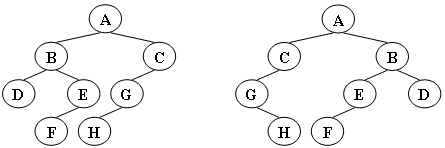
Figure 1
Format of functions:
int Isomorphic( Tree T1, Tree T2 );
where Tree is defined as the following:
typedef struct TreeNode *Tree;
struct TreeNode {
    ElementType Element;
    Tree  Left;
    Tree  Right;
};
The function is supposed to return 1 if T1 and T2 are indeed isomorphic, or 0 if not.
Sample program of judge:
#include <stdio.h>
#include <stdlib.h>

typedef char ElementType;

typedef struct TreeNode *Tree;
struct TreeNode {
    ElementType Element;
    Tree  Left;
    Tree  Right;
};

Tree BuildTree(); /* details omitted */

int Isomorphic( Tree T1, Tree T2 );

int main()
{
    Tree T1, T2;
    T1 = BuildTree();
    T2 = BuildTree();
    printf(“%d\n”, Isomorphic(T1, T2));
    return 0;
}

/* Your function will be put here */
Sample Output 1 (for the trees shown in Figure 1):
1
Sample Output 2 (for the trees shown in Figure 2):
0
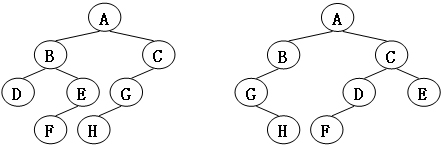
Figure2
具体代码实现为:
int Isomorphic(Tree T1,Tree T2)
{
 	if((T1 == NULL) && (T2 == NULL))  //树都为空树,视为同构
 	    return 1;
 	if(((T1 == NULL)&&(T2 != NULL)) || ((T1 != NULL)&&(T2 == NULL)))  //两树其中之一为空树,不同构
	    return 0;
	if(T1->Element != T2->Element)  //若两树都非空的话,比较根结点
	    return 0;
	if((T1->Left == NULL) && (T2->Left == NULL))  //左子树都为空,比较右子树
	    return Isomorphic(T1->Right,T2->Right);
    if((T1->Left != NULL)&&(T2->Left != NULL) && (T1->Left->Element == T2->Left->Element))
    /*左子树非空,并且左子树根结点相同,递归比较左右子树*/
        return (Isomorphic(T1->Left,T2->Left) && Isomorphic(T1->Right,T2->Right));
    else
        return (Isomorphic(T1->Left,T2->Right) && Isomorphic(T1->Right,T2->Left));
 }





 扫一扫
扫一扫


 908
908

 被折叠的 条评论
为什么被折叠?
被折叠的 条评论
为什么被折叠?
 到【灌水乐园】发言





