



 博客围绕二叉树链式结构展开,介绍了BinTree.h和BinTree.c相关内容。包含二叉树的创建、拷贝、销毁、遍历等操作的思路及注意事项,如创建时传索引地址、拷贝时递归操作、销毁采用后序遍历等,还提及测试二叉树基本操作及代码运行测试图。
BinTree.h
#pragma once

typedef char BTDataType;

typedef struct BTNode
{
 struct BTNode* _pLeft;
 struct BTNode* _pRight;
 BTDataType _data;
}BTNode;

// 二叉树的创建
BTNode* CreateBinTree(BTDataType* array, int size,  BTDataType invalid);

// 二叉树的拷贝
BTNode* CopyBinTree(BTNode* pRoot);

// 二叉树的销毁
void DestroyBinTree(BTNode** pRoot);

// 递归:前序遍历
void PreOrder(BTNode* pRoot);

// 递归:中序遍历
void InOrder(BTNode* pRoot);

// 递归:后序遍历
void PostOrder(BTNode* pRoot);

// 层序遍历
void LevelOrder(BTNode* pRoot);

// 获取二叉树中节点个数
int GetBinTreeSize(BTNode* pRoot);

// 获取二叉树中第K层节点个数
int GetKLevelNodeCount(BTNode* pRoot, int K);

// 获取二叉树中叶子节点个数
int GetLeafCount(BTNode* pRoot);

// 获取二叉树深度(高度)
int GetBinTreeHeight(BTNode* pRoot);

// 检测值为x的元素是否在二叉树中,在返回该节点的地址,否则返回NULL
BTNode* BinaryTreeFind(BTNode* root, BTDataType x);

// 二叉树的镜像
void Mirror(BTNode* pRoot);

// 判断二叉树是否是完全二叉树
int BinaryTreeComplete(BTNode* root);
BinTree.c
#include "BinTree.h"
#include "queue.h"
#include <stdio.h>
#include <malloc.h>
#include <assert.h>
#include <string.h>

BTNode* BuyNode(BTDataType data)
{
	 BTNode* pNewNode = (BTNode*)malloc(sizeof(BTNode));

	 if (pNewNode == NULL)
	 {
		  assert(0);
	 }
	 pNewNode->_data = data;
	 pNewNode->_pLeft = NULL;
	 pNewNode->_pRight = NULL;

	 return pNewNode;
}

void swap(BTDataType* a, BTDataType* b)
{
	 BTDataType tmp = *a;
	 *a = *b;
	 *b = tmp;
}
思路:根据概念,先创建根节点,在创建根的左子树,根的右子树
注意:
<1>传的索引是临时变量,函数运行结束后被销毁,所以需要传地址,将索引数值的变化带出递归
<2>将函数封装起来,便于使用
<3>传入的标记使用invalid,防止换标记二叉树创建不了
// 二叉树的创建
BTNode* _CreateBinTree(BTDataType* array, int size, int* index, BTDataType invalid)
{
	 BTNode* pRoot = NULL;
	 if (*index<size && array[*index]!='#')
	 {
		  pRoot = BuyNode(array[*index]);
		  (*index)++;
		  pRoot->_pLeft = _CreateBinTree(array, size, index, invalid);
		  (*index)++;
		  pRoot->_pRight = _CreateBinTree(array, size, index, invalid);
	 }
	 return pRoot;
}

BTNode* CreateBinTree(BTDataType* array, int size,  BTDataType invalid)
{
	 int index = 0;
	 return _CreateBinTree(array, size, &index, invalid);
}
思路:根据二叉树的概念,同创建一样操作
<1>空树不拷贝
<2>子树不为空就递归拷贝子树,为空就用创建的新子树节点接收
<3>最后把拷贝好的左右子树用新的根节点接收
// 二叉树的拷贝
BTNode* CopyBinTree(BTNode* pRoot)
{
	 if (pRoot == NULL)
	 {
		  return NULL;
	 }

	 BTNode* newLeft = NULL;
	 BTNode* newRight = NULL;
	 BTNode* newNode = BuyNode(pRoot->_data);
	 if (pRoot->_pLeft != NULL)
	 {
		  newLeft=CopyBinTree(pRoot->_pLeft);
	 }
	 else
	 {
		  newLeft = NULL;
	 }
	 if (pRoot->_pRight != NULL)
	 {
		  newRight = CopyBinTree(pRoot->_pRight);
	 }
	 else
	 {
		  newRight = NULL;
	 }

	 newNode->_pLeft = newLeft;
	 newNode->_pRight = newRight;

	 return newNode;
}
注意:
<1>最后才可以销毁根节点,所以采用后序遍历规则-----销毁完所有的节点之后要把Root节点置空
<2>函数体内部修改形参的值,要传形参的地址,所以销毁函数中传Root的地址!!!
// 二叉树的销毁
void DestroyBinTree(BTNode** pRoot)
{
	 if (*pRoot != NULL)
	 {
		  DestroyBinTree((*pRoot)->_pLeft);
		  DestroyBinTree((*pRoot)->_pRight);
		  free(pRoot);
		  *pRoot = NULL;
	 }
}
对二叉树的遍历操作:
// 递归:前序遍历
void PreOrder(BTNode* pRoot)
{
	 if (pRoot != NULL)
	 {
		  printf("%c ", pRoot->_data);
		  PreOrder(pRoot->_pLeft);
		  PreOrder(pRoot->_pRight);
	 }
}

// 递归:中序遍历
void InOrder(BTNode* pRoot)
{
	 if (pRoot != NULL)
	 {
		  InOrder(pRoot->_pLeft);
		  printf("%c ", pRoot->_data);
		  InOrder(pRoot->_pRight);
	 }
}

// 递归:后序遍历
void PostOrder(BTNode* pRoot)
{
	 if (pRoot != NULL)
	 {
		  PostOrder(pRoot->_pLeft);
		  PostOrder(pRoot->_pRight);
		  printf("%c ", pRoot->_data);
	 }
}
注意:需要借助之前的队列辅助,队列中存放的是二叉树节点的指针
// 层序遍历
void LevelOrder(BTNode* pRoot)
{
	 Queue q;
	 QueueInit(&q);
	 QueuePush(&q,pRoot);

	 while (QueueEmpty(&q) != 0)
	 {
		  //取队头元素
		  BTNode* p=QueueFront(&q);

		  //遍历该元素
		  printf("%c ", p->_data);

		  //如果左孩子存在,保存
		  if (p->_pLeft != NULL)
		  {
			   QueuePush(&q, p->_pLeft);
		  }

		  //如果右孩子存在,保存
		  if (p->_pRight != NULL)
		  {
			   QueuePush(&q, p->_pRight);
		  }

		  //删除队头
		  QueuePop(&q);
	 }
}
注意:空树节点为0,非空递归求解左右子树节点个数,最后还要加上根节点的1才能返回
// 获取二叉树中节点个数
int GetBinTreeSize(BTNode* pRoot)
{
	 if (pRoot == NULL)
	 {
		  return 0;
	 }
	 else
	 {
		  return GetBinTreeSize(pRoot->_pLeft) + GetBinTreeSize(pRoot->_pRight) + 1;
	 }
}
思路:将复杂的问题转换为子问题,k层的节点就是k-1层节点的左子树节点和右子树节点的和
// 获取二叉树中第K层节点个数
int GetKLevelNodeCount(BTNode* pRoot, int K)
{
	 if (pRoot == NULL)
	 {
		  return 0;
	 }
	 if (pRoot->_pLeft == NULL && pRoot->_pRight == NULL)
	 {
		  return 1;
	 }
	 else
	 {
		  return GetKLevelNodeCount(pRoot->_pLeft, K - 1) + GetKLevelNodeCount(pRoot->_pRight, K - 1);
	 }
}
// 获取二叉树中叶子节点个数
int GetLeafCount(BTNode* pRoot)
{
	 //叶子节点没有子节点
	 if (pRoot == NULL)
	 {
		  return 0;
	 }
	 if (pRoot->_pLeft == NULL && pRoot->_pRight == NULL)
	 {
		  return 1;
	 }
	 else
	 {
		  return GetLeafCount(pRoot->_pLeft) + GetLeafCount(pRoot->_pRight);
	 }
}
// 获取二叉树深度(高度)
int GetBinTreeHeight(BTNode* pRoot)
{
	 if (pRoot == NULL)
	 {
		  return 0;
	 }
	 if (pRoot->_pLeft == NULL && pRoot->_pRight == NULL)
	 {
		  return 1;
	 }
	 else
	 {
		  int t1 = GetBinTreeHeight(pRoot->_pLeft);
		  int t2 = GetBinTreeHeight(pRoot->_pRight);

		  if (t1 < t2)
		  {
			   return t2 + 1;
		  }
		  else
		  {
			   return t1 + 1;
		  }
	 }
}
// 检测值为x的元素是否在二叉树中,在返回该节点的地址,否则返回NULL
BTNode* BinaryTreeFind(BTNode* root, BTDataType x)
{
	 if (root == NULL)
	 {
		  return NULL;
	 }

	 if (root->_data == x)
	 {
		  return root;
	 }

	 BinaryTreeFind(root->_pLeft,x);
	 BinaryTreeFind(root->_pRight, x);
}
// 二叉树的镜像
void Mirror(BTNode* pRoot)
{
	 if (pRoot != NULL)
	 {
	  BTNode* tmp = pRoot->_pLeft;
	  pRoot->_pLeft = pRoot->_pRight;
	  pRoot->_pRight = tmp;

	  Mirror(pRoot->_pLeft);
	  Mirror(pRoot->_pRight);
	 }
}
思路:层序遍历+判断
<1>空树也属于完全二叉树
<2>如果该节点有右孩子没有左孩子,肯定不是完全二叉树
<3>如果该节点只有左孩子或者其是叶子节点,那么在它之后的所有节点都要是叶子节点
// 判断二叉树是否是完全二叉树
int BinaryTreeComplete(BTNode* root)
{
	 //空树也是完全二叉树
	 if (root == NULL)
	 {
		  return 1;
	 }

	 Queue q;
	 QueueInit(&q);
	 QueuePush(&q, root);

	 while (QueueEmpty(&q) != 0)
	 {
		  BTNode* p=QueueFront(&q);

		  //只有右孩子没有左孩子,肯定不是完全二叉树
		  if (p->_pLeft == NULL && p->_pRight != NULL)
		  {
			   return 0;
		  }

		  //如果左右孩子都不在,或者只有左孩子,后面的节点必须都是叶子节点
		  if ((p->_pLeft != NULL && p->_pRight == NULL) || (p->_pLeft == NULL && p->_pRight == NULL))
		  {
			   QueuePop(&q);

			   //则该节点之后的所有结点都是叶子节点
			   while (QueueEmpty(&q)!=0)
			   {
				    BTNode* p = QueueFront(&q);
				    if (p->_pLeft == NULL && p->_pRight == NULL)
				    {
					     QueuePop(&q);
				    }
				    else
				    {
					     return 0;
				    }
			   }
			   return 1;
		  }

		  if (p->_pLeft!=NULL)
		  {
			   QueuePush(&q, p->_pLeft);
		  }
		  if (p->_pRight != NULL)
		  {
			   QueuePush(&q, p->_pRight);
		  }
		  QueuePop(&q);
	 }
	 return 1;
}
测试二叉树的基本操作:
void TestBinTree()
{
	 char a[] = "ABD###CE##F";
	 int index = 0;
	 BTNode* pRoot=CreateBinTree(a, strlen(a), &index, '#');

	 printf("开始前序遍历:");
	 PreOrder(pRoot);
	 printf("\n");

	 printf("开始中序遍历:");
	 InOrder(pRoot);
	 printf("\n");

	 printf("开始后序遍历:");
	 PostOrder(pRoot);
	 printf("\n");

	 printf("获取第3层的节点个数: %d\n", GetKLevelNodeCount(pRoot,3));

	 printf("获取二叉树的最大深度: %d\n",GetBinTreeHeight(pRoot));

	 printf("开始层序遍历:");
	 LevelOrder(pRoot);
	 printf("\n");

	 printf("开始拷贝:");
	 CopyBinTree(pRoot);
	 LevelOrder(CopyBinTree(pRoot));
	 printf("\n");

	 printf("%p\n", BinaryTreeFind(pRoot, 'C'));

	 printf("开始镜像:");
	 Mirror(pRoot);
	 LevelOrder(pRoot);
	 printf("\n");

	 if (BinaryTreeComplete(pRoot) == 0)
	 {
		  printf("如此遗憾,这不是一棵完全二叉树~\n");
	 }
	 else
	 {
		  printf("恭喜,这是一棵完全二叉树~\n");
	 }

	 Mirror(pRoot);

	 if (BinaryTreeComplete(pRoot) == 0)
	 {
		  printf("如此遗憾,这不是一棵完全二叉树~\n");
	 }
	 else
	 {
		  printf("恭喜,这是一棵完全二叉树~\n");
	 }

}
主函数:
int main()
{
	 TestBinTree();
	 system("pause");
	 return 0;
}
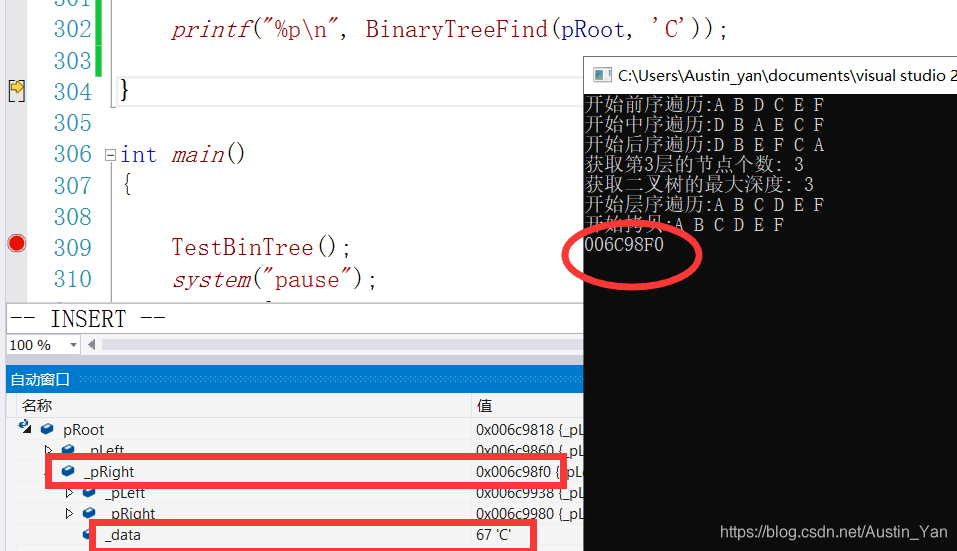
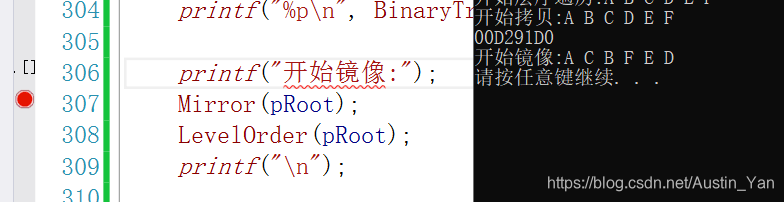
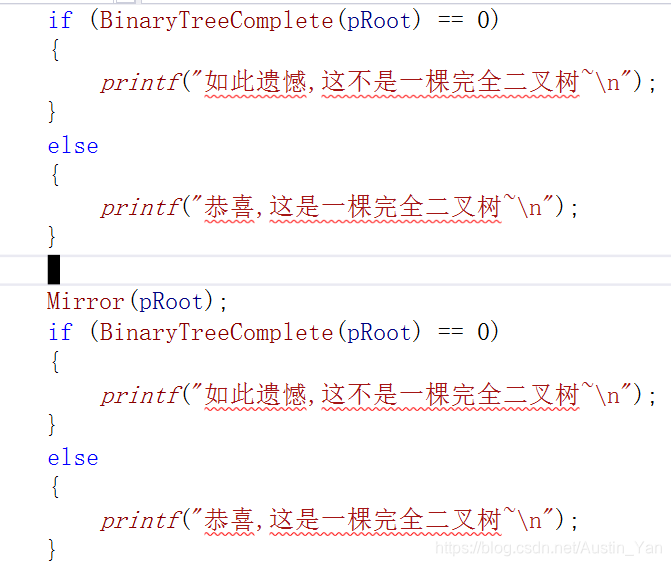
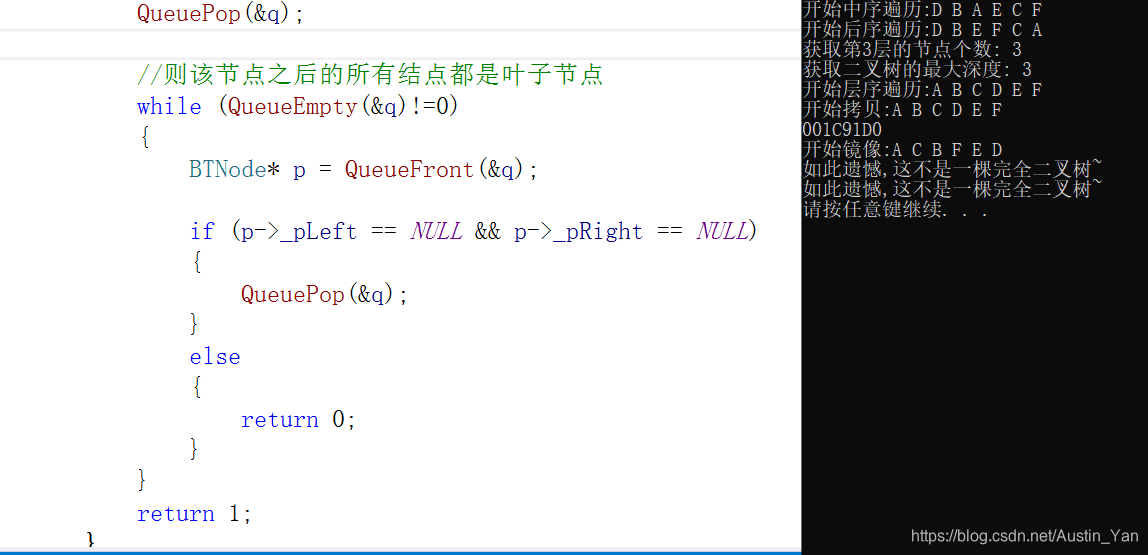
代码运行测试图:
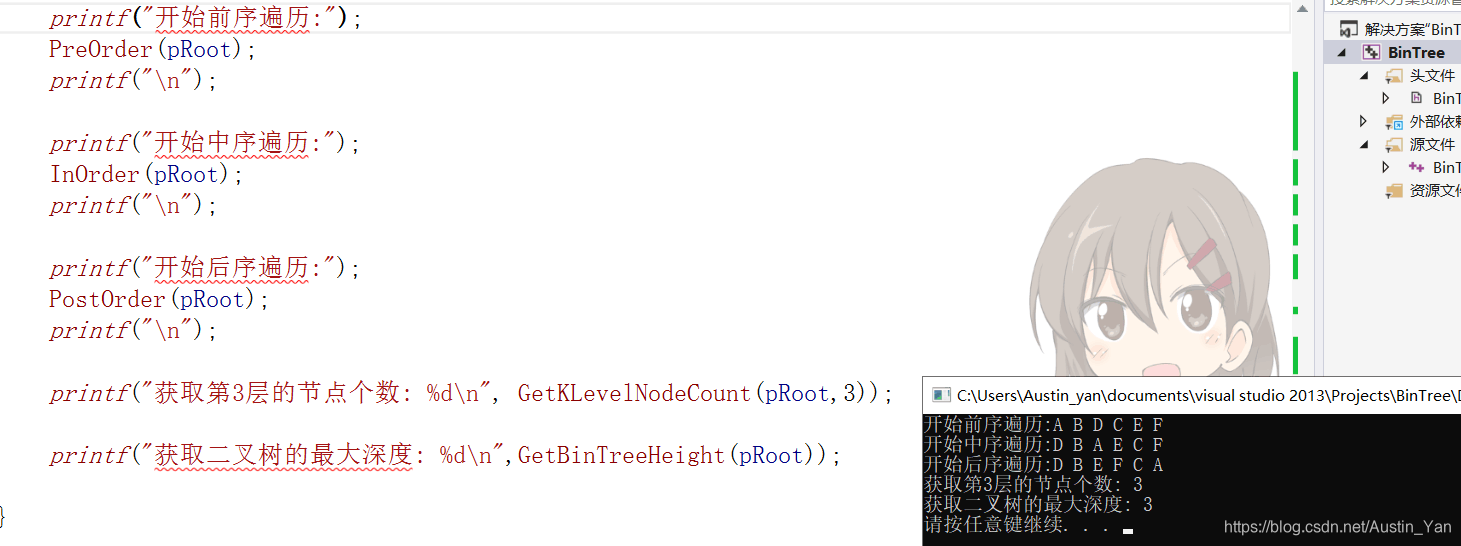
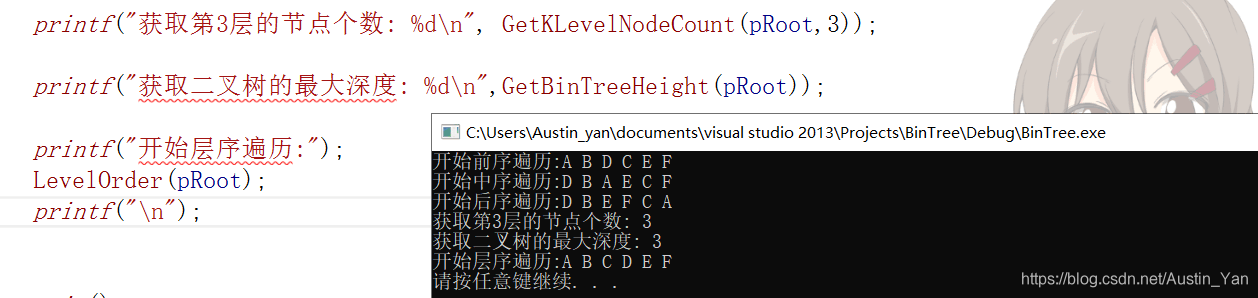
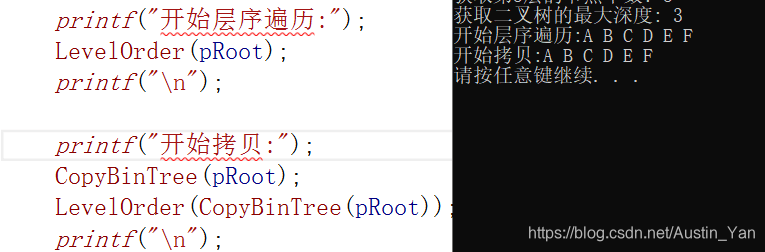
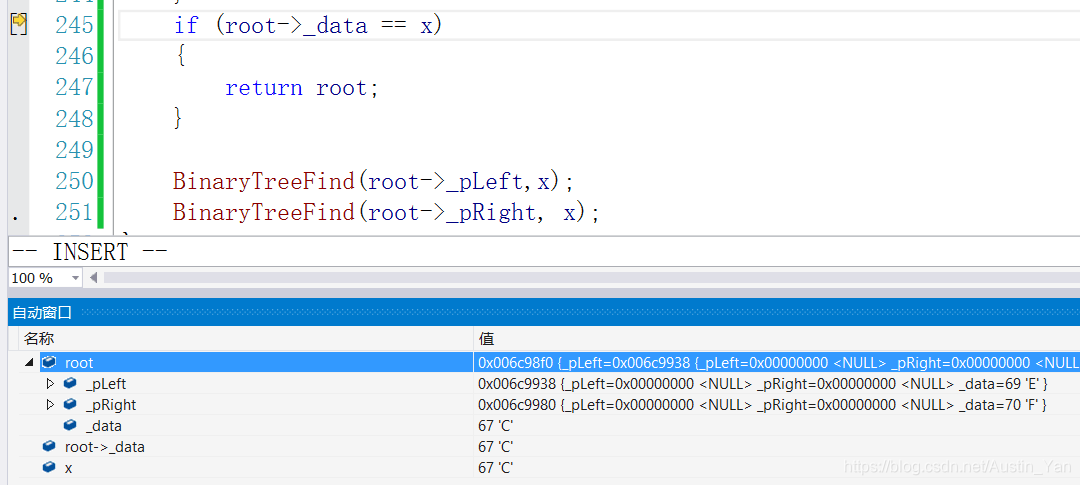





 扫一扫
扫一扫


 1297
1297

 被折叠的 条评论
为什么被折叠?
被折叠的 条评论
为什么被折叠?
 到【灌水乐园】发言





