



 本文详细介绍了如何在 LaTeX 中定义并使用数学相关的环境,包括引理(Lemma)、定理(Theorem)、证明(Proof)和假设(Assumption)。通过示例展示了它们的编译效果,为撰写技术论文或报告提供了必要的排版指导。
1. 引理
\newtheorem{lemma}{Lemma}[section]
\begin{lemma} \label{lemma1}

\end{lemma}
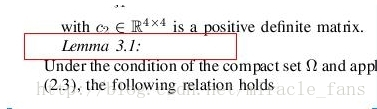
编译效果:
2. 定理
\newtheorem{thm}{\bf Theorem}[section]
\begin{thm}\label{thm1}
Suppose system (\ref{l1}) satisfies Assumption (\ref{mim1}), the closed-loop system consisting of
system (\ref{l1}), the disturbance observer (\ref{g1}) and the proposed controller (\ref{n3}) is semi-globally ISS.
\end{thm}
编译效果:

3. 证明
\begin{proof}
***
\end{proof}
编译效果:

4. 假设
\newtheorem{assumption}{Assumption}[section]
\begin{assumption}
***
\end{assumption}
编译效果:
5. tex中实现空白行
\viskp\baselineskip
\viskp\baselineskip
\viskp\baselineskip
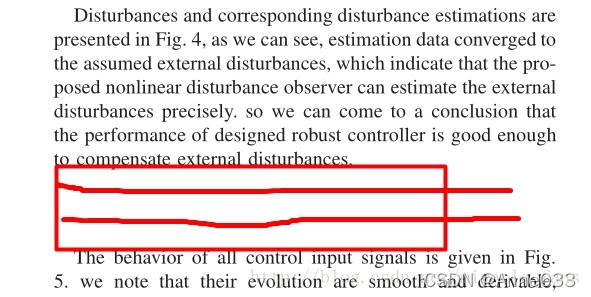
编译效果:空出三行的距离
原文链接:https://blog.youkuaiyun.com/miracle_fans/article/details/78255650





 扫一扫
扫一扫


 8284
8284

 被折叠的 条评论
为什么被折叠?
被折叠的 条评论
为什么被折叠?
 到【灌水乐园】发言





