



 本文详细介绍了一种将整数转换为罗马数字的算法实现,通过解析不同位数的数值,对应转换为罗马数字的不同符号组合,适用于1到3999范围内的整数转换。
Description:
Difficulty
Medium
358
1351
Discuss (387)
Favorite
Share
ACCEPTED
171,689
SUBMISSIONS
358,141
Roman numerals are represented by seven different symbols: I, V, X, L, C, D and M.
Symbol Value
I 1
V 5
X 10
L 50
C 100
D 500
M 1000
For example, two is written as II in Roman numeral, just two one’s added together. Twelve is written as, XII, which is simply X + II. The number twenty seven is written as XXVII, which is XX + V + II.
Roman numerals are usually written largest to smallest from left to right. However, the numeral for four is not IIII. Instead, the number four is written as IV. Because the one is before the five we subtract it making four. The same principle applies to the number nine, which is written as IX. There are six instances where subtraction is used:
I can be placed before V (5) and X (10) to make 4 and 9.
X can be placed before L (50) and C (100) to make 40 and 90.
C can be placed before D (500) and M (1000) to make 400 and 900.
Given an integer, convert it to a roman numeral. Input is guaranteed to be within the range from 1 to 3999.
Example1:
Input: 3
Output: “III”
Example2:
Input: 4
Output: “IV”
Example3:
Input: 9
Output: “IX”
Example4:
Input: 58
Output: “LVIII”
Explanation: L = 50, V = 5, III = 3.
Example5:
Input: 1994
Output: “MCMXCIV”
Explanation: M = 1000, CM = 900, XC = 90 and IV = 4.
提交代码:
char* intToRoman(int num) {
   	int tmp = num;
	int i, j,pos=0;
	char* roman=(char*)malloc(50*sizeof(char));
	int thousands, hundreds, tens, units;

	thousands = tmp / 1000;
	tmp = tmp - thousands * 1000;
	hundreds = tmp / 100;
	tmp = tmp - hundreds * 100;
	tens = tmp / 10;
	tmp = tmp - tens * 10;
	units = tmp;

	if (thousands != 0)
	{
		for (i = 0; i < thousands; i++)
		{
			roman[pos++] = 'M';  //pos-1为最后一个字符所在位置
		}
	}
	if (hundreds != 0)
	{
		if (hundreds == 9)
		{
			roman[pos++] = 'C';
			roman[pos++] = 'M';
		}
		else if (hundreds == 4)
		{
			roman[pos++] = 'C';
			roman[pos++] = 'D';
		}
		else if (hundreds == 5)
			roman[pos++] = 'D';
		else if(hundreds>5)
		{
			roman[pos++] = 'D';
			hundreds -= 5;
			for (i = 0; i < hundreds; i++)
			{
				roman[pos++] = 'C';
			}
		}
		else
		{
			for (i = 0; i < hundreds; i++)
			{
				roman[pos++] = 'C';
			}
		}
	}
	if (tens != 0)
	{
		if (tens == 9)
		{
			roman[pos++] = 'X';
			roman[pos++] = 'C';
		}
		else if (tens == 4)
		{
			roman[pos++] = 'X';
			roman[pos++] = 'L';
		}
		else if (tens == 5)
			roman[pos++] = 'L';
		else if (tens>5)
		{
			roman[pos++] = 'L';
			tens -= 5;
			for (i = 0; i < tens; i++)
			{
				roman[pos++] = 'X';
			}
		}
		else
		{
			for (i = 0; i < tens; i++)
			{
				roman[pos++] = 'X';
			}
		}
	}
	if (units != 0)
	{
		if (units == 9)
		{
			roman[pos++] = 'I';
			roman[pos++] = 'X';
		}
		else if (units == 4)
		{
			roman[pos++] = 'I';
			roman[pos++] = 'V';
		}
		else if (units == 5)
			roman[pos++] = 'V';
		else if (units>5)
		{
			roman[pos++] = 'V';
			units -= 5;
			for (i = 0; i < units; i++)
			{
				roman[pos++] = 'I';
			}
		}
		else
		{
			for (i = 0; i < units; i++)
			{
				roman[pos++] = 'I';
			}
		}
	}
	roman[pos] = '\0';
	return roman;
}
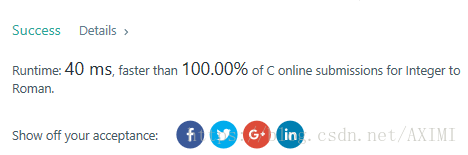
运行结果:





 扫一扫
扫一扫


 3376
3376

 被折叠的 条评论
为什么被折叠?
被折叠的 条评论
为什么被折叠?
 到【灌水乐园】发言





