



(20) decltype 类型推断时会保留引用类型么? 首先 typeid ( A ) .name ( ) 在打印时是会去掉引用 && 这些符号的:
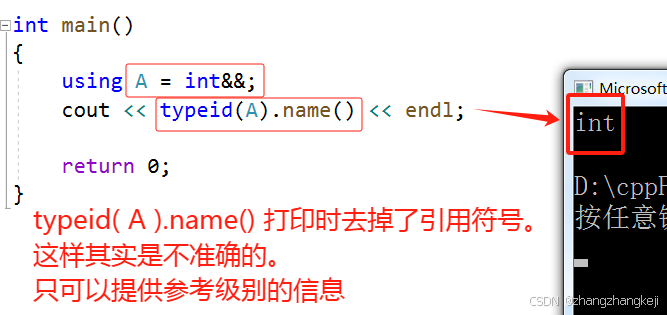
++ 那么 decltype ( ) 可以提供准确的类型信息推断么。答案是可以提供准确的类型推断的,先学习其语法:
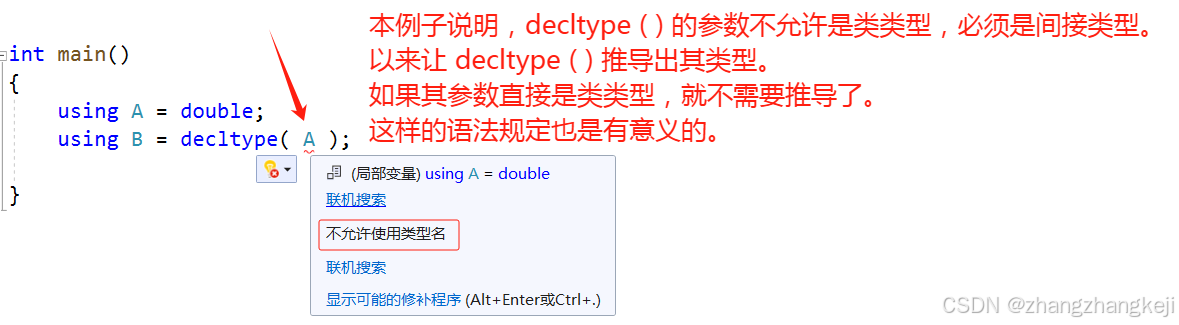
++ 再写测试例:
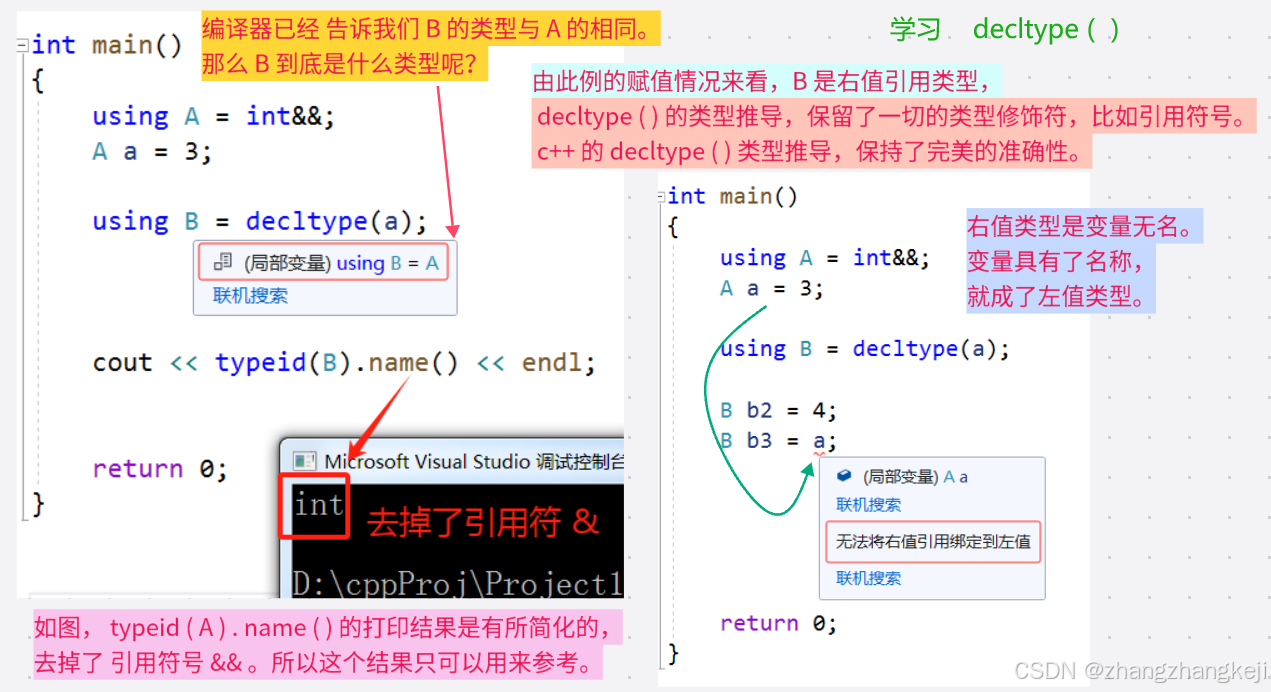
++ 当然,实际的 decltype ( ) 肯定不会这么简单,而是比如用于对函数的返回值的类型的判断与推导。再举例:
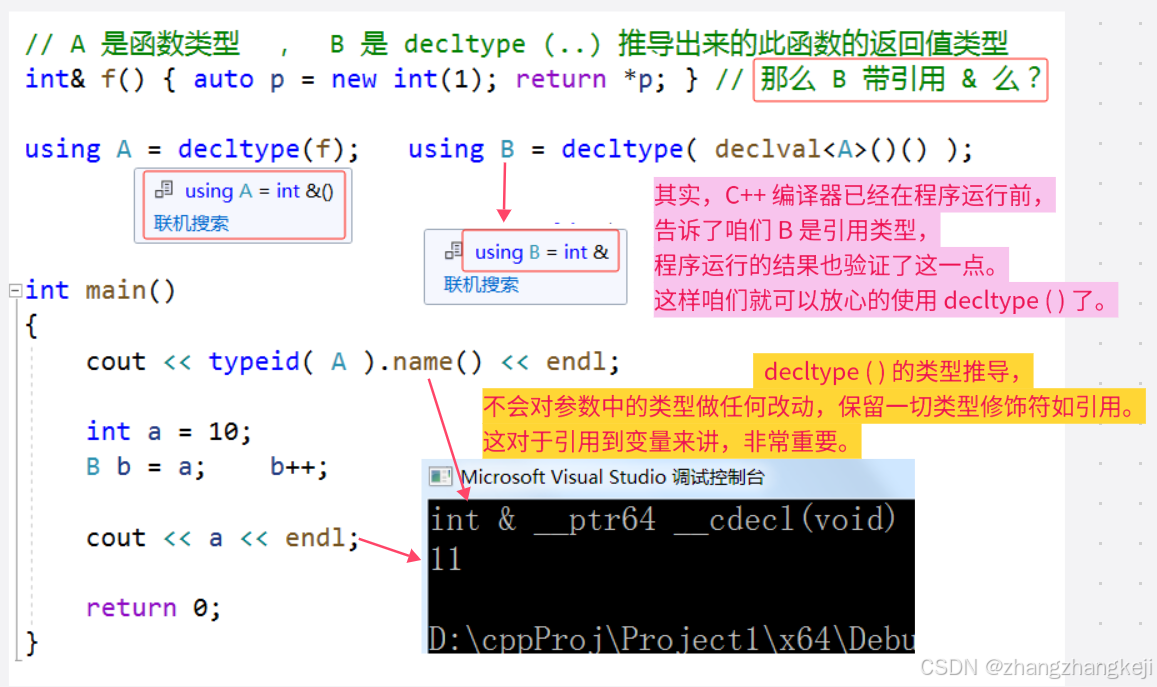
++ 推导函数的返回值类型,在本 < future > 头文件中,也会用到。所以单独整理学习一下其用法。
(21) 全局函 _Get_associated_state (),字面意思,该函数生成一个 _Associated_state 类型的的对象,该对象保存了线程中函数的返回值,但 _Associated_state 类型既有儿子类,又有孙子类,本函数实际是返回一个爷爷类指针,实现爷爷类指针指向孙子类对象。源码如下:
// construct associated asynchronous state object for the launch type 为启动类型构造关联的异步状态对象
// 模板参数 _Fty 就是 _Fake_no_copy_callable_adapter<T...> 类型,该类型的对象是可调用对象;
template <class _Ret, class _Fty>  // 模板参数 _Fty 的对象其实是一个包含被调函数及其实参的 tuple 元组
_Associated_state<typename _P_arg_type<_Ret>::type>*  // 返回值
_Get_associated_state(launch _Psync, _Fty&& _Fnarg)
{
    switch (_Psync) // select launch type
    {
    case launch::deferred :  	 // 这是爷爷 _Associated_state 的孙类
        return new _Deferred_async_state<_Ret>(_STD forward<_Fty>(_Fnarg));
		// 这个 _Ret 是函数的返回结果,可以是值,引用或者为 void ,重载般的选择一个父类 _Packaged_state

    case launch::async :  // TRANSITION, fixed in vMajorNext, should create a new thread here
    default:              // 注意,默认态下也将创建新线程   //这也是爷爷 _Associated_state的孙类
        return new _Task_async_state<_Ret>(_STD forward<_Fty>(_Fnarg));
    }
}
(22) 管理函数返回值的状态的基类 _State_manager, 顾名思义, _State_manager 就是为了管理 _Associated_state<_Ty> 的。本序号开始,又开始了一个大的系列,又定义了一组模板类 ( 父类与子类 ),该类的源码如下:
//*******************下面这是一段父类 _State_manager 与子类 future,子类 shared_future*********************

// 爷类 _Associated_state 与子类 _Packaged_state 与孙类 _Deferred_async_state + _Task_async_state
// 顾名思义,现在是要开始管理这些 包含了函数返回值的 state 类。
template <class _Ty>
class _State_manager
{
private:
    _Associated_state<_Ty>* _Assoc_state; // 本模板类管理里一个 state 类
    bool _Get_only_once; // 当 本模板 作为 future        的父类时,_Get_only_once 为 true ;
                         // 当 本模板 作为 shared_future 的父类时,_Get_only_once 为 false
public:
    // construct with no associated asynchronous state object
    _State_manager() : _Assoc_state(nullptr) { _Get_only_once = false; } // 默认构造函数

    // construct with _New_state
    _State_manager(_Associated_state<_Ty>* _New_state, bool _Get_once)   // 有参构造函数
        : _Assoc_state(_New_state) { _Get_only_once = _Get_once; }

    // template <class _Ty> //用于管理关联同步状态的类
    // class _Associated_state
    // {   void _Release() { if (_MT_DECR(_Refs) == 0)  _Delete_this();  }    };
    ~_State_manager() { if (_Assoc_state)  _Assoc_state->_Release(); } // 析构函数

    // copy stored associated asynchronous state object from _Other 从“其他”复制存储的关联异步状态对象
    void _Copy_from(const _State_manager& _Other)  // 感觉核心代码就是增加了一个引用计数
    {
        if (this != _STD addressof(_Other)) // 本函数服务于 copy 构造函数与 copy 赋值运算符函数
        {
            if ( _Assoc_state )   _Assoc_state->_Release(); // 释放本类原来管理的函数返回值

            if (_Other._Assoc_state)        // do the copy
            {
                _Other._Assoc_state->_Retain();
                // class _Associated_state { void _Retain(){ _MT_INCR(_Refs); } }; //增加引用计数

                _Assoc_state   = _Other._Assoc_state   ;
                _Get_only_once = _Other._Get_only_once ;
            }
            else
                _Assoc_state = nullptr;
        }
    }

    _State_manager(const _State_manager& _Other, bool _Get_once = false) // copy 构造函数
        : _Assoc_state(nullptr) {  _Copy_from(_Other); _Get_only_once = _Get_once;  }

    _State_manager& operator=(const _State_manager& _Other) { _Copy_from(_Other); return *this; }

    void _Move_from(_State_manager& _Other)  // 服务于 move 构造函数与 move 赋值运算符函数
    {
        if (this != _STD addressof(_Other))
        {
            if (_Assoc_state)   _Assoc_state->_Release();  // 释放本类原来管理的函数返回值

            _Assoc_state        = _Other._Assoc_state   ;
            _Other._Assoc_state = nullptr               ;
            _Get_only_once      = _Other._Get_only_once ;
        }
    }

    _State_manager(_State_manager&& _Other, bool _Get_once = false)  // 移动构造函数
        : _Assoc_state(nullptr) {  _Move_from(_Other); _Get_only_once = _Get_once; }

    _State_manager& operator=(_State_manager&& _Other) {  _Move_from(_Other);  return *this; }

    // abandon shared state  这是出错时候的逻辑,本函数用的应该不多。正常情况下线程不会出错。故略
    void _Abandon() { if (_Assoc_state)    _Assoc_state->_Abandon(); }

    // exchange with _Other
    void _Swap(_State_manager& _Other) { _STD swap(_Assoc_state, _Other._Assoc_state); }

    _Associated_state<_Ty>* _Ptr() const { return _Assoc_state; } // 返回本类保存的裸指针成员

    //*********以下是各种成员功能函数*****

    bool _Is_ready() const { return _Assoc_state && _Assoc_state->_Is_ready(); }
    /*
    class _Associated_state // 爷爷类,本注释服务于附近的三个成员函数
    {
        int _Ready;         bool _Ready_at_thread_exit;   bool _Retrieved;

        bool _Is_ready() const { return _Ready != 0; }
        bool _Is_ready_at_thread_exit() const { return _Ready_at_thread_exit; }
        bool _Already_retrieved() const { return _Retrieved; }
    };
    */
    bool _Is_ready_at_thread_exit() const
    {
        return _Assoc_state && _Assoc_state->_Is_ready_at_thread_exit();
    }

    // 如经        future 读取,_Get_only_once 为 true  ,只要读过一次,就不让读了
    // 如经 shared_future 读取,_Get_only_once 为 false ,则本 valid() 始终返 true,表可多次读取
    bool valid() const noexcept // 表本类管理的函数的返回值是否有效可读,是则返回 true
    {
        return _Assoc_state && !(_Get_only_once && _Assoc_state->_Already_retrieved());
    }

    _Ty& _Get_value() const // 获得对 _Associated_state<_Ty> 中保存的函数返回值的左值引用
    {
        if ( !valid() )
            _Throw_future_error(make_error_code(future_errc::no_state));

        return _Assoc_state->_Get_value(_Get_only_once);
    }

    void _Set_value(const _Ty& _Val, bool _Defer)  // copy 函数的返回值
    {
        if ( !valid() )
            _Throw_future_error(make_error_code(future_errc::no_state));
/*
template <class _Ty>
class _Associated_state  //用于管理关联同步状态的类
{
    // store a result while inside a locked block
    void _Set_value_raw(const _Ty& _Val, unique_lock<mutex>* _Lock, bool _At_thread_exit)
    {
        if (_Has_stored_result)
            _Throw_future_error(make_error_code(future_errc::promise_already_satisfied));

        _Result = _Val;
        _Do_notify(_Lock, _At_thread_exit);
    }

    void _Set_value(const _Ty& _Val, bool _At_thread_exit)  // store a result
    {
        unique_lock<mutex> _Lock(_Mtx);
        _Set_value_raw(_Val, &_Lock, _At_thread_exit);
    }
};
*/
        _Assoc_state->_Set_value(_Val, _Defer);
    }
    // 从这里可以看出:_Packaged_state<T> 内封装的函数执行完后,可以设置函数的返回值;
    // 但 future<T> 除了可以读取函数的返回值,也有此 set_value(..) 成员函数可以直接设置一个函数返回值
    void _Set_value(_Ty&& _Val, bool _Defer)      // 移动函数的返回值
    {
        if (!valid())
            _Throw_future_error(make_error_code(future_errc::no_state));
/*
template <class _Ty>
class _Associated_state  //用于管理关联同步状态的类
{
    // store a result while inside a locked block
    void _Set_value_raw(_Ty&& _Val, unique_lock<mutex>* _Lock, bool _At_thread_exit)
    {
        if (_Has_stored_result)
            _Throw_future_error(make_error_code(future_errc::promise_already_satisfied));

        _Result = _STD forward<_Ty>(_Val);
        _Do_notify(_Lock, _At_thread_exit);
    }

    void _Set_value(_Ty&& _Val, bool _At_thread_exit) // store a result
    {
        unique_lock<mutex> _Lock(_Mtx);
        _Set_value_raw(_STD forward<_Ty>(_Val), &_Lock, _At_thread_exit);
    }
};
*/
        _Assoc_state->_Set_value(_STD forward<_Ty>(_Val), _Defer);
    }

    void _Set_exception(exception_ptr _Exc, bool _Defer) //异常处理用的不多
    {
        if (!valid())
            _Throw_future_error(make_error_code(future_errc::no_state));

        _Assoc_state->_Set_exception(_Exc, _Defer);
    }

    //********以下是关于等待*******

    void wait() const  // wait for signal
    {
        if (!valid())  // valid() 定义就在上面
            _Throw_future_error(make_error_code(future_errc::no_state));
/*
template <class _Ty>
class _Associated_state  //用于管理关联同步状态的类
{
    virtual void _Wait()  // wait for signal
    {
        unique_lock<mutex> _Lock(_Mtx);
        // 传递锁进来,是为了解锁,只有写返回值时候才需要加锁。其余时候不必要一直持有锁

        _Maybe_run_deferred_function(_Lock);

        while (!_Ready)       _Cond.wait(_Lock);
    }
};
*/
        _Assoc_state->_Wait();
    }

    template <class _Rep, class _Per> // wait for duration
    future_status wait_for(const chrono::duration<_Rep, _Per>& _Rel_time) const
    {
        if (!valid())
            _Throw_future_error(make_error_code(future_errc::no_state));

/*
// names for timed wait function returns
enum class future_status { ready, timeout, deferred };

template <class _Ty>
class _Associated_state  //用于管理关联同步状态的类
{
    template <class _Rep, class _Per>   // wait for duration
    future_status _Wait_for(const chrono::duration<_Rep, _Per>& _Rel_time)
    {
        unique_lock<mutex> _Lock(_Mtx);

        if (_Has_deferred_function())
            return future_status::deferred;

        if (_Cond.wait_for(_Lock, _Rel_time, _Test_ready(this)))
            return future_status::ready;

        return future_status::timeout;
    }
};*/
        return _Assoc_state->_Wait_for(_Rel_time);
    }

    template <class _Clock, class _Dur>   // wait until time point
    future_status wait_until(const chrono::time_point<_Clock, _Dur>& _Abs_time) const
    {
#if _HAS_CXX20
        static_assert(chrono::is_clock_v<_Clock>, "Clock type required");
#endif // _HAS_CXX20

        if (!valid())
            _Throw_future_error(make_error_code(future_errc::no_state));

/*
template <class _Ty>
class _Associated_state  //用于管理关联同步状态的类
{
    template <class _Clock, class _Dur>  // wait until time point
    future_status _Wait_until(const chrono::time_point<_Clock, _Dur>& _Abs_time)
    {
        unique_lock<mutex> _Lock(_Mtx);

        if (_Has_deferred_function())  // 注释在上面的函数里
            return future_status::deferred;

        if (_Cond.wait_until(_Lock, _Abs_time, _Test_ready(this)))
            return future_status::ready;

        return future_status::timeout;
    }
};
*/
        return _Assoc_state->_Wait_until(_Abs_time);
    }

};
(23)
谢谢





 扫一扫
扫一扫


 2128
2128

 被折叠的 条评论
为什么被折叠?
被折叠的 条评论
为什么被折叠?
 到【灌水乐园】发言





