



 本文深入探讨了优先队列的不同实现方式,包括d-堆、左式堆和二项队列的特点及操作方法,并提供了详细的算法实现。
【数据结构与算法分析】第六章 优先队列(堆)(二)
1.d-堆
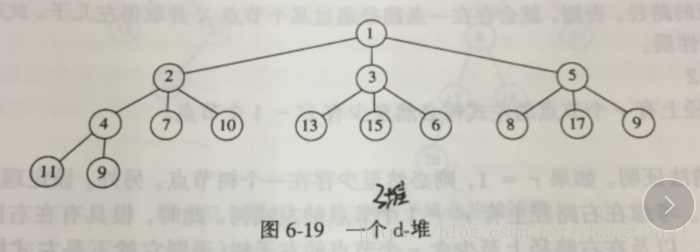
d-堆是二叉堆的简单推广,所有的节点都有d个儿子,有可能的例外是在底层,如图为一个3-堆
2.左式堆
左式堆具有结构特性和堆序性质。
2.1左式堆的性质
节点X的零路径长(Npl(X)):从X到一个没有两个儿子的节点的最短路径长,即具有0个或1个儿子的节点的Npl为0
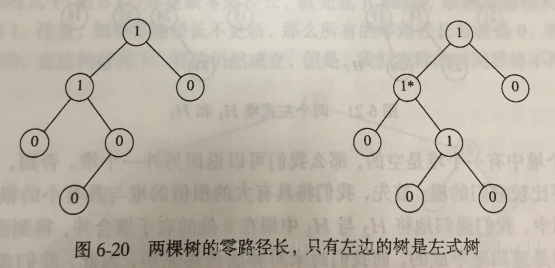
左式堆的性质:对于堆中的每一个节点X,左儿子的零路径长都大于或等于右儿子的零路径长
左式树更偏重于使树向左增加深度,有可能存在由左节点形成的长路径构成的树,因此就有了左式堆这个名称。
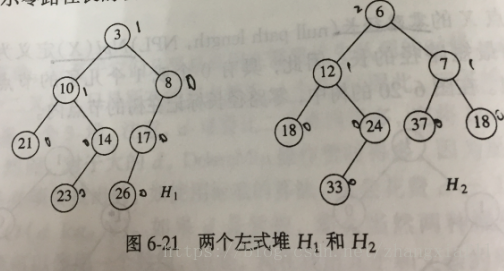
如图为两个左式堆:
2.2左式堆的操作
基本操作为合并
(1)将具有大的根植的堆与具有小的根植的堆的右子堆合并。如图,递归的将H2与H1中根在8处的右子堆合并
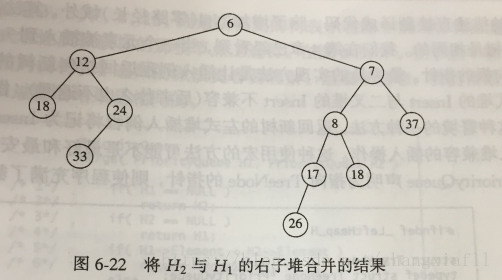
(2)让第一步形成的新的堆作为H1的根的右儿子,如图
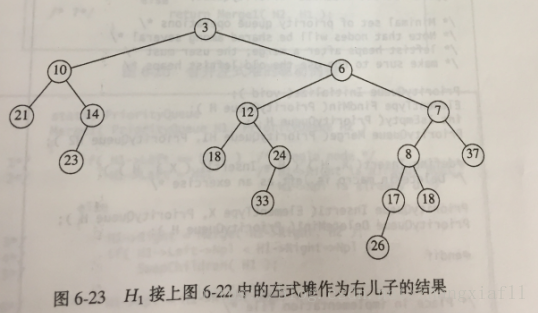
(3)交换根的左儿子和右儿子并更新零路径长,完成合并
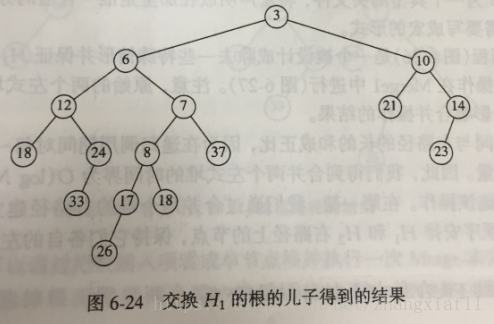
左式堆的类型声明:
#ifndef _LeftHeap_H
struct TreeNode;
typedef struct TreeNode *PriorityQueue;
PriorityQueue Initialize(void);
ElementType FindMin(PriorityQueue H);
int IsEmpty(PriorityQueue H);
PriorityQueue Merge(PriorityQueue H1,PriorityQueue H2);
#define Insert(X,H) (H=Insert1(X,H))
PriorityQueue Insert1(ElementType X,PriorityQueue H);
PriorityQueue DeleteMin1(PriorityQueue H);
#endif
struct TreeNode
{
    ElementType Element;
    PriorityQueue Left;
    PriorityQueue Right;
    int Npl;
};
合并左式堆的驱动程序:
PriorityQueue Merge(PriorityQueue H1,PriorityQueue H2)
{
    if(H1==NULL)
        return H2;
    if(H2==NULL)
        return H1;
    if(H1->Element<H2->Element)//找出两左式堆的最小根节点
        return Merge1(H1,H2);
    else
        return Merge1(H2,H1);
}
合并左式堆的实际例程:
static PriorityQueue Merge1(PriorityQueue H1,PriorityQueue H2)
{
    if(H1->Left==NULL)
        H1->Left=H2;
    else
    {
        H1->Right=Merge(H1->Right,H2);
        if(H1->Left->Npl<H1->Right->Npl)
            SwapChildren(H1);
        H1->Npl=H1->Right->Npl+1;
    }
    return H1;
}
左式堆的插入例程:
PriorityQueue Insert1(ElementType X,PriorityQueue H)
{
    PriorityQueue SingleNode;
    SingleNode=malloc(sizeof(struct TreeNode));
    if(SingleNode==NULL)
        FatalError("out of space");
    else
    {
        SingleNode->Element=X;SingleNode->Npl=0;
        SingleNode->Left=SingleNode->Right=NULL;
        H=Merge(SingleNode,H);
    }
    return H;
}
左式堆的DeleteMin例程:
PriorityQueue DeleteMin1(PriorityQueue H)
{
    PriorityQueue LeftHeap,RightHeap;
    if(IsEmpty(H))
    {
        Error("Priority queue is empty");
        return H;
    }
    LeftHeap=H->Left;
    RightHeap=H->Right;
    free(H);
    return Merge(LeftHeap,RightHeap);
}
3.二项队列
3.1二项队列结构
二项队列不是一棵堆序的树,而是堆序树的集合,称为森林。堆序树中的每一棵树都是有约束的形式,叫做二项树。每一个高度上至多存在一棵二项树。
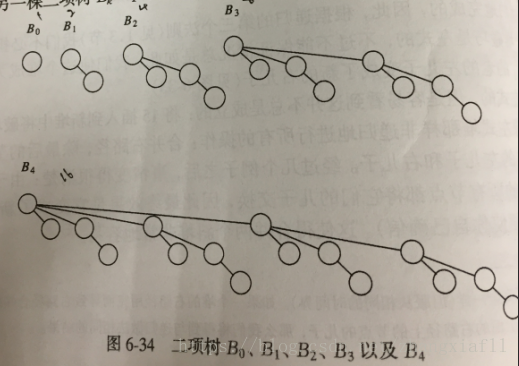
高度为0的二项树是一棵单节点树,如B0
高度为k的二项树Bk通过将一棵二项树B(k-1)附接到另一棵二项树B(k-1)的根上而构成。如B1,B2,B3,B4
二项树Bk由一个带有儿子B0,B1...B(K-1)的根组成,如B4由B0,B1,B2,B3组成,高度为k的二项树恰好有2^k个节点。
例:大小为13的优先队列可以写成1101,用森林B3,B2,B0来表示
3.2二项队列操作
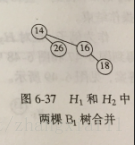
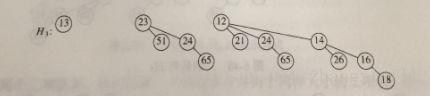
合并操作:合并H1和H2
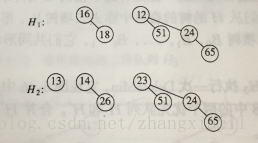
将H1和H2中高度为1的二项树合并后得到下图:
然后再将其他合并得到H3
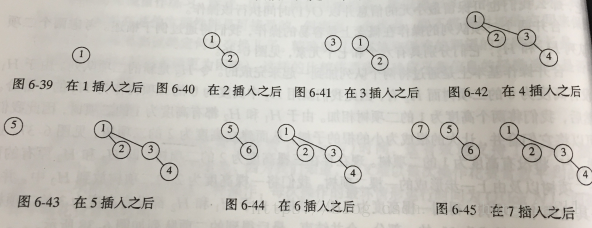
插入操作:
DeleteMin操作:
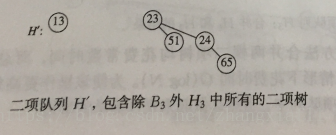
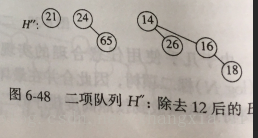
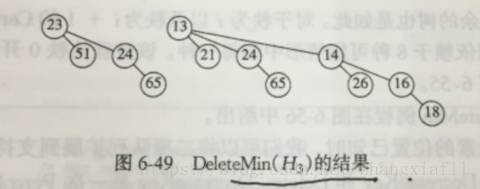
例:对H3执行一次DeleteMin操作,如图,H3含有森林B0,B2,B3,最小的根是12
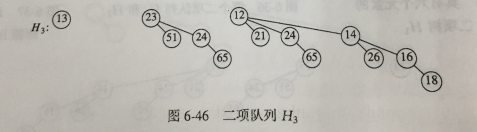
除去B3外的H3为:
除去12后的B3为:
合并得:
3.3二项队列的实现
DeleteMin操作需要快速找出根的所有子树的能力,因此,需要一般树的标准表示方法:
每个节点的儿子都存在一个链表中,而且每个节点都有一个指向它的第一个儿子的指针。
总之:
-
二项树的每一个节点将包含有:(1)数据,(2)第一个儿子(最右的儿子),(3)兄弟节点。
-
二项树中的儿子以递减顺序排列
例:
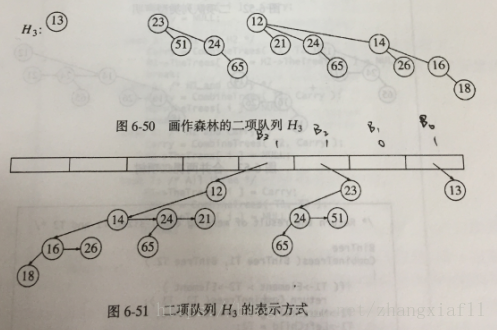
二项队列H3的表达方式,将从B3,B2,B0成降序排列,每个节点含有自身数据,第一个儿子和兄弟节点
二项队列的声明:
typedef struct BinNode *Position;
typedef struct Collection *BinQueue;
struct BinNode
{
    ElementType Element;
    Position LeftChild;
    Position NextSibling;
};
struct Collection
{
    int CurrentSize;
    BinTree TheTrees[MaxTrees];
}
合并同样大小的两棵二项树:
BinTree CombineTrees(BinTree T1,BinTree T2)
{
    if(T1->Element>T2->Element)
        return CombineTrees(T2,T1);
    T2->NextSibling=T1->LeftChild;
    T1->LeftChild=T2;
    return T1;
}
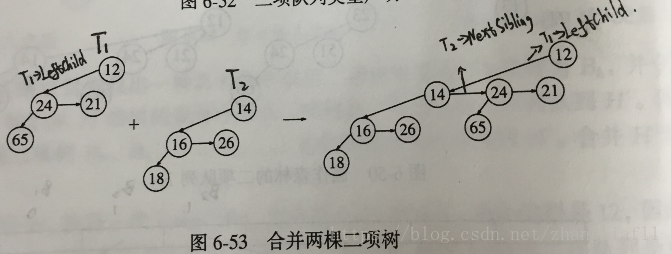
合并两个优先队列的例程:
BinQueue Merge(BinQueue H1, BinQueue H2)
{
    BinTree T1, T2, Carry = NULL;
    int i,j;
    if(H1->CurrentSize+H2->CurrentSize>Capacity)
        Error("Exceed the Capacity");
    H1->CurrentSize = H1->CurrentSize + H2->CurrentSize;
    for(i=0,j=1;j<H1->CurrentSize;i++,j*=2)
    {
        T1 = H1->TheTrees[i];
        T2 = H2->TheTrees[i];
        switch(!!T1+2*!!T2+4*!!Carry)//如果T1存在则!!T1为1,否则为0
        {
            case 0: //No Trees
            case 1: //Only H1
                break;
            case 2:
                H1->TheTrees[i] = T2;
                H2->TheTrees[i] = NULL;
                break;
            case 4: //Only Carry
                H1->TheTrees[i] = Carry;
                Carry = NULL;
                break;
            case 3: //T1,T2
                Carry = CombineTree(T1,T2);
                H1->TheTrees[i] = H2->TheTrees[i] = NULL;
                break;
            case 5:
                Carry = CombineTree(T1,Carry);
                H1->TheTrees[i] = NULL;
                break;
            case 6:
                Carry = CombineTree(T2,Carry);
                H2->TheTrees[i] = NULL;
                break;
            case 7:
                H1->TheTrees[i] = Carry;
                Carry = CombineTree(T1,T2);
                H2->TheTrees[i] = NULL;
                break;
        }
    }
    return H1;
}
二项队列的DeleteMin操作:
ElementType DeleteMin(BinQueue H)
{
    int i,j;
    int MinTree;
    BinQueue DeleteQueue;
    Position DeletedTree, OldRoot;
    ElementType MinItem;

    if(IsEmpty(H))
    {
        Error("Empty BinQueue!!");
        return -Infinity;
    }
    //find the minmum
    Min = Infinity;
    for(i=0;i<MaxTree;i++)
    {
        if(H->TheTrees[i] && H->TheTrees[i]->Element<MinItem)
        {
            // Updata the minmun
            MiniItem = H->TheTrees[i]->Element;
            MinTree = i;
        }
    }
    // have found the DeleteTree
    DeleteTree = H->TheTrees[MinTree];
    OldRoot = DeleteTree;
    DeleteTree = OldRoot->LeftChild;
    free(OldRoot);

    // form the DeleteQueue
    DeletedQueue = Initialize();
    DeletedQueue->CurrentSize = (1<<MinTree) - 1;

    for(j=MinTree-1;j>=0;j--)
    {
        DeletedQueue->TheTree[j] = DeletedTree;
        DeletedTree = DeletedTree->Sibling;
        DeletedQueue->TheTree[j]->Sibling = NULL;
    }
    H->TheTrees[MiniTree] = NULL;
    H->CurrentSize -= DeletedQueue->CurrentSize+1;

    Merge(H,DeletedQueue);
    return MinItem;

}





 扫一扫
扫一扫


 474
474

 被折叠的 条评论
为什么被折叠?
被折叠的 条评论
为什么被折叠?
 到【灌水乐园】发言





