


 本文介绍如何使用Apache Flink实现K-means聚类算法,详细解释了算法流程及其实现细节,包括数据点与聚类中心的读取、迭代过程、聚类中心更新等关键步骤。
Flink K-means算法的实现
关于K-means聚类算法的介绍:https://zhangvalue.blog.youkuaiyun.com/article/details/102511274
代码的github地址:https://github.com/zhangvalue/LearnFlink/tree/master/src/main/java/flink/kmeans
/**
* @ Author zhangsf
* @CreateTime 2019/12/27 - 11:10 AM
*/
package flink.kmeans;
import org.apache.commons.lang3.StringUtils;
import org.apache.flink.api.common.functions.MapFunction;
import org.apache.flink.api.common.functions.ReduceFunction;
import org.apache.flink.api.common.functions.RichMapFunction;
import org.apache.flink.api.java.DataSet;
import org.apache.flink.api.java.ExecutionEnvironment;
import org.apache.flink.api.java.functions.FunctionAnnotation;
import org.apache.flink.api.java.operators.IterativeDataSet;
import org.apache.flink.api.java.tuple.Tuple2;
import org.apache.flink.api.java.tuple.Tuple3;
import org.apache.flink.api.java.utils.ParameterTool;
import org.apache.flink.configuration.Configuration;
import java.io.Serializable;
import java.util.LinkedList;
import java.util.List;
/**
* K-Means 是迭代的聚类算法,初始设置K个聚类中心
* 在每一次迭代过程中,算法计算每个数据点到每个聚类中心的欧式距离
* 每个点被分配到它最近的聚类中心
* 随后每个聚类中心被移动到所有被分配的点
* 移动的聚类中心被分配到下一次迭代
* 算法在固定次数的迭代之后终止(在本实现中,参数设置)
* 或者聚类中心在迭代中不在移动
* 本项目是工作在二维平面的数据点上
* 它计算分配给集群中心的数据点
* 每个数据点都使用其所属的最终集群(中心)的id进行注释。
* For example <code>"1.2 2.3\n5.3 7.2\n"</code> gives two data points (x=1.2, y=2.3) and (x=5.3, y=7.2).
* <li>Cluster centers are represented by an integer id and a point value.<br>
* For example <code>"1 6.2 3.2\n2 2.9 5.7\n"</code> gives two centers (id=1, x=6.2, y=3.2) and (id=2, x=2.9, y=5.7).
* </ul>
* <p>Usage: KMeans --points <path> --centroids <path> --output <path> --iterations <n></code><br>
* 如果没有参数提供,项目使用默认数据运行聚类程序并迭代10次。
**/
public class KmeanTask {
public static void main(String[] args) throws Exception {
final ParameterTool params = ParameterTool.fromArgs(args);
ExecutionEnvironment env = ExecutionEnvironment.getExecutionEnvironment();
env.getConfig().setGlobalJobParameters(params);
// 获取输入的数据点和聚类中心,如果路径中有数据就读文件,否则取默认数据
DataSet<Point> points = getPointDataSet(params, env);
DataSet<Centroid> centroids = getCentroidDataSet(params, env);
// 设置 K-Means算法的迭代次数
IterativeDataSet<Centroid> loop = centroids.iterate(params.getInt("iterations", 10));
DataSet<Centroid> newCentroids = points
// 为每个点(point)计算最近的聚类中心
.map(new SelectNearestCenter()).withBroadcastSet(loop, "centroids")
// 每个聚类中心的点坐标的计数和求和
.map(new CountAppender())
.groupBy(0)
.reduce(new CentroidAccumulator())
// 从点计数和坐标,计算新的聚类中心
.map(new CentroidAverager());
// 将新的中心点放到下一次迭代中,closeWith代表最后一次迭代
DataSet<Centroid> finalCentroids = loop.closeWith(newCentroids);
// 最后将分类和聚类的点生成元组
DataSet<Tuple2<Integer, Point>> clusteredPoints = points
// 将point分派到最后聚类中
.map(new SelectNearestCenter()).withBroadcastSet(finalCentroids, "centroids");
// 将结果集存到csv文件中或者打印到控制台
if (params.has("output")) {
clusteredPoints.writeAsCsv(params.get("output"), "\n", StringUtils.SPACE);
// since file sinks are lazy, we trigger the execution explicitly
env.execute("KMeans Example");
} else {
System.out.println("Printing result to stdout. Use --output to specify output path.");
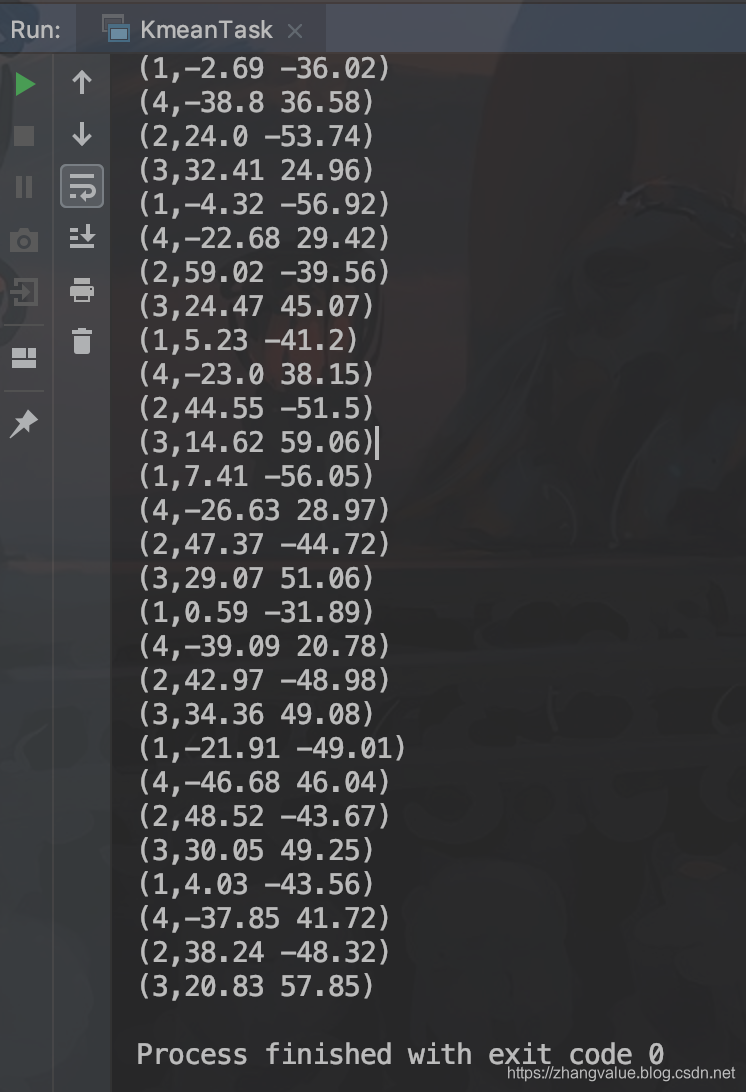
clusteredPoints.print();
}
}
// *************************************************************************
// 数据源读取 (数据点和聚类中心)
// *************************************************************************
private static DataSet<Centroid> getCentroidDataSet(ParameterTool params, ExecutionEnvironment env) {
DataSet<Centroid> centroids;
if (params.has("centroids")) {
centroids = env.readCsvFile(params.get("centroids"))
.fieldDelimiter(StringUtils.SPACE)
.pojoType(Centroid.class, "id", "x", "y");
} else {
System.out.println("执行 K-Means 用默认的中心数据集合.");
System.out.println("Use --centroids to specify file input.");
centroids = KMeansData.getDefaultCentroidDataSet(env);
}
return centroids;
}
private static DataSet<Point> getPointDataSet(ParameterTool params, ExecutionEnvironment env) {
DataSet<Point> points;
if (params.has("points")) {
// read points from CSV file
points = env.readCsvFile(params.get("points"))
.fieldDelimiter(StringUtils.SPACE)
.pojoType(Point.class, "x", "y");
} else {
System.out.println("Executing K-Means example with default point data set.");
System.out.println("Use --points to specify file input.");
points = KMeansData.getDefaultPointDataSet(env);
}
return points;
}
// *************************************************************************
// 数据类型,POJO内部类
// *************************************************************************
/**
* 简单的二维点.
*/
public static class Point implements Serializable {
public double x, y;
public Point() {}
public Point(double x, double y) {
this.x = x;
this.y = y;
}
public Point add(Point other) {
x += other.x;
y += other.y;
return this;
}
public Point div(long val) {
x /= val;
y /= val;
return this;
}
public double euclideanDistance(Point other) {
return Math.sqrt((x - other.x) * (x - other.x) + (y - other.y) * (y - other.y));
}
public void clear() {
x = y = 0.0;
}
@Override
public String toString() {
return x + StringUtils.SPACE + y;
}
}
/**
* 简单的二维中心,包括ID的点
*/
public static class Centroid extends Point {
public int id;
public Centroid() {}
public Centroid(int id, double x, double y) {
super(x, y);
this.id = id;
}
public Centroid(int id, Point p) {
super(p.x, p.y);
this.id = id;
}
@Override
public String toString() {
return id + " " + super.toString();
}
}
// *************************************************************************
// 自定义函数
// *************************************************************************
/** 从数据点确定最近的聚类中心. */
@FunctionAnnotation.ForwardedFields("*->1")
public static final class SelectNearestCenter extends RichMapFunction<Point, Tuple2<Integer, Point>> {
private List<Centroid> centroids;
/** 从广播变量中读取聚类中心值到集合中. */
@Override
public void open(Configuration parameters) throws Exception {
this.centroids = getRuntimeContext().getBroadcastVariable("centroids");
}
@Override
public Tuple2<Integer, Point> map(Point p) throws Exception {
double minDistance = Double.MAX_VALUE;
int closestCentroidId = -1;
// 检查所有的聚类中心
for (Centroid centroid : centroids) {
// 计算每个点与聚类中心的距离(欧式距离)
double distance = p.euclideanDistance(centroid);
// 满足条件更新最近的聚类中心Id
if (distance < minDistance) {
minDistance = distance;
closestCentroidId = centroid.id;
}
}
// 生成一个包含聚类中心id和数据点的元组tuple.
return new Tuple2<>(closestCentroidId, p);
}
}
/** 向tupel2追加计数变量. */
@FunctionAnnotation.ForwardedFields("f0;f1")
public static final class CountAppender implements MapFunction<Tuple2<Integer, Point>, Tuple3<Integer, Point, Long>> {
@Override
public Tuple3<Integer/*id*/, Point, Long/*1L*/> map(Tuple2<Integer, Point> t) {
return new Tuple3<>(t.f0, t.f1, 1L);
}
}
/** 求同一个类所有点的x,y坐标总数和计数点坐标. */
//@FunctionAnnotation.ForwardedFields("0")
public static final class CentroidAccumulator implements ReduceFunction<Tuple3<Integer, Point, Long>> {
@Override
public Tuple3<Integer, Point, Long> reduce(Tuple3<Integer, Point, Long> val1, Tuple3<Integer, Point, Long> val2) {
return new Tuple3<>(val1.f0, val1.f1.add(val2.f1), val1.f2 + val2.f2);
}
}
/** 从坐标和点的个数计算新的聚类中心. */
//@FunctionAnnotation.ForwardedFields("0->id")
public static final class CentroidAverager implements MapFunction<Tuple3<Integer/*id*/, Point/*累加的坐标点*/, Long/*个数*/>, Centroid> {
@Override
public Centroid map(Tuple3<Integer, Point, Long> value) {
return new Centroid(value.f0, value.f1.div(value.f2));
}
}
/**
* 缺省的数据准备
*/
public static class KMeansData {
// We have the data as object arrays so that we can also generate Scala Data Sources from it.
public static final Object[][] CENTROIDS = new Object[][] {
new Object[] {1, -31.85, -44.77},
new Object[]{2, 35.16, 17.46},
new Object[]{3, -5.16, 21.93},
new Object[]{4, -24.06, 6.81}
};
public static final Object[][] POINTS = new Object[][] {
new Object[] {-14.22, -48.01},
new Object[] {-22.78, 37.10},
new Object[] {56.18, -42.99},
new Object[] {35.04, 50.29},
new Object[] {-9.53, -46.26},
new Object[] {-34.35, 48.25},
new Object[] {55.82, -57.49},
new Object[] {21.03, 54.64},
new Object[] {-13.63, -42.26},
new Object[] {-36.57, 32.63},
new Object[] {50.65, -52.40},
new Object[] {24.48, 34.04},
new Object[] {-2.69, -36.02},
new Object[] {-38.80, 36.58},
new Object[] {24.00, -53.74},
new Object[] {32.41, 24.96},
new Object[] {-4.32, -56.92},
new Object[] {-22.68, 29.42},
new Object[] {59.02, -39.56},
new Object[] {24.47, 45.07},
new Object[] {5.23, -41.20},
new Object[] {-23.00, 38.15},
new Object[] {44.55, -51.50},
new Object[] {14.62, 59.06},
new Object[] {7.41, -56.05},
new Object[] {-26.63, 28.97},
new Object[] {47.37, -44.72},
new Object[] {29.07, 51.06},
new Object[] {0.59, -31.89},
new Object[] {-39.09, 20.78},
new Object[] {42.97, -48.98},
new Object[] {34.36, 49.08},
new Object[] {-21.91, -49.01},
new Object[] {-46.68, 46.04},
new Object[] {48.52, -43.67},
new Object[] {30.05, 49.25},
new Object[] {4.03, -43.56},
new Object[] {-37.85, 41.72},
new Object[] {38.24, -48.32},
new Object[] {20.83, 57.85}
};
public static DataSet<Centroid> getDefaultCentroidDataSet(ExecutionEnvironment env) {
List<Centroid> centroidList = new LinkedList<Centroid>();
for (Object[] centroid : CENTROIDS) {
centroidList.add(
new Centroid((Integer) centroid[0], (Double) centroid[1], (Double) centroid[2]));
}
return env.fromCollection(centroidList);
}
public static DataSet<Point> getDefaultPointDataSet(ExecutionEnvironment env) {
List<Point> pointList = new LinkedList<Point>();
for (Object[] point : POINTS) {
pointList.add(new Point((Double) point[0], (Double) point[1]));
}
return env.fromCollection(pointList);
}
}
}





 扫一扫
扫一扫


 2734
2734

 被折叠的 条评论
为什么被折叠?
被折叠的 条评论
为什么被折叠?
 到【灌水乐园】发言





