



 本文介绍了如何使用贪心策略解决POJ 1328题目的区间选点问题。通过将区间按右端点排序并优先选择未被满足的小区间,确保所有区间至少包含一个点。贪心策略在包含关系和不包含关系下都能正确找到最少的点数量。
区间选点问题(贪心)
数轴上有n个闭区间[ai,bi]。取尽量少的点,使得每个区间内都至少有一个点(不同区间内含的点可以是同一个)。
贪心策略:
按照b1<=b2<=b3…(b相同时按a从大到小)的方式排序排序,从前向后遍历,当遇到没有加入集合的区间时,选取这个区间的右端点b。
证明:
为了方便起见,如果区间i内已经有一个点被取到,我们称区间i被满足。
1、首先考虑区间包含的情况,当小区间被满足时大区间一定被满足。所以我们应当优先选取小区间中的点,从而使大区间不用考虑。
按照上面的方式排序后,如果出现区间包含的情况,小区间一定在大区间前面。所以此情况下我们会优先选择小区间。
则此情况下,贪心策略是正确的。
2、排除情况1后,一定有a1<=a2<=a3……。

对于区间1来说,显然选择它的右端点是明智的。因为它比前面的点能覆盖更大的范围。
从而此情况下,贪心策略也是正确的。
例题如下: POJ 1328 Radar Installation
Radar Installation
Time Limit : 2000/1000ms (Java/Other) Memory Limit : 20000/10000K (Java/Other)
Total Submission(s) : 54 Accepted Submission(s) : 28
Problem Description
Assume the coasting is an infinite straight line. Land is in one side of coasting, sea in the other. Each small island is a point locating in the sea side. And any radar installation, locating on the coasting, can only cover d distance, so an island in the sea can be covered by a radius installation, if the distance between them is at most d.
We use Cartesian coordinate system, defining the coasting is the x-axis. The sea side is above x-axis, and the land side below. Given the position of each island in the sea, and given the distance of the coverage of the radar installation, your task is to write a program to find the minimal number of radar installations to cover all the islands. Note that the position of an island is represented by its x-y coordinates.
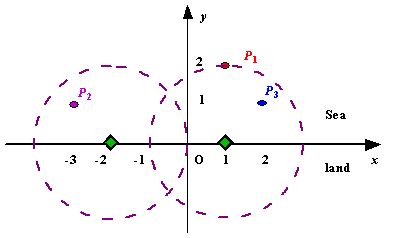
Figure A Sample Input of Radar Installations
We use Cartesian coordinate system, defining the coasting is the x-axis. The sea side is above x-axis, and the land side below. Given the position of each island in the sea, and given the distance of the coverage of the radar installation, your task is to write a program to find the minimal number of radar installations to cover all the islands. Note that the position of an island is represented by its x-y coordinates.
Figure A Sample Input of Radar Installations
Input
The input consists of several test cases. The first line of each case contains two integers n (1<=n<=1000) and d, where n is the number of islands in the sea and d is the distance of coverage of the radar installation. This is followed by n lines each containing two integers representing the coordinate of the position of each island. Then a blank line follows to separate the cases.
The input is terminated by a line containing pair of zeros
The input is terminated by a line containing pair of zeros
Output
For each test case output one line consisting of the test case number followed by the minimal number of radar installations needed. "-1" installation means no solution for that case.
Sample Input
    3 2
1 2
-3 1
2 1

1 2
0 2

0 0
Sample Output
    Case 1: 2
Case 2: 1
如果小岛能被雷达覆盖,则转换在一维坐标上的最大区间为,[x-sqrt(d*d*1.0-y*y),x+sqrt(d*d*1.0-y*y)]
如果其中某个小岛不能被覆盖,则用标记变量标记。直接输出-1。
如果所有小岛都能被雷达覆盖,则进行贪心策略。
对所有区间右端进行从小大到排序(右端相同时,左端从大到小排序),则如果出现区间包含的情况,小区间一定排在前面。
然后开始遍历区间。如果当前区间超过上一个区间的覆盖范围,则雷达数+1。
第一个区间去最右值。
证明:如果第一个区间不取最右值,而取中间的点,那么把点移到最右端,被满足的区间增加了。而原先被满足的区间现在一定被满足。
*/
ac码
<strong style="color: rgb(255, 0, 0);">#include <cstdio>
</strong>#include <cmath>
#include <algorithm>
const int maxn = 1010;
using namespace std;
struct radar
{
	double s,e;
}arr[maxn];
bool cmp(radar x,radar y)
{
	if(x.e==y.e) return x.s>y.s;
	else return x.e<y.e;
}
int main()
{
	int n,d,i,x,y,flag,count;
	int k=1;
	double temp;
	while(scanf("%d%d",&n,&d))
	{
		if(n==0&&d==0) break;
		flag=0;					//标记是否有小岛无法被覆盖
		for(i=0;i<n;++i)
		{
			scanf("%d%d",&x,&y);
			if(y>d)
			{
				flag=1;			//如果雷达不足以覆盖,则标记
				continue;
			}
			temp=sqrt(d*d*1.0-y*y);
			arr[i].s=x-temp;
			arr[i].e=x+temp;
		}
		printf("Case %d: ",k++);
		if(flag)
		{
			printf("-1\n");
			continue;
		}
		sort(arr,arr+n,cmp);
		count = 1;
		temp=arr[0].e;
		for(i=1;i<n;++i)
		{
			if(arr[i].s>temp)
			{
				temp=arr[i].e;
				count++;
			}
		}
		printf("%d\n",count);
	}
	return 0;
}





 扫一扫
扫一扫


 2610
2610

 被折叠的 条评论
为什么被折叠?
被折叠的 条评论
为什么被折叠?
 到【灌水乐园】发言





