 课程注册系统优化


 本文介绍了一个课程注册系统的优化过程,对比了使用vector和set的数据结构在处理大量学生选课信息时的性能差异。通过实验证明,对于大规模数据处理,使用vector结合sort()函数的方法在时间和空间效率上优于使用set。
题目
Zhejiang University has 40,000 students and provides 2,500 courses. Now given the registered course list of each student, you are supposed to output the student name lists of all the courses.
Input Specification:
Each input file contains one test case. For each case, the first line contains 2 numbers: N(≤40,000)N(\le40,000)N(≤40,000), the total number of students, and K(≤2,500)K(\le2,500)K(≤2,500), the total number of courses. Then N lines follow, each contains a student’s name (3 capital English letters plus a one-digit number), a positive number C(≤20)C(\le20)C(≤20) which is the number of courses that this student has registered, and then followed by CCC course numbers. For the sake of simplicity, the courses are numbered from 111 to KKK.
Output Specification:
For each test case, print the student name lists of all the courses in increasing order of the course numbers. For each course, first print in one line the course number and the number of registered students, separated by a space. Then output the students’ names in alphabetical order. Each name occupies a line.
Sample Input:
10 5
ZOE1 2 4 5
ANN0 3 5 2 1
BOB5 5 3 4 2 1 5
JOE4 1 2
JAY9 4 1 2 5 4
FRA8 3 4 2 5
DON2 2 4 5
AMY7 1 5
KAT3 3 5 4 2
LOR6 4 2 4 1 5
Sample Output:
1 4
ANN0
BOB5
JAY9
LOR6
2 7
ANN0
BOB5
FRA8
JAY9
JOE4
KAT3
LOR6
3 1
BOB5
4 7
BOB5
DON2
FRA8
JAY9
KAT3
LOR6
ZOE1
5 9
AMY7
ANN0
BOB5
DON2
FRA8
JAY9
KAT3
LOR6
ZOE1
思路
一开始想到用vector<set<string> >存储每门课的学生姓名, 姓名在set里会自动排序。然而最后一个测试点超时。后改用vector<vector<string> >,顺利通过。
复杂度分析
课程数是k,学生数是n。
set复杂度
set的insert()复杂度为logn(n是当前大小),最坏情况下每门课程插入n个学生的名字,用时log1 + log2 + log3 + …… logn = log(n!) = O(nlogn),k门课就是O(knlogn)。
set遍历操作++,--复杂度均为O(logn),输出时复杂度又是O(knlogn)。
vector复杂度
若用vector<vector<string> >存储,插入操作用时kn,远低于用set的插入;
排序操作用时O(knlogn),输出时间kn,与set输出持平。
所以vector+sort()比用set更快。
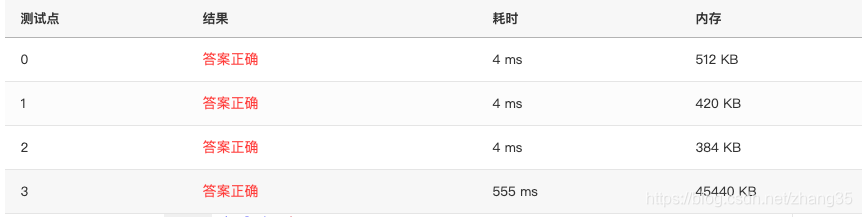
还要注意必须用scanf和printf输入输出才能不超时,用cin、cout + ios::sync_with_stdio(false); cin.tie(0);依然超时。
代码
#include <iostream>
#include <vector>
#include <algorithm>
using namespace std;

int main(){
    //ios::sync_with_stdio(false);
    //cin.tie(0);
    int n, k;
    scanf("%d%d", &n, &k);
    //cin >> n >> k;
    vector<vector<string> > course(k+1);
    for (int i=0; i<n; i++){
        char buf[5];
        int c;
        //cin >> name >> c;
        scanf("%s%d", buf, &c);
        string name(buf);
        for (int j=0; j<c; j++){
            int id;
            scanf("%d", &id);
            //cin >> id;
            course[id].push_back(name);
        }
    }
    for (int i=1; i<k+1; i++){
        sort(course[i].begin(), course[i].end());
        printf("%d %d\n", i, (int)course[i].size());
        //cout << i << " " << course[i].size() << endl;
        for (auto it=course[i].begin(); it!=course[i].end(); ++it){
            printf("%s\n", (*it).c_str());
            //cout << *it << endl;
        }
    }
    return 0;
}





 扫一扫
扫一扫


 到【灌水乐园】发言



