



 本文详细介绍如何为ARM设备跨平台编译Linphone,包括所需的依赖库如libav、libeXosip2等的配置及编译过程,并提供了解决常见问题的方法。
FRIDAY, AUGUST 12, 2011
Cross Compiling Linphone(1)
In this post, we will cross compile linphone for ARM devices. When it comes to video capability, it will support video output via SDL but no web cam interface. Including camera support is not difficult as long as V4L library is prepared.
First gather the required sources:
and extract them under a directory, say linphone. Then create a target output directory, say install. Your directory structure then will look like this:
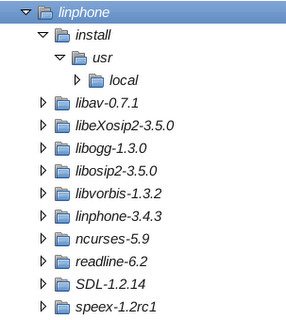
To save tedious repetitive typing, prepare environmental variables
export PREFIX=/usr/local
export HOSTTPL=arm-none-linux-gnueabi
export INSTALLDIR=/home/user/linphone/install
These may vary on your situation. Most of the procedures for each library compilation basically consist of following three steps:
$ configure
$ make
$ make install
So we will just list the commands with arguments until the last step, which will requires some interventions. Before we start, we may need intltool package
$ sudo apt-get install intltool
Now, let's get started. We have a long way to go.
ncurses
We won't use gtk+ gui interface so we need this for better command line interface.
$ ./configure --prefix=$PREFIX --host=$HOSTTPL --with-shared --with-gnu-ld
$ make
$ make install DESTDIR=$INSTALLDIR
Before going further, there is one thing you have to remember. As it is directed by the INSTALLDIR variable, the outputs will reside on the directory:
/home/user/linphone/install/usr/local
Under that directory you can find lib subdirectory where all the resulting libraries will populate. You can also find libtool archive files (*.la) there. Because we are doing cross compilation, these files usually contains wrong information so it should be deleted as soon as it is created. If you meet compilation error with strange library reference (looking for a library in the wrong place), then you should check the *.la files there.
readline
$ ./configure --prefix=$PREFIX --host=$HOSTTPL --disable-static
$ make
$ make install DESTDIR=$INSTALLDIR
libosip2
$ ./configure --prefix=$PREFIX --host=$HOSTTPL --with-gnu-ld --disable-static
$ make
$ make install DESTDIR=$INSTALLDIR
libogg
$ ./configure --prefix=$PREFIX --host=$HOSTTPL --with-gnu-ld
$ make
$ make install DESTDIR=$INSTALLDIR
libeXosip2
$ ./configure --prefix=$PREFIX --host=$HOSTTPL --with-gnu-ld --disable-static \
$ make
$ make install DESTDIR=$INSTALLDIR
It is the good time to check the target library for the "la" files and delete them.
speex
$ ./configure --prefix=$PREFIX --host=$HOSTTPL --with-gnu-ld --disable-static \
$ make
$ make install DESTDIR=$INSTALLDIR
libav
$ ./configure --prefix=$PREFIX --enable-cross-compile \
$ make
$ make install DESTDIR=$INSTALLDIR
There are a bunch of --enable-xxx and --disable-xxx options are there. You can spend some time to fine tune the options to minimize the size of the output.
SDL
$ ./configure --prefix=$PREFIX --host=$HOSTTPL --with-gnu-ld
$ make
$ make install DESTDIR=$INSTALLDIR
libvorbis
$ ./configure --prefix=$PREFIX --host=$HOSTTPL --with-gnu-ld \
$ make
$ make install DESTDIR=$INSTALLDIR
First gather the required sources:
- libav-0.7.1
- libeXosip2-3.5.0
- libogg-1.3.0
- libosip2-3.5.0
- libvorbis-1..3.2
- linphone-3.4.3
- ncurses-5.9
- readline-6.2
- SDL-1.2.14
- speex-1.2rc1
and extract them under a directory, say linphone. Then create a target output directory, say install. Your directory structure then will look like this:

To save tedious repetitive typing, prepare environmental variables
export PREFIX=/usr/local
export HOSTTPL=arm-none-linux-gnueabi
export INSTALLDIR=/home/user/linphone/install
These may vary on your situation. Most of the procedures for each library compilation basically consist of following three steps:
$ configure
$ make
$ make install
So we will just list the commands with arguments until the last step, which will requires some interventions. Before we start, we may need intltool package
$ sudo apt-get install intltool
Now, let's get started. We have a long way to go.
ncurses
We won't use gtk+ gui interface so we need this for better command line interface.
$ ./configure --prefix=$PREFIX --host=$HOSTTPL --with-shared --with-gnu-ld
$ make
$ make install DESTDIR=$INSTALLDIR
Before going further, there is one thing you have to remember. As it is directed by the INSTALLDIR variable, the outputs will reside on the directory:
/home/user/linphone/install/usr/local
Under that directory you can find lib subdirectory where all the resulting libraries will populate. You can also find libtool archive files (*.la) there. Because we are doing cross compilation, these files usually contains wrong information so it should be deleted as soon as it is created. If you meet compilation error with strange library reference (looking for a library in the wrong place), then you should check the *.la files there.
readline
$ ./configure --prefix=$PREFIX --host=$HOSTTPL --disable-static
$ make
$ make install DESTDIR=$INSTALLDIR
libosip2
$ ./configure --prefix=$PREFIX --host=$HOSTTPL --with-gnu-ld --disable-static
$ make
$ make install DESTDIR=$INSTALLDIR
libogg
$ ./configure --prefix=$PREFIX --host=$HOSTTPL --with-gnu-ld
$ make
$ make install DESTDIR=$INSTALLDIR
libeXosip2
$ ./configure --prefix=$PREFIX --host=$HOSTTPL --with-gnu-ld --disable-static \
$ make
$ make install DESTDIR=$INSTALLDIR
It is the good time to check the target library for the "la" files and delete them.
speex
$ ./configure --prefix=$PREFIX --host=$HOSTTPL --with-gnu-ld --disable-static \
$ make
$ make install DESTDIR=$INSTALLDIR
libav
$ ./configure --prefix=$PREFIX --enable-cross-compile \
$ make
$ make install DESTDIR=$INSTALLDIR
There are a bunch of --enable-xxx and --disable-xxx options are there. You can spend some time to fine tune the options to minimize the size of the output.
SDL
$ ./configure --prefix=$PREFIX --host=$HOSTTPL --with-gnu-ld
$ make
$ make install DESTDIR=$INSTALLDIR
libvorbis
$ ./configure --prefix=$PREFIX --host=$HOSTTPL --with-gnu-ld \
$ make
$ make install DESTDIR=$INSTALLDIR
Labels:
FRIDAY, AUGUST 12, 2011
Cross Compiling Linphone(2)
It is time to compile the linphone. Command line argument list is quite long this case:
$ ./configure --prefix=$PREFIX --host=$HOSTTPL --with-gnu-ld \
Still there are some Makefiles and a source file we have to fix before we build them.
mediastreamer2/tests/Makefile
Find the LIBS variable and change it as:
LIBS = -pthread -lpthread -lrt -lvorbisenc -lvorbis -logg -lspeexdsp
mediastreamer2/coreapi/Makefile
Find the LIBS variable and change it as:
LIBS = -losip2 -lspeex -lSDL -lvorbis -lvorbisenc -lspeexdsp -logg -lavutil
mediastreamer2/coreapi/help/Makefile
Find the LIBS variable and change it as:
LIBS = -leXosip2 -lspeex -lSDL -lvorbisenc -losipparser2 -losip2 -lvorbis \
And find the helloworld_LADD variable and add $(EXOSIP_LIBS) as:
helloworld_LDADD = $(top_builddir)/coreapi/liblinphone.la \
mediastreamer2/console/Makefile
Find the LIBS variable and change it as:
LIBS = -leXosip2 -losip2 -lSDL -lvorbis -lvorbisenc -lspeexdsp -logg -losipparser2
And find linphonecsh_LDADD variable and change it as:
linphonecsh_LDADD = $(ORTP_LIBS) -L/home/user/linphone/install/usr/local/lib
mediastreamer2/src/videoout.c
This file contains some obsolete function calls such as ms_sws_freeContext, ms_sws_getContext and, so on. So it won't compile unless we fix them (replace them with correct function calls). Details are here:
https://bugs.gentoo.org/attachment.cgi?id=269363&action=diff
Finally, we are ready to build linphone. What you need is a good luck now.
$ make
$ make install DESTDIR=$INSTALLDIR
$ ./configure --prefix=$PREFIX --host=$HOSTTPL --with-gnu-ld \
Still there are some Makefiles and a source file we have to fix before we build them.
mediastreamer2/tests/Makefile
Find the LIBS variable and change it as:
LIBS = -pthread -lpthread -lrt -lvorbisenc -lvorbis -logg -lspeexdsp
mediastreamer2/coreapi/Makefile
Find the LIBS variable and change it as:
LIBS = -losip2 -lspeex -lSDL -lvorbis -lvorbisenc -lspeexdsp -logg -lavutil
mediastreamer2/coreapi/help/Makefile
Find the LIBS variable and change it as:
LIBS = -leXosip2 -lspeex -lSDL -lvorbisenc -losipparser2 -losip2 -lvorbis \
And find the helloworld_LADD variable and add $(EXOSIP_LIBS) as:
helloworld_LDADD = $(top_builddir)/coreapi/liblinphone.la \
mediastreamer2/console/Makefile
Find the LIBS variable and change it as:
LIBS = -leXosip2 -losip2 -lSDL -lvorbis -lvorbisenc -lspeexdsp -logg -losipparser2
And find linphonecsh_LDADD variable and change it as:
linphonecsh_LDADD = $(ORTP_LIBS) -L/home/user/linphone/install/usr/local/lib
mediastreamer2/src/videoout.c
This file contains some obsolete function calls such as ms_sws_freeContext, ms_sws_getContext and, so on. So it won't compile unless we fix them (replace them with correct function calls). Details are here:
https://bugs.gentoo.org/attachment.cgi?id=269363&action=diff
Finally, we are ready to build linphone. What you need is a good luck now.
$ make
$ make install DESTDIR=$INSTALLDIR





 扫一扫
扫一扫


 1443
1443

 被折叠的 条评论
为什么被折叠?
被折叠的 条评论
为什么被折叠?
 到【灌水乐园】发言





