



|
Hangover
Description How far can you make a stack of cards overhang a table? If you have one card, you can create a maximum overhang of half a card length. (We're assuming that the cards must be perpendicular to the table.) With two cards you can make the top card overhang the bottom one by half a card length, and the bottom one overhang the table by a third of a card length, for a total maximum overhang of 1/2 + 1/3 = 5/6 card lengths. In general you can make n cards overhang by 1/2 + 1/3 + 1/4 + ... + 1/(n + 1) card lengths, where the top card overhangs the second by 1/2, the second overhangs tha third by 1/3, the third overhangs the fourth by 1/4, etc., and the bottom card overhangs the table by 1/(n + 1). This is illustrated in the figure below. 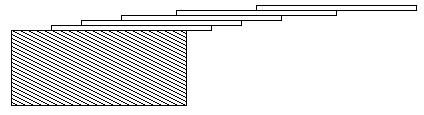
Input
The input consists of one or more test cases, followed by a line containing the number 0.00 that signals the end of the input. Each test case is a single line containing a positive floating-point number c whose value is at least 0.01 and at most 5.20; c will contain exactly three digits.
Output
For each test case, output the minimum number of cards necessary to achieve an overhang of at least c card lengths. Use the exact output format shown in the examples.
Sample Input 1.00 3.71 0.04 5.19 0.00 Sample Output 3 card(s) 61 card(s) 1 card(s) 273 card(s) Source |
import java.util.Scanner;

public class Main {

	public static void main(String[] args) {
		Scanner sc = new Scanner(System.in);
		while(sc.hasNext()){
			double x = sc.nextDouble();
			if(x == 0)
				break;
			int result = f(x);
			System.out.println(result + " card(s)");
		}
	}

	private static int f(double x) {
		int i=1;
		double sum=0;
		while(sum < x){
			sum += 1.0/(i+1);
			i++;
		}
		return i-1;
	}
}





 扫一扫
扫一扫


 828
828

 被折叠的 条评论
为什么被折叠?
被折叠的 条评论
为什么被折叠?
 到【灌水乐园】发言





