



 本文介绍如何在Spring Boot应用中批量读取未知数量和名称的资源文件,包括在不同部署环境下(如开发环境与打包成jar后的运行环境)的正确实现方式。
前言
适用springboot 简单搭建了一个小环境,通过classLoader获取classpath下的文件夹中的文件,批量获取文件,也许你不知道有多少文件和文件的名称,基于这个情况下总结了一些经验教训
环境
-
resource下创建文件夹
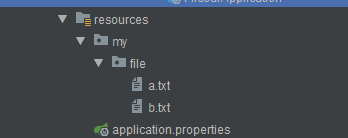
这里创建了2个文件,a 和b , 如果我们确定知道文件名称 就好办了 通过classLoader.getResourceAsStream() 即可获取, 假设我们不知道文件名称和数量 -
编写测试类
错误代码示范\color{red}{错误代码示范}错误代码示范
     // 获取class 根目录
    URL resource = FileJar.class.getClassLoader().getResource("my/file");
    System.out.println(resource.getPath());
    //        获取my/file 下的所有文件
    File[] files = new File(resource.getPath()).listFiles();
    if (files != null) {
    Arrays.stream(files).forEach(e -> System.out.println("file path = " + e.getAbsolutePath()));

    }
输出
   /F:/workSpaces/idea/springboot-test/file-jar/target/classes/my/file
file path = F:\workSpaces\idea\springboot-test\file-jar\target\classes\my\file\a.txt
file path = F:\workSpaces\idea\springboot-test\file-jar\target\classes\my\file\b.txt
** 看似没问题,但是打包为jar后输出
file:/F:/workSpaces/idea/springboot-test/file-jar/target/file-jar-0.0.1-SNAPSHOT.jar!/BOOT-INF/classes!/my/file
是一个压缩文件 jar路径, file 是读取不了的**
正确方式
   Enumeration<URL> resources = FileJar.class.getClassLoader().getResources("my/file");
        while (resources.hasMoreElements()) {
            URL url = resources.nextElement();
            // 通过判断协议是不是jar文件
            if (url.getProtocol().equals("jar")) {
                JarURLConnection urlConnection = (JarURLConnection) url.openConnection();
                JarFile jarFile = urlConnection.getJarFile();
                Enumeration<JarEntry> entries = jarFile.entries(); // 返回jar中所有的文件目录
                while (entries.hasMoreElements()) {
                    JarEntry jarEntry = entries.nextElement();
                    if (!jarEntry.isDirectory() && jarEntry.getName().startsWith("my/file")) {  // 是我们需要的文件类型
                        String name = jarEntry.getName();
                        System.out.println("name  = " + name);
                        InputStream resourceAsStream = FileJar.class.getClassLoader().getResourceAsStream(name);
                        Properties p = new Properties();
                        p.load(resourceAsStream);
                        System.out.println(p);
                    }
                }
            } else if (url.getProtocol().equals("file")) {
                // 获取class 根目录
                URL resource = FileJar.class.getClassLoader().getResource("my/file");
                System.out.println(resource.getPath());
                // 获取my/file 下的所有文件
                File[] files = new File(resource.getPath()).listFiles();
                if (files != null) {
                    Arrays.stream(files).forEach(e -> System.out.println("file path = " + e.getAbsolutePath()));
                }
            }
        }
通过jarFile 来获取jar包中的文件, 如果有其他jar包和你的文件夹命名相同可以添加 url条件进行判断
知识点
ClassLoader.getResource(String name);

ClassLoader.getResource("");  // 获取的是项目根目录,也就是到classes/这一层

ClassLoader.getResources(String name);

ClassLoader.getResources("my/file/a.properties"); // 加载多个jar文件中的 my/file/a.properties 文件, springboot的spring.factories 就是这么加载的

ClassLoader.getResourceAsStream(String name);





 扫一扫
扫一扫


 2万+
2万+

 被折叠的 条评论
为什么被折叠?
被折叠的 条评论
为什么被折叠?
 到【灌水乐园】发言





