



 本文深入探讨了Java中线程控制的四种主要方法:join、CountDownLatch、CyclicBarrier及分阶段控制策略。通过具体代码示例,对比分析了这些方法在控制线程同步与等待时的不同应用场景与特性。
1、join
模拟现在有三个worker,采用join的方法控制:
package org.pbccrc.org.pbccrc.thread;

public class Test {

	 public static void main(String[] args) throws InterruptedException {
		Worker worker1=new Worker("第一个任务", (int)(Math.random()*1000+2000));
		Worker worker2=new Worker("第二个任务", (int)(Math.random()*1000+2000));
		Worker worker3=new Worker("第三个任务", (int)(Math.random()*1000+2000));

		Thread thread1 =new Thread(worker1);
		Thread thread2 =new Thread(worker2);
		Thread thread3 =new Thread(worker3);

		thread1.start();
		thread2.start();

		thread1.join();
		thread2.join();

		System.out.println("wait thread1 and thread2 complete :");
		thread3.start();
		thread3.join();

		System.out.println("three threads have complete!");

	}

}
package org.pbccrc.org.pbccrc.thread;

public class Worker implements Runnable {

	 private String name;

	 private int time;

	public Worker(String name, int time) {
		super();
		this.name = name;
		this.time = time;
	}


	@Override
	public void run() {
       System.out.println("task :"+name+":is running!");
       try {
		Thread.sleep(time);
	} catch (InterruptedException e) {
		e.printStackTrace();
	}
       System.out.println("task :"+name+":complete!");

	}

}
task :第一个任务:is running!
task :第二个任务:is running!
task :第二个任务:complete!
task :第一个任务:complete!
wait thread1 and thread2 complete :
task :第三个任务:is running!
task :第三个任务:complete!
three threads have complete!
2、Countdownlatch
采用countDownlatch控制:
package org.pbccrc.org.pbccrc.thread;

import java.util.concurrent.CountDownLatch;

public class Test {

	 public static void main(String[] args) throws InterruptedException {
		 CountDownLatch latch=new CountDownLatch(2);
		Worker worker1=new Worker("第一个任务", (int)(Math.random()*1000+2000),latch);
		Worker worker2=new Worker("第二个任务", (int)(Math.random()*1000+2000),latch);
		Worker worker3=new Worker("第三个任务", (int)(Math.random()*1000+2000),latch);


		Thread thread1 =new Thread(worker1);
		Thread thread2 =new Thread(worker2);
		Thread thread3 =new Thread(worker3);

		thread1.start();
		thread2.start();

		latch.await();

		System.out.println("wait thread1 and thread2 complete :");
		thread3.start();
		thread3.join();
		System.out.println("three threads have complete!");

	}

}
package org.pbccrc.org.pbccrc.thread;

import java.util.concurrent.CountDownLatch;

public class Worker implements Runnable {

	 private String name;

	 private int time;

	 private CountDownLatch latch;

	public Worker(String name, int time,CountDownLatch latch) {
		super();
		this.name = name;
		this.time = time;
		this.latch = latch;
	}


	@Override
	public void run() {
       System.out.println("task :"+name+":is running!");
       try {
		Thread.sleep(time);
	} catch (InterruptedException e) {
		e.printStackTrace();
	}
       System.out.println("task :"+name+":complete!");
	   latch.countDown();
	}

}
task :第二个任务:is running!
task :第一个任务:is running!
task :第二个任务:complete!
task :第一个任务:complete!
wait thread1 and thread2 complete :
task :第三个任务:is running!
task :第三个任务:complete!
three threads have complete!
我们发现好像join与countdownlatch没有区别:看下面的例子吧:
3、分阶段控制使用countdownlatch
package org.pbccrc.org.pbccrc.thread;

import java.util.concurrent.CountDownLatch;

public class Worker implements Runnable {

	 private String name;

	 private int time;

	 private CountDownLatch latch;

	public Worker(String name, int time,CountDownLatch latch) {
		super();
		this.name = name;
		this.time = time;
		this.latch = latch;
	}


	@Override
	public void run() {
       System.out.println("task :"+name+":is running for first process!");
       try {
		Thread.sleep(time);
	} catch (InterruptedException e) {
		e.printStackTrace();
	}

       latch.countDown();


       try {
    	System.out.println("task :"+name+":is begin for second process!");
   		Thread.sleep(time);
   		System.out.println("task :"+name+":is complete for second process!");
   	} catch (InterruptedException e) {
   		e.printStackTrace();
   	}
       System.out.println("task :"+name+":complete!");

	}

}
task :第一个任务:is running for first process!
task :第二个任务:is running for first process!
task :第一个任务:is begin for second process!
task :第二个任务:is begin for second process!
wait thread1 and thread2 complete :
task :第三个任务:is running for first process!
task :第一个任务:is complete for second process!
task :第一个任务:complete!
task :第二个任务:is complete for second process!
task :第二个任务:complete!
task :第三个任务:is begin for second process!
task :第三个任务:is complete for second process!
task :第三个任务:complete!
three threads have complete!
区别在:线程执行过程中我们可以使用countdownlatch的方法countDown;countdownlatch是减数器,当数量为0时会唤醒其他的线程执行;
4、CyclicBarrier
public class Test {

	 public static void main(String[] args) throws InterruptedException, BrokenBarrierException {
		 CyclicBarrier barrier=new CyclicBarrier(3);
		Worker worker1=new Worker("第一个任务", (int)(Math.random()*1000+2000),barrier);
		Worker worker2=new Worker("第二个任务", (int)(Math.random()*1000+2000),barrier);
		Worker worker3=new Worker("第三个任务", (int)(Math.random()*1000+2000),barrier);


		Thread thread1 =new Thread(worker1);
		Thread thread2 =new Thread(worker2);
		Thread thread3 =new Thread(worker3);

		thread1.start();
		thread2.start();
		thread3.start();

	}

}
public class Worker implements Runnable {

	 private String name;

	 private int time;

	 private CyclicBarrier  barrier;

	public Worker(String name, int time,CyclicBarrier barrier) {
		super();
		this.name = name;
		this.time = time;
		this.barrier = barrier;
	}


	@Override
	public void run() {
       try {
			Thread.sleep(time);
			System.out.println("task :"+name+":has already!");
			barrier.await();
			System.out.println("task :"+name+":run !");
			Thread.sleep(time);
		} catch (Exception e) {
			e.printStackTrace();
		}
       System.out.println("task :"+name+":complete!");

	}

}
task :第二个任务:has already!
task :第一个任务:has already!
task :第三个任务:has already!
task :第二个任务:run !
task :第三个任务:run !
task :第一个任务:run !
task :第二个任务:complete!
task :第一个任务:complete!
task :第三个任务:complete!
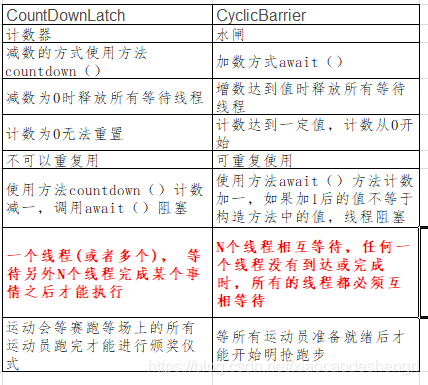
5、区别:CyclicBarrier和CountDownLatch





 扫一扫
扫一扫


 789
789

 被折叠的 条评论
为什么被折叠?
被折叠的 条评论
为什么被折叠?
 到【灌水乐园】发言





