



 本文介绍了一种利用最小生成树算法来解决热带岛屿Lagrishan上道路维护成本优化问题的方法。通过计算连接所有村庄的最经济道路网络,避免了丛林吞噬带来的高额维护费用。输入村庄信息和道路连接情况,输出每月最低维护成本。
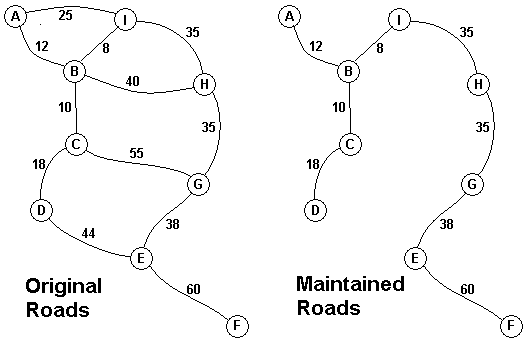
The Head Elder of the tropical island of Lagrishan has a problem. A burst of foreign aid money was spent on extra roads between villages some years ago. But the jungle overtakes roads relentlessly, so the large road network is too expensive to maintain. The Council of Elders must choose to stop maintaining some roads. The map above on the left shows all the roads in use now and the cost in aacms per month to maintain them. Of course there needs to be some way to get between all the villages on maintained roads, even if the route is not as short as before. The Chief Elder would like to tell the Council of Elders what would be the smallest amount they could spend in aacms per month to maintain roads that would connect all the villages. The villages are labeled A through I in the maps above. The map on the right shows the roads that could be maintained most cheaply, for 216 aacms per month. Your task is to write a program that will solve such problems.Input
The input consists of one to 100 data sets, followed by a final line containing only 0. Each data set starts with a line containing only a number n, which is the number of villages, 1 < n < 27, and the villages are labeled with the first n letters of the alphabet, capitalized. Each data set is completed with n-1 lines that start with village labels in alphabetical order. There is no line for the last village. Each line for a village starts with the village label followed by a number, k, of roads from this village to villages with labels later in the alphabet. If k is greater than 0, the line continues with data for each of the k roads. The data for each road is the village label for the other end of the road followed by the monthly maintenance cost in aacms for the road. Maintenance costs will be positive integers less than 100. All data fields in the row are separated by single blanks. The road network will always allow travel between all the villages. The network will never have more than 75 roads. No village will have more than 15 roads going to other villages (before or after in the alphabet). In the sample input below, the first data set goes with the map above.
Output
The output is one integer per line for each data set: the minimum cost in aacms per month to maintain a road system that connect all the villages. Caution: A brute force solution that examines every possible set of roads will not finish within the one minute time limit.
Sample Input
9
A 2 B 12 I 25
B 3 C 10 H 40 I 8
C 2 D 18 G 55
D 1 E 44
E 2 F 60 G 38
F 0
G 1 H 35
H 1 I 35
3
A 2 B 10 C 40
B 1 C 20
0
Sample Output
216
30
思路:典型的最小生成树问题。
实现代码:
#include<stdio.h>
#include<string.h>
#include<iostream>
#include<algorithm>
using namespace std;
int pre[10101];
struct ch
{
	int x1,x2,s;
}sh[10101];
bool cmp(ch a,ch b)
{
	return a.s<b.s;
}
int find(int x)
{
	if(pre[x]!=x)
	pre[x]=find(pre[x]);
	return pre[x];
}
int merge(int a,int b)
{
	int x1=find(a);
	int x2=find(b);
	if(x1!=x2){pre[x1]=x2;
	return 1;
	}
	return 0;
}
int main()
{
	int n;char a[10],b[10];int l;int m,cou;
	while(cin>>n,n)
	{
		int ans=0;
		cou=1;//记录总共多少条边
		for(int i=1;i<=n-1;i++)
		{
			cin>>a>>m;
			for(int i=1;i<=m;i++)
			{
				cin>>b>>l;
				sh[cou].x1=a[0]-'A'+1;
				sh[cou].x2=b[0]-'A'+1;
				sh[cou++].s=l;
			}
		}
		for(int i=0;i<=n;i++)
		pre[i]=i;//初始化

		sort(sh,sh+cou,cmp);//排序注意是cou
		for(int i=0;i<cou;i++)
		{
			if(merge(sh[i].x1,sh[i].x2))
			ans+=sh[i].s;
		}
		cout<<ans<<endl;
	}
	return 0;
}

٩(๑>◡<๑)۶





 扫一扫
扫一扫


 3095
3095

 被折叠的 条评论
为什么被折叠?
被折叠的 条评论
为什么被折叠?
 到【灌水乐园】发言





