



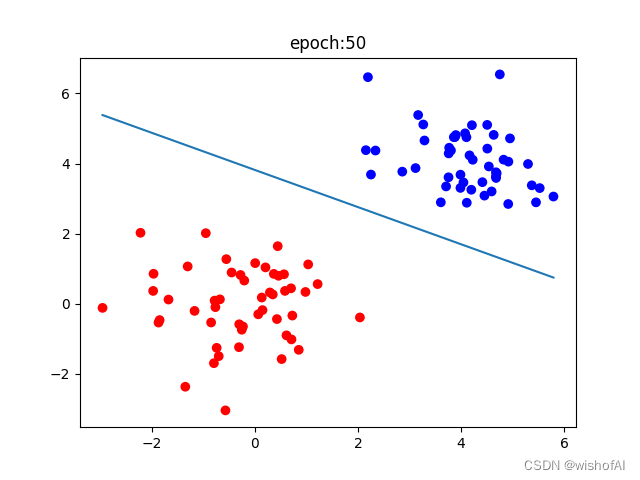
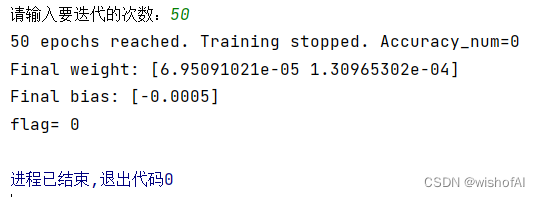
 该代码实现了一个简单的感知器类,用于训练数据。它包含了初始化、预测、更新权重、激活函数(阶跃函数)以及训练过程。在训练过程中,如果所有样本都被正确分类,则提前结束训练。最后,它会显示决策边界并输出最终的权重和偏置。
代码:
import numpy as np
import matplotlib.pyplot as plt
class Perceptron():
    def __init__(self,epoch):
        self.alpha = 0.0001
        self.epochs=epoch
        self.flag=0
        self.X=np.vstack([np.random.randn(50, 2), (np.random.randn(50, 2) + 4)])
        self.label=np.vstack([np.zeros((50, 1)), np.ones((50, 1))])
    #预测函数
    def predict(self,x):
        predict=self.step_function(np.dot(self.w,x)+self.b)
        return predict
    #update
    def update(self,x_train,Y):
        update=self.alpha*(self.predict(x_train)-Y)
        self.w =self.w-update*x_train
        self.b =self.b-update
    #激活函数
    def step_function(self,X):
        return np.where(X> 0, 1, 0)
    #training
    def fit(self):
        self.n_samples,self.n_features=self.X.shape
        self.w= np.zeros(self.n_features)
        self.b = np.zeros(1)
        for epoch_1 in range(self.epochs):
            accuracy=0
            for i in range(self.n_samples):
                if (self.X[i]==self.predict(self.X[i])).all():
                    accuracy+=1
                else:
                    self.update(self.X[i],self.label[i])
            if accuracy == self.n_samples:
                print("Training completed after {} epochs. Accuracy_num={}".format(epoch_1+1,accuracy))
                self.flag=1
                self.show()
                break
            if epoch_1 == self.epochs-1:
                print("{} epochs reached. Training stopped. Accuracy_num={}".format(self.epochs,accuracy))
                self.show()
        print("Final weight:", self.w)
        print("Final bias:", self.b)
        return self.flag
    # 图形显示结果
    def show(self):
        x1 = np.linspace(min(self.X[:, 0]), max(self.X[:, 0]), 100)
        x2 = (- self.w[0] * x1-self.b ) / self.w[1]
        plt.plot(x1, x2.reshape(-1))
        # 画出数据集的散点图
        plt.title("epoch:"+str(self.epochs))
        colors = ['blue' if label == 1 else 'red' for label in self.label]
        plt.scatter(self.X[:, 0], self.X[:, 1], c=colors)
        plt.show()
if __name__ == '__main__':
    epochs=eval(input("请输入要迭代的次数:"))
    classify=Perceptron(epochs)
    flag=classify.fit()
    print("flag=",flag)
结果:





 扫一扫
扫一扫


 810
810

 被折叠的 条评论
为什么被折叠?
被折叠的 条评论
为什么被折叠?
 到【灌水乐园】发言





