 有限元方法在二维三维网格中的应用与数值模拟



💥💥💞💞欢迎来到本博客❤️❤️💥💥
🏆博主优势:🌞🌞🌞博客内容尽量做到思维缜密,逻辑清晰,为了方便读者。
⛳️座右铭:行百里者,半于九十。
目录
💥1 概述
质量和刚度矩阵被组装成嵌套的均匀网格(2D 中的三角形和 3D 中的四面体),从具有少量元素的粗网格(level=1 网格)开始,到具有多达数百万元素的最精细网格(level=levels,其中级别是预定义的),具体取决于可用内存。
弗里德里希、庞加莱是从广义特征值问题近似出来的。如果已知,则将近似值与精确值进行比较(例如,对于 2D 中的矩形域和 3D 中的长方体域),并可视化相应的特征函数。域几何可以通过修改输入矩阵轻松更改:node2coords,elems2nodes,dirichlet。还有一个麦克斯韦常数的实验计算。本文解释的弗里德里希常数的原始计算。
📚2 运行结果
2D


3D
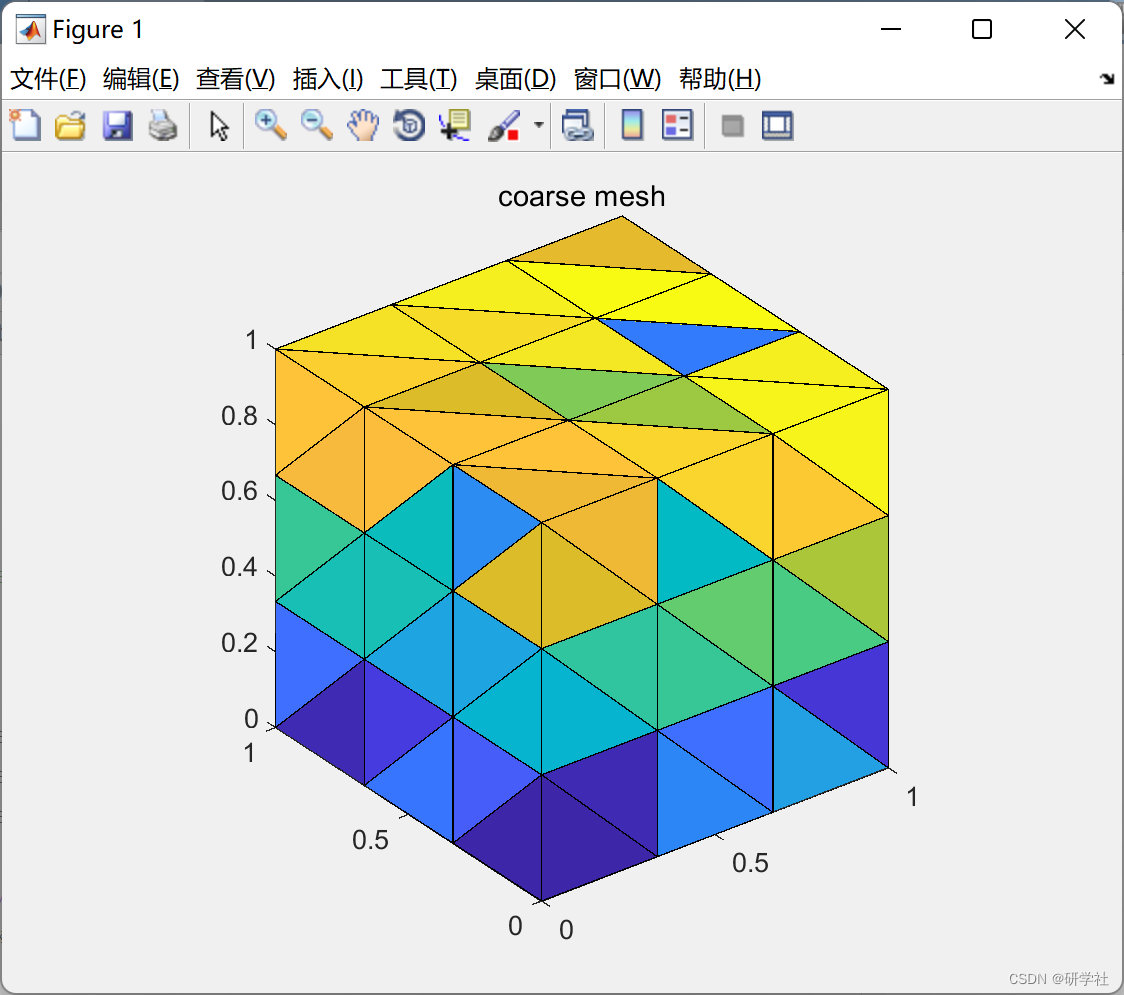


部分代码:
d=2; %problem dimension
levels=5; %level=9 uniform refinement leading to elements=524288, edges=787456, nodes=263169 triagulation for the unit square problem
level_visualize=3;
levels_CF=levels; %level uniform refinement for the Friedrichs constant
levels_CP=levels; %level uniform refinement for the Poincare constant
levels_CM=0*levels; %level uniform refinement for the Maxwell constant, set zero to switch off this computation
level_visualize_eigenfunctionF=min(levels_CF,level_visualize);
level_visualize_eigenfunctionP=min(levels_CP,level_visualize);
level_visualize_eigenfunctionM=min(levels_CM,level_visualize);
if ~exist('levels')
levels=max(max(levels_CF,levels_CP),levels_CM);
end
fprintf('The last level of uniform refinement is %d. ', levels);
fprintf('Please wait for all levels. \n');
fprintf('\n');
switch model
case 'rectangle'
a=1; b=1; %rectangle lengths
%coarse mesh of the unit square
nodes2coord = 0.5*[0 0; 1 0; 2 0; 2 1; 1 1; 0 1; 0 2; 1 2; 2 2];
elems2nodes = [1 2 5; 5 6 1; 2 3 4; 2 4 5; 6 5 8; 6 8 7; 5 4 9; 5 9 8];
dirichlet = [1 2; 2 3; 3 4; 4 9; 9 8; 8 7; 7 6; 6 1];
nodes2coord(:,1)=nodes2coord(:,1)*a;
nodes2coord(:,2)=nodes2coord(:,2)*b;
[nodes2coord,elems2nodes,dirichlet] = refinement_uniform_2D(nodes2coord,elems2nodes,dirichlet);
ab=[a,b]; %max(max(nodes2coord,1))-min(min(nodes2coord,1));
CF_exact=sum((pi./ab).^2)^(-1/2); %exact value of the Fridrichs constant for rectangle a x b
CP_exact=max(ab)/pi; %exact value of the Poincare constant
CM_exact=CF_exact; %exact value of the Maxwell constant (with zero normal bc) if available
case 'Lshape'
%switching back to Lshape as in the first paper
nodes2coord = 0.5*[0 0; 1 0; 2 0; 2 1; 1 1; 0 1; 0 2; 1 2];
elems2nodes = [1 2 5; 5 6 1; 2 3 4; 2 4 5; 6 5 8; 6 8 7];
dirichlet = [1 2; 2 3; 3 4; 4 5; 5 8; 8 7; 7 6; 6 1];
[nodes2coord,elems2nodes,dirichlet] = refinement_uniform_2D(nodes2coord,elems2nodes,dirichlet);
case 'annulus'
a=0.5; b=2; L=2; N=10;
[elems2nodes,nodes2coord,~,~,outer_boundary,inner_boundary]=get_ring_data(a,b,N,L);
dirichlet=[outer_boundary; inner_boundary];
end
figure; show_mesh(elems2nodes,nodes2coord); xlabel('x'); ylabel('y'); axis image; enlarge_axis(0.1,0.1); title('coarse mesh');
if printout
prepare_to_print; print('-painters','-dpdf','mesh_coarse');
end
level_nodes = zeros(levels,1);
level_edges = zeros(levels,1);
level_CF=zeros(levels_CF,1);
level_CP=zeros(levels_CP,1);
level_CM=zeros(levels_CM,1);
%level_CM_zeroEigenvalueMultiplicity=zeros(levels,1);
for level=1:levels
% uniform refinement
if (level>1)
if strcmp(model,'annulus')
N=N*2; L=L*2;
[elems2nodes,nodes2coord,~,~,outer_boundary,inner_boundary]=get_ring_data(a,b,N,L);
dirichlet=[outer_boundary; inner_boundary];
else
[nodes2coord,elems2nodes,dirichlet] = refinement_uniform_2D(nodes2coord,elems2nodes,dirichlet);
end
end
% affine transformations
[B_K,~,B_K_det] = affine_transformations(nodes2coord,elems2nodes);
% edgewise data for Nedelec0 and RT0 element
elems2edges = get_edges(elems2nodes);
signs = signs_edges(elems2nodes);
assembly_all_matrices;
dirichlet_nodes=unique(dirichlet);
compute_constants;
visualize_eigenfunctions;
if level==level_visualize
figure; show_mesh(elems2nodes,nodes2coord); xlabel('x'); ylabel('y'); axis image; enlarge_axis(0.1,0.1); title('fine mesh');
if printout
prepare_to_print; print('-painters','-dpdf','mesh_fine');
end
end
end
visualize_constants;
if strcmp(model,'rectangle')
test_wave
end
🎉3 参考文献
部分理论来源于网络,如有侵权请联系删除。
[1] Jan Valdman, Minimization of Functional Majorant in A Posteriori Error Analysis based on H(div) Multigrid-Preconditioned CG Method, Advances in Numerical Analysis, vol. 2009, Article ID 164519 (2009)
[2] Talal Rahman, Jan Valdman, Fast MATLAB assembly of FEM matrices in 2D and 3D: nodal elements. Applied Mathematics and Computation 219, 7151–7158 (2013)
[3] Immanuel Anjam, Jan Valdman, Fast MATLAB assembly of FEM matrices in 2D and 3D: Edge elements. Applied Mathematics and Computation 267, 252–263 (2015)





 扫一扫
扫一扫


 630
630

 被折叠的 条评论
为什么被折叠?
被折叠的 条评论
为什么被折叠?
 到【灌水乐园】发言





