



 本文通过示例详细解析了在Netty中遇到的粘包/拆包问题,并提供了三种解决方案:使用LineBasedFrameDecoder、DelimiterBasedFrameDecoder和FixedLengthFrameDecoder来正确处理网络数据的分隔。
粘包/拆包及Netty预置解码器解决示例
发生粘包/拆包的示例
在客户端我们在发送的每一句话末尾加上了系统的换行符:System.getProperty(“line.separator”)。我们期望对方接收的时候,能一行一行地接收,接收100条消息。
服务端:
import io.netty.bootstrap.ServerBootstrap;
import io.netty.channel.ChannelFuture;
import io.netty.channel.ChannelInitializer;
import io.netty.channel.EventLoopGroup;
import io.netty.channel.nio.NioEventLoopGroup;
import io.netty.channel.socket.SocketChannel;
import io.netty.channel.socket.nio.NioServerSocketChannel;

import java.net.InetSocketAddress;

public class EchoServer  {

    private final int port;

    public EchoServer(int port) {
        this.port = port;
    }

    public static void main(String[] args) throws InterruptedException {
        EchoServer echoServer = new EchoServer(9999);
        System.out.println("服务器即将启动");
        echoServer.start();
        System.out.println("服务器关闭");
    }

    public void start() throws InterruptedException {
        final EchoServerHandler serverHandler = new EchoServerHandler();
        EventLoopGroup group = new NioEventLoopGroup();/*线程组*/
        try {
            ServerBootstrap b = new ServerBootstrap();/*服务端启动必须*/
            b.group(group)/*将线程组传入*/
                .channel(NioServerSocketChannel.class)/*指定使用NIO进行网络传输*/
                .localAddress(new InetSocketAddress(port))/*指定服务器监听端口*/
                /*服务端每接收到一个连接请求,就会新启一个socket通信,也就是channel,
                所以下面这段代码的作用就是为这个子channel增加handle*/
                .childHandler(new ChannelInitializer<SocketChannel>() {
                    protected void initChannel(SocketChannel ch) throws Exception {
                        ch.pipeline().addLast(serverHandler);/*添加到该子channel的pipeline的尾部*/
                    }
                });
            ChannelFuture f = b.bind().sync();/*异步绑定到服务器,sync()会阻塞直到完成*/
            System.out.println("服务器启动完成,等待客户端的连接和数据.....");
            f.channel().closeFuture().sync();/*阻塞直到服务器的channel关闭*/
        } finally {
            group.shutdownGracefully().sync();/*优雅关闭线程组*/
        }
    }
}
服务端自定义handler:
import io.netty.buffer.ByteBuf;
import io.netty.buffer.Unpooled;
import io.netty.channel.ChannelHandler;
import io.netty.channel.ChannelHandlerContext;
import io.netty.channel.ChannelInboundHandlerAdapter;
import io.netty.util.CharsetUtil;
import io.netty.util.ReferenceCountUtil;

import java.util.concurrent.atomic.AtomicInteger;

@ChannelHandler.Sharable
public class EchoServerHandler extends ChannelInboundHandlerAdapter {

    private AtomicInteger counter = new AtomicInteger(0);

    /*** 服务端读取到网络数据后的处理*/
    @Override
    public void channelRead(ChannelHandlerContext ctx, Object msg) throws Exception {
        ByteBuf in = (ByteBuf)msg;
        String request = in.toString(CharsetUtil.UTF_8);
        System.out.println("Server Accept["+request
                +"] and the counter is:"+counter.incrementAndGet());
        String resp = "Hello!This is EchoServer. Welcome to Netty World!"
                + System.getProperty("line.separator");
        ctx.writeAndFlush(Unpooled.copiedBuffer(resp.getBytes()));
		//释放资源
        //方法一:继承SimpleChannelInboundHandler,重写channelRead0
        //方法二:引用计数减1
        ReferenceCountUtil.release(msg);
        //方法三:往后传递。pipeline的两端其实有自己的handler,
        // 当入站请求传入最后的handler时,会自动释放。
        //ctx.fireChannelRead();
    }

//    /*** 服务端读取完成网络数据后的处理*/
//    @Override
//    public void channelReadComplete(ChannelHandlerContext ctx) throws Exception {
//        ctx.writeAndFlush(Unpooled.EMPTY_BUFFER).addListener(ChannelFutureListener.CLOSE);
//    }

    /*** 发生异常后的处理*/
    @Override
    public void exceptionCaught(ChannelHandlerContext ctx, Throwable cause) throws Exception {
        cause.printStackTrace();
        ctx.close();
    }
}
客户端:
import io.netty.bootstrap.Bootstrap;
import io.netty.channel.ChannelFuture;
import io.netty.channel.ChannelInitializer;
import io.netty.channel.EventLoopGroup;
import io.netty.channel.nio.NioEventLoopGroup;
import io.netty.channel.socket.SocketChannel;
import io.netty.channel.socket.nio.NioSocketChannel;

import java.net.InetSocketAddress;

public class EchoClient {

    private final int port;
    private final String host;

    public EchoClient(int port, String host) {
        this.port = port;
        this.host = host;
    }

    public void start() throws InterruptedException {
        EventLoopGroup group = new NioEventLoopGroup();/*线程组*/
        try {
            final Bootstrap b = new Bootstrap();;/*客户端启动必须*/
            b.group(group)/*将线程组传入*/
                    .channel(NioSocketChannel.class)/*指定使用NIO进行网络传输*/
                    .remoteAddress(new InetSocketAddress(host,port))/*配置要连接服务器的ip地址和端口*/
                    .handler(new ChannelInitializer<SocketChannel>() {
                        protected void initChannel(SocketChannel ch) throws Exception {
                            ch.pipeline().addLast(new EchoClientHandler());
                        }
                    });
            ChannelFuture f = b.connect().sync();
            f.channel().closeFuture().sync();
        } finally {
            group.shutdownGracefully().sync();
        }
    }

    public static void main(String[] args) throws InterruptedException {
        new EchoClient(9999,"127.0.0.1").start();
    }
}
客户端自定义handler:
package cn.enjoyedu.nettybasic.splicing.demo;

import io.netty.buffer.ByteBuf;
import io.netty.buffer.Unpooled;
import io.netty.channel.ChannelHandlerContext;
import io.netty.channel.SimpleChannelInboundHandler;
import io.netty.util.CharsetUtil;

import java.util.concurrent.atomic.AtomicInteger;

public class EchoClientHandler extends SimpleChannelInboundHandler<ByteBuf> {

    private AtomicInteger counter = new AtomicInteger(0);

    /*** 客户端读取到网络数据后的处理*/
    protected void channelRead0(ChannelHandlerContext ctx, ByteBuf msg) throws Exception {
        System.out.println("client Accept["+msg.toString(CharsetUtil.UTF_8)
                +"] and the counter is:"+counter.incrementAndGet());
    }

    /*** 客户端被通知channel活跃后,做事*/
    @Override
    public void channelActive(ChannelHandlerContext ctx) throws Exception {
        ByteBuf msg ;
        String request = "Hello,world.This is EchoClient."
                + System.getProperty("line.separator");
        for(int i=0;i<100;i++){
            msg = Unpooled.buffer(request.length());
            msg.writeBytes(request.getBytes());
            ctx.writeAndFlush(msg);
        }
    }

    /*** 发生异常后的处理*/
    @Override
    public void exceptionCaught(ChannelHandlerContext ctx, Throwable cause) throws Exception {
        cause.printStackTrace();
        ctx.close();
    }
}
运行结果:
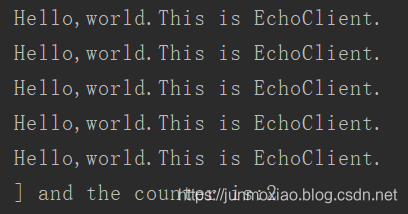
客户端:

服务端:

从结果可以看出,服务端只接收到了2次消息并且第一次信息还不完整,这就是粘包/拆包现象。这是因为客户端在发送消息的时候,由于TCP协议的Nagle算法,将等待更多的数据一次性发送。客户端只收到了1次消息也是一样的道理。
解决方案一:利用 LineBasedFrameDecoder
服务端:
import io.netty.bootstrap.ServerBootstrap;
import io.netty.channel.Channel;
import io.netty.channel.ChannelFuture;
import io.netty.channel.ChannelInitializer;
import io.netty.channel.EventLoopGroup;
import io.netty.channel.nio.NioEventLoopGroup;
import io.netty.channel.socket.nio.NioServerSocketChannel;
import io.netty.handler.codec.LineBasedFrameDecoder;

import java.net.InetSocketAddress;

public class LineBaseEchoServer {

    public static final int PORT = 9998;

    public static void main(String[] args) throws InterruptedException {
        LineBaseEchoServer lineBaseEchoServer = new LineBaseEchoServer();
        System.out.println("服务器即将启动");
        lineBaseEchoServer.start();
    }

    public void start() throws InterruptedException {
        EventLoopGroup group = new NioEventLoopGroup();/*线程组*/
        try {
            ServerBootstrap b = new ServerBootstrap();/*服务端启动必须*/
            b.group(group)/*将线程组传入*/
                .channel(NioServerSocketChannel.class)/*指定使用NIO进行网络传输*/
                .localAddress(new InetSocketAddress(PORT))/*指定服务器监听端口*/
                /*服务端每接收到一个连接请求,就会新启一个socket通信,也就是channel,
                所以下面这段代码的作用就是为这个子channel增加handle*/
                .childHandler(new ChannelInitializerImp());
            ChannelFuture f = b.bind().sync();/*异步绑定到服务器,sync()会阻塞直到完成*/
            System.out.println("服务器启动完成,等待客户端的连接和数据.....");
            f.channel().closeFuture().sync();/*阻塞直到服务器的channel关闭*/
        } finally {
            group.shutdownGracefully().sync();/*优雅关闭线程组*/
        }
    }

    private static class ChannelInitializerImp extends ChannelInitializer<Channel> {

        @Override
        protected void initChannel(Channel ch) throws Exception {
        	//对客户端传来的带换行符的消息进行解码
            ch.pipeline().addLast(new LineBasedFrameDecoder(1024));
            ch.pipeline().addLast(new LineBaseServerHandler());
        }
    }
}
服务端自定义handler:
import io.netty.buffer.ByteBuf;
import io.netty.buffer.Unpooled;
import io.netty.channel.ChannelHandler;
import io.netty.channel.ChannelHandlerContext;
import io.netty.channel.ChannelInboundHandlerAdapter;
import io.netty.util.CharsetUtil;

import java.util.concurrent.atomic.AtomicInteger;

@ChannelHandler.Sharable
public class LineBaseServerHandler extends ChannelInboundHandlerAdapter {

    private AtomicInteger counter = new AtomicInteger(0);

    @Override
    public void channelActive(ChannelHandlerContext ctx) throws Exception {
        System.out.println("客户端:["+ctx.channel().remoteAddress()+"]已连接.........");
    }

    /*** 服务端读取到网络数据后的处理*/
    @Override
    public void channelRead(ChannelHandlerContext ctx, Object msg) throws Exception {
        ByteBuf in = (ByteBuf)msg;
        String request = in.toString(CharsetUtil.UTF_8);
        System.out.println("Server Accept["+request
                +"] and the counter is:"+counter.incrementAndGet());
        String resp = "Hello,"+request+". Welcome to Netty World!"
                + System.getProperty("line.separator");
        ctx.writeAndFlush(Unpooled.copiedBuffer(resp.getBytes()));
    }

    /*** 服务端读取完成网络数据后的处理*/
    @Override
    public void channelReadComplete(ChannelHandlerContext ctx) throws Exception {
//        ctx.writeAndFlush(Unpooled.EMPTY_BUFFER).addListener(ChannelFutureListener.CLOSE);
    }

    /*** 发生异常后的处理*/
    @Override
    public void exceptionCaught(ChannelHandlerContext ctx, Throwable cause) throws Exception {
        cause.printStackTrace();
        ctx.close();
    }

    @Override
    public void channelInactive(ChannelHandlerContext ctx) throws Exception {
        System.out.println(ctx.channel().remoteAddress()+"即将关闭...");
    }
}
客户端:
import io.netty.bootstrap.Bootstrap;
import io.netty.channel.Channel;
import io.netty.channel.ChannelFuture;
import io.netty.channel.ChannelInitializer;
import io.netty.channel.EventLoopGroup;
import io.netty.channel.nio.NioEventLoopGroup;
import io.netty.channel.socket.nio.NioSocketChannel;
import io.netty.handler.codec.LineBasedFrameDecoder;

import java.net.InetSocketAddress;

public class LineBaseEchoClient {

    private final String host;

    public LineBaseEchoClient(String host) {
        this.host = host;
    }

    public void start() throws InterruptedException {
        EventLoopGroup group = new NioEventLoopGroup();/*线程组*/
        try {
            final Bootstrap b = new Bootstrap();;/*客户端启动必须*/
            b.group(group)/*将线程组传入*/
                    .channel(NioSocketChannel.class)/*指定使用NIO进行网络传输*/
                    .remoteAddress(new InetSocketAddress(host,LineBaseEchoServer.PORT))/*配置要连接服务器的ip地址和端口*/
                    .handler(new ChannelInitializerImp());
            ChannelFuture f = b.connect().sync();
            System.out.println("已连接到服务器.....");
            f.channel().closeFuture().sync();
        } finally {
            group.shutdownGracefully().sync();
        }
    }

    private static class ChannelInitializerImp extends ChannelInitializer<Channel> {

        @Override
        protected void initChannel(Channel ch) throws Exception {
            //换行符做了分割,一行最大1024字节。
            ch.pipeline().addLast(new LineBasedFrameDecoder(1024));
            ch.pipeline().addLast(new LineBaseClientHandler());
        }
    }

    public static void main(String[] args) throws InterruptedException {
        new LineBaseEchoClient("127.0.0.1").start();
    }
}
客户端handler:
import io.netty.buffer.ByteBuf;
import io.netty.buffer.Unpooled;
import io.netty.channel.ChannelHandlerContext;
import io.netty.channel.SimpleChannelInboundHandler;
import io.netty.util.CharsetUtil;

import java.util.concurrent.atomic.AtomicInteger;

public class LineBaseClientHandler extends SimpleChannelInboundHandler<ByteBuf> {

    private AtomicInteger counter = new AtomicInteger(0);

    /*** 客户端读取到网络数据后的处理*/
    protected void channelRead0(ChannelHandlerContext ctx, ByteBuf msg) throws Exception {
        System.out.println("client Accept["+msg.toString(CharsetUtil.UTF_8)
                +"] and the counter is:"+counter.incrementAndGet());
    }

    /*** 客户端被通知channel活跃后,做事*/
    @Override
    public void channelActive(ChannelHandlerContext ctx) throws Exception {
        ByteBuf msg ;
        String request = "Hello,world.This is LineBaseClient."
            + System.getProperty("line.separator");
        for(int i=0;i<10;i++){
            System.out.println(System.currentTimeMillis()+":即将发送数据:"
                    +request);
            msg = Unpooled.buffer(request.length());
            msg.writeBytes(request.getBytes());
            ctx.writeAndFlush(msg);
        }
    }

    /*** 发生异常后的处理*/
    @Override
    public void exceptionCaught(ChannelHandlerContext ctx, Throwable cause) throws Exception {
        cause.printStackTrace();
        ctx.close();
    }
}
结果:
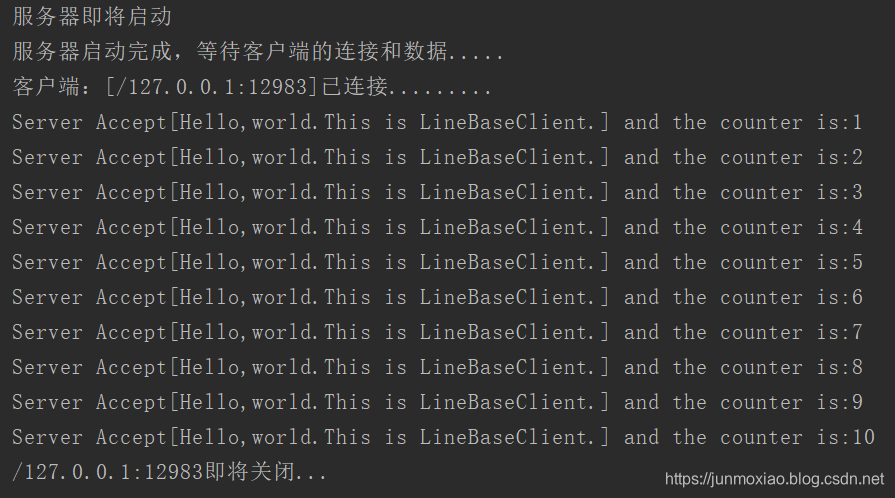
服务端:
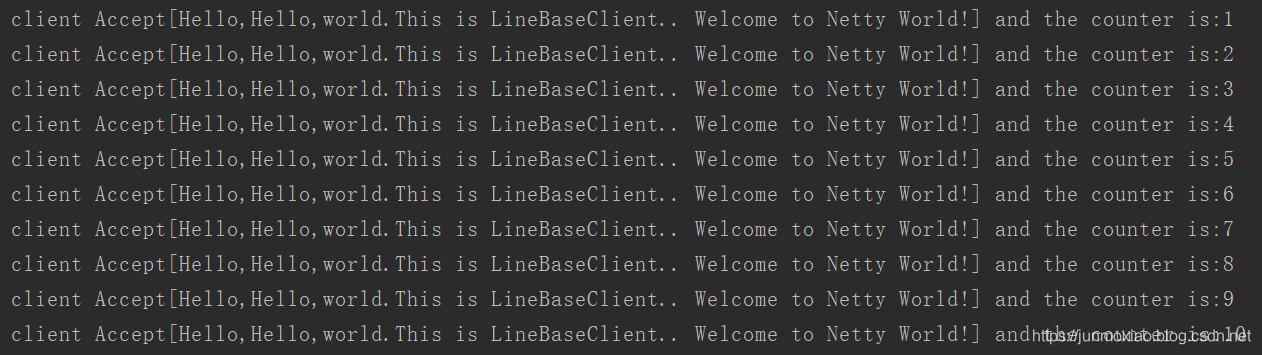
客户端:
解决方案二:利用 DelimiterBasedFrameDecoder
服务端:
import io.netty.bootstrap.ServerBootstrap;
import io.netty.buffer.ByteBuf;
import io.netty.buffer.Unpooled;
import io.netty.channel.Channel;
import io.netty.channel.ChannelFuture;
import io.netty.channel.ChannelInitializer;
import io.netty.channel.EventLoopGroup;
import io.netty.channel.nio.NioEventLoopGroup;
import io.netty.channel.socket.nio.NioServerSocketChannel;
import io.netty.handler.codec.DelimiterBasedFrameDecoder;

import java.net.InetSocketAddress;

public class DelimiterEchoServer {

    public static final String DELIMITER_SYMBOL = "@~";
    public static final int PORT = 9997;

    public static void main(String[] args) throws InterruptedException {
        DelimiterEchoServer delimiterEchoServer = new DelimiterEchoServer();
        System.out.println("服务器即将启动");
        delimiterEchoServer.start();
    }

    public void start() throws InterruptedException {
        final DelimiterServerHandler serverHandler = new DelimiterServerHandler();
        EventLoopGroup group = new NioEventLoopGroup();/*线程组*/
        try {
            ServerBootstrap b = new ServerBootstrap();/*服务端启动必须*/
            b.group(group)/*将线程组传入*/
                .channel(NioServerSocketChannel.class)/*指定使用NIO进行网络传输*/
                .localAddress(new InetSocketAddress(PORT))/*指定服务器监听端口*/
                /*服务端每接收到一个连接请求,就会新启一个socket通信,也就是channel,
                所以下面这段代码的作用就是为这个子channel增加handle*/
                .childHandler(new ChannelInitializerImp());
            ChannelFuture f = b.bind().sync();/*异步绑定到服务器,sync()会阻塞直到完成*/
            System.out.println("服务器启动完成,等待客户端的连接和数据.....");
            f.channel().closeFuture().sync();/*阻塞直到服务器的channel关闭*/
        } finally {
            group.shutdownGracefully().sync();/*优雅关闭线程组*/
        }
    }

    private static class ChannelInitializerImp extends ChannelInitializer<Channel> {

        @Override
        protected void initChannel(Channel ch) throws Exception {
            ByteBuf delimiter = Unpooled.copiedBuffer(DELIMITER_SYMBOL
                    .getBytes());
            ch.pipeline().addLast( new DelimiterBasedFrameDecoder(1024,
                    delimiter));
            ch.pipeline().addLast(new DelimiterServerHandler());
        }
    }
}
服务端handler:
import io.netty.buffer.ByteBuf;
import io.netty.buffer.Unpooled;
import io.netty.channel.ChannelHandler;
import io.netty.channel.ChannelHandlerContext;
import io.netty.channel.ChannelInboundHandlerAdapter;
import io.netty.util.CharsetUtil;

import java.util.concurrent.atomic.AtomicInteger;

@ChannelHandler.Sharable
public class DelimiterServerHandler extends ChannelInboundHandlerAdapter {

    private AtomicInteger counter = new AtomicInteger(0);
    private AtomicInteger completeCounter = new AtomicInteger(0);

    /*** 服务端读取到网络数据后的处理*/
    @Override
    public void channelRead(ChannelHandlerContext ctx, Object msg) throws Exception {
        ByteBuf in = (ByteBuf)msg;
        String request = in.toString(CharsetUtil.UTF_8);
        System.out.println("Server Accept["+request
                +"] and the counter is:"+counter.incrementAndGet());
        String resp = "Hello,DelimiterClient. Welcome to Netty World!"
                + DelimiterEchoServer.DELIMITER_SYMBOL;
        ctx.writeAndFlush(Unpooled.copiedBuffer(resp.getBytes()));
    }

    /*** 服务端读取完成网络数据后的处理*/
    @Override
    public void channelReadComplete(ChannelHandlerContext ctx)
            throws Exception {
        ctx.fireChannelReadComplete();
        System.out.println("the ReadComplete count is "
                +completeCounter.incrementAndGet());
    }

    /*** 发生异常后的处理*/
    @Override
    public void exceptionCaught(ChannelHandlerContext ctx, Throwable cause) throws Exception {
        cause.printStackTrace();
        ctx.close();
    }
}
客户端:
import io.netty.bootstrap.Bootstrap;
import io.netty.buffer.ByteBuf;
import io.netty.buffer.Unpooled;
import io.netty.channel.Channel;
import io.netty.channel.ChannelFuture;
import io.netty.channel.ChannelInitializer;
import io.netty.channel.EventLoopGroup;
import io.netty.channel.nio.NioEventLoopGroup;
import io.netty.channel.socket.nio.NioSocketChannel;
import io.netty.handler.codec.DelimiterBasedFrameDecoder;

import java.net.InetSocketAddress;

public class DelimiterEchoClient {

    private final String host;

    public DelimiterEchoClient(String host) {
        this.host = host;
    }

    public void start() throws InterruptedException {
        EventLoopGroup group = new NioEventLoopGroup();/*线程组*/
        try {
            final Bootstrap b = new Bootstrap();;/*客户端启动必须*/
            b.group(group)/*将线程组传入*/
                    .channel(NioSocketChannel.class)/*指定使用NIO进行网络传输*/
                    .remoteAddress(new InetSocketAddress(host,DelimiterEchoServer.PORT))/*配置要连接服务器的ip地址和端口*/
                    .handler(new ChannelInitializerImp());
            ChannelFuture f = b.connect().sync();
            System.out.println("已连接到服务器.....");
            f.channel().closeFuture().sync();
        } finally {
            group.shutdownGracefully().sync();
        }
    }

    private static class ChannelInitializerImp extends ChannelInitializer<Channel> {

        @Override
        protected void initChannel(Channel ch) throws Exception {
            ByteBuf delimiter
                    = Unpooled.copiedBuffer(DelimiterEchoServer.DELIMITER_SYMBOL
                    .getBytes());
            ch.pipeline().addLast( new DelimiterBasedFrameDecoder(1024,
                    delimiter));
            ch.pipeline().addLast(new DelimiterClientHandler());
        }
    }

    public static void main(String[] args) throws InterruptedException {
        new DelimiterEchoClient("127.0.0.1").start();
    }
}
客户端handler:
import io.netty.buffer.ByteBuf;
import io.netty.buffer.Unpooled;
import io.netty.channel.ChannelHandlerContext;
import io.netty.channel.SimpleChannelInboundHandler;
import io.netty.util.CharsetUtil;

import java.util.concurrent.atomic.AtomicInteger;

public class DelimiterClientHandler extends SimpleChannelInboundHandler<ByteBuf> {

    private AtomicInteger counter = new AtomicInteger(0);

    /*** 客户端读取到网络数据后的处理*/
    protected void channelRead0(ChannelHandlerContext ctx, ByteBuf msg) throws Exception {
        System.out.println("client Accept["+msg.toString(CharsetUtil.UTF_8)
                +"] and the counter is:"+counter.incrementAndGet());
    }

    /*** 客户端被通知channel活跃后,做事*/
    @Override
    public void channelActive(ChannelHandlerContext ctx) throws Exception {
        ByteBuf msg ;
        String request = "Hello,this is DelimiterClient!"
                +  DelimiterEchoServer.DELIMITER_SYMBOL;
        for(int i=0;i<10;i++){
            msg = Unpooled.buffer(request.length());
            msg.writeBytes(request.getBytes());
            ctx.writeAndFlush(msg);
        }
    }

    /*** 发生异常后的处理*/
    @Override
    public void exceptionCaught(ChannelHandlerContext ctx, Throwable cause) throws Exception {
        cause.printStackTrace();
        ctx.close();
    }
}
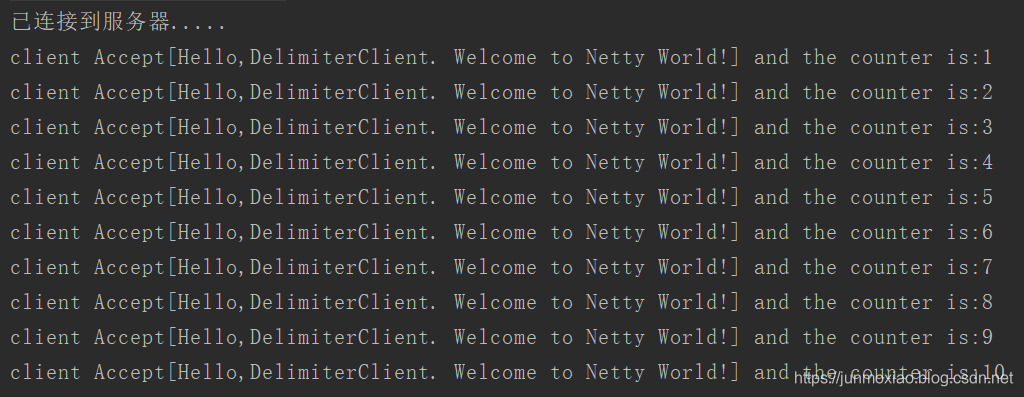
结果:
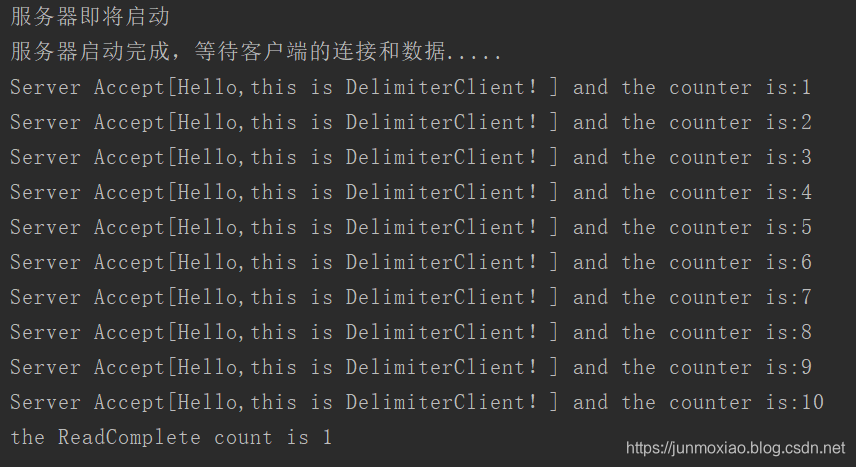
服务端:
客户端:
解决方案三:利用 FixedLengthFrameDecoder
服务端:
import io.netty.bootstrap.ServerBootstrap;
import io.netty.channel.Channel;
import io.netty.channel.ChannelFuture;
import io.netty.channel.ChannelInitializer;
import io.netty.channel.EventLoopGroup;
import io.netty.channel.nio.NioEventLoopGroup;
import io.netty.channel.socket.nio.NioServerSocketChannel;
import io.netty.handler.codec.FixedLengthFrameDecoder;

import java.net.InetSocketAddress;

public class FixedLengthEchoServer {

    public static final String RESPONSE = "Welcome to Netty!";
    public static final int PORT = 9996;

    public static void main(String[] args) throws InterruptedException {
        FixedLengthEchoServer fixedLengthEchoServer = new FixedLengthEchoServer();
        System.out.println("服务器即将启动");
        fixedLengthEchoServer.start();
    }

    public void start() throws InterruptedException {
        final FixedLengthServerHandler serverHandler = new FixedLengthServerHandler();
        EventLoopGroup group = new NioEventLoopGroup();/*线程组*/
        try {
            ServerBootstrap b = new ServerBootstrap();/*服务端启动必须*/
            b.group(group)/*将线程组传入*/
                .channel(NioServerSocketChannel.class)/*指定使用NIO进行网络传输*/
                .localAddress(new InetSocketAddress(PORT))/*指定服务器监听端口*/
                /*服务端每接收到一个连接请求,就会新启一个socket通信,也就是channel,
                所以下面这段代码的作用就是为这个子channel增加handle*/
                .childHandler(new ChannelInitializerImp());
            ChannelFuture f = b.bind().sync();/*异步绑定到服务器,sync()会阻塞直到完成*/
            System.out.println("服务器启动完成,等待客户端的连接和数据.....");
            f.channel().closeFuture().sync();/*阻塞直到服务器的channel关闭*/
        } finally {
            group.shutdownGracefully().sync();/*优雅关闭线程组*/
        }
    }

    private static class ChannelInitializerImp extends ChannelInitializer<Channel> {

        @Override
        protected void initChannel(Channel ch) throws Exception {
            ch.pipeline().addLast(
                    new FixedLengthFrameDecoder(
                            FixedLengthEchoClient.REQUEST.length()));
            ch.pipeline().addLast(new FixedLengthServerHandler());
        }
    }
}
服务端handler:
import io.netty.buffer.ByteBuf;
import io.netty.buffer.Unpooled;
import io.netty.channel.ChannelHandler;
import io.netty.channel.ChannelHandlerContext;
import io.netty.channel.ChannelInboundHandlerAdapter;
import io.netty.util.CharsetUtil;

import java.util.concurrent.atomic.AtomicInteger;

@ChannelHandler.Sharable
public class FixedLengthServerHandler extends ChannelInboundHandlerAdapter {

    private AtomicInteger counter = new AtomicInteger(0);

    /*** 服务端读取到网络数据后的处理*/
    @Override
    public void channelRead(ChannelHandlerContext ctx, Object msg) throws Exception {
        ByteBuf in = (ByteBuf)msg;
        String request = in.toString(CharsetUtil.UTF_8);
        System.out.println("Server Accept["+request
                +"] and the counter is:"+counter.incrementAndGet());
        ctx.writeAndFlush(Unpooled.copiedBuffer(
                FixedLengthEchoServer.RESPONSE.getBytes()));
    }

    /*** 发生异常后的处理*/
    @Override
    public void exceptionCaught(ChannelHandlerContext ctx, Throwable cause) throws Exception {
        cause.printStackTrace();
        ctx.close();
    }
}
客户端:
import io.netty.bootstrap.Bootstrap;
import io.netty.channel.Channel;
import io.netty.channel.ChannelFuture;
import io.netty.channel.ChannelInitializer;
import io.netty.channel.EventLoopGroup;
import io.netty.channel.nio.NioEventLoopGroup;
import io.netty.channel.socket.nio.NioSocketChannel;
import io.netty.handler.codec.FixedLengthFrameDecoder;

import java.net.InetSocketAddress;

public class FixedLengthEchoClient {

    public final static String REQUEST = "Hello!This is FixedLengthClient.";

    private final String host;

    public FixedLengthEchoClient(String host) {
        this.host = host;
    }

    public void start() throws InterruptedException {
        EventLoopGroup group = new NioEventLoopGroup();/*线程组*/
        try {
            final Bootstrap b = new Bootstrap();/*客户端启动必须*/
            b.group(group)/*将线程组传入*/
                    .channel(NioSocketChannel.class)/*指定使用NIO进行网络传输*/
                    .remoteAddress(new InetSocketAddress(host,FixedLengthEchoServer.PORT))/*配置要连接服务器的ip地址和端口*/
                    .handler(new ChannelInitializerImp());
            ChannelFuture f = b.connect().sync();
            System.out.println("已连接到服务器.....");
            f.channel().closeFuture().sync();
        } finally {
            group.shutdownGracefully().sync();
        }
    }

    private static class ChannelInitializerImp extends ChannelInitializer<Channel> {

        @Override
        protected void initChannel(Channel ch) throws Exception {
            ch.pipeline().addLast(
                    new FixedLengthFrameDecoder(
                            FixedLengthEchoServer.RESPONSE.length()));
            ch.pipeline().addLast(new FixedLengthClientHandler());
        }
    }

    public static void main(String[] args) throws InterruptedException {
        new FixedLengthEchoClient("127.0.0.1").start();
    }
}
客户端handler:
import io.netty.buffer.ByteBuf;
import io.netty.buffer.Unpooled;
import io.netty.channel.ChannelHandlerContext;
import io.netty.channel.SimpleChannelInboundHandler;
import io.netty.util.CharsetUtil;

import java.util.concurrent.atomic.AtomicInteger;

public class FixedLengthClientHandler extends SimpleChannelInboundHandler<ByteBuf> {

    private AtomicInteger counter = new AtomicInteger(0);

    /*** 客户端读取到网络数据后的处理*/
    protected void channelRead0(ChannelHandlerContext ctx, ByteBuf msg) throws Exception {
        System.out.println("client Accept["+msg.toString(CharsetUtil.UTF_8)
                +"] and the counter is:"+counter.incrementAndGet());
    }

    /*** 客户端被通知channel活跃后,做事*/
    @Override
    public void channelActive(ChannelHandlerContext ctx) throws Exception {
        ByteBuf msg = null;
        for(int i=0;i<10;i++){
            msg = Unpooled.buffer(FixedLengthEchoClient.REQUEST.length());
            msg.writeBytes(FixedLengthEchoClient.REQUEST.getBytes());
            ctx.writeAndFlush(msg);
        }
    }

    /*** 发生异常后的处理*/
    @Override
    public void exceptionCaught(ChannelHandlerContext ctx, Throwable cause) throws Exception {
        cause.printStackTrace();
        ctx.close();
    }
}
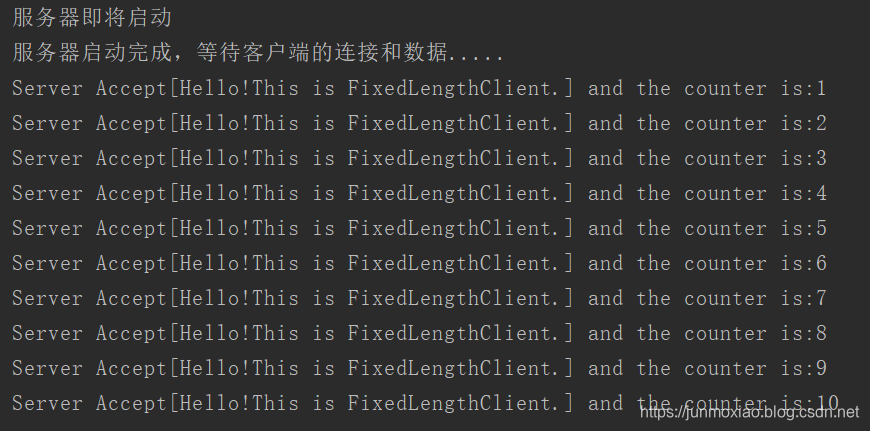
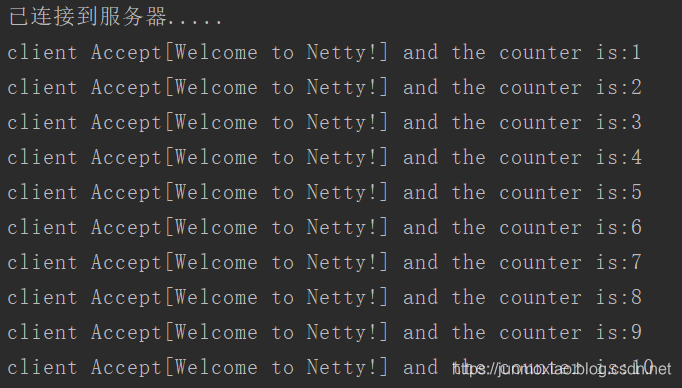
结果:
服务端:
客户端:






 扫一扫
扫一扫


 1万+
1万+

 被折叠的 条评论
为什么被折叠?
被折叠的 条评论
为什么被折叠?
 到【灌水乐园】发言





