


 本文深入解析了MySQL5.6中InnoDB的异步IO实现,主要处理预读和数据文件写请求。同步IO用于常规页面读取。文章从Linux native aio的角度,详细介绍了数据页同步IO和异步IO的执行过程,包括关键数据结构os_aio_array_t和os_aio_slot_t,以及os_aio_func、os_aio_linux_dispatch和fil_aio_wait等核心函数的工作流程。
之前的一篇内核月报InnoDB IO子系统 中介绍了InnoDB IO子系统中包含的同步IO以及异步IO。本篇文章将从源码层面剖析一下InnoDB IO子系统中,数据页的同步IO以及异步IO请求的具体实现过程。
在MySQL5.6中,InnoDB的异步IO主要是用来处理预读以及对数据文件的写请求的。而对于正常的页面数据读取则是通过同步IO进行的。到底二者在代码层面上的实现过程有什么样的区别? 接下来我们将以Linux native io的执行过程为主线,对IO请求的执行过程进行梳理。
重点数据结构
os_aio_array_t
/** 用来记录某一类(ibuf,log,read,write)异步IO(aio)请求的数组类型。每一个异步IO请求都会在类型对应的数组中注册一个innodb
aio对象。*/
os_aio_array_t {
os_ib_mutex_t mutex; // 主要用来控制异步read/write线程的并发操作。对于ibuf,log类型,由于只有一个线程,所以不存在并发操作问题
os_event_t not_full; // 一个条件变量event,用来通知等待获取slot的线程是否os_aio_array_t数组有空闲的slot供aio请求
os_event_t is_empty; // 条件变量event,用来通知IO线程os_aio_array_t数组是否有pening的IO请求。
ulint n_slots; // 数组容纳的IO请求数。= 线程数 * 每个segment允许pending的请求数(256)
ulint n_segments; // 允许独立wait的segment数,即某种类型的IO的允许最大线程数
ulint cur_seg; /* IO请求会按照round robin的方式分配到不同的segment中,该变量指示下一个IO请求可以分配的segment */
ulint n_reserved; // 已经Pending的IO请求数
os_aio_slot_t* slots; // 用来记录具体的每个IO请求对象的数组,也即n_segments 个线程共用n_slots个槽位来存放pending io请求
\#ifdef __WIN__
HANDLE* handles;
/*!< Pointer to an array of OS native
event handles where we copied the
handles from slots, in the same
order. This can be used in
WaitForMultipleObjects; used only in
Windows */
\#endif __WIN__
\#if defined(LINUX_NATIVE_AIO)
io_context_t* aio_ctx; // aio上下文的数组,每个segment拥有独立的一个aio上下文数组,用来记录以及完成的IO请求上下文
struct io_event* aio_events; // 该数组用来记录已经完成的IO请求事件。异步IO通过设置事件通知IO线程处理完成的IO请求
struct iocb** pending; // 用来记录pending的aio请求
ulint* count; // 该数组记录了每个segment对应的pending aio请求数量
\#endif /* LINUX_NATIV_AIO */
}
os_aio_slot_t
// os_aio_array_t数组中用来记录一个异步IO(aio)请求的对象
os_aio_slot_t {
ibool is_read; /*!< TRUE if a read operation */
ulint pos; // os_aio_array_t数组中所在的位置
ibool reserved; // TRUE表示该Slot已经被别的IO请求占用了
time_t reservation_time; // 占用的时间
ulint len; // io请求的长度
byte* buf; // 数据读取或者需要写入的buffer,通常指向buffer pool的一个页面,压缩页面有特殊处理
ulint type; /* 请求类型,即读还是写IO请求 */
os_offset_t offset; /*!< file offset in bytes */
os_file_t file; /*!< file where to read or write */
const char* name; /*!< 需要读取的文件及路径信息 */
ibool io_already_done; /* TRUE表示IO已经完成了
fil_node_t* message1; /* 该aio操作的innodb文件描述符(f_node_t)*/
void* message2; /* 用来记录完成IO请求所对应的具体buffer pool bpage页 */
\#ifdef WIN_ASYNC_IO
HANDLE handle; /*!< handle object we need in the
OVERLAPPED struct */
OVERLAPPED control; /*!< Windows control block for the
aio request */
\#elif defined(LINUX_NATIVE_AIO)
struct iocb control; /* 该slot使用的aio请求控制块iocb */
int n_bytes; /* 读写bytes */
int ret; /* AIO return code */
\#endif /* WIN_ASYNC_IO */
}
流程图
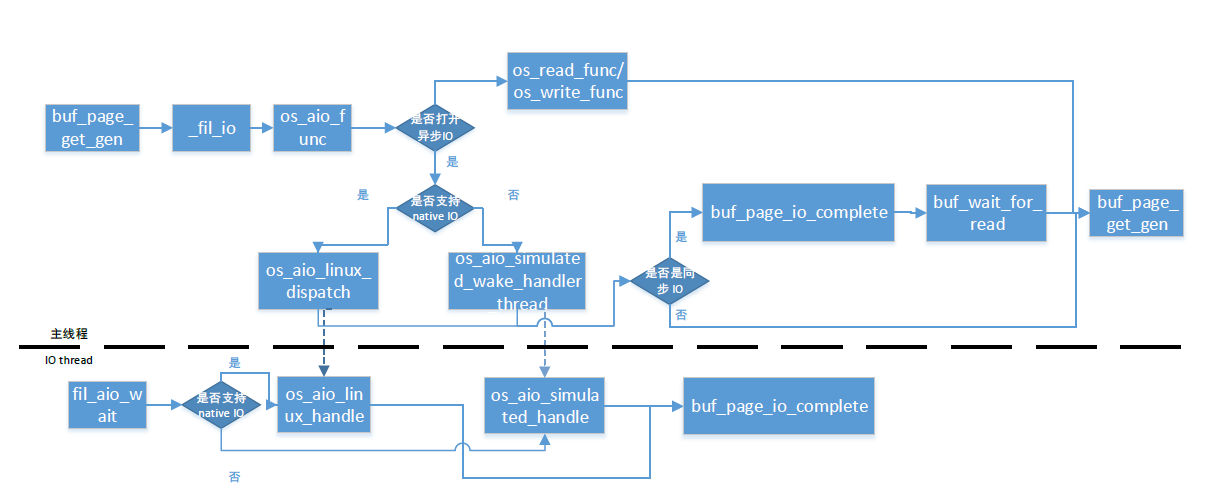
源码分析
物理数据页操作入口函数os_aio_func
ibool
os_aio_func(
/*========*/
ulint type, /* IO类型,READ还是WRITE IO */
ulint mode, /* 这里表示是否使用SIMULATED aio执行异步IO请求 */
const char* name, /* IO需要打开的tablespace路径+名称 */
os_file_t file, /* IO操作的文件 */
void* buf, // 数据读取或者需要写入的buffer,通常指向buffer pool的一个页面,压缩页面有特殊处理
os_offset_t offset, /*!< in: file offset where to read or write */
ulint n, /* 读取或写入字节数 */
fil_node_t* message1, /* 该aio操作的innodb文件描述符(f_node_t),只对异步IO起作用 */
void* message2, /* 用来记录完成IO请求所对应的具体buffer pool bpage页,只对异步IO起作用 */
ibool should_buffer, // 是否需要缓存aio请求,该变量主要对预读起作用
ibool page_encrypt,
/*!< in: Whether to encrypt */
ulint page_size)
/*!< in: Page size */
{
...
wake_later = mode & OS_AIO_SIMULATED_WAKE_LATER;
mode = mode & (~OS_AIO_SIMULATED_WAKE_LATER);
if (mode == OS_AIO_SYNC
#ifdef WIN_ASYNC_IO
&& !srv_use_native_aio
#endif /* WIN_ASYNC_IO */
) {
/* This is actually an ordinary synchronous read or write:
no need to use an i/o-handler thread. NOTE that if we use
Windows async i/o, Windows does not allow us to use
ordinary synchronous os_file_read etc. on the same file,
therefore we have built a special mechanism for synchronous
wait in the Windows case.
Also note that the Performance Schema instrumentation has
been performed by current os_aio_func()'s wrapper function
pfs_os_aio_func(). So we would no longer need to call
Performance Schema instrumented os_file_read() and
os_file_write(). Instead, we should use os_file_read_func()
and os_file_write_func() */
/* 这里如果是同步IO,并且native io没有开启的情况下,直接使用os_file_read/write函数进行读取,
不需要经过IO线程进行处理 */
if (type == OS_FILE_READ) {
if (page_encrypt) {
return(os_file_read_decrypt_page(file, buf, offset, n, page_size));
} else {
return(os_file_read_func(file, buf, offset, n));
}
}
ut_ad(!srv_read_only_mode);
ut_a(type == OS_FILE_WRITE);
if (page_encrypt) {
return(os_file_write_encrypt_page(name, file, buf, offset, n, page_size));
} else {
return(os_file_write_func(name, file, buf, offset, n));
}
}
try_again:
switch (mode) {
// 根据访问类型,定位IO请求数组
case OS_AIO_NORMAL:
if (type == OS_FILE_READ) {
array = os_aio_read_array;
} else {
ut_ad(!srv_read_only_mode);
array = os_aio_write_array;
}
break;
case OS_AIO_IBUF:
ut_ad(type == OS_FILE_READ);
/* Reduce probability of deadlock bugs in connection with ibuf:
do not let the ibuf i/o handler sleep */
wake_later = FALSE;
if (srv_read_only_mode) {
array = os_aio_read_array;
}
break;
case OS_AIO_LOG:
if (srv_read_only_mode) {
array = os_aio_read_array;
} else {
array = os_aio_log_array;
}
break;
case OS_AIO_SYNC:
array = os_aio_sync_array;
#if defined(LINUX_NATIVE_AIO)
/* In Linux native AIO we don't use sync IO array. */
ut_a(!srv_use_native_aio);
#endif /* LINUX_NATIVE_AIO */
break;
default:
ut_error;
array = NULL; /* Eliminate compiler warning */
}
// 阻塞为当前IO请求申请一个用来执行异步IO的slot
slot = os_aio_array_reserve_slot(type, array, message1, message2, file,
name, buf, offset, n, page_encrypt, page_size);
DBUG_EXECUTE_IF("simulate_slow_aio",
{
os_thread_sleep(1000000);
}
);
if (type == OS_FILE_READ) {
if (srv_use_native_aio) {
os_n_file_reads++;
os_bytes_read_since_printout += n;
#ifdef WIN_ASYNC_IO
// 这里是Windows用来处理异步IO读请求
ret = ReadFile(file, buf, (DWORD) n, &len,
&(slot->control));
#elif defined(LINUX_NATIVE_AIO)
// 这里是Linux来处理native io
if (!os_aio_linux_dispatch(array, slot, should_buffer)) {
goto err_exit;
#endif /* WIN_ASYNC_IO */
} else {
if (!wake_later) {
// 唤醒simulated aio处理线程
os_aio_simulated_wake_handler_thread(
os_aio_get_segment_no_from_slot(
array, slot));
}
}
} else if (type == OS_FILE_WRITE) {
ut_ad(!srv_read_only_mode);
if (srv_use_native_aio) {
os_n_file_writes++;
#ifdef WIN_ASYNC_IO
// 这里是Windows用来处理异步IO写请求
ret = WriteFile(file, buf, (DWORD) n, &len,
&(slot->control));
#elif defined(LINUX_NATIVE_AIO)
// 这里是Linux来处理native io
if (!os_aio_linux_dispatch(array, slot, false)) {
goto err_exit;
}
#endif /* WIN_ASYNC_IO */
} else {
if (!wake_later) {
// 唤醒simulated aio处理线程
os_aio_simulated_wake_handler_thread(
os_aio_get_segment_no_from_slot(
array, slot));
}
}
} else {
ut_error;
}
...
}
负责通知Linux内核执行native IO请求的函数os_aio_linux_dispatch
static
ibool
os_aio_linux_dispatch(
/*==================*/
os_aio_array_t* array, /* IO请求函数 */
os_aio_slot_t* slot, /* 申请好的slot */
ibool should_buffer) // 是否需要缓存aio 请求,该变量主要对预读起作用
{
...
/* Find out what we are going to work with.
The iocb struct is directly in the slot.
The io_context is one per segment. */
// 每个segment包含的slot个数,Linux下每个segment包含256个slot
slots_per_segment = array->n_slots / array->n_segments;
iocb = &slot->control;
io_ctx_index = slot->pos / slots_per_segment;
if (should_buffer) {
/* 这里也可以看到aio请求缓存只对读请求起作用 */
ut_ad(array == os_aio_read_array);
ulint n;
ulint count;
os_mutex_enter(array->mutex);
/* There are array->n_slots elements in array->pending, which is divided into
* array->n_segments area of equal size. The iocb of each segment are
* buffered in its corresponding area in the pending array consecutively as
* they come. array->count[i] records the number of buffered aio requests in
* the ith segment.*/
n = io_ctx_index * slots_per_segment
+ array->count[io_ctx_index];
array->pending[n] = iocb;
array->count[io_ctx_index] ++;
count = array->count[io_ctx_index];
os_mutex_exit(array->mutex);
// 如果当前segment的slot都已经被占用了,就需要提交一次异步aio请求
if (count == slots_per_segment) {
os_aio_linux_dispatch_read_array_submit(); //no cover line
}
// 否则就直接返回
return (TRUE);
}
// 直接提交IO请求到内核
ret = io_submit(array->aio_ctx[io_ctx_index], 1, &iocb);
...
}
IO线程负责监控aio请求的主函数fil_aio_wait
void
fil_aio_wait(
/*=========*/
ulint segment) /*!< in: the number of the segment in the aio
array to wait for */
{
ibool ret;
fil_node_t* fil_node;
void* message;
ulint type;
ut_ad(fil_validate_skip());
if (srv_use_native_aio) { // 使用native io
srv_set_io_thread_op_info(segment, "native aio handle");
#ifdef WIN_ASYNC_IO
ret = os_aio_windows_handle( // Window监控入口
segment, 0, &fil_node, &message, &type);
#elif defined(LINUX_NATIVE_AIO)
ret = os_aio_linux_handle( // Linux native io监控入口
segment, &fil_node, &message, &type);
#else
ut_error;
ret = 0; /* Eliminate compiler warning */
#endif /* WIN_ASYNC_IO */
} else {
srv_set_io_thread_op_info(segment, "simulated aio handle");
ret = os_aio_simulated_handle( // Simulated aio监控入口
segment, &fil_node, &message, &type);
}
ut_a(ret);
if (fil_node == NULL) {
ut_ad(srv_shutdown_state == SRV_SHUTDOWN_EXIT_THREADS);
return;
}
srv_set_io_thread_op_info(segment, "complete io for fil node");
mutex_enter(&fil_system->mutex);
// 到这里表示至少有一个IO请求已经完成,该函数设置状态信息
fil_node_complete_io(fil_node, fil_system, type);
mutex_exit(&fil_system->mutex);
ut_ad(fil_validate_skip());
/* Do the i/o handling */
/* IMPORTANT: since i/o handling for reads will read also the insert
buffer in tablespace 0, you have to be very careful not to introduce
deadlocks in the i/o system. We keep tablespace 0 data files always
open, and use a special i/o thread to serve insert buffer requests. */
if (fil_node->space->purpose == FIL_TABLESPACE) { // 数据文件读写IO
srv_set_io_thread_op_info(segment, "complete io for buf page");
// IO请求完成后,这里处理buffer pool对应的bpage相关的一些状态信息并根据checksum验证数据的正确性
buf_page_io_complete(static_cast(message));
} else { // 日志文件的读写IO
srv_set_io_thread_op_info(segment, "complete io for log");
log_io_complete(static_cast(message));
}
}
#endif /* UNIV_HOTBACKUP */
IO线程负责处理native IO请求的函数os_aio_linux_handle
ibool
os_aio_linux_handle(ulintglobal_seg, // 属于哪个segment
fil_node_t**message1, /* 该aio操作的innodb文件描述符(f_node_t)*/
void**message2, /* 用来记录完成IO请求所对应的具体buffer pool bpage页 */
ulint*type){ // 读or写IO
// 根据global_seg获得该aio 的os_aio_array_t数组,并返回对应的segment
segment = os_aio_get_array_and_local_segment(&array, global_seg);
n = array->n_slots / array->n_segments; //获得一个线程可监控的io event数
/* Loop until we have found a completed request. */
for (;;) {
iboolany_reserved = FALSE;
os_mutex_enter(array->mutex);
for (i = 0; i < n; ++i) { // 遍历该线程所发起的所有aio请求
slot = os_aio_array_get_nth_slot(
array, i + segment * n);
if (!slot->reserved) { // 该slot是否被占用
continue;
} else if (slot->io_already_done) { // IO请求已经完成,可以通知主线程返回数据了
/* Something for us to work on. */
goto found;
} else {
any_reserved = TRUE;
}
}
os_mutex_exit(array->mutex);
// 到这里说明没有找到一个完成的io,则再去collect
os_aio_linux_collect(array, segment, n);
found: // 找到一个完成的io,将内容返回
*message1 = slot->message1;
*message2 = slot->message2; // 返回完成IO所对应的bpage页
*type = slot->type;
if (slot->ret == 0 && slot->n_bytes == (long) slot->len) {
if (slot->page_encrypt
&& slot->type == OS_FILE_READ) {
os_decrypt_page(slot->buf, slot->len, slot->page_size, FALSE);
}
ret = TRUE;
} else {
errno = -slot->ret;
/* os_file_handle_error does tell us if we should retry
this IO. As it stands now, we don't do this retry when
reaping requests from a different context than
the dispatcher. This non-retry logic is the same for
windows and linux native AIO.
We should probably look into this to transparently
re-submit the IO. */
os_file_handle_error(slot->name, "Linux aio");
ret = FALSE;
}
os_mutex_exit(array->mutex);
os_aio_array_free_slot(array, slot);
return(ret);
}
等待native IO请求完成os_aio_linux_collect
os_aio_linux_collect(os_aio_array_t* array,
ulint segment,
ulint seg_size){
events = &array->aio_events[segment * seg_size]; // 定位segment所对应的io event的数组位置
/* 获得该线程的aio上下文数组 */
io_ctx = array->aio_ctx[segment];
/* Starting point of the segment we will be working on. */
start_pos = segment * seg_size;
/* End point. */
end_pos = start_pos + seg_size;
retry:
/* Initialize the events. The timeout value is arbitrary.
We probably need to experiment with it a little. */
memset(events, 0, sizeof(*events) * seg_size);
timeout.tv_sec = 0;
timeout.tv_nsec = OS_AIO_REAP_TIMEOUT;
ret = io_getevents(io_ctx, 1, seg_size, events, &timeout); // 阻塞等待该IO线程所监控的任一IO请求完成
if (ret > 0) { // 有IO请求完成
for (i = 0; i < ret; i++) {
// 记录完成IO的请求信息到对应的os_aio_slot_t 对象
os_aio_slot_t*slot;
struct iocb*control;
control = (struct iocb*) events[i].obj; // 获得完成的aio的iocb,即提交这个aio请求的iocb
ut_a(control != NULL);
slot = (os_aio_slot_t*) control->data; // 通过data获得这个aio iocb所对应的os_aio_slot_t
/* Some sanity checks. */
ut_a(slot != NULL);
ut_a(slot->reserved);
os_mutex_enter(array->mutex);
slot->n_bytes = events[i].res; // 将该io执行的结果保存到slot里
slot->ret = events[i].res2;
slot->io_already_done = TRUE; // 标志该io已经完成了,这个标志也是外层判断的条件
os_mutex_exit(array->mutex);
}
return;
}
…
}
综上重点对InnoDB navtive IO读写数据文件从源码角度进行了分析,有兴趣的读者也可以继续了解InnoDB自带的simulated IO的实现过程,原理雷同native IO,只是在实现方式上自己进行了处理。本篇文章对InnoDB IO请求的执行流程进行了梳理,对重点数据结构以及函数进行了分析,希望对读者日后进行源码阅读及修改有所帮助。





 扫一扫
扫一扫


 628
628

 被折叠的 条评论
为什么被折叠?
被折叠的 条评论
为什么被折叠?
 到【灌水乐园】发言





