


 本文深入解析了IDR(Identifier Resource)的数据结构及其操作方法,包括初始化、分配ID、构建32叉树等过程,并详细解释了相关函数的工作原理。
一、idr构建的结构可以看成是32叉树, 它需要用到2个结构体:
struct idr {
    struct idr_layer __rcu *top;    /*根节点*/
    struct idr_layer *id_free;         /*空闲节点*/
    int          layers;                 /*树的高度*/
    int          id_free_cnt;        /*空闲节点数*/
    spinlock_t      lock;
};

struct idr_layer {
    unsigned long         bitmap;     /*位图*/
    struct idr_layer __rcu    *ary[1<<IDR_BITS];    /*孩子节点或者地址数据*/
    int             count;     /*ary已存放数*/
    int             layer;     /* 相对叶子节点的高度 */
    struct rcu_head         rcu_head;
};
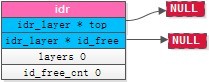
二、idr初始化:


1 #define IDR_INIT(name)      \
2 {               \
3     .top        = NULL, \
4     .id_free        = NULL, \
5     .layers         = 0,    \
6     .id_free_cnt    = 0,    \
7     .lock       = __SPIN_LOCK_UNLOCKED(name.lock),  \
8 }
9 #define DEFINE_IDR(name)    struct idr name = IDR_INIT(name)
三、分配空闲节点
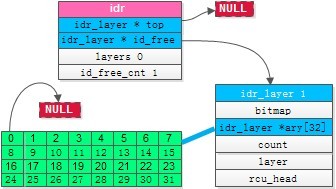
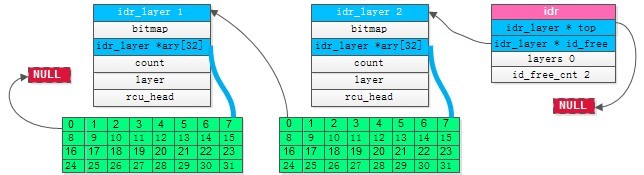
 1 /*创建多个idr_layer结构,组成一条链,存入idr->id_free区域, 区域含有
 2   *IDR_FREE_MAX个这样的结构, id_free_cnt = IDR_FREE_MAX
 3   */
 4
 5 int idr_pre_get(struct idr *idp, gfp_t gfp_mask)
 6 {
 7     while (idp->id_free_cnt < IDR_FREE_MAX) {
 8         struct idr_layer *new;
 9         new = kmem_cache_zalloc(idr_layer_cache, gfp_mask);
10         if (new == NULL)
11             return (0);
12         move_to_free_list(idp, new);
13     }
14     return 1;
15 }
16
17 static void move_to_free_list(struct idr *idp, struct idr_layer *p)
18 {
19     unsigned long flags;
20
21     /*
22      * Depends on the return element being zeroed.
23      */
24     spin_lock_irqsave(&idp->lock, flags);
25     __move_to_free_list(idp, p);
26     spin_unlock_irqrestore(&idp->lock, flags);
27 }
28
29 static void __move_to_free_list(struct idr *idp, struct idr_layer *p)
30 {
31     p->ary[0] = idp->id_free;
32     idp->id_free = p;
33     idp->id_free_cnt++;
34 }
第一次循环结果
第二次循环结果
接着
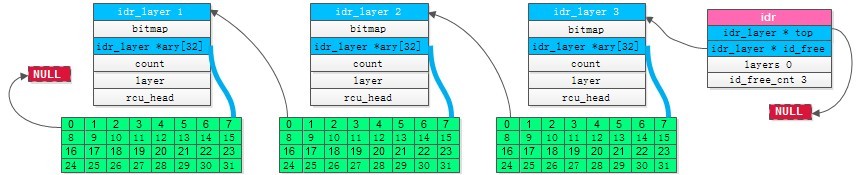
最后得到一条链(循环IDR_FREE_MAX次)

四、构建树并申请ID, 绑定地址
idr_get_new和idr_get_new_above函数
/* 申请0~0x7fffffff之间的id */
int idr_get_new(struct idr *idp, void *ptr, int *id)
{
    int rv;

    rv = idr_get_new_above_int(idp, ptr, 0);
    /*
     * This is a cheap hack until the IDR code can be fixed to
     * return proper error values.
     */
    if (rv < 0)
        return _idr_rc_to_errno(rv);
    *id = rv;
    return 0;
}

/* 申请starting_id~0x7fffffff之间的id  */
int idr_get_new_above(struct idr *idp, void *ptr, int starting_id, int *id)
{
    int rv;

    rv = idr_get_new_above_int(idp, ptr, starting_id);
    /*
     * This is a cheap hack until the IDR code can be fixed to
     * return proper error values.
     */
    if (rv < 0)
        return _idr_rc_to_errno(rv);
    *id = rv;
    return 0;
}
为什么只能到0x7fffffff呢, 到后面就知道了.
idr_get_new和idr_get_new_above两个函数都是调用idr_get_new_above_int函数:
 1 static int idr_get_new_above_int(struct idr *idp, void *ptr, int starting_id)
 2 {
 3         /* MAX_LEVEL = 7 */
 4     struct idr_layer *pa[MAX_LEVEL];
 5     int id;
 6
 7     /* 从idr->top中寻找可用的最小ID */
 8     id = idr_get_empty_slot(idp, starting_id, pa);
 9     if (id >= 0) {
10         /*
11          *  将ID与对象地址ptr绑定, 并且标记
12                  *  pa[0]->ary[id & IDR_MASK] =(struct idr_layer *)ptr;
13          */
14         rcu_assign_pointer(pa[0]->ary[id & IDR_MASK],
15                 (struct idr_layer *)ptr);
16         pa[0]->count++;
17         idr_mark_full(pa, id);
18     }
19
20     return id;
21 }
idr_get_empty_slot函数.
 1 static int idr_get_empty_slot(struct idr *idp, int starting_id,
 2                   struct idr_layer **pa)
 3 {
 4     struct idr_layer *p, *new;
 5     int layers, v, id;
 6     unsigned long flags;
 7
 8     id = starting_id;
 9 build_up:
10     p = idp->top;
11     layers = idp->layers;
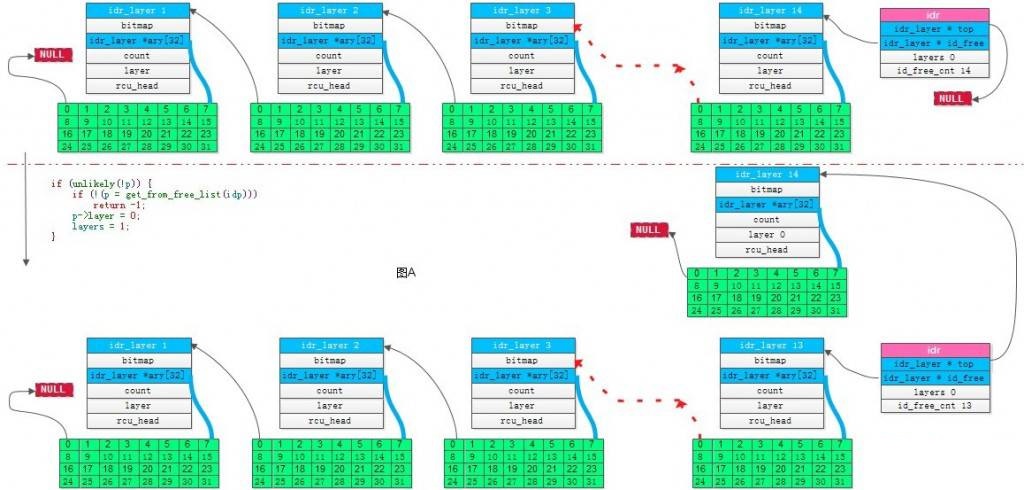
12     /* 第一次申请ID时,p都为null,看图A */
13     if (unlikely(!p)) {
14         if (!(p = get_from_free_list(idp)))
15             return -1;
16         p->layer = 0;
17         layers = 1;
18     }
19     /*
20      * 当申请ID比目前分配的空间数还大时,开辟新层
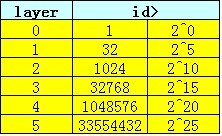
21      * 比如目前是2层结构, 可以分配的空间数为32^2=1024,最大ID为1023, 现在需要申请的ID为1050,
22      * 则需要开辟1层变成3层结构,这样可以分配的空间数为32^3, 最大ID变为32^3 - 1
23      * 看图B
24      */
25     while ((layers < (MAX_LEVEL - 1)) && (id >= (1 << (layers*IDR_BITS)))) {
26         layers++;
27         if (!p->count) {
28             /*
29                          *这里不知道怎么进去的
30                         */
31             p->layer++;
32             continue;
33         }
34         /* 从idp->id_free中取出一个idr_layer结构失败 */
35         if (!(new = get_from_free_list(idp))) {
36             /*
37              * The allocation failed.  If we built part of
38              * the structure tear it down.
39              */
40             spin_lock_irqsave(&idp->lock, flags);
41             for (new = p; p && p != idp->top; new = p) {
42                 p = p->ary[0];
43                 new->ary[0] = NULL;
44                 new->bitmap = new->count = 0;
45                 __move_to_free_list(idp, new);
46             }
47             spin_unlock_irqrestore(&idp->lock, flags);
48             return -1;
49         }
50         new->ary[0] = p;
51         new->count = 1;
52         new->layer = layers-1;
53         if (p->bitmap == IDR_FULL)
54             __set_bit(0, &new->bitmap);
55         p = new;
56     }
57     /* idp->top = p */
58     rcu_assign_pointer(idp->top, p);
59     idp->layers = layers;
60         /* 以上部分主要处理layer相关,以下部分主要处理id相关 */
61     v = sub_alloc(idp, &id, pa);
62     if (v == IDR_NEED_TO_GROW)
63         goto build_up;
64     return(v);
65 }
图a:
图b:
get_from_free_list函数.
 1 static struct idr_layer *get_from_free_list(struct idr *idp)
 2 {
 3     struct idr_layer *p;
 4     unsigned long flags;
 5
 6     spin_lock_irqsave(&idp->lock, flags);
 7     /* 从空闲节点链中取出1个节点 */
 8     if ((p = idp->id_free)) {
 9         idp->id_free = p->ary[0];
10         idp->id_free_cnt--;
11         p->ary[0] = NULL;
12     }
13     spin_unlock_irqrestore(&idp->lock, flags);
14     return(p);
15 }
sub_alloc函数, 里面就有判断如果id>=0x80000000是无法申请的.
 1 static int sub_alloc(struct idr *idp, int *starting_id, struct idr_layer **pa)
 2 {
 3     int n, m, sh;
 4     struct idr_layer *p, *new;
 5     int l, id, oid;
 6     unsigned long bm;
 7
 8     id = *starting_id;
 9  restart:
10     p = idp->top;
11     l = idp->layers;
12     pa[l--] = NULL;
13     while (1) {
14         /*
15          *  从根节点开始寻找直到到达叶子节点
16          */
17
18         /* n = 0~31 */
19         n = (id >> (IDR_BITS*l)) & IDR_MASK;
20
21         bm = ~p->bitmap;
22         m = find_next_bit(&bm, IDR_SIZE, n);
23         /* 顶层位图已满,需要再开辟1层 */
24         if (m == IDR_SIZE) {
25             l++;
26             oid = id;
27             id = (id | ((1 << (IDR_BITS * l)) - 1)) + 1;
28
29             if (id >= 1 << (idp->layers * IDR_BITS)) {
30                 *starting_id = id;
31                 return IDR_NEED_TO_GROW;
32             }
33             p = pa[l];
34             BUG_ON(!p);
35
36             /* If we need to go up one layer, continue the
37              * loop; otherwise, restart from the top.
38              */
39             sh = IDR_BITS * (l + 1);
40             if (oid >> sh == id >> sh)
41                 continue;
42             else
43                 goto restart;
44         }
45         /* 改变ID */
46         if (m != n) {
47             sh = IDR_BITS*l;
48             id = ((id >> sh) ^ n ^ m) << sh;
49         }
50         /* 如果id>=0x80000000,无法申请 */
51         if ((id >= MAX_ID_BIT) || (id < 0))
52             return IDR_NOMORE_SPACE;
53         if (l == 0)
54             break;
55         /*
56          * Create the layer below if it is missing.
57          */
58         if (!p->ary[m]) {
59             new = get_from_free_list(idp);
60             if (!new)
61                 return -1;
62             new->layer = l-1;
63             rcu_assign_pointer(p->ary[m], new);
64             p->count++;
65         }
66         pa[l--] = p;
67         p = p->ary[m];
68     }
69
70     pa[l] = p;
71     return id;
72 }
find_next_bit函数.
 1 /* find_next_bit就是从地址addr处的size位2进制数据中,从第offset位向左开始寻找下一个置1位
 2  */
 3 unsigned long find_next_bit(const unsigned long *addr, unsigned long size,
 4                 unsigned long offset)
 5 {
 6     const unsigned long *p = addr + BITOP_WORD(offset);
 7     /* result 是32的倍数 */
 8     unsigned long result = offset & ~(BITS_PER_LONG-1);
 9     unsigned long tmp;
10
11
12     if (offset >= size)
13         return size;
14     size -= result;
15     /* offset =0~31, 这个offset 加上 result 等于 输入参数的offset */
16     offset %= BITS_PER_LONG;
17     /* 查找低32位 */
18     if (offset) {
19         tmp = *(p++);
20         tmp &= (~0UL << offset);
21         if (size < BITS_PER_LONG)
22             goto found_first;
23         if (tmp)
24             goto found_middle;
25         size -= BITS_PER_LONG;
26         result += BITS_PER_LONG;
27     }
28
29     /* size是32的倍正整数, 32位一次寻找置1位 */
30     while (size & ~(BITS_PER_LONG-1)) {
31         if ((tmp = *(p++)))
32             goto found_middle;
33         result += BITS_PER_LONG;
34         size -= BITS_PER_LONG;
35     }
36     /* 走到这里就是整个数已无置1位, 返回最开始的size值 */
37     if (!size)
38         return result;
39
40     /* 走到这里size一开始就不是32的倍数, 比如是37位数, 低32位已无置1位, 后面寻找高5位的置1位 */
41     tmp = *p;
42
43 found_first:
44     tmp &= (~0UL >> (BITS_PER_LONG - size));
45     if (tmp == 0UL)        /* Are any bits set? */
46         return result + size;    /* Nope. */
47 found_middle:
48     return result + __ffs(tmp);
49 }
五、利用ID寻找地址
idr_find函数.
 1 void *idr_find(struct idr *idp, int id)
 2 {
 3     int n;
 4     struct idr_layer *p;
 5
 6     p = rcu_dereference_raw(idp->top);
 7     if (!p)
 8         return NULL;
 9     n = (p->layer+1) * IDR_BITS;
10
11     /* id最大为0x7fffffff */
12     id &= MAX_ID_MASK;
13
14     if (id >= (1 << n))
15         return NULL;
16     BUG_ON(n == 0);
17
18     /* 一直到叶子节点 */
19     while (n > 0 && p) {
20         n -= IDR_BITS;
21         BUG_ON(n != p->layer*IDR_BITS);
22         p = rcu_dereference_raw(p->ary[(id >> n) & IDR_MASK]);
23     }
24     return((void *)p);
25 }





 扫一扫
扫一扫


 2089
2089

 被折叠的 条评论
为什么被折叠?
被折叠的 条评论
为什么被折叠?
 到【灌水乐园】发言





